
Moving frontiers in Agrarian Colonisation
Latin American Histories of Land, Labour and Power
Edited by Carolina Hormaza, Georg Fischer, Philipp Wolfesberger and Olaf Kaltmeier
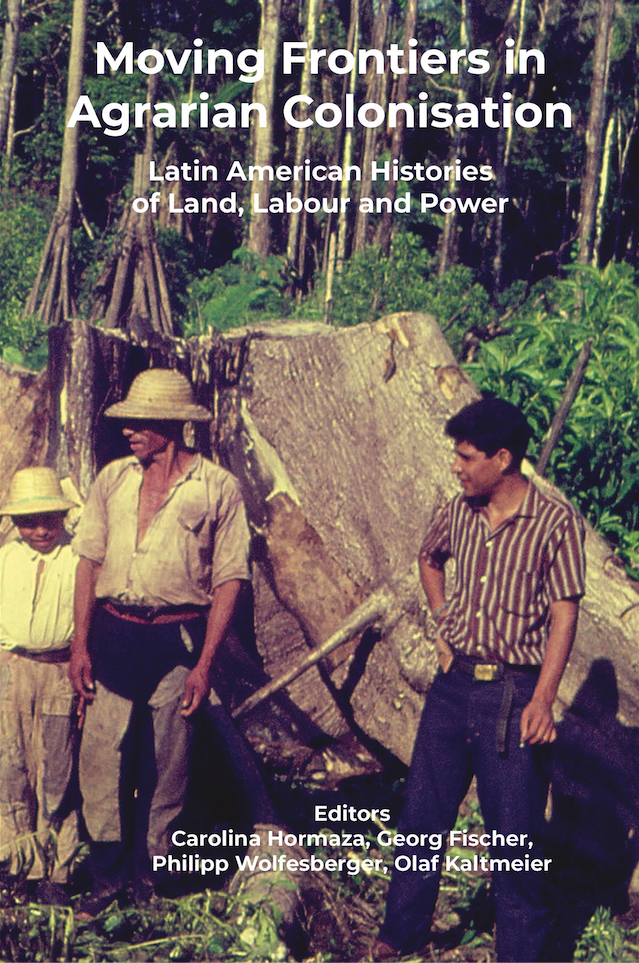
Moving Frontiers in Agrarian Colonisation examines the meanings of agrarian colonisation in nineteenth- and twentieth-century Latin America and its roots in the Ibero-American colonial past. The volume historicises agrarian colonisation as an ongoing process of agricultural expansion situated within enduring colonial regimes. It explores the practices and epistemologies of diverse actors involved in the making of agrarian frontiers, including European immigrants, Mennonite communities, mestizo settlers, Indigenous peoples and Afro-descendants, while also highlighting the roles of governments and international organisations. Through fifteen chapters, the volume offers a fresh take on agrarian colonisation as a process that illustrates the profoundly unequal positions of different rural communities within colonial and postcolonial societies, and examines the ambivalent histories of exploitation and resistance that shaped Latin America’s rural frontiers. The conceptual introduction approaches agrarian colonisation as a more-than-human process and a point of departure for engaging tensions between decolonial and settler-colonial studies in Latin America.
This book was supported by The Centre for Inter-American Studies (CIAS) and The Centre for Brazilian and Global Affairs (CEBRAGA). It is Open Access through the funding support of The German Federal Ministry of Research, Technology and Space (Bundesministerium für Forschung, Technologie und Raumfahrt; BMFTR).



Editors:
Carolina Hormaza is a Research Associate, lecturer and academic coordinator of the collaborative research project ‘Turning Land into Capital’. She is the current executive secretary of CALAS – Maria Sibylla Merian Center for Advanced Latin American Studies in the Humanities and Social Sciences. She holds a Ph.D. in History from Bielefeld University and specialises in global, environmental and agrarian history. Her research interests include science and knowledge, climate, agriculture and bonded labour in Latin America.
Georg Fischer is an Associate Professor for Brazilian Studies at the Department of Global Studies at Aarhus University and a co-director of the Aarhus University Centre for Brazilian and Global Affairs. He holds a Ph.D. in History from the Freie Universität of Berlin. His research interests include nature-society relations, science and knowledge, and North–South inequalities. Fischer’s regional focus is on Latin America and its connections to the wider world with emphasis on nineteenth and twentieth-century Brazil.
Philipp Wolfesberger is a Research Associate, lecturer and managing director at the Center for InterAmerican Studies at Bielefeld University. He holds a doctoral degree in Political Science from the University of Vienna and specialises in international politics, political sociology and political theory. His research interests include state transformations in Latin America, organised crime, masculinities, radical democracy and decolonial theories.
Olaf Kaltmeier is a Professor of Iberoamerican history at Bielefeld University. Since its foundation in 2018, he has been the director of CALAS – Maria Sibylla Merian Center for Advanced Latin American Studies in the Humanities and Social Sciences. He is founding director and member of the Executive Board of the Center for InterAmerican Studies (CIAS) at Bielefeld University and director of the collaborative research project ‘Turning Land into Capital’.
CONTENTS
Introduction: Conceptualising the History of Agrarian Colonisation in Latin America
Part 1. Agrarian Colonisation as a Particular Form of Settler Colonialism
Appropriation of Land and Labour
Chapter 1. The Victory of the Landowners. Pablo F. Luna
Chapter 2. The Final Years of Agrarian Colonisation in Mexico: Land Market and Agrarian Reform, 1947–1963. Luis Aboites Aguilar
Chapter 3. Agrarian Colonisation, Drug trafficking and Agro-industry in Michoacán, 1947–2000. Salvador Maldonado Aranda
Chapter 4. Peasants Becoming Criminals: Squatters, Land Reform, and Forest Conservation in Late Twentieth-Century Costa Rica. Wilson Picado-Umaña and Elisa Botella Rodríguez
Tension between Established and Newly Arrived Colonists
Chapter 5. Designing White Farmers for the Brazilian Tropical Agribusiness: Ethno-technification in the Soybean-Anthropocene. Claiton Marcio da Silva
Chapter 6. To Conquer the Earth: Agrarian Colonisation in Bolivia 1952–1990. Olivia Arigho Stiles
Chapter 7. Mennonites in Southern Mexico: Four Decades of Agrarian Colonisation in a Peripheral Region. Wolfgang Gabbert and Ute Schüren
Part 2. Agrarian Colonisation as a More-Than-Human Process
Dwelling in the Forest
Chapter 8. Beyond the Enclave: Colonists’ Agency and the Making of Lago Agrio in the Ecuadorian Amazon, 1969–1984. Pablo Campaña
Chapter 9. ‘Being Organic’: Cobbling together Campesino Colonisation within Agrarian Extraction in La Chiquitanía, 1989–2025. Frederik Andersen Tjalve
Chapter 10. The Unruliness of Sacred Plants: Why Ka’a Miri’i and Coca have caused Less Deforestation than Coffee and Sugar. Freg J. Stokes, Timóteo Tupã Verá Popygua and Jürgen Renn
Chapter 11. Disputed Sovereignties: Colonisation and Armed Conflict in Southern Colombia, 2002–2016. Estefanía Ciro Rodríguez
Improving the Forest
Chapter 12. Expert Imaginaries of Landscapes and Bodies: Colonisation in Colombia and Peru, 1950–1970. Mercedes Prieto and Ernesto Camargo Hernández
Chapter 13. In Search of the Ideal Soil: Colonisation, Trade and Agrarian Scientific Exchange Between Brazil and Germany (1930–1945). Carolina da Cunha Rocha
Chapter 14. German Agrarian Colonisation in Nineteenth-Century Southern Brazil: Urwald, Fire and Socioecological Changes in the Atlantic Rainforest. Eduardo Relly
Chapter 15. Biotech Corporations at the Front Line of Transgenic Crops in Latin America: A New Phase of Agrarian Colonisation. Josué García Veiga
Publication date: 10 December 2026
ISBN 978-1-917813-34-1 (PB) £32
eISBN 978-1-917813-35-8 (Open Access PDF)
eISBN 978-1-917813-36-5 (Open Access ePub)
DOI: 10.63308/63925337113519.book