
Border-Crossing Battle
The Bark Beetle Blight in Bohemia, Austria and Bavaria (1868–1929)
Kristýna Kaucká
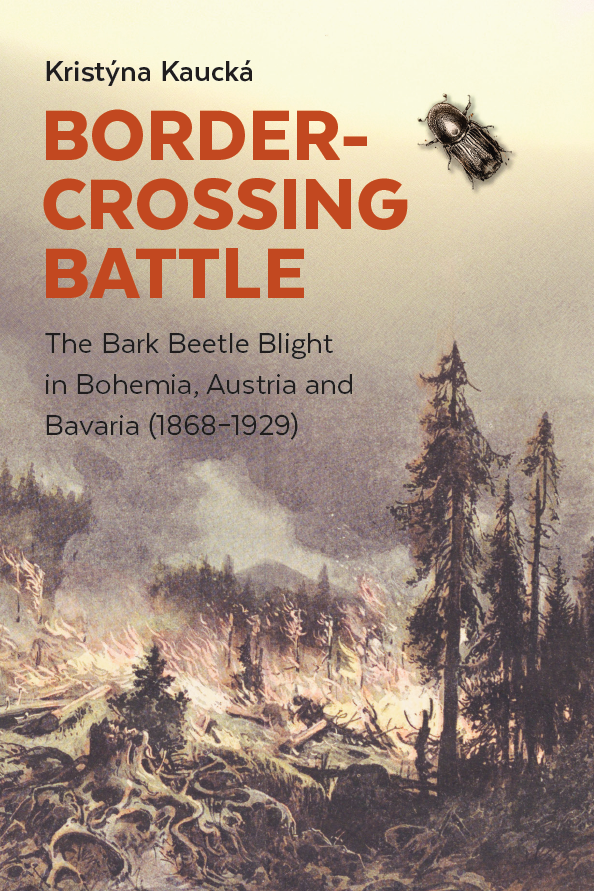
Climate change accelerates natural events that are perceived as disastrous from the perspective of human society, be it deforestation, fires or overpopulation of forest pests (bark beetles, nun moths). Humans have faced such phenomena in the past, and their responses have ranged from fatalism to active moderation of natural processes. This book examines natural disasters as a transnational phenomenon spanning the Habsburg Monarchy and the Kingdom of Bavaria, taking the example of the extreme weather events of 1858–1878, which culminated in two major storms (1868, 1870) that led to an overpopulation of bark beetles, with profound social consequences. The study area is the so-called Böhmerwald, a geographical unit that historically spanned the Habsburg Monarchy and the Kingdom of Bavaria (today’s Šumava, Bavarian Forest and Böhmerwald). The milestones of the study are not political, but meteorological events: the storms of 1868 and 1929. The overpopulation of bark beetles in the region in the 1870s is analysed as a significant event in the context of environmental history. The human response to this crisis exemplified how to deal with major forest catastrophes in the Central European region and the procedures established to mitigate the bark beetle disaster served as a model for similar events. The book covers the 1870s and the subsequent socio-economic development of the region, including afforestation, the overpopulation of other so-called pests (especially nun moths in the 1890s), the construction of infrastructure and the beginnings of forest conservation. The book’s temporal scope ends in 1929, when another storm swept through the area. The hypothesis is that, unlike in previous periods, from the 1870s humans became increasingly aware of their ‘power’ to change nature. Human impact on the area had been significant before, but it was the interventionist policies of the state and administrations of the late nineteenth century that became part of the central European cultural narrative about humans consciously altering the forest ecosystem.
Author biography:
Kristýna Kaucká is a research fellow at the Masaryk Institute and Archives of the Czech Academy of Sciences in Prague. Her research focuses on modern economic, social, agrarian and environmental history, particularly land reform, aristocratic estates and changing relationships between society and the environment. Her current work explores the environmental history of the Böhmerwald region, with a focus on aristocratic landowners’ responses to windstorms and bark beetle outbreaks in the late nineteenth and early twentieth centuries. She is the recipient of the Otto Wichterle Award and the Visegrad Group Academies Young Researcher Award, as well as the Jaroslav Krejčí Award and the CEFRES Award for Best Article (published in English or in French) in social sciences and humanities for ‘The Unknown Infection, or “Rožňava Disease” in Czechoslovakia in 1951’.
CONTENTS
Chapter 1. The Green Empire is Falling: The Bark Beetle as an Agent of Change
Böhmerwald: Borders, Landscape and Changes Through Time
Shaping the Forest’s Fate Through the Bark Beetle
Forest Science and Management in the Context of Bark Beetle Outbreaks
Governmentalism, State Power and Social Transformation
The Bark Beetle and Böhmerwald in Five Perspectives
Chapter 2. Crowned Trees: Landowners and their Domains in the Habsburg Monarchy and Bavarian Kingdom
The Historical Significance of Land Tenure
Lords of the Forest: Aristocratic Magnates and Noble Glassmakers
Landowners and Their Foresters
Tracing the Past
Chapter 3. Negotiating Nature: The Entanglements of the Bark Beetle, Landowners, and the State
State Commissioners and the Rise of Forest Governmentality;
The Central Committee and the Mechanisms of Governmentality
Chasing Workers: The Cross-border Search for Timber Crews
Sharing Burdens: Public and Private Budgets in Financing Forestry
Chapter 4. Debating the Beetle: Scientific Perspectives of Foresters and Entomologists
Before Science: Early Observations of the Bark Beetle
Many Pens, One Pest: Textual Debates on Beetle Control
Crafting Knowledge: An Entomologist, His Book and the Foresters
Between Order and Disturbance: The Scientific Remaking of Böhmerwald
The Beetle as a Mirror of Modernity
Chapter 5. Shifting Landscapes: From Forest Pests to Nature Protection
Engineering Regrowth: Spruce and the Design of Post-Calamity Forests
Mapping Nature: The Nun Moth Crisis and the Rise of Scientific Pest Control
Seeds of Conservation: Civic Initiatives and the Emergence of Forest Protection
Nation and Nature in Böhmerwald after World War One
Infrastructures, Tourists and the Struggle to Control Forest Hazards
Chapter 6. The Birth of the Anthropocene in Böhmerwald
Disturbance as Cultural Shock
Klostermann and the Narrative Grammar of Crisis
The Long Afterlives, National Parks and Memory Conservation
Transitive Shock: 1929 and the Automation of Stewardship
Conclusion
From Wingbeat to Historical Trail
Appendix: Geographical Framework
Publication date: 1 February 2027
ISBN 978-1-917813-18-1 (PB) £30
eISBN 978-1-917813-19-8 (PDF)
eISBN 978-1-917813-20-4 (ePub)
DOI: t.b.c.