

WASTE ETHNOGRAPHIES COLLECTION
Ritualising Waste, Disposal and Afterlife in Japanese Buddhism

Religious waste requires special attention from religious practitioners. Handling of emotionally charged exhausted objects, human-like dolls and ‘lonely deaths’ likewise reflects key aspects of the religion and the cultural understanding of what is and what is not valued as enduring life and disposable waste. What kind of religious practice is required for what kind of waste and death? How are these objects and bodies disposed of, transformed, left to fade, reincarnated or revitalised through pragmatic handling and symbolic rituals? This article examines the imaginaries, trajectories and ritual dimensions of managing the death and afterlife of used, excess and exhaust objects and souls in a contemporary Japanese Buddhist context. It demonstrates that the interplay of ritual practices, affective bonds and networks of actors expresses and shapes ontologies and protocols for disposable waste, bodies and transformable value.
Japanese Buddhism, ritual transformation, death, value, waste management
Apart from being a visible worldwide problem, waste is a ‘mirror of humanity’ (Reno 2015: 558). As a conceptual and cultural ordering principle, waste – famously framed by Mary Douglas (1966) through the structuralist axiom of ‘dirt’ as ‘matter out of place’ – signifies boundaries of right and wrong, inside and outside, purity and impurity. Its transgression calls for ritual regulation and, at times, punitive response. While structures of classification might be universal, what is considered waste and non-waste is also contextually contingent. What constitutes waste – whether of negative or zero value (Brox 2026) – may, for others, signify wealth (Wodzer 2026) or hold potential for religious repurposing (Holmes-Tagchungdarpa 2023). As Thompson and Reno (2017) argue, the status and value of ‘rubbish’ are shaped by social and cultural contexts and processes, rendering it a situated concept that resists fixed definition (Zsuzsa and Lepawsky 2022: 4). As both material ‘stuff’ and symbolic ordering principle, waste also has a ‘productive afterlife’ with effects in the world (Reno 2015: 558), the construction and management of which itself signify cultural particularities and possible universals.
Religion is one cultural domain in which ‘more-than-human or inter-species’ (Alexander and O’Hare 2020: 421) interact in human-waste relations as ‘moral-political waste that comes from systems of symbolic classification’ (Reno 2018: 2). Just as ritual and conceptual patterns of purity/impurity are potential gateways to broader understandings of culture, managing disposable materialities and physical bodies can be seen as implicit symptoms of religious values and ritual agency. Throughout the history of religion, objects have been material manifestations of sacredness or disposable things used in ritual settings with only transient value. Nails, bones and hair have been transformed from dead matter into magical stuff enshrined as sanctified symbols, and dead bodies have been entombed as relics and even mummified icons of holy persons, both categories with ascribed value and magic agency. Waste as excess and abundance has been ritually constructed as such (e.g. clay pots deliberately broken for the gods) or produced as symbolic signifiers of social status and prosperity (e.g. lavish potlatch rituals) in what could be termed ‘benevolent iconoclasm’ (Rambelli and Reinders 2012, Triplett 2017). Destruction of religious buildings, statues, altars, paraphernalia and sacred objects has been part of dramatic performances and cycles of purification and power structures, some of which were related also to adoption of a new religion.1
Religious waste, including objects considered sacred, constitutes a category often demanding special care. Avoidance of discarding religious objects has been embodied in moral prescriptions or even sanctified by taboos or restrictions against ‘wastefulness’, leaving disposal to religious specialists in sacred settings at certain times with specific ritual practices.2 Also excess, exhausted, broken or used objects with particular status or value need special attention in religious contexts. The concept of ‘sacred waste’ is defined by Irene Stengs as ‘material residues and surpluses that cannot be disposed of as just garbage (or rubble), but neither can be kept or left alone [being] charged with a religious, moral or emotional value on the one hand, but at the same time a kind of leftover for which no proper destination exists’ (Stengs 2014: 2). Stengs exemplifies sacred waste with the rubble of Ground Zero, piles of flowers and objects placed in tribute to Princess Diana, Christ’s transubstantiated blood remaining in priest’s chalice after the Eucharist, worn Qur’ans, tattered spirit houses in Thailand and holy statuettes from abandoned churches and monasteries. Other examples fitting this category are religious figures thrown in lakes and rivers in India to continue a proper afterlife, worn-out ritual objects being ‘reincarnated’ through recycling and used as filling to consecrate other religious objects (Holmes-Tagchungdarpa 2022), used sacred objects being ritually desacralised (Kendall 2021) and disposal of sacred scripture deserving special ritual attention (Myrvold 2010, El Shamsy 2022), also in a Japanese Buddhist context (Moerman 2010, Thumas 2022). Some religious institutions have suggested ‘rules of thumb’ for how to dispose of sacred things, blessed ones often demanding specific care and rules.3
Sacred waste is analytically a universal category, but empirically ambiguous and often without a well-defined protocol guiding how to deal with it. As an aspect of material religion and waste management, it is indeed relevant to investigate ‘how stuff dematerializes and how it is treated when it is exhausted, dissolved, broken, worn out, excessive, impure, or dead’ (Brox 2022: 2), whether it is excess from religious practices, sanctified leftovers, dead actants, emissions from commodities and everyday garbage (ibid: 4). Both ‘waste’ and ‘sacred’ are fluid concepts, the semiotic content and functional relevance being subject to contexts and perspectives. Waste for whom, sacred when? Is all stuff used in religious contexts equally sacred and/or disposable? Are certain non-religious objects or beings ascribed too much emotional, moral and existential value to be meaningfully designated and handled as ‘waste’? Would the remains of dead bodies be considered waste, or ‘necro-waste’?4 In all religions, deaths of persons require ritual actions, some of which are meant to transfer the soul into a post-mortem life while letting the leftover body dissolve by natural or forced decomposition. While some traditions have regulated manners of avoiding the ‘impurity’ of death to secure such processes, others – such as Hindu ascetics consuming corpses and excrement to gain superhuman power (Parry 1982) and Buddhist monks engaging in cemetery ascetism while reusing funeral cloth and discarded rags as Buddhist robes (Langer 2014) – symbolically transcend life-death boundaries by transgressive behaviour.
The interrelations of what Trine Brox (2023: 821) calls waste imaginaries (the ideas, feelings, values ascribed waste) and waste trajectories (the infrastructural processes of handling waste) are gateways to also understand perspectives of religious ideas and practices. Buddhism is religion that has achieved special attention in its understanding of, relation to and management of waste (Brox and Williams-Oerberg 2022). Rather than being at the margin of lived Buddhism, such a prism of waste imaginaries and trajectories might even lie ‘at its very core’ (Brox 2023: 833), offering a lens through which to examine how Buddhist things come to be regarded as excess (too much), discard (worthless), or afterlife (potent) (ibid., Brox 2022).
This article investigates how waste is understood and ritually handled in a Japanese Buddhist context. Environment and ecology have previously received scholarly attention in the study of contemporary Japanese Buddhism and the ‘greening of dharma’ has been variously adopted as a platform of practice and marketing in religious institutions (Williams 2012, Dessí 2013, Nelson 2013, Rots 2021; Borup 2025) where not least Zen monastic traditions of minimalist lifestyle, self-sufficiency and correlation between mental and material purity have served as obvious arguments for contemporary campaigns of waste reduction and avoidance,5 also as popular global discourses to handle the excess of consumer goods (Gould 2022a). In recent years, different aspects of religious (mainly Buddhist) waste have received scholarly attention: waste disposal of inanimate objects in death rituals has been interpreted as semiotic and social practice by Fabio Rambelli (2007); Fabio Gygi has analysed the meanings and practices of disposing of dolls (2022) and talismans (2018); Hannah Gould has researched the disposal and handling of used altars (2019, 2022b) in also a broader ‘necromaterial’ perspective (2023); Paulina Kolata has investigated the increasing requests to Buddhist temples for handling used altars and religious paraphernalia (2022); whereas the reuse and revitalisation of used Buddhist objects and buildings have been the focus of Gould (2024) (bone buddhas), Morse (2023) (icons), Pedersen (2023) and Lomi (2023) (sculptures), Fowler (2023) (temple bells), Gygi (2023) (dolls), Graf (altars)6 and Borup (2025) (temples).
The present article builds on the insights of these scholars, aiming to further underscore the relevance of (the study of) religion as an important gateway to understand the often delicate relations between waste and (moral) value. It contributes new perspectives by analysing concrete representations of religious waste management and imaginaries in Japanese Buddhist rituals. It is argued that the matrix of ritual practices, affective bonds and networks of actors expresses and produces ontologies and protocols for disposable waste and transformable value. Ritual settings will be described and analysed individually as examples of waste and death management. The three main rituals, contextualised also with references to other parallel rituals, are from different contexts but are nevertheless seen as semiotically parallel cases, functioning as prisms through which to investigate the research topic. The concluding paragraph discusses the empirical cases as both symptoms of contemporary societal challenges and illustrations of broader waste imaginaries and trajectories.
Material for this article was collected through fieldwork in Japan (mainly Tokyo and the Kansai region) in 2022, 2023 and 2024 (see also Borup 2025) with visits to a number of ritual activities and talks with Buddhist priests, practitioners and representatives from the commercial industry (including a real estate company and a funeral home).7
While much doctrinal Buddhism has refuted ontologies with animate ‘souls’, practised (especially Mahayana) Buddhism typically also includes an ‘enchanted world’ with space for souls, spirits, ancestors and gods. In Japan, there is a general ‘absence of a unified ontology about spirits and their agency’ (Rambelli 2019: 10), the ontological ambiguity of which opens up for a plethora of religious ideas and practices. Esoteric traditions have interpreted relics, scriptures and figures as manifestations of Buddha-nature and practised Buddhism has revered and ascribed extraordinary value to objects in an ontology where signs are not only iconic representations, but indexes of sacred dimensions in this world. One concrete ritual expressing this is inserting ‘life’ into sacred figures by ‘opening the eyes’ (kaigen) through the agency of a religious specialist or a sculptor ‘animating’ the object through ritual consecration by inserting a ‘soul’ (tamashii)8 into a Buddha figure. A ‘reverse’ ritual of de-sacralisation or extraction (hakkenshiki) is conducted for such sacralised figures, statues and even altars (butsudan) (Gould 2023: 105ff) to properly distinguish what is valuable and what can be disposed as exhausted material waste.
Varieties of kinds of waste and senses of waste (Reno 2018: 2) are also parts of Buddhist imaginaries and trajectories of waste. Asking priests about the status and ritual handling of used things and artefacts gives a variety of explanations, not always correlated with Buddhist lineage. Based on talks with a number of priests and lay Buddhists, there seems to be certain structures and hierarchies of ordering things. Garbage and excess products such as plastic and paper wrappings, flowers used for offerings, broken furniture and utensils can easily be discarded (or redistributed)9 since they are meant to decay or be thrown away. Although having been used in religious settings with indirect relation to religious practices, they have not been ascribed sacred value and, as disposable objects, they are typically the only ones unproblematically termed and categorised as ‘waste’ (gomi, haikibutsu) in Japanese. Some objects have instrumental value for religious practice (old books, used furniture and instruments) but are not ascribed sacredness and can be directly thrown away or handed over to disposal companies, while certain wish-bringing objects (Daruma dolls, amulets, prayer tablets) have transient power and efficacy and need to be changed periodically to the benefit of both the owner and the producer in a relation of circular religious economy. Such exhausted items are typically piled up in collection boxes outside shrines and temples, later to be desacralised and burned in ritual fire (otakiage). Religious objects such as Buddha figures, bells or pieces of art are objects meant to last and not be thrown away as waste after use. Such an object is considered to have ‘enduring value’ because people feel connected to it, it is significant or it has a new life and purpose (Brox 2022: 20). Objects in this category may be reused or even sold at antique shops,10 or handed over to the temple where the priest will be the ritual caretaker transforming and desacralising the objects from religious artefacts into things that can then be properly disposed of.
Also non-religious objects can be ascribed a certain status reaching beyond mere material value. Used things felt to have a vital essence can trigger ‘empathy toward things’ (mono no aware) in their transient nature, a relationship especially experienced by artisans having emotional bonds to their instruments. Funeral or memorial rituals (kuyō)11 have thus been conducted for exhausted objects such as pens, seals, tea whisks, fans, footwear, scissors, printed materials, combs, dolls, chopstick, bags, glasses, needles, dentures, ceramics, porcelain, photos and broken record player needles.12 As Paulina Kolata (2022) writes, the increasing number of requests to Buddhist temples for assisting with disposal and care of such things relates to their emotionally and spiritually charged ‘stickiness’ of accumulated affective value. This is one of the reasons why disposal of religious objects has been outsourced to commercial entities and has become a key service for Buddhist altar retailers where processes of disposal include purification rites, disassembly and incineration (Gould 2023: 113).
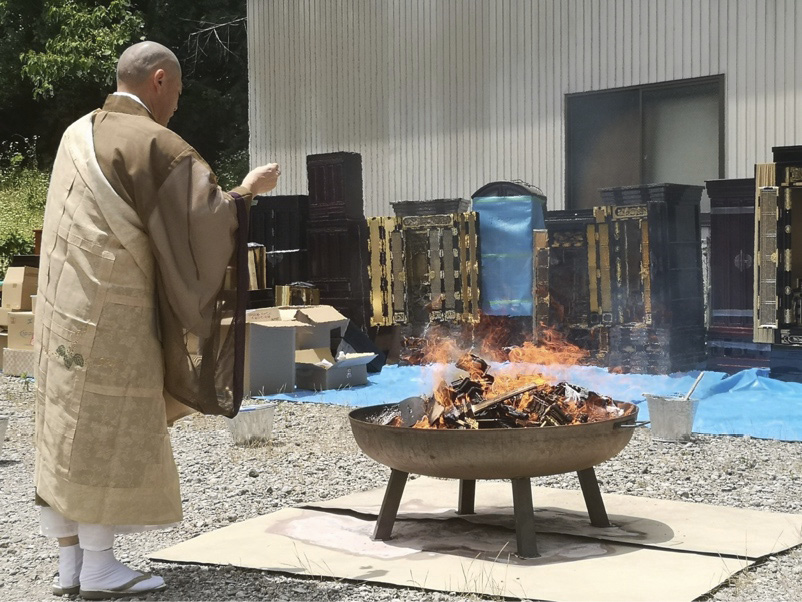
Figure 1. Memorial service (kuyō) for used Buddhist altars, Hikone 2024. Photo by the author.
One such ritual disposal of used Buddhist altars (butsudan), believed to house and be ‘infused with the “spirits” of the buddhas, the ancestors and the kami’ (Rambelli 2007: 85), is arranged biannually by the local Buddhist altar business cooperative (butsudan jigyō kyōdō kumiai) in Hikone. When I attended this in May 2024, twenty altars had been handed in by private owners who no longer had space for them, or who had themselves died, leaving no descendants willing or able to keep the symbol of family lineage alive. In front of the altars were numerous boxes filled with Buddha figures, ancestor tablets, wooden grave tablets, family register books, sutra books, altar tables, candle holders, prayer beads, hanging scrolls and other religious paraphernalia. Before the ceremony, the local priest had already conducted a ritual to remove the spirit of the most important religious objects. After reciting sutras for transferring good merit and purification, he sprinkled consecrated water over each altar and all the boxes containing leftover Buddhist utensils before assistants from the altar association set fire to some of the boxes, soon to be consumed in a ritual burning. Watching the old Buddha statues burn, the priest agreed to my quiet uttering ‘mottainai’ (‘what a waste’), lamenting the waste of valuable religious artefacts, but ritual and moral prescripts prevented him from yielding to an older participant’s offer to purchase one of the statues. Business remains, however, an underlying reason for the altar association to have the rituals conducted, underscoring their relevance in an increasingly individualised and urbanised society, where the value of family altar transmission is no longer automatically recognised and where simple lack of space can be the pragmatic trigger of disposal. For the owners, engaging religious and artisanal professionals to secure the afterlife of the religious object (altar, tablets, Buddha figures) and what they represent (fading images of ancestral presence and family traditions) provides a valuable solution, allowing the defunct religious objects to be collectively purified, desacralised and transformed into burnable and disposable waste. As religious objects they have undergone a ritual transformation, symbolically securing an afterlife for the removed souls contained therein. While the ontological status of such ‘inanimate objects’ may be shrouded in conceptual and semantic ambiguity, the afterlife status of objects with intrinsic human likeness and emotional ‘stickiness’ appears less problematic for their owners – though often more difficult to dispose of. Memorial services for ‘human dolls’ illustrate this complexity.
Dolls in Japan have a long history as cultural artefacts. Disposing of dolls, a phenomenon having substantially increased in the last few decades, is an act considered emotionally challenging. Dolls (ningyō, ‘human form’) are humanlike and especially older ones are thought to be ‘ensouled’ and even creepy,13 probably because such animated objects can be seen as ‘body substitutes for the believer’ (Gygi 2018: 426) or humanised as part of the family.14 Disposing of a doll can thus evoke associations with death (ibid: 440). The extent to which an ontological ascription of ‘life’ and an emotionally felt bond is attributed to dolls naturally varies between owners. For some, the relationship may be relatively shallow and a doll can be discarded as a toy no longer needed. For others, however, the doll ‘sticks to’ the owner as an animate subject and the physical material is seldom associated with mere waste. For the latter, memorial services for dolls (ningyō kuyō) thus mark a symbolic transition and serve as ritual expressions of gratitude and merit dedication to the deceased doll. Ideally, the doll’s life force is transformed through ritual removal of the spirit (tamashii-nuki), ensuring a proper process of disposal and socialisation into a new form of existence as a ‘dead actant’ (Brox 2022: 4). Such ceremonies are conducted throughout the country with the participation of Buddhist priests and often sponsored by local doll manufacturing companies.15 According to Gygi (2022), both the owners and the providers of rituals through such transactions of transforming cherished objects into waste internalise what he calls ‘double forgetting’. Those bringing the dolls forget that they will be disposed of like rubbish while the ritual caretakers must forget that the dolls were emotionally charged objects of affection (Gygi 2022: 120). Through this double forgetting, ‘the doll is freed from human attachment and returns to being merely a thing’ (ibid.).
A lesser known, but equally symbolically rich, type of service is rituals conducted for (owners of) a life-size ‘human doll’ or ‘love doll’. Such a doll is neither sacred nor inherently connected to religion. Resembling a ‘real human’ and imbued with deep emotional bonds with physical intimacy to the owner, a human doll is regarded as a life companion with its own personality. When the doll is too old or when the owner, due to ageing or health issues, can no longer care for it, it needs to be ritually taken care of to ensure its afterlife, rather than being treated and discarded as mere waste. Although it is not a particularly widespread phenomenon, the doll’s resemblance to a ‘real human’ and its emotional and physical intimacy with the owner make the handling of a used human doll an intriguing and illustrative case of the relationship between object, waste, value and ritual practice.16
Arata Leiya is a professional photographer and the head of the Human Love Doll Company (Ningen rabu dōru seizōsho) in Osaka.17 She makes her customers dress up as murderers or turns them into dolls in her small photo lab, where she also conducts funerals (or ‘memorial services’, (kuyō) for love dolls. She established the Doll Funeral Home (dōru sōgisha) because she wanted to service those doll owners who wished to say a proper goodbye and have someone take care of the soul and body of the love doll.18 Rather than selling the used dolls to vendors, she felt it more respectful to conduct proper funerals and take responsibility for their souls and bodies. Rather than just throwing them out as waste, a ritual is performed to remove and take care of the spirit (tamashii). Although not feeling (or calling) herself a funeral director, she functions as such, giving and marketing the funeral services which she considers also address social issues.
When I was greeted in the small apartment with the photo studio, the doll Sayaka was already lying in a flower-covered coffin, dressed in a fine white robe. After explaining the ritual procedures, Arata, dressed in a black suit and high hat, began the ceremony by welcoming the spirit of the doll on behalf of her owner. Kato Rei, a Buddhist priest from the shugendō order of ‘mountain ascetics’ (yamabushi),19 placed a sword on the doll in the coffin, a symbol of the doll’s tonsure as a disciple of Buddha. Dressed in purple robes indicating her status as a high-ranking priest, the priest then opened her book with sutras and magic spells and with a high voice she rhythmically recited these, accompanied by strokes on the bell and ritualised hand gestures as symbolic signs from the esoteric Buddhist tradition. The recitation and physical gestures, she afterwards explained, are for purification (oharae) and exorcism (reijutsu) to secure the removal and transferal of the doll’s spirit (tamashii) without intervention of evil spirits. Following the recitation, Arata read a letter to Sayaka the doll from her owner, thanking her for the life lived together and bidding her farewell. More flowers were put into the coffin, which was then covered by a lid. After the formal ceremony, Arata showed a video on her mobile phone with the doll’s owner crying while reading a farewell letter to his beloved Sayaka. After years of companionship, his advanced age and illness had left him with no choice but to depart from her, not being able to carry and take care of her. Shortly after the ceremony, I was told, he died himself. It is unclear if he received the funeral certificate issued by Arata for Sayaka, before his own certificate was issued by his own Buddhist temple.
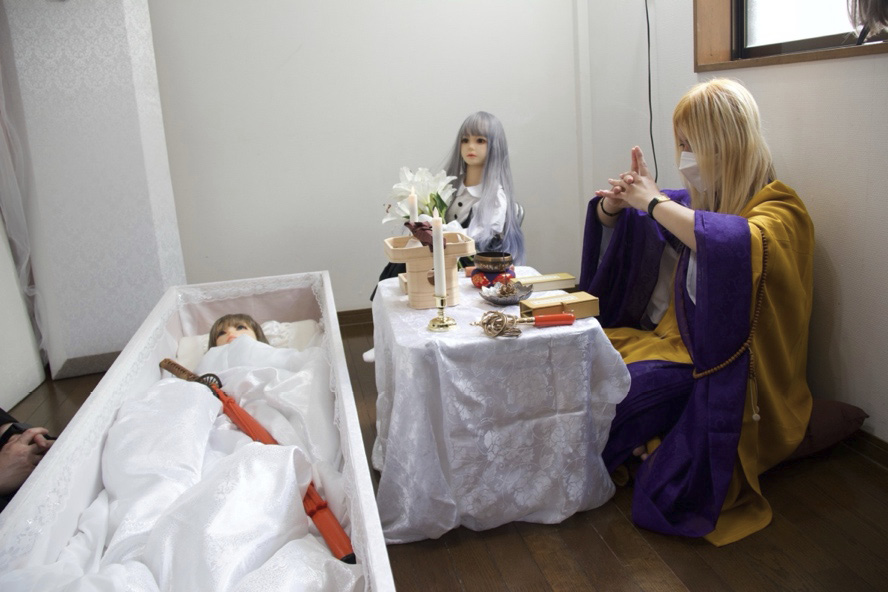
Figure 2: Memorial service for human doll (ningen dōru kuyō) with Buddhist Shugendō priest chanting in front of the doll in the coffin, Osaka 2023. Photo by the author.
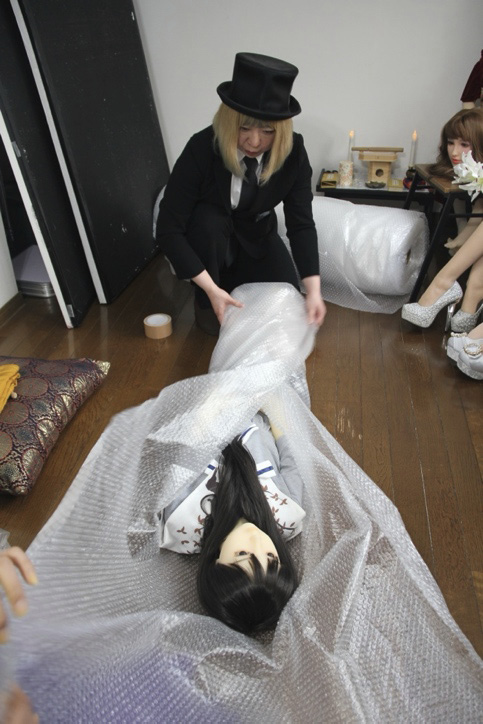
Figure 3: Body of dead human doll wrapped in cellophane before being collected for disposal, Osaka 2022. Photo by the author.
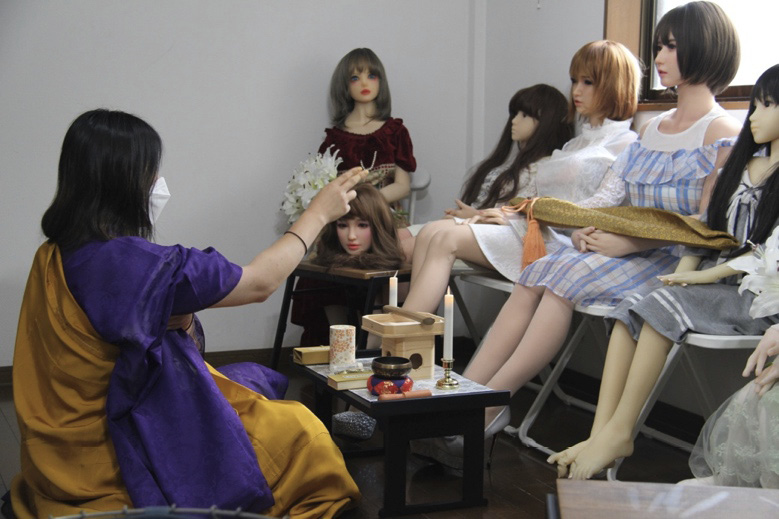
Figure 4: Ritual chanting in front of six human dolls in a collective memorial service, Osaka 2023. Photo by the author.
The ritual procedure was the same when visiting the following year (2023), observing the funeral and memorial service of six dolls, three of which were owned by the same man. The dolls were disassembled, with parts containing metal set aside for special disposal, while the remaining bodies were wrapped in cellophane later to be collected by a delivery service for disposal at an industrial waste disposal company. Neither Sayaka nor the six dolls were given a posthumous name (kaimyō), and no future memorial services were planned. But, Arata reassured, if the owners wished for it, that would be possible to conclude the ritual connections to the family (kazoku). Both she and the priest Kato Rei were convinced of a continuation of life ‘after death’, a sentiment typically shared by the owners of the dolls.20 Transferring the dolls ritually (and symbolically with tonsure) into Buddha’s disciple (or ‘becoming Buddha’ which is the Japanese term for dying, jōbutsu ni naru) with chants, spells and gestures gave them an afterlife where respectful disposal is a prerogative for ‘perpetuation of life’ (Reno 2014: 9). The human dolls were transformed not through ‘double forgetting’ (Gygi 2022: 120), but by recognition of the effects of ritual dramatisation legitimating both waste disposal of the material body and continued bonds of affection to the translocated surviving spirit. The ritual service for dolls, proposes Rambelli, is effective by analogy: ‘as human beings become buddhas when they lose their human form, so do dolls’ (2007: 220). Such analogical reasoning and affection seem even more apparent when applied to human dolls. The ritual process and infrastructural procedures changed the identity and value of the doll. While still with its owner, and in the hands of the priest and funeral conductor, the doll was still considered to be alive, possessing soul and body. After the ceremony, the dead body was wrapped and prepared for its final departure as waste for disposal.
Taking care of the life and death of human love dolls indicates a ritualised trans-human ontology which also in recent years has been applied to modern technology. Japan has often been described as a culture transgressing naturalist dualism between man and nature (or ‘animate’ and ‘inanimate’) having fewer reservations against including technology within a broader religious life world (Robertson 2018), conceptually having been suggested to represent ‘techno-animism’ (Bruun Jensen and Blok 2013). Mori Masahiro already in 1981 envisioned the robot as a functional entity having Buddha-nature (Mori 1981), with Shinto priests in their capacity of ritual specialists consecrating the first robots that were introduced to industrial manufacturing processes, at least until the ‘newness and exoticness of the robots wore off [and] ‘‘animism’’ disappeared from the workplace’ (Geraci 2006: 236). Robots and ‘robo priests’ have been employed for rituals and performative showcases, and a ‘Robohon’ (a smartphone shaped like a small robot) has become a popular gadget for users seeing them as part of the family, a partner or a friend, believing them to be alive (Aoki and Kimura 2021: 12). Handling the death of waste technology has entered the field of Buddhist rituals with the list of inanimate objects deserving ritual responses being expanded to include technological objects. Already in the late 1990s, I encountered a Zen priest in Kyoto planning a memorial service for ‘lost information’ (hard disks, software, files, etc.) and a Nagoya-based temple later offered computer memorial services (pasokon kuyō). Computer tombs (dennō haka) and memorial services for (the now extinct technology of) pagers, tamagochi, digital Buddhist practice apps, recitation machines and iPhones have been conducted – some of which were sponsored by manufacturers – and with future prospects of also including services for AI.21
Ritual handling of such objects can be seen as a gesture of gratitude and as performative security of disposing excess objects in a proper way. As the young owner of a newly established funeral company with plans for focusing on digital memorial services explained, it is for ‘restoring life for descendants’, with the pragmatic idea of having the ‘relics’ reborn as recycled products.22 Having ‘animate’ technological objects repaired was also possible in a repair shop for old dog robots. In 1999, Sony began selling the ‘pet robot’ Aibo. After they stopped producing them in 2006, a retired Sony worker (Norimatsu Nobuyuki) in 2015 created a ‘hospital’ doing ‘surgery’ for old Aibos, and as a ‘doctor’ he used spare parts from ‘dead Aibos’ to repair broken ones. Customers and robot owners who were emotionally attached to the ‘dead dog’ later had the opportunity to experience a proper funeral for them at a temple in Chiba, where the priest, realising the complex teaching of Buddha-nature through ritual experiences (White and Katsuno 2021: 236), comforted the spirits of robots by setting them free from their mechanical bodies and dedicating ‘the merit of the service to the departed spirits of the robots’ (ibid: 222).
Rather than interpreting such ritual performances as inauthentic or degenerated, they can be seen as adaptations to address contemporary challenges (ibid.) of the growing numbers of senior citizens, and the depopulation of rural areas with increasing urbanisation and detraditionalisation, as Kolata (2022) has also argued. Spiritual technology and ‘post-humanist Buddhism in which reincarnation is understood as a means of extending the non-transient self or soul’ (Robertson 2018: 170) are thus both means and expressions of transgressing divisions between human, nature and technology, doctrinally legitimised by Mahayana ideals of universal Buddha-nature and cosmic interrelatedness. In that sense, they could be seen as cases to justify going beyond anthropometry, ‘measuring all beings and actions according to how only people do things’ (Reno 2018: 3). Love dolls and robot dogs have life and deserve proper deaths. By having their material remains discarded, they transmute into a religious state of consecrated afterlife.
Ritually removing the spirits from used objects, dolls and robots secures a proper handling of disposable waste while keeping the ties of emotional bonds to the spiritual beings. Such caretaking stands in stark contrast to human beings who die alone and anonymously, living and dying as socially deprived existences. As lost souls with no bonds they become dead people with no relations, muenbotoke (literally ‘buddha with no relations’). This category also includes aborted foetuses and individuals who have died under tragic circumstances (e.g. through suicide or accidents). All are regarded as lost souls needing care from Buddhist priests to ensure a proper death and transferral to ‘the other side’ through rituals of purification and, at times, exorcism (Horie 2016, Takahashi 2016). As religious specialists with the ability to perceive spirits and spiritually charged spaces (reijō, shinrei supotto), some priests, mainly from esoteric Buddhist traditions, specialise in such engagements.23 In recent years, services have emerged in new settings addressing specific social issues, namely the rising number of solitary deaths (kodoku shi). Like the ’animated’ human dolls, the ’lost life’ of the lonely dead requires ritual transformation by human agents to secure a proper afterlife.
According to statistics, one quarter of Japan’s population now lives alone, in what has been described as a ‘disconnected society’ (mu-en shakai) within Japan’s broader ‘mass death society’ (Allison 2023: 53).24 As opposed to the ‘good death’ with family and friends around to take care of you before and after death, many of those who die alone eventually end up in public cemeteries with (often untended)25 graves for people with no relations (muenbaka), or have their remains stored at small ossuaries (‘permanent memorial graves’).
Anne Allison (2023: 5) has investigated the ‘necrosociological condition’ of contemporary Japan. She focuses on what she terms ‘necro-animism’ as ‘the ordering and ritualising of preparations for the dead in an age of shrinking sociality’ (ibid: 55) denoting ‘activities of endingness in which mortuary arrangements are being carried out by a range of actors and means, blurring the orders of self and other, human and nonhuman, person and thing’ (ibid: 19). Disposal of things as well as human decomposition has become part of processes involving cooperation among a variety of actors. The booming ‘ending industry’ (shūkatsu, litt. ‘ending activity’) involves religious institutions, funeral companies, crematories, urban columbaria, real estate agencies, cleaning and disposal companies,26 business platforms, post-mortem arrangements and ‘end of life exhibitions’ like the annual Endex (Ending Exhibit).27 Preparing one’s own death with ‘ending notes’ and ‘ending support plans’ have become new existential options and commodities in the ending industry. These services and products target those preparing their own life-ending process, where communal bonds to friends and relatives secure a ‘good death’. Or they may be purchased by some of those lonely individuals, who – rather than incidentally having their abandoned corpses found through the ‘smell of death’ (ibid: 124) and being left as ‘dead with no relations’ (muenbotoke) in ‘eternal graves’ with their belongings disposed of as leftover waste – prepare at least parts of their own afterlife.
A concrete symptom of the increasing number of lonely deaths is the equally rising number of apartments and houses owned by recluses that remain vacant after their deaths. As ‘stigmatised property’ (jiko bukken) with a history of tragic death, they trigger negative feelings and uncanny or even creepy associations. Some Buddhist priests specialise in the purification of such properties, with exorcism of bad spirits as a prerequisite for sending them properly off to the other world and appeasing the descendants.28 A growing number of real estate companies have entered the market and promote such services. As commercial enterprises, they offer solutions to address these social issues by cleaning and transforming such stigmatised properties into liveable alternatives for buyers and tenants seeking more affordable homes. Jōbutsu Estate, owned by MarksLife Co, is a real estate company in Yokohama whose mission is ‘to transform disliked properties into chosen properties’ providing ‘peace of mind and new value to residents’.29 Although not based on Buddhist teachings or related to Buddhist institutions, the name of the company is derived from a Buddhist term of dying (jōbutsu, ‘attaining buddhahood’) with the hope that both the deceased and the property can ‘find peace’.30 A special ‘jōbutsu certification’31 issued by the company is provided to reassure potential buyers that the property has indeed been purified by a Buddhist (or Shinto) priest. Such a symbolic statement refers to religiously sanctified purification, but also serves as legal insurance. Under the Real Estate Transaction Law, the real estate company is legally obliged to inform a new buyer of any known unnatural deaths having occurred in the property.32
With representatives from the real estate company Jōbutsu Estate, I entered the deceased’s four-room apartment on the eighth floor. The body of the former owner, a male in his fifties, had been lying for two weeks before a neighbour identified the smell of death several months ago. The apartment was completely empty, with no furniture or signs of a lived life. Remote relatives had been contacted to acquire a few belongings, but a professional disposal company (ihinseirigaisha) had already been employed to sort out and dispose the possessions of the deceased. Some of the belongings might have had enough value to be reused or sold, but most would be disposed of as garbage, although some disposal companies market their services with symbolic alchemy by treating such belongings as not trash.33 If the deceased had an altar, a local Buddhist priest would have removed the spirit and, like any other valuable Buddhist items, would either have stored it at the temple or – more realistically – passed it on to interested buyers. As a last resort, the priest would have a disposal company throw it out as bulky waste (sodaigomi). Remains of body fluids still lingered beneath the floor, emitting an unmistakable smell of death. The apartment had not been properly cleaned until then, when a cleaning company arrived to sanitise it. A man and a woman in their 40s, both seeming very experienced in their endeavours, first identified the sources of the bad smells and started removing the floorboards under which the smell was still present, cleaning the whole apartment with chemical disinfectants. For three hours (and again a few more hours the following morning), they cleaned and remade the rooms, the whole process attended by three real estate employees, one of whom documented the purification with photos and videos.
The following morning, a Buddhist priest from the Nichiren school (who also works part-time as a schoolteacher) arrived on his scooter. After checking his directions, he positioned himself carefully with his back to the east, considered favourable for spiritual influence in his ritual practice. He unpacked his religious paraphernalia and began chanting sutras and spells for about fifteen minutes, setting the rhythm with a stick on a wooden block and a bell. The chanting – dramatised through high-pitched intonation and the rhythmic clapping of wooden sticks – was, he later explained, intended to transfer merit (ekō) to the spirit of the deceased, enabling its passage into buddhahood.
It was also, he stated, intended for purification (harae) of the apartment by repelling bad spirits and cutting off ties to relatives.34 After his performance, everyone present was invited to offer incense to honour the spirit of the deceased. Before departing with his honorarium, he spoke informally about the value of relationships, emphasising how Buddhist teachings and practice foster such connections. A tragic death like this, he said, was an unfortunate case of waste of life (jinsei no muda).
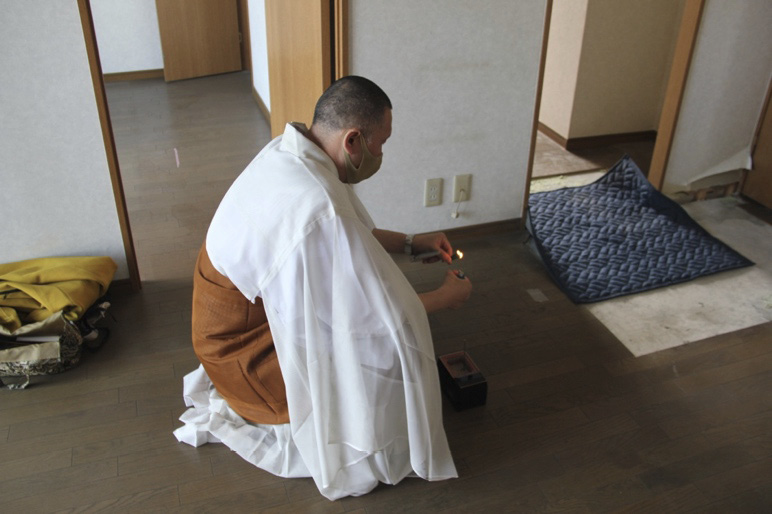
Figure 5. Buddhist priest conducting rituals of purification and exorcism in a ‘stigmatised property’ (jiko bukken), Yokohama 2023. Photo by the author.
Jōbutsu Estate is a real estate company sanitising and transforming what are considered ‘polluted’ and potentially deteriorating former residences into what could be termed ‘reincarnated’ apartments. As such, what many find to be waste properties are made marketable by undergoing both physical renovation and spiritual purification, turning the image of ‘stigmatised property’ into ‘reborn property’. Part of such transformation relies on religious transferal of ‘waste life’ into a ‘proper death’. The sorrowful life of the lonely dead will not be remembered, and probably no communal bonds will secure his afterlife until it is ritually taken care of by a Buddhist priest. Just as the spirit removal of dead objects secures the afterlife of the spirit (and returns the material part back to mere disposable ‘thing-ness’), the purification and transfer of merit to the deceased in these property rituals secures a proper afterlife through the postmortem symbolic attainment of buddhahood. Transgressing death and an unfortunate state of liminal in-between-ness (muenbotoke being a symbol of social deprivation), the dead person (as opposed to the animated doll being attributed life through emotional bonding) was born animate and only ritually reincarnated with valuable afterlife after a ‘lost life’ with a lonely death. Material and human-made waste have been sorted and purified through the engagement of a real estate company, a cleaning company and a Buddhist priest, making proper a balance of the disposal, renewal and perpetuation of afterlife.
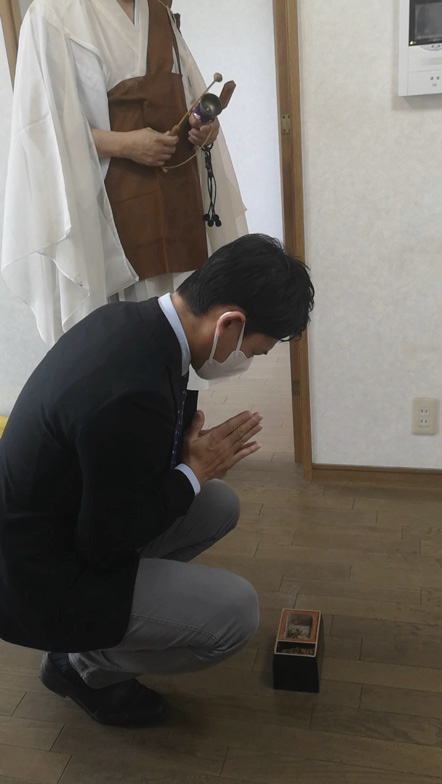
Figure six. Company employee from the real estate company Jōbutsu Estate offering incense for the deceased, Yokohama 2023. Photo by the author.
The three cases here described of ritual handling of death – within a naturalistic ontology: one concrete, two metaphorical – reflect, in different ways, the emergence of new ways to manage different kinds of religious waste through processes of disposal and transformation. Disposing of ancestor altars and human-like love dolls and handling the death of lonely people are all poignant symptoms of an increasingly urbanised, secularised and detraditionalised lifestyle in an ageing and ‘relation-less society’, with dwindling collective ties and devoid of relationships.35 Ritual services for dead things and persons also, however, point to a culture where relationships are valued and need proper attention, even with traditional rituals and religious specialists. Paradoxically, the individualised lifestyle of modernity, having surpassed the communal ties of traditional religion and its former focus on ancestor worship, in postmodern society has re-sacralised the ideal of relations (tsunagari) as a value in itself. Memories in themselves are signs of relationships and inanimate things can have an effect on animate beings, especially when ritually staged. Rituals of death and memorial services transfer bonds of post-mortem comfort. But they also establish breaks, signifying the limited lifespan of human life. Through ritual transformation, the body is divided from the eternal afterlife as disposable matter.
Managing religious waste and ‘exhausted life’ signify cultural values and ontologies. What is valued and less valued, what can be disposed of, what need transformation? Stengs’ (2014: 2) understanding of sacred waste as material residue charged with a religious, moral or emotional value which cannot be disposed of as just garbage is probably universally applicable, but the cases explored in contemporary Japanese Buddhism suggest a hierarchy of ritual valuation that qualifies this. Whereas some material used in religious contexts can easily be disposed of (garbage, plastic and paper wrappings, flowers, broken furniture, books and utensils) and some objects with transient value (amulets, prayer tablets) can be discarded after use, other objects (Buddha figures, pieces of art) having more enduring value can be reused, resold or handed over to temples for permanent possession. Used objects that have no inherent religious affiliation, but are ascribed vital emotional value by their owner, require ritual transformation before being discarded as mere dead material. The appreciation of the transience of things (mono no aware) extends even to certain technological tools (such as robots or phones), with affective ‘stickiness’ being attached to their instrumental value beyond mere pragmatic use.
‘Waste is not, but it is made’ (Zsuzsa and Lepawsky 2022: 5), as it is a socially constructed concept opposite to value (Thompson and Reno 2017). A dead body is a category of ‘exhausted life’ that must be treated carefully since if it is improperly treated or forgotten the remains become waste (Morgan 2022). In Japan, neither a dead body nor a sacred Buddha figure would be called waste (gomi or haikibutsu), although both will be handled as such after having been properly and respectfully desacralised and ‘depersonified’. An altar containing the sign of deceased ancestors and (‘animated’) love dolls having been ascribed strong emotional bonds can only be disposed of after ritual ‘de-ensoulment’, just like a ‘stigmatised property’ can only be reused after material and spiritual purification. The continuation in afterlife requires a soul removal and ritual transferal, differentiating the material object from its ‘content’, securing also the descendants and owners an afterlife through memories and emotional bonds.
Religious management of sacred and valuable objects and beings needs ritual practice. Ritual is communicative but also has efficacy in performing ontologies and enacting transformation. The distinction between disposable waste and non-disposable or enduring values is not merely revealed but actively created through the ritual act. Just like there is a ‘complex set of relations between waste producers, collectors, distributors, disassemblers and resellers’ (Zsuzsa and Lepawsky 2022: 7), there is a complex set of relations among a network of actors in religious settings managing persons’ and objects’ end of life. The Buddhist priest acts as a religious specialist guaranteeing the ritual order with the knowledge and ritual expertise in chanting the correct spells and enacting the right gestures with institutional authority. The owners of the objects participate in and/or sponsor the ritual as interlocutors with different enterprises (undertaker, real estate company, altar company, disposal company, cleaning service) serving as commercial agents effectuating the procedures. Ritual configurations involving purification, exorcism and transformation serve to differentiate disposable waste from non-disposable ‘afterlife’ within a relational ontology that itself depends on interactional networks and affective ties. This configurative logic and metaphorically related connection underpin the religious management of life and afterlife, whether it concerns ancestor altars, cherished instruments, human dolls, robot dogs or lonely deaths.
Waste is, in itself, a fluid and ‘plastic’ concept and phenomenon. It is formable, transactionable (meaning ascribable), distinguishable and sortable. Observing waste management can be a symbolic gateway for understanding the dynamics of religious worlds. What happens upon the ‘death’ of a being or an object, how it is discarded, transformed, allowed to fade away, reincarnated or revitalised through pragmatic handling and symbolic ritualisation point to key aspects of the religion and the cultural understanding of waste. Sorting waste from non-waste, dividing disposable things from life too valuable to dispose of is also within the domain of religion, enacted most visibly in ritual processes. Dead things and persons matter and, as the cases in this article have suggested, need ritual practices and interacting networks of people to perform afterlives and Buddha-natures.
This research is registered as a research project at Aarhus University (April 2023), which serves as the data controller. The project is conducted in accordance with applicable data protection legislation and institutional ethical standards, ensuring responsible handling of data and compliance with established research integrity and ethics requirements. All individuals named in this article have signed a consent form agreeing to participate in the research project and to be depicted in an academic article; therefore, their identities are not anonymised.
Research for this article was made possible with the financial support from Veluxfonden and the collaborative research project ‘WASTE: Consumption and Buddhism in the age of garbage’ (grant number: 34934, PI Trine Brox, Copenhagen University).
Jørn Borup
Department for the Study of Religion
Aarhus University,
Denmark
https://orcid.org/0000-0003-1750-6772
Alexander, C. and P. O’Hare. 2020. ‘Waste and its disguises: Technologies of (un)knowing’ Ethnos 88 (3): 419–43. Crossref
Allison, A. 2023. Being Dead Otherwise. Durham: Duke University Press. Crossref
Aoki, B.Y. and T. Kimura. 2021. ‘Sexuality and affection in the time of technological innovation: Artificial partners in the Japanese Context’ Religions 12: 296. Crossref
Asano-Cavanagh, Y. 2019. ‘Inochi and tamashii: Incursions into Japanese ethnopsychology’. In B. Peeters (ed.), Heart- and Soul-like Constructs across Languages, Cultures and Epochs, pp. 30–57. New York: Routledge. Crossref
Baumann, Z. 2004. Wasted lives. Modernity and Its Outcasts. Cambridge: Polity Press.
Borup, J. 2025. ‘Temple death and revitalization: Managing religious waste and excess’. Journal of Religion in Japan 14: 1–32. Crossref
Brox, T. 2022. ‘A framework for studying Buddhism and waste’. In T. Brox and E. Williams-Oerberg (eds), Buddhism and Waste: The Excess, Discard, and Afterlife of Buddhist Consumption, pp. 1–30. London: Bloomsbury Academic Crossref
Brox, T. 2026. ‘Introduction: Waste ethnography’. Worldwide Waste 9: 15–25. Crossref
Brox, T. 2023. ‘Tibetan Buddhism in the Age of Waste’. Journal of the American Academy of Religion 91 (4): 820–35. Crossref
Brox, T. and E. Williams-Oerberg (eds). 2022. Buddhism and Waste: The Excess, Discard and Afterlife of Buddhist Consumption. Bloomsbury Academic. Crossref
Bruun Jensen, C. and A. Blok. 2013. ‘Techno-animism in Japan: Shinto cosmograms, actor-network theory and the enabling powers of non-human agencies’. Theory, Culture & Society 30 (2): 84–115. Crossref
Dessí, U. 2013. ‘“Greening dharma”: Contemporary Japanese Buddhism and ecology’. Journal for the Study of Religion, Nature and Culture 7 (3): 334–55. Crossref
Douglas, M. 1966. Purity and Danger: An Analysis of the Concepts of Pollution and Taboo. London: Routledge & Kegan Paul.
El Shamsy, A. 2022. ‘The death and disposal of sacred texts’ Der Islam 99 (1): 97–112. Crossref
Fowler, S. 2023. ‘The emotional toll of wartime bell deployment in Japan’ Ars Orientalis 52: 172–96 Crossref
Geraci, R.M. 2006. ‘Spiritual robots: Religion and our scientific view of the natural world’ Theology and Science 4 (3): 229–246. Crossref
Gould, H. 2019. ‘Caring for sacred waste: The disposal of butsudan (Buddhist altars) in contemporary Japan’ Japanese Religions 43 (1 & 2): 197–220. Crossref
Gould, H. 2022a. ‘Modern minimalism and the magical Buddhist art of disposal’. In Brox and Williams-Oerberg (eds), Buddhism and Waste, pp. 53–74. Crossref
Gould, H. 2022b. ‘The life of Buddhist altars for the dead in contemporary Japan’. In I.M. Rodov (ed.) Enshrining the Sacred: Microarchitecture in Ritual Spaces, pp. 401–24. New York: Peter Lang.
Gould, H. 2023. When Death Falls Apart: Making and Unmaking the Necromaterial Traditions of Contemporary Japan. Chicago: University of Chicago. Crossref
Gould, H. 2024. ‘Becoming a bone Buddha: Fragmenting and remaking death rites in contemporary Japan’ Asian Studies Review 49 (3): 1–21. Crossref
Gould, H., M. Arnold, T. Kohn, B. Nansen and M. Gibbs 2021. ‘Robot death care: A study of funerary practice’. International Journal of Cultural Studies 24 (4): 603–21. Crossref
Gygi, F. 2018. ‘Things that believe talismans, amulets, dolls, and how to get rid of them’. Japanese Journal of Religious Studies 45 (2): 423–52. Crossref
Gygi, F. 2022. ‘The great Heisei doll massacre : Disposal and the production of ignorance in contemporary Japan’. In Brox and Williams-Oerberg (eds), Buddhism and Waste, pp. 103–24 Crossref
Gygi, F. 2023. ‘The afterlives of dolls: On the productive death of terminal commodities’ Ars Orientalis 52: 197–221. Crossref
Holmes-Tagchungdarpa, A. 2022. ‘Reincarnating sacred objects: The recycling of generative efficacy and question of waste in Tibetan and Himalayan Buddhist material cultures’. In Brox and Williams-Oerberg (eds), Buddhism and Waste, pp. 125–44. Crossref
Holmes-Tagchungdarpa, A. 2023. ‘Preserving offerings, prolonging merit: Efficacy, skilful means and re-purposing in plastic Buddhist material culture in contemporary Sikkim’. Worldwide Waste: Journal of Interdisciplinary Studies 6 (1): 1–11. Crossref
Horie, N. 2016. ‘Continuing bonds in the Tōhoku disaster area: Locating the destinations of spirits’. Journal of Religion in Japan 5 (2–3): 199–226. Crossref
Kendall, L. 2021. Mediums and Magical Things: Statues, Paintings, and Masks in Asian Places. Oakland: University of California Press. Crossref
Kolata P. 2022. ‘Heritage out of control: Buddhist material excess in contemporary Japan’. Allegra Lab 2. https://allegralaboratory.net/heritage-out-of-control-buddhist-material-excess-in-depopulating-japan/ (accessed 16 Dec 2024).
Kretschmer, Angelika. 2000. ‘Mortuary rites for inanimate objects: The case of Hari Kuyō’. Japanese Journal of Religious Studies 27 (3–4): 379–404. Crossref
Langer, R. 2014. ‘From riches to rags: How new clothes for the dead become old robes for monks’. Journal of the Royal Asiatic Society 24 (1): 125–44. Crossref
Lomi, B. 2023. ‘Refurbish, reconsecrate, repurpose: Handling old and incinerated icons in medieval Japan’ Ars Orientalis 52: 151–71. Crossref
Moerman, M ٢٠١٠ ‘The death of the dharma: Buddhist sutra burials in early medieval Japan’. In K. Myrvold (ed.), The Death of Sacred Texts: Ritual Disposal and Renovation of Texts in World Religions, pp. 71–90. Farnham: Ashgate Publishing.
Morgan, D. 2022. ‘Material culture and religion’ Oxford Research Encyclopedia of Religion. Crossref
Mori, M. 1981. The Buddha in the Robot: A Robot Engineer’s Thoughts on Science and Religion, trans. C.S. Terry. Tokyo: Kosei Publishing Co.
Morse, S. 2023. ‘Kaijō, jakuchō and repurposing wood for sacred images in Kamakura-Period Sculpture’ Ars Orientalis 52: 98–125. Crossref
Myrvold, K. (ed.) 2010. The Death of Sacred Texts: Ritual Disposal and Renovation of Texts in World Religions, Farnham: Ashgate Publishing.
Nelson, John. 2013. Experimental Buddhism. Innovation and Activism in Contemporary Japan. Honolulu: University of Hawaii Press.
Olson, P. R. 2015. ‘Knowing “Necro-waste”’ Social Epistemology 30 (3): 326–45. Crossref
Parry J. 1982. ‘Sacrificial death and the necrophagous ascetic’. In M. Bloch and J. Parry (eds), Death and the Regeneration of Life, pp. 74–110. New York: Cambridge University Press. Crossref
Pedersen, H. 2023. ‘Making memories: The conceptual reuse of the kakuanji kokūzō bosatsu sculpture’ Ars Orientalis 52: 126–150. Crossref
Rambelli, F. 2007 Buddhist Materiality: A Cultural History of Objects in Japanese Buddhism Palo Alto: Stanford University Press. Crossref
Rambelli, F. (ed.). 2019. Spirits and Animism in Contemporary Japan: The Invisible Empire. London: Bloomsbury.
Rambelli, F. and E. Reinders 2012. Buddhism and Iconoclasm in East Asia. London and New York: Bloomsbury Publishing Plc.
Reider, N.T. 2009 ‘The record of tool specters’ Japanese Journal of Religious Studies 36: 1–19. Crossref
Reno, J. 2014. ‘Toward a new theory of waste: From ‘matter out of place’ to signs of life’. Theory, Culture & Society 31 (6): 3–27. Crossref
Reno, J. 2015. ‘Waste and waste management’ Annual Review of Anthropology 44: 557–572 Crossref
Reno, J. 2018. ‘What is waste?’ Worldwide Waste: Journal of Interdisciplinary Studies 1 (1): 1–10. Crossref
Robertson, J. 2018. ‘Robot reincarnation: Rubbish, artefacts, and mortuary rituals’. In K.J. Cwiertka and E. Machotka (eds), Consuming Life in Post-Bubble Japan: A Transdisciplinary Perspective, pp. 153–73. Amsterdam: Amsterdam University Press,
Crossref
Rots, A. 2021. ‘Environmentalism’. In E. Baffelli, A. Castiglioni and F. Rambelli (eds), The Bloomsbury Handbook of Japanese Religions, pp. 65–72. London and New York: Bloomsbury. Crossref
Rumble, H., J. Troyer, T. Walter and K. Woodthorpe 2014. ‘Disposal or dispersal? Environmentalism and final treatment of the British dead’. Mortality 19 (3): 243–60. Crossref
Saikia, A. 2024. ‘Death, reincarnation and rebirth of BJDs’. Religions 15 (9): 1072 Crossref
Schattschneider, E. 2004. ‘Family resemblances: Memorial images and the face of kinship’. Japanese Journal of Religious Studies 31 (1): 141–62. Crossref
Siniawer, E. M. 2018 Waste: Consuming Postwar Japan Ithaca: Cornell University Press. Crossref
Sissons, J. 2014. The Polynesian Iconoclasm: Religious Revolution and the Seasonality of Power. New York and Oxford: Berghahn Books. Crossref
Stengs, I. 2014. ‘Sacred waste’ Material Religion 10 (2): 235–38. Crossref
Takahashi, H. 2016. ‘The ghosts of tsunami dead and kokoro no kea in Japan’s religious landscape’ Journal of Religion in Japan 5 (2–3): 176–98. Crossref
Thompson, M. and J. Reno. 2017. Rubbish Theory: The Creation and Destruction of Value. Pluto Press. Crossref
Thumas, J. 2022. ‘Buried scripture and the interpretation of ritual’ Cambridge Archaeological Journal 32 (4): 585–99. Crossref
Triplett, K. 2017. ‘The making and unmaking of religious objects: Sacred waste management in comparative perspective’. In S.S. Morishita (ed.), Materiality in Religion and Culture, pp. 143–54. Zurich: Lit Verlag.
White, D. and H. Katsuno 2021. ‘Toward an affective sense of life: Artificial intelligence, animacy and amusement at a robot pet memorial service in Japan’. Cultural Anthropology 36: 222–51. Crossref
Williams, D.R. 2012. ‘Buddhist environmentalism in contemporary Japan’. In I. Prohl and J. Nelson (eds), Handbook of Contemporary Japanese Religions, pp. 373–92. Leiden: Brill. Crossref
Wirtz, K. 2009. ‘Hazardous waste: The semiotics of ritual hygiene in Cuban popular religion’. Journal of the Royal Anthropological Institute 15 (3): 476–501. Crossref
Wodzer, T. 2026. ‘From yak dung to plastics: Rethinking zero waste in a Tibetan pastoral community’. Worldwide Waste 9: 40–52. Crossref
Zsuzsa, G. and J. Lepawsky 2022. ‘Introduction: Waste studies as a field’. In G. Zsuzsa and J. Lepawsky (eds), The Routledge Handbook of Waste Studies, pp. 3–19. London: Routledge. Crossref
1 On ‘Polynesian iconoclasm’ as a response to the arrival of Christianity and a variation of Pacific traditions, see Sissons 2014. A UNDP development consulting agency suggests that religious messaging itself has an influence on waste sorting behaviour https://www.undp.org/sites/g/files/zskgke326/files/2024-11/final-eng_report_from_faith_to_action_nov_6_vers.pdf (accessed 16 May 2025).
2 In Cuba, ritual remains thought to contain spiritual power have been seen as ‘hazardous waste’ to be avoided or discarded (Wirtz 2009). In Japan, tsukumogami (‘tool kami’) have been thought to be objects acquiring vengeful spirits when reaching one hundred years old, calling for ritual events to avoid misfortune (Reider 2009).
3 In one Catholic church, there is a rule of thumb saying that broken objects which have been blessed (sacramentals, statues, pictures, rosaries) should be burned or buried as respectful disposal, or alternatively be reused or given to a friend https://catholicdos.org/disposal-of-religious-items (accessed 16 May 2025).
4 Analysing the management of dead human bodies in a North-American context, Olson (2015) characterises this form of material waste as ‘necro-waste’, a category that also encompasses recent decades’ ‘dispersal practices’ in which dead bodies are dispersed back into environments rather than simply disposed of (Rumble et. al. 2014).
5 One example is the Zen Buddhist sect Myōshinji, whose campaign of sustainable living focusing on ‘reduce, reuse and recycle’ is based on mottainai, a concept conveying a sense of regret over waste (‘what a waste’). On decluttering in Japan as a popular cultural phenomenon with also spiritual elements, see Siniawer 2018.
6 Tim Graf has made YouTube videos of the reuse of Japanese Buddhist altars: https://www.youtube.com/c/TimGraf (accessed 16 May 2025).
7 As part of a collaborative research project on Buddhism and waste, this ‘patchwork fieldwork’, lasting in total almost half a year, also included other parallel topics such as handling ‘waste’ temples (Borup 2025).
8 The concept tamashii can meaningfully be translated to ‘soul’, though naturally with the latter concept’s Christian connotations in mind. As opposed to other parallel concepts such as inochi (‘life’) or kokoro (‘heart/mind’), tamashii is often understood in connection with belief in some version of reincarnation or continuation of life beyond death. Although also used in classical Shinto myths (as tama), tamashii is typically connected to Buddhism (Asano-Cavanagh 2019), even though followers of doctrinal Buddhism will often be reluctant to accept ideas of a permanent ‘soul’.
9 Buddhist priests have initiated redistribution of excess food donated to temples through the project Otera oyatsu kurabu https://otera-oyatsu.club/ (accessed 13 Aug. 2025). Redistributing of pet food donated to pet cemeteries has also been initiated https://news.line.me/detail/oa-ctvnews/ikkpwk23nsuu (accessed 16 May 2025).
10 Some antique shops have guidelines for how to dispose of what kind of religious objects and utensils. Nikkōdō is one example: https://nikkoudou-kottou.com/blog/butsuzo/8415 (accessed 16 May 2025). See also Borup 2025.
11 The term most often used to describe rituals connected with funerals and with caring for objects that are to be discarded after having fulfilled their role is kuyō. Kuyō is the Japanese rendering of the Sanskrit concept pūjā, meaning religious offering. In Japan the meaning has expanded to include rituals of offering, memorialisation, and care directed toward transferring the dead, ancestors, animals or inanimate objects from the world of the living to the world of the dead.
12 See Kretschmer 2000 and Rambelli 2007: 211–58 on rituals for such inanimate objects (‘mono kuyō’). The list above is based also on my own observations over the years.
13 When Universal Studios Japan in 2016 made a haunted doll attraction called Tatari: Curse of the Living Dolls, it received a letter of protest from the Japanese Doll Association saying it was inappropriate to use dolls given to the Shinto shrine for such a purpose (https://soranews24.com/2016/10/20/universal-studios-japan-receives-letter-of-protest-over-haunted-house-using-shinto-shrines-dolls/, accessed 16 May 2025). On masks and statues in other Asian contexts, see Kendall 2021.
14 Fabio Rambelli notes that dolls in Japan were previously objects of sacrifice, rather than unwanted objects to get rid of (Rambelli 2007: 215). Ellen Schattschneider’s (2004) research into memorial services for ‘bride dolls’ (to the souls of unmarried dead) analyses the doubleness of the dolls as both signifiers and signified.
15 One such memorial service for ‘dead dolls’ that has gained status as also a spectacular tourist attraction is the ‘doll memorial festival’ (ningen kuyō matsuri) at the Zen nunnery Hōkyōji in Kyoto, taking place each October. I have observed the festival twice, first back in 1996. In the presence of invited local geishas, priests offer tea, incense and flowers, chant sutras and prayers before large piles of donated ‘used dolls’ which are later to be cremated in a cremation hall.
16 Alisha Saikia (2024) has analysed ‘BJD’ (Ball-Jointed Dolls) in European contexts, seeing the emotional relationship between doll and owner as a case of neo-animism. Although the dolls are occasionally being resold and ‘reincarnated’ (or ‘re-shelled’) when the owner is no longer bonded to them, she has not come across any doll funerals (personal e-mail correspondence).
17 At the Human Love Doll Company’s homepage, the ritual services are described: https://ningenlovedoll.com/doll (accessed 12 Aug. 2025).
18 Aoki and Kimura (2021) used Arata’s help to reach out to owners of dolls in their investigation of love dolls in Japan. Referring to Arata’s own investigation of doll owners, more than a fifth of the 216 respondents affirmed that they would like to say goodbye to their dolls through a memorial service and said they could not let go of their dolls due to their emotional attachment. Also, they worried about other people’s judgment if they discarded their dolls as trash (2021: 17).
19 Shugendō is a syncretic religious tradition including esoteric and ascetic practices from both Buddhist (mainly Shingon and Tendai) and Shinto orientations.
20 Ascribing life to love dolls is not a necessity for the owners having funerals/memorial services conducted. In a small survey among Arata’s clients (twelve respondents), seven (58%) believed that they had a soul or heart, while three respondents (25%) did not believe that dolls could have a heart or soul or be alive in any way (Aoki and Kimura 2021: 10). Questions of agency, belief, ontology and ritual efficacity are naturally not fixed as coherent categories and domains of rationale in the minds of different practitioners. Doctrinal background does, however, also play important roles for reflection, legitimation and participation. After my visits to the Doll Funeral Home I learned that a new priest from the Pure Land Buddhist Jōdo Shinshū tradition sometimes came to assist in conducting the rituals. Through Arata, I asked him (e-mail correspondence June and August 2025) about his understanding of the religious rationale behind the rituals. Being a Jōdo Shinshū priest, he does not believe in – and Pure Land Buddhist doctrines do not support – the continuation of a soul (tamashii) or the relevance of purification rituals, exorcisms or ‘soul-removal’ rituals. Rather, he explained, the funeral and memorial service is to be seen as a way for the owner to say ‘thank you’ and to part peacefully with the doll, with the priest offering this gratitude and farewell to Amida Buddha on behalf of the owner. The doll is not to be treated as ordinary waste, but rather as something important that has fulfilled its role. The ritual reassures the owner that his doll will be entrusted to Amida Buddha and respectfully cared for: ‘you no longer need to worry’. He did not see it as contradicting the doctrines but saw the rituals as occasions of expressing compassion in practice. To ignore them simply because they are not explicitly found in the scriptures, he wrote, ‘would not be true to the spirit of Buddhism’.
21 On funerary practices and robot death care, see Gould et. al 2021.
22 Interview, Kyoto, May 2023.
23 Priests from Buddhist traditions typically not ascribing to ‘animistic’ practices are also occasionally asked by parishioners to engage in such rituals. A Rinzai Zen priest told me that he was asked to conduct rituals of purification and exorcism for a family who needed to have the spirit of a wandering ghost (yūrei) removed. He did so, although not believing in ghosts or the efficacy of ritually removing them. The ghost did, however, disappear.
24 80% of the lonely dead in Japan are men, averaging 60 years of age, retired or unemployed, and often estranged from children, kin and spouse (Allison 2023: 127). There are an estimated 68,000 elderly people who die at home alone annually (https://www.asahi.com/ajw/articles/15265760, accessed 16 May 2025).
25 Neglected graves in such public cemeteries make up nearly 60% of the 765 municipalities (https://www.asahi.com/ajw/articles/15021722, accessed 16 May 2025).
26 Allison distinguishes among clean up companies between ihinseirisha (some of whom have a variety of services, some even with own professional mourners) (2023: 129) and benriyasan, who are known to be merely carting away unwanted possessions to a junkyard and are generally negatively associated with waste and death (ibid: 128).
27 Gould terms such a network of actors related to the death and funeral industry in Japan as ‘religious third actors’ (2023: 13).
28 Taishōji in Osaka is one such temple specialising in a variety of memorial services for pets and inanimate things, including altars. The priest performs purificatory rituals and exorcism in (also garbage-filled) houses and ‘stigmatised property’ where a person has committed suicide or died a lonely death (https://www.osaka-jikobukkenkuyo.com/realestate.php, (accessed 16 May 2025). A Soto Zen priest warning against fraudulent exorcists trying to make money on people’s sufferings offers the same kind of exorcism, although not claiming to actually see spirits himself (https://www.shuraku.co.jp/obosancolumn/reality/0006/ (accessed 16 May 2025). A Kyoto-based company offers special services dispatching priests from all major sects to do exorcism for jiko bukken (https://kakuyasuso.jp/obosan/jikobukken/kyoto/, (accessed 16 May 2025).
29 https://jobutsu.jp/, https://sos.jobutsu.jp/feature (accessed 16 May 2025).
30 Personal e-mail communication, June 2022.
31 https://jobutsu.jp/memorial/ (accessed 16 May 2025).
32 The real estate company is only obliged to inform the very next buyer of the property (or tenant). Some companies thus rent out the apartment very cheaply (or even for free) for a period to students or one of their own staff.
33 The disposal company, Keepers, claims to be the first in the country to specialise in sorting out belongings of the deceased. One of their slogans is ‘Remains are not trash’, explaining that the deceased person is never completely gone from this world until the belongings are sorted out, after which the deceased becomes a person in the memories of the bereaved family. According to their website: ‘we consider the items we have entrusted to us to be moved to heaven, and we are here to help’ (http://www.keepers.co.jp/ (accessed 16 May 2025).
34 The priest phrased it as warui mono wo tachikiru, which literally means ’to cut off bad things’, referring to both concrete malevolent spirits and harmful forces believed to be attached to the dead person and to the surrounding space (such as the apartment).
35 Similar to how immigrants and refugees, according to Zygmunt Baumann (2004), have become the epitome of ‘wasted lives’ in a globalised, modern world, the same category can cynically be said to also account for the ‘exhausted human lives’ in an ageing Japanese society.