WORLDWIDE WASTE: Journal of Interdisciplinary Studies
Volume 9 (2026): 53-66


WASTE ETHNOGRAPHIES COLLECTION
When to Waste:
Timing and Discarding in the Indian Himalayas
 & Tenzin Passang
This article contributes to waste and discard studies ethnographic insights into waste as a public problem, highlighting the question of when rather than where to place waste. It presents the waste challenges confronting a town nestled in the Indian Himalayas as it has witnessed substantial population growth and burgeoning tourism, resulting in increased consumption and a massive amount of waste. Based upon collaborative practice-led ethnographic research in 2023, the study reveals how local waste challenges relate not only to the spatial logics of waste but also to the issue of timing. Effective waste management depends upon coordination and synchronicity between waste producers, collectors and the temporality of the waste itself. This can be especially complex in contexts where waste infrastructures and disposal practices are inadequate and unable to keep up with accelerating waste generation.
Bureaucratic time, discarding, practice-led research, temporal coordination, waiting, waste management
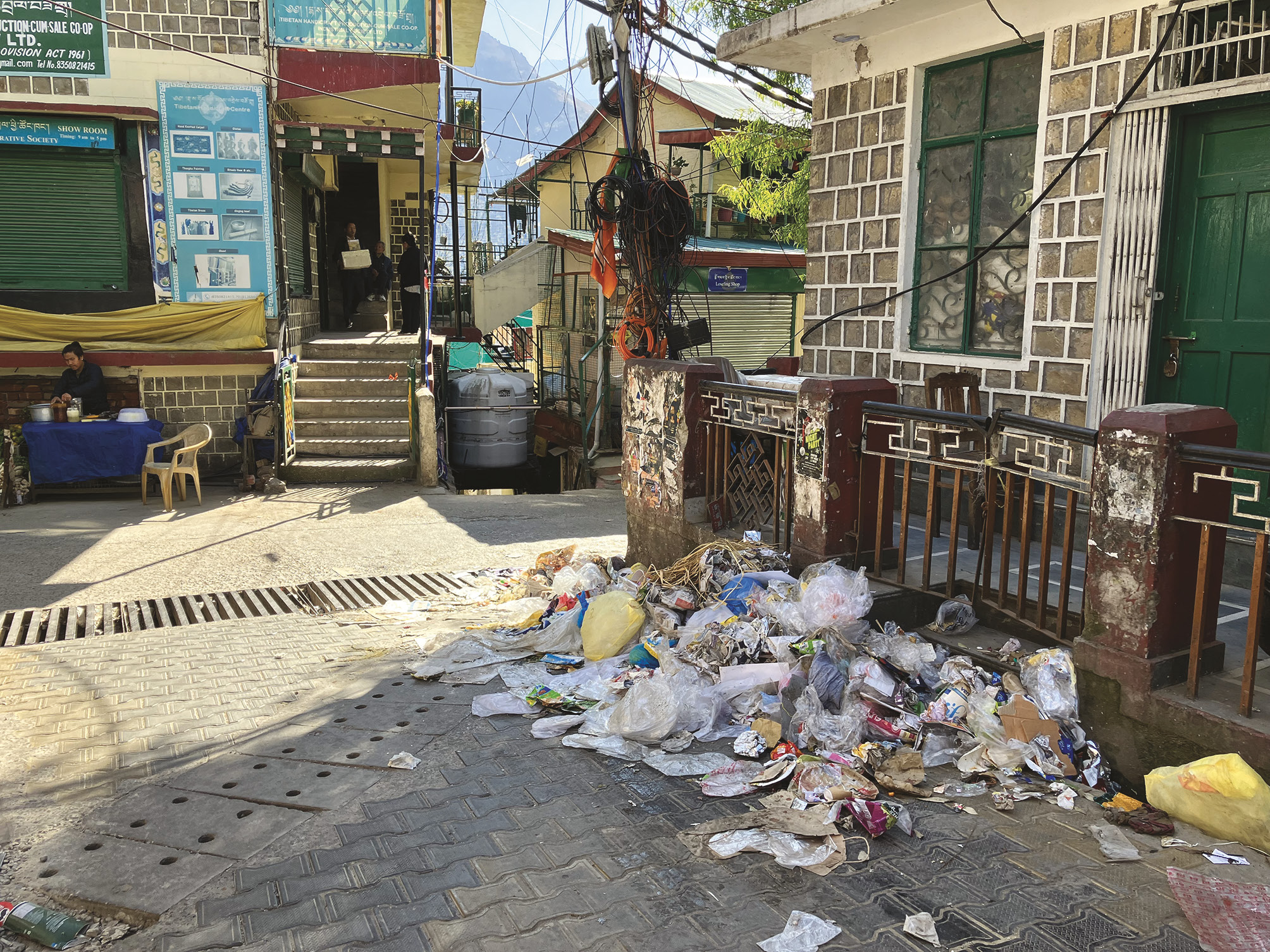
In 2023, the authors organised collaborative practice-led, ethnographic research into waste practices and experiences in the upper section of Dharamshala, a town situated in the foothills of the Indian Himalayas. Waste could be seen everywhere. Chips and instant noodle bags, old clothes, broken glass bottles, single-use teacups, rubber slippers – all kinds of waste were discarded along roads and in the forest, down the hillsides and in open drains and riverbeds. Organic waste was dumped in public places, serving as a source of sustenance for stray animals and wildlife. Construction waste scarred the hillsides. Sometimes waste ended up in these public places because people littered as they went about their everyday lives. Other times it was intentionally dumped after sunset. This was illegal, but inspections and penalties were uncommon, and there were widespread ignorance and indifference about waste disposal regulations among residents and tourists. As reported much earlier, in 2007, ‘[m]any locals assume that rain and water will “wash away” their rubbish, but it never gets that far. The plastic, bags, and cloth collect along the streams and gutters, causing floods during monsoon’ (Gillis 2007: 16). It was not only local residents but also businesses and tourists who littered; we observed the latter chucking garbage out of their car windows and saw how others, having partied by the riverside or trekked up a mountain, just left their waste behind. Upper Dharamshala residents often complained to us about the littering practices of these ‘outsiders’.
This article examines the waste challenges confronting Upper Dharamshala in the wake of substantial population growth, burgeoning tourism and increased consumption over the past couple of decades. By doing so, it highlights how time and timing are at the heart of waste experiences and practices and, hence, the success or failure of waste interventions. Dharamshala residents’ complaints about waste and waste management solutions tend to address sorting and placing; this is unsurprising given waste’s spatial logic (Douglas 2002 [1966], Gille 2010, Strasser 2000). Physical margins are important to separate waste from non-waste, so that waste is ‘kept out of the way’ (Strasser 2000: 7; see also Melosi 2020, Reno 2019). In Dharamshala, as elsewhere, waste is sorted from non-waste, bagged, binned and (ideally) moved to the outskirts of the town. Still, waste is not only about the ‘where’ but also the ‘when’. As William Viney argues, ‘[an] insistence on spaces of waste can confuse and obscure the crucial influence that time has in our experience of and dealings with waste things. Waste is also (and in both senses of the phrase) matter out of time’ (Viney 2015: 2; see also Allon, Barcan and Eddison-Cogan 2021: 3). Viney here invokes Mary Douglas’ Purity and Danger, in which she detailed the disorder of ‘dirt’ or matter ‘recognisably out of place’ (Douglas 2002 [1966]: 197). Yet, for Douglas, waste such as spoiled food or used napkins is not ‘dirt’ when it has been properly disposed of in the designated place to which it belongs, ‘a rubbish heap of one kind or another’ (Douglas 2002 [1966]: 197–8; see also Liboiron 2019, Reno 2018). While Douglas is commonly acknowledged for identifying this spatial dimension of waste, she also recognises rubbish as a temporal category; with the passing of time, unwanted things transform and lose their identity to become a ‘mass of common rubbish’ through ‘a long process of pulverizing, dissolving and rotting’ (Ibid.: 197). Time is inherent in waste. To borrow from Tim Ingold (2012: 439), the metamorphosis of waste through degradation, crumbling, corrosion, putrefaction, rusting and so forth does not occur in time; it is the passage of time itself. Compare, for example, the inherently short lifespans of perishable foodstuffs (Giles 2020) with the post-linear time of the circular economy with its reduce, reuse and recycle ideal (Wodzer 2026). Think about the lingering duration of plastic waste (Hawkins 2018) and the generational effects of toxic waste (Nielsen 2023).
Not only is waste a temporal category but, as this article will argue, it is managed through the differentiated and contested temporalities of those who generate it, collect it and scavenge it. Our focus is especially on bureaucratic time (Allon, Barcan and Eddison-Cogan 2021, Barak 2013, Thompson 1967). Bureaucratic time is organised according to the time management structures designed by institutions or authorities through standardised schedules, rhythms, deadlines and work hours. Although these are imposed to secure efficiency, uniformisation and predictability, they can be at odds with other temporal regimes, including people’s experiences, needs and practices, but also capitalist and tourist economies that compress and accelerate temporal expectations (Harvey 1990, Thompson 1967). In this article, bureaucratic time refers to the municipal solid-waste timetable: collection cycles that organise waste management across time and space and, ideally, run like ‘clockwork’ (Kruger 2021) – from Peru (Harvey 2017) to Japan (Siniawer 2018). We will show that, in Dharamshala, these waste schemes create temporal orders for disposal that are challenged when the collection cycle is disrupted or inefficient; they presuppose people’s ability to act at the right moment. Specifically, we argue that the timing of interventions – including both municipal waste collections and citizens’ waste practices, and the inherent time of waste – must be synchronised. This requires the superimposition of what Raysa Martinez Kruger (2001) refers to as a ‘temporal grid of compliance’, which coordinates waste management through people’s routine punctual and consistent enactment of ‘individual disciplinary micro-practices’ (62) such as bagging, binning, collection and disposal in accordance with the scheduled waste collection times. Waste must be moved outside the boundaries of the home before it starts to decompose, smell and attract pests. Still, it must not accumulate in public spaces where it is a health risk and an aesthetic problem that calls for management. Because waste is such a ‘public problem’ (Hird 2022), dealing with it in time demands a collective effort.
In India, scholars have discussed how navigating the bureaucracy involves judgements about timing to avoid disempowered waiting, specifically, the temporal displacement of ‘waiting for the state’ (Gagné 2019, Ghertner 2017, Mathur 2014). Misaligned timing triggers waiting but not everyone experiences it in the same way; waiting is an unevenly distributed and socially differentiated experience (Hage 2009). As argued by Sarah Sharma (2014), the temporal is a form of social difference: time is unequal, with some able to align with municipal rhythms, while others cannot avoid waiting and experience it as disturbance or risk. In Dharamsala, competing temporal regimes – including the everyday routines of households, the rhythms of the waste workers and the different seasonal tempos, as well as the material temporality of waste itself – sometimes clash, producing waiting, frustration and breakdown.
In the following, we first discuss our methodology and provide an overview of waste management in Upper Dharamshala. We then zoom in on people’s waste practices and experiences, revealing how those who generate waste, who bin it and who remove it all experience good disposal as vulnerable to timing. Timing determines whether waste can be moved along its designated conduits smoothly or disrupts the flow and clogs up the system. Showing the different temporalities and dependencies, we argue that all participants in this operation – consumers, waste collectors and municipal bodies – must act in sync for the system to function effectively. As we then turn to look at different kinds of waste and their lifespans, it becomes clear that segregating waste allows for better timing. In this Himalayan setting, timing, in the sense of ‘the ability to select the precise moment for doing something for optimum effect’,1 involves synchronisation. Actions must be coordinated not only in relation to other actors but also to the temporality of waste. Finally, we reflect on the displacement of waste, which can be both spatial (littering, dumping) and temporal, as shown by the widespread forward-looking view among our respondents, who tended to look toward the future for a solution while simultaneously anticipating that the problems would inevitably return. The article concludes by reflecting on the dependencies that make timing a decisive factor in a Himalayan waste management operation.
This article is based on data collected as part of a collaboration between the research project WASTE led by Trine Brox, and a practice partner responsible for dealing with waste, the CUDP (Clean Upper Dharamshala Programme), where Tenzin Passang served as Environment Coordinator. We co-developed a practice-led initiative on waste management in Upper Dharamshala in 2023 defined by the needs identified by the CUDP and the research agenda of the WASTE project. As we detail in the next section, the CUDP has been organising different initiatives to tackle waste management in Upper Dharamshala for over thirty years. The research project ‘WASTE: Consumption and Buddhism in the Age of Garbage’ (2021–2026) aims to draw attention to the global waste crisis through ethnographic investigation of consumption practices, waste imaginaries and waste trajectories in five Buddhist communities in India, Nepal, Bhutan, Japan and Oceania respectively. One of these waste ethnographies is Trine Brox’s study of waste management issues in Dharamshala, and it is in this connection that WASTE partnered up with the CUDP for a joint practice-led research project.
We have been working together to co-develop initiatives with the dual purpose of producing knowledge on waste management (research) and addressing waste challenges (practice), collaborating to identify and define the research problem, produce data and interventions, and process and write up the results. This article presents results from the first stage of our collaboration, launched through meeting and workshopping with local stakeholders (NGOs and residents) in April 2023, through which we identified several problematics regarding waste. These all related to two overall waste management challenges in Upper Dharamshala: waste disposal and segregation (Brox and Tenzin Passang 2024). This article concerns the former, and more specifically municipal solid waste disposal, which includes problems of littering (casual and unsystematic discarding of waste in public spaces) and illegal dumping (collected waste discarded openly and in violation of established regulations). These were unwanted but frequent waste practices in Upper Dharamshala.
In addition to an initial stakeholder workshop, we conducted thirteen structured, in-depth interviews together, and Trine Brox conducted semi-structured interviews on waste with 23 different interlocutors, some of whom were interviewed more than once. Our interlocutors were drawn from all strata of society, from the mayor to street sweepers, as well as representatives of households, businesses and institutions in Upper Dharamshala. Each contributed insights into local waste management practices and challenges, offering various perspectives. By engaging with such a broad spectrum of stakeholders, the study was able to capture the complexities of waste and its disposal in Upper Dharamshala. We also investigated what happens to waste after it is dumped, binned or handed over to the waste collectors, including visits to a processing site and a material recovery facility. Furthermore, Tenzin Passang explored the history of the dumpsites and engaged in continuous dialogue with local authorities. Her practical investment in waste management due to her position at the CUDP and as a Dharamshala resident significantly enriched our understanding of waste management issues in Dharamshala and inspired waste interventions.
As it turned out, our collaboration was itself challenged by different temporalities. The algorithms of practice and research are very different.2 As a practitioner, Tenzin Passang grappled with the pressing urgency of waste issues under rapid and, at times, unpredictable changes, while Trine navigated a more protracted research perspective. This meant that we were working under divergent temporal regimes. In addition, Tenzin Passang’s focus lay in the imperative for practical solutions to problems that the community had experienced and had knowledge about for years. In contrast, Trine had to build up her knowledge of the context and complexities of the problems slowly and systematically – sometimes at a pace that could not keep up with their continuous evolution. This tension between the urgency of practice and the deliberative nature of research meant that we had to take a flexible, responsive approach, ensuring that the findings would be directly relevant to the evolving waste management landscape. The collaboration thus produced a nuanced, context-sensitive body of knowledge that is both practical and grounded in the lived realities of the stakeholders involved.
A further challenge was the (at times) unpredictability of swift decision-making by the Municipal Council Dharamshala (MCD), officially responsible for waste management, and the evolving circumstances within which the MCD operated, which were not always fully transparent to us. We often did not know what might transpire the day or week after a meeting, as decisions could be retracted at any time and new decisions made. This complicated our long-term planning. For example, when we started our collaboration in 2023, the waste infrastructure in Upper Dharamshala included CUDP waste collection trucks, underground dustbins and the MCD jeep collection service (Brox and Tenzin Passang 2024). However, underground bins were removed over the summer of 2023 and the CUDP truck ceased operations in April 2024, when the MCD assumed full responsibility for waste management in Upper Dharamshala. Our research had to adapt to this evolving situation. At times we invested time and effort in examining issues related to infrastructures that were unexpectedly discontinued, leaving us scrambling to generate insights into the impact of these sudden changes on waste management practices. We experienced how decisions to remove dustbins, close collection points, change timings, raise charges, redirect the CUDP truck, install CCTV and so forth were not communicated effectively. The jeep collection service emerged from these changes as the primary mechanism for waste management and is therefore the central focus of this article.
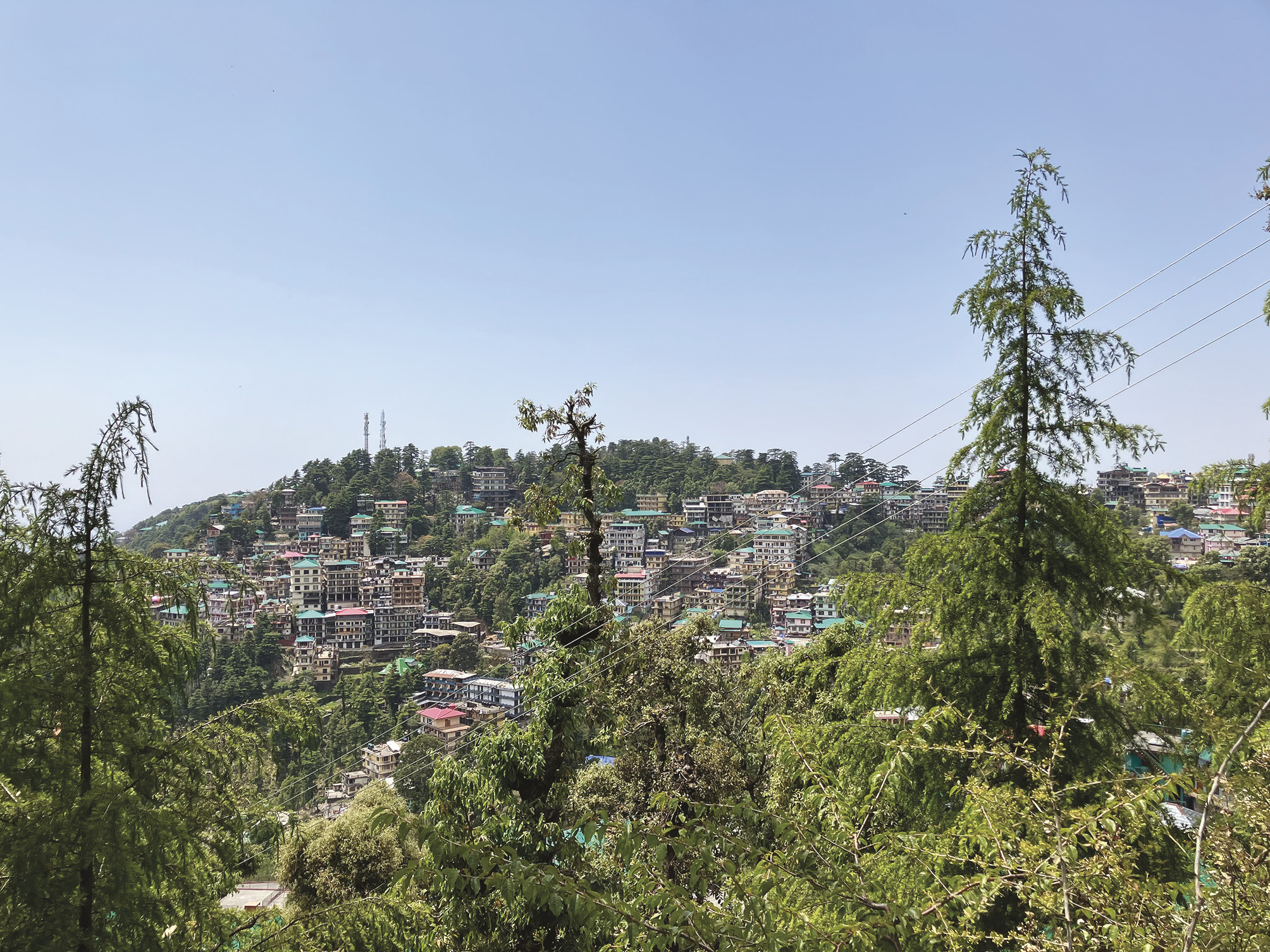
Dharamshala is a town that ascends from the Kangra Valley (Lower Dharamshala) to an elevation of 2,100 metres above sea level (Upper Dharamshala) in the Dhauladhar range (Figure 1). Residents and businesses in Upper Dharamshala are concentrated in its urban centre, McLeodganj, which has a distinct Tibetan feel as the home-in-exile of the Fourteenth Dalai Lama and a substantial Tibetan refugee population since 1960. The town’s fragile environment is challenged by rising population numbers, tourism and consumption.3 Dharamshala was awarded ‘Smart City’ status in June 2015, ushering in infrastructure improvements aimed at stimulating the economy. However, it is expected that completion of these infrastructure projects will result in intensified tourist influx, more traffic, increased pollution, elevated water use and a surge in consumption, leading to even more dense urbanisation and heightened waste generation; some of these effects were already visible in 2023 (Brox and Tenzin Passang 2024). In that sense, the Dharamshala case reflects a more general problem across India, where ‘urban economic growth is putting tremendous pressure on already overwhelmed waste management in infrastructures and services’ (Luthra 2019: 140).
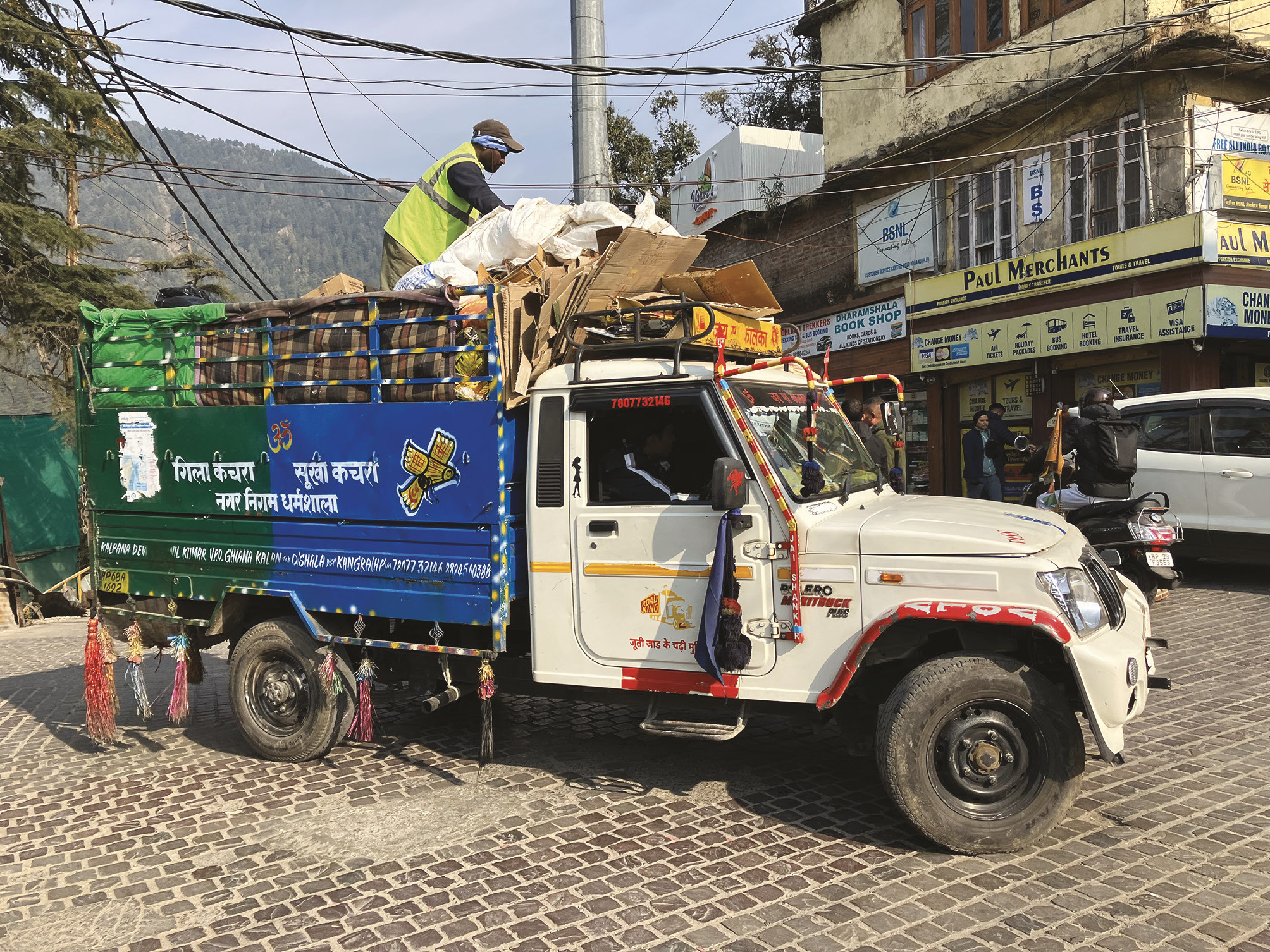
As the executive arm of the municipality, the MCD bears the legal authority and official responsibility for the town’s waste management. The MCD’s role encompasses the collection, processing and disposal of solid waste within the municipal area. In practice, the MCD has outsourced this responsibility to a private contractor working on a three to five year term; as of 2024, this contractor was employing 250 ‘green workers’ who were responsible for gathering waste (Dharamshala Municipal Corporation 2024). The latter swept the streets every morning to clean up the piles of sweepings generated by local shopkeepers and the litter that had been dispersed around the town during the night by guests and animals. These piles of waste, as well as the waste brought out by households, businesses and institutions, were then collected by open-backed jeeps (Figure 2). In 2024, the MCD reported 100 per cent waste collection coverage in Dharamshala, with 20.33 tonnes per day of waste being taken to an open dumping site, referred to as a ‘processing site’ (Dharamshala Municipal Corporation 2024). It was visually evident, however, that not all waste was being collected and the actual amount of waste generated in Dharamshala was likely much higher than these official figures suggest.4
Although the MCD is responsible for overall waste management, the CUDP has been instrumental in practical arrangements in Upper Dharamshala over the past three decades. When middle-class consumerism became possible in the 1990s (Doron and Jeffrey 2018: 53) and plastics became a ubiquitous part of life in India, mixed waste with single-use plastic bottles and packaging accumulated on Dharamshala hillsides as elsewhere in India (see also Gill 2009). Tibetans in Dharamshala realised they had to do something with the accumulating waste and thus established the CUDP in 1994. The CUDP is organised under the Tibetan Settlement Office (formerly the Tibetan Welfare Office), which is entrusted with responsibility for the well-being and rehabilitation of the displaced Tibetan population in Dharamshala. Between 1994 and 2002, the CUDP organised various initiatives such as door-to-door waste collections and arranged public awareness activities. In this period, the CUDP received funding from foreign sources, including Save the Children and SOIR-IM. This enabled the CUDP to hire green workers (at one point up to 26 persons) and to buy three trucks to move waste from Upper Dharamshala to the processing site in Lower Dharamshala.
In 2002, the CUDP was given the legal sanitation contract for Upper Dharamshala. It carried out street sweeping and the cleaning of the open drainage system, and also operated trucks to collect dry waste (recyclables) from the doorstep and wet waste (non-recyclables) from the curbside. However, with the introduction of the Smart City format, the CUDP was unable to make a bid and therefore lost its contract in 2017. Without the waste management contract and with minimal funding, the CUDP has had to scale down its operations. In 2023, it was serving with only one truck, which collected dry waste from selected Tibetan institutions six days a week. Additionally, as elsewhere in India (Demaria 2023, Gill 2009, Luthra 2019), there was an informal sector, with scrap dealers making a living from going door to door to collect, segregate and sell recyclable paper, metals and plastics.
Our collaboration in 2023 worked in this setting, with a slimmed-down CUDP with diminishing waste management responsibilities and an MCD that was about to take full charge of the waste situation under the banner of the Smart City. In the following, we provide a snapshot of the MCD jeep waste collection service in Upper Dharamshala in 2023 and how it was experienced by our interlocutors. We focus on this service since it became the main conduit through which solid waste was collected from the town and moved to the processing site, particularly with the removal of underground bins in summer 2023 and cessation of the CUDP’s collections the following year. The jeep collection service is therefore a crucial element in the town’s waste infrastructure, and its success or failure as a waste intervention is critical to the town’s waste management. As will unfold in the following, we found time to be central to how people related to the collection system, which they found inconvenient and inconsistent in its timings. These insights stem from respondents’ complaints in our interviews, revealing how the temporal order superimposed by the MCD was not working properly.
Dharamshala’s municipal jeep collection system is not unique; it is common all over India, where waste collection is the responsibility of municipal councils as stipulated in the Municipal Solid Waste (Management and Handling) Rules. Municipalities are allowed to outsource this responsibility to other actors, such as NGOs or private firms (Luthra 2019: 144), but according to Doron and Jeffrey (2018: 29), implementation of this public-private partnership model has not lived up to its ‘promises of technical rationality and efficiency’. In Dharamshala, waste collection was being outsourced to a private company that hired teams of two persons (often two men, sometimes a husband and wife) to collect waste on jeeps and transport it to the processing site. These jeeps are fairly big vehicles but still small enough to manoeuvre narrow, steep and uneven roads. Each has an enclosed cab for the driver and an open cargo area at the back, where a worker stands to receive the waste (Figure 3). In 2023, each jeep made its rounds twice a day: every morning and evening except Sundays. Upper Dharamshala households, businesses and institutions brought their waste to the jeeps when they passed by, sometimes (but not always) stopping to receive waste. The exact schedule was not publicly known; some even suggested there was no fixed schedule. But the jeeps arrived at approximately the same times each day and announced their arrival by playing a recurring, distinctive melody on repeat. This alerted residents to bring out their waste bags or dustbins.
The jeep collection system ideally relieved households, businesses and institutions from having to either store waste for extended periods inside their premises or leave it in the street for scavengers. However, there were frequent missed opportunities for waste disposal as people often failed to hand over their waste to the jeep collection services. While our interlocutors related several reasons for this, the three most common had to do with timing: residents were not home when the jeep arrived, the jeep did not wait to receive their waste, or residents arrived belatedly as they were unable to hear the distinctive melody played by the jeep to herald its impending arrival. Since the jeep could not stop right outside the door of each household, business and institution, people had to go after it to get rid of their waste, but this required good timing.
In the case of household waste, the underlying assumption was that each household would have a member able to stay at home to hand the jeep its waste during the collection rounds. This system was widely employed across India, where multigenerational households often have women or elders who stay at home. In Upper Dharamshala, however, numerous households consisted of families where everybody was at work and school, or comprised a diverse group of individuals cohabiting without a designated head of the household or a homemaker who was available during the collection. Many households in Upper Dharamshala thus found the existing waste management system to be burdensome because it relied so much on household availability being timed with the availability of the collection jeep. Thus, the system only ran smoothly if ‘compliant citizens’ aligned their waste practices with bureaucratic time.
Respondents raised three issues with bureaucratic time, namely that the waste collection times were inconvenient, inconsistent and unknown. First, the timing of waste collection would be more convenient if the jeep arrived when people were not already at work or school. Many respondents suggested that the ideal timing for the pickups would be between 8:30 and 9:30 in the morning and sometime after 5:00 in the evening. Second, since collection relied on coordinating the jeep’s arrival with households being ready, the timing needed to be predictable. As it stood, there was inconsistency in where the jeep stopped to collect waste and its arrival and waiting times. This inconsistency was connected to the last point: lack of transparency. Since the schedule was not publicly available, people were uncertain about when to expect the jeep, making it difficult to be a compliant citizen and collaborate with the waste infrastructure and service provider.
One respondent related how she seldom gave her waste to the municipal jeep. She had tried several times to do so. She would hear the jeep coming, but by the time she got outside with her dustbin, the jeep was already gone. It stopped further down the road, but she had experienced too many times that she could not reach it before it left. We listened to many stories like this from householders and business owners. ‘The jeep just goes back and forth without taking our waste even though we actually pay the monthly fee to the MCD!’ one woman complained. Another interlocutor summarised:
It would be good if the inhabitants could receive a map of where the jeeps stop, their timings and how long they wait for people to bring their waste. Nobody knows when the jeep is coming. People clean their houses every day, and they give their trash to the evening jeep, but when the timing is off, they just dump it.
Municipal collection was kept deliberately flexible, pushing residents into a two-hour waiting window that mapped onto wider inequalities: Early working hours and unpredictable arrival times meant that some people were unable to wait for the jeep, and renters with little or no indoor storage may have felt pressured to dispose of waste illegally. This was particularly challenging for small shops, eateries and households located along narrow main roads. It included Tibetans who, as non-citizens, felt unable to demand services and also discouraged other Tibetans from complaining.5 By contrast, others could absorb delays: Upscale hotels and restaurants with bigger properties allowing vehicles space to wait faced less problems. Wealthier businesses and homeowners hired cleaners and could store waste, and Indian residents feel entitled to demand attention and complain. Thus, waiting is differentiated: people do not wait in the same way or with the same capacity (Hage 2009). Waiting was a problem for the waste workers as any hold-ups caused traffic congestion. Also, with capacity already strained, tourist-season spikes meant jeeps skipped collection points because they were already filled to the brim after stops at larger hotels, leaving others to wait until the next day or find their own solution. The mismatch between waste collectors and residents over waiting time often recast unequal capacities to wait as a mindset rather than a structural problem. One Tibetan official we interviewed moralised waiting: ‘When people come and wait for the jeep to give their waste, if the jeep is not coming or came too late, then they should just take their bags home, not throw them everywhere.’ He framed the issue as a failure to wait properly, adding: ‘Actually, Tibetans have no habit of waiting’.
Uncertainty about the jeep’s arrival meant that some residents missed the collection and would leave their bags in the street, returning home empty-handed instead of taking their trash back with them. Waste became a public nuisance because it was left unattended in the street. Animals would then spread it and eat it, with potentially detrimental effects on the health, environment and economy of Dharamshala. Even so, some people prioritised keeping the home or business clean over the state of the public space outside, which they did not seem to bother too much about, an observation confirmed in other studies (eg., Cornea, Véron and Zimmer 2017). To understand this reluctance to keep waste inside for too long, we have to zoom in on the waste material itself, its inherent temporality and how this influences questions of timing. As we will show in the next section, the requirement for the timely disposal of waste caused people to illegally dump it when the timing was off.
The temporality of waste has to do with the speed and progression of an item’s transition into waste and its transformation over time as waste. The pace of this development is determined by the properties of the material and how it is stored, but the time it takes before an item has to be discarded is up to households, businesses and institutions. As theorised by Ingold (2012), time is embedded in the material composition of the waste itself, its inherent qualities determining its lifecycle. But waste is also a social category: for something to become waste involves not only a material transformation, but also a transformation of value. This inevitably influences both when and with what level of urgency people discard stuff. Looking at waste experiences and practices in Upper Dharamshala, we learn that some people mix their waste while others segregate it. This has consequences for waste timing. Our interlocutors distinguished between four kinds of waste: dry waste, wet waste, food remains and sanitary waste. To each category, they attached ideas about and experiences of waste temporalities that influenced their placing and timing, which was more urgent for some types of waste than others.
Dry waste such as plastics, glass, paper, cardboard and metals was considered recyclable but often also contained multi-layered plastics or composite materials that are not recyclable. Ideally, dry waste was collected in a separate bin and taken to the MCD jeep when the bin was full; the green worker standing atop the discarded waste in the back of the jeep would empty it and give the bin back. How long it took to fill the bin varied. Households reported that they had enough dry waste to give the jeep two or three times a week or on a weekly basis. Offices produced mostly paper waste, which was usually given for free to the CUDP’s paper workshop rather than being handed over to the jeep operator. Some people kept their dry waste in plastic bags. When the person operating the back of the jeep received a bag, they might rip it open to conduct a rudimentary sorting, throwing plastic bottles and tin cans into a large sack suspended on the back of the jeep and piling cardboard on the head of the jeep while en route (see Figure 3). This dry waste was considered cleaner than other kinds of waste. There was no urgency to discard it as it did not rot and decay fast and could therefore be stored for longer. During the monsoon, residents would keep dry waste in plastic bags rather than the bin, as the wet weather could easily spoil it. As dry waste became moist and began to look and smell awful, it became wet waste.
The category of wet waste was interpreted differently by people. Some considered it to encompass everything that was not recyclable, from dirty plastic bags and food leftovers to paper and plastic packaging bearing traces of food or dirt. Wet waste was considered dirty and created its own temporal pressure: It degraded quicker than dry waste and smelled if stored too long. During the monsoon everything got drenched, increasing wet volumes and speeding the decay of waste that is otherwise manageable in dry conditions. This raised the urgency of disposal for households, businesses and institutions. Rain also slowed the jeeps by making narrow hill roads harder to reach, and delays in turn contributed to more dumping. Yet, beyond prioritising larger generators such as hotels and restaurants when rounds ran late, we saw no specific strategies to manage monsoon-related surges or delays. Thus, the problem of timing was especially critical with wet waste as it had to be discarded often – daily, if possible. A Tibetan lady who ran a tea shop and segregated her waste showed us a big sack for dry waste and a closed plastic bag with wet waste. The latter was heavy and compact, and looked fit to burst as she lifted it up to demonstrate. She could not store the wet waste for too long since it quickly smelled but, nonetheless, she had lined up several plastic bags swelling with wet waste along one of the outside walls of the teashop because she was unable to get rid of them. She complained that the jeep did not stop to receive her waste, so she had to store it on the premises, where it started to smell. This problem, she told us, was not unique to her tea shop. She complained: ‘If you don’t wait for us, then where do we throw our waste? The jeep should stop and wait for at least 5–10 minutes.’ Knowing that it was common for the jeep to ignore them left her frustrated: Why wouldn’t others speak up? Her fear was that without action, ‘the town would be unkept’.
While food remains were often seen as wet waste, some households considered them as a separate waste category comprised of organic, biodegradable waste that usually contained leftovers suitable for animals to eat. Residents and businesses gathered their leftovers to throw in the street or forest for mules, cattle, dogs and monkeys to eat. Some interlocutors assured us that they first removed plastics and made sure that the waste contained only eatables, but not everybody was that conscientious. A report from 2007 related how some people, especially those running shops and restaurants, did not segregate their food waste but dumped mixed waste in the street under the cover of darkness, meaning that animals also got access to non-edibles (Gillis 2007: 17). Other Tibetans deemed food waste as having properties appropriate for use as fertiliser and disposed of it onto plants and trees. Respondents usually got rid of their food waste every day, especially if it was given to the same street dogs or cattle, and they saw it as their responsibility to feed these animals daily. Food’s limited lifespan, especially perishables, created an urgency for food waste disposal.
Some respondents operated with a separate, albeit ambiguous, category for sanitary waste. There was general confusion among people in Dharamshala about how to handle this kind of waste. It was sometimes kept separately in a black bag, but others defined it as either wet or dry according to how they evaluated its quality and condition: they might mix it with the dry waste if it lacked moisture content or with the wet waste when it had significant moisture content. If they kept it separately, they gave the black bag to the jeep operator; it was believed that there was a mutual understanding that a black bag meant sanitary waste and should be kept separate from wet and dry waste. According to the NGO Waste Warriors, during an interview in April 2023, sanitary waste was supposed to be sent to an incinerator plant fifteen kilometres away from Dharamshala, but since the plant charged the waste collectors a fee of 15 INR per kilogram for incineration, it was commonly diverted to the processing site or just dumped into the river.
Unless all waste was mixed, which necessitated more frequent disposal, segregation made people less vulnerable to timing issues as it allowed them to discard different types of waste with varying levels of urgency. In Upper Dharamshala, however, dense settlement and near-absent storage made disposal timing essential, especially for wet and food waste. With little capacity to hold waste for long, residents had to rely on the jeep collection system. Missed collections could lead to public health risks as people dumped their waste in public areas rather than letting it pile up at home. In summary, waste disposal was more than just a logistical and spatial concern – it was also an issue of timing.
The MCD jeeps moved all waste – dry, wet, food and sanitary – to the processing site located adjacent to the bus station in Lower Dharamshala, proximate to the village of Sudher. The site lacked segregation facilities and frequently experienced overflow and combustion. If we use Joshua Reno’s (2016: 29) terminology, the processing site in 2023 could be called a ‘dump’ in that it represented ‘unthinking and unregulated disposal’ with waste contaminating its surroundings through the air, soil and water. In contrast, a landfill is a sanitised entity that is concealed from vision and secured from leakage and contamination of its surroundings (Melosi 2020, Reno 2016). The processing site in Lower Dharamshala was a visible and olfactive mismanaged flood of waste, which flowed down the hillside (see also Anand and Singh 2014). It was a rather lively place with a myriad of green workers and their playing toddlers, roaming cows and stray dogs and a large habitat for different birds, all of which affected the impression that this was a dump with unruly, uncontained and mixed waste (see also Doron 2021). When we visited the processing site, the person in charge related how the old, non-recyclable, mixed waste had been lying there exposed to the sun for at least a decade. However, in the summer of 2023, the MCD reported that it had bought new technology to enable segregation and compression at the processing site, promising to handle waste better in the future.
Despite the MCD reporting 100 per cent waste collection coverage, it was obvious that not all waste was moved by the MCD to the processing site in 2023. The town still had a massive problem with shadow disposal practices. These problems intensified during peak tourist seasons. Tourist surges created temporal stress because municipality collection schedules often remained unchanged despite waste generation spikes. Domestic short-term tourists were the most common and visible type in Dharamshala, especially during the peak season from March until the beginning of the monsoon in July. Staying in hotels, they were largely detached from waste management responsibilities, as hotel services handled disposal. The influx of tourists and accompanying increase in street food vendors lead to greater congestion on the roads and a significant rise in littering and dumping. Whereas Dharamshala residents considered these short-term domestic tourists less mindful of their waste disposal, long-term resident tourists tended to develop expectations similar to Tibetan and Indian residents. Since they lived in Dharamshala for months or years as volunteers or students of Tibetan Buddhism, language or yoga, they became more aware of, and affected by, local waste management issues. Like residents, they had to manage their own household waste and faced the same struggles of timing disposal with the passing collection jeeps, storing their waste and waiting for the next collection, perhaps resorting to roadside dumping – like locals. In addition to the different relations to waste across these two markedly different tourist categories, temporary population fluctuations and increased waste also resulted from religious gatherings or teaching events that produced waste spikes that were not fully absorbed by the town’s disposal timing.
The many issues that the MCD and CUDP tried to tackle in 2023 were the same overall problems reported twenty years previously by Sterkele and Zurbrügg (2003). They related how practices of littering and dumping in Dharamshala were not only visually unappealing but also entailed health hazards, including risks associated with physical contact, the propagation of disease vectors and the potential for flood damage. Five years later, Gillis (2007: 19) estimated that ‘30–40% of households, shop, and hotel owners continue to dump their waste indiscriminately’. We observed that the issues had escalated over the past two decades, given the increased encroachment of urban areas into the forest, the growth of a floating population and an overwhelming volume of waste exceeding the carrying capacity (see also Anand and Singh 2014). Waste piled up on the steep hillsides, but it was not confined to that specific area permanently. The weather and animals set it in motion. Heavy monsoon rainfalls washed waste and wastewater downhill, with plastic bags and other debris clogging the open drains and overflowing onto roads and pathways. As monkeys, cows and other animals rummaged through the waste, they spread it around.
The situation in Dharmshala reflects a nationwide predicament of illegal disposal, with an estimated 85 per cent of all waste generated in India being disposed of through unauthorised methods (Sharma, Sharma and Ganguly 2022: 914). Although our study did not produce any statistics on this, our qualitative investigation reveals that the timing issues around service provision (untimely waste collection and disposal services) were a significant factor in littering and illegal dumping in Dharamshala as of 2023. When our interlocutors detailed how they experienced the consequences of the prevailing shortcomings in waste management infrastructure and practices, they problematised when to place waste because of the question of where. Dependencies that have to do with the spatial logics of waste, where waste is conceived as a problem that needs management in terms of placing, had led to the creation of a temporal order for municipal solid waste disposal that relied on very precise timing. In Denmark or the UK, for example, residents and businesses can put out their bins the night before a scheduled collection to be emptied into collection trucks by garbage personnel. In contrast, the residents of Dharamshala had to be ready to hand their waste to the jeeps at exactly the moment they passed by. This added a layer of complexity that included the inherent temporal dimensions of waste and the divergent temporalities of people’s waste practices and the MCD’s service provision.
The displacement of waste in Dharamshala was not only spatial, however. As is evident in the MCD’s promises to handle waste better in the future, it also had a temporal dimension. Our investigation revealed a widespread forward-looking view: respondents looked toward the future for a solution, waiting for the development of new technology or a new management solution in the belief that ‘we don’t do it now, but it will happen in the future’ (see also Harvey 2017). They anticipated that the dumpsite would start using segregation technology, non-recyclables would be turned into refuse-derived fuel, the MCD jeeps would come more often and, with time, the MCD would take the waste to be recycled at a materials recovery facility or to a biogas plant (not yet in existence) to be converted into green energy. This kind of ‘waste talk’, which anticipated future technological solutions as inevitable, was a recurrent theme in discussions with the municipality and other waste agents. Sometimes it stalled initiatives, the belief that these things were going to happen anyway pushing the waste problem into the future. Anticipation of what would eventually happen sounded in the speeches of authorities and the hopes of our interlocutors. The institutions involved also hoped that the Smart City scheme would upgrade everything in the future. This is reminiscent of what historian Martin V. Melosi (2020: 549) describes as the ‘mistaken belief that one best way for disposal was possible and that it was just a matter of discovering or fashioning it’, which he found running throughout the history of New York’s waste management.
This orientation toward the imagined ‘waste futures’ (Harvey 2017) of Dharamshala revealed a temporal displacement of the waste issue through hopes and beliefs about the inevitably of the solutions that lay ahead. At the same time, there was also a creeping doubt: ‘Yesterday, they [the authorities] told me this, and tomorrow I do not know,’ one waste manager complained. Thus, anticipation of what was to come was not productive or empowering in the sense of preparing for the future but rather became a position of what Nayanika Mathur (2014) calls ‘disempowered waiting’. Indian bureaucratic time often keeps citizens, especially marginalised groups, waiting for services, approvals and recognition (Gagné 2019, Ghertner 2017, Mathur 2014). Tibetan residents’ position as ‘foreign guests’ is itself a temporal condition shaped by prolonged political uncertainty, restricted mobility, and limits on property ownership.6 This status became visible in everyday encounters with waste. One interlocutor described how domestic tourists littered freely and how difficult it was to intervene. He recalled asking an Indian tourist to pick up his litter, only to be told: ‘This is my land; I throw where I want. You are only a guest, so you cannot tell me what to do.’ In other situations, Tibetan residents urged one another not to complain to the municipality or demand improvements in waste collection, fearing that, as refugees, they had no right to make such claims as they were living there at the mercy of the Indian authorities. These interactions show how a legally precarious temporal condition shapes the policing, negotiation, and timing of waste, even as many Tibetans held on to a tentative, wounded hope that conditions might eventually improve. Still, having experienced the same issues ten, twenty or thirty years ago (see also Sterkele and Zurbrügg 2003, Gillis 2007), some interlocutors believed that casual littering and open dumping would continue despite efforts to prevent or control them. There was a degree of hopelessness that no matter what one does, the jeep will never arrive on schedule, people will dump waste and not care, those in power will fail to issue fines, and the day after a cleanup the hills will be littered again.
The accelerating speed of waste generation has exceeded the capacity of the waste management infrastructure in Dharamshala. If we think about how the collection system ideally operates on bureaucratic timing, with standardisation of efficiency, uniformisation and predictability, it is down to citizens to adjust to these timings. In the context of the development of waste collection services in the United States, Kruger argues that ‘the goal of producing the clean spaces ... necessitated the superimposition of a temporal grid of compliance upon its inhabitants, synchronising their previously random waste management practices and bringing a measure of order to the uncontrollable biological and environmental processes of waste decay’ (Kruger 2021: 61–62, emphasis in original). In other words, the system required each individual to regulate their waste management practices, its success relying on the ‘normalisation’ of the regular waste collection schedule such that it became ‘a routine, unquestioned part of our collective waste management practices’ (Kruger 2021: 61).
This kind of normalisation had not been established in Dharamshala. People had not yet found the rhythm, but this was not solely down to a lack of citizen compliance. Instead, the normalisation of bureaucratic time was compromised, we conclude, by a combination of inconsistency and transparency in bureaucratic timing, making it difficult for citizens to comply. This means that the development of a waste management system in Dharamshala has failed to keep up with the rapid changes ushered in with full force as a result of the acceleration of the plastic revolution, burgeoning tourism and the promises of the Smart City. The question of whether waste could be moved along its designated conduits smoothly in Upper Dharamshala was dependent on both compliant citizens responsible for timing their waste and the waste collectors arriving promptly. As we saw in our study, waste segregation at the source (households, businesses and institutions) reduced vulnerability to timing issues by allowing people to manage waste with varying levels of urgency. Even so, good disposal of those various kinds of waste still requires synchronicity between the inherent time of waste and the timing of interventions, including both municipal waste collections and citizens’ waste practices.
Typically, the discussions and solutions of those in charge of the waste infrastructure revolved around changing people’s minds and habits – for example the ability and moral of waiting – in the belief that they were the ones who needed reform to become complying citizens. They complained about public ignorance (inadequate waste disposal education), indifference (lack of public engagement and cooperation among community members), and reluctance to assume responsibility for both individual and collective waste management. At the same time, there was a widespread belief that the system was difficult to challenge. Yet, in 2024, the MCD notified the public of the jeep timings, making the system more predictable. This shows that it is possible to work with the infrastructures that enable, support and restrict waste practices, offering hope for timely and transparent waste pick-up in the future. Our ongoing collaboration will allow us to assess whether this has had any impact in practice on the waste problem in Dharamshala – or on the forward-looking view we identified among our respondents, who simultaneously believed that the solution to the waste problem would inevitably come in the future and anticipated the waste problems that would inevitably return. Any waste intervention has to account for not only immediate concerns but also such anticipated or unavoidable elements – for both the expected and unforeseen aspects of waste, wasting and waste management.
The research was supported by the VELUX FONDEN (2021–2026, grant number: 34934) but it has not had any involvement in the design, execution or communication of the study. The project received ethics approval dated 30 August 2022 from the Research Ethics Committee at the Faculty of Humanities and the Faculty of Law, University of Copenhagen, Denmark. The conceptual framework was developed at the panel Waste Temporalities and Practices in India and Japan at the University of Copenhagen, 17 November 2023, where Paulina Kolata, Fabio Gygi and Gayatri Rathore inspired our thinking about the temporality of waste. We would also like to thank all participants in the clean-ups and workshops in Dharamshala, as well as our interlocutors, and the MCD for providing valuable information and granting permission to visit the processing site. Acknowledgements are also due to Jane Caple for copy editing.
Trine Brox
Department of Cross-Cultural and Regional Studies
University of Copenhagen
Denmark
https://orcid.org/0000-0002-1158-7826
Tenzin Passang
Former Environment Coordinator,
Clean Upper Dharamshala Programme,
India
Trine Brox
Conceptualisation, investigation, methodology, writing (original draft preparation, reviewing and editing).
Tenzin Passang
Data curation, investigation, writing (reviewing and editing).
Allon, F.R., R. Barcan and K. Eddison-Cogan (eds). 2021. The Temporalities of Waste: Out of Sight, Out of Time. Abingdon, Oxon: Routledge. Crossref
Anand, S. and A. Singh. 2014. ‘Tourism and solid waste management’. In R.B. Singh and R. Hietala (eds), Livelihood Security in Northwestern Himalaya: Case Studies from Changing Socio-economic Environments in Himachal Pradesh, India, pp. 189–202. Tokyo: Springer Japan. Crossref
Barak, O. 2013. On Time: Technology and Temporality in Modern Egypt. Berkeley: University of California Press.
Brox, T. and Tenzin Passang 2024. Survey on Waste in Upper Dharamshala 2023. https://researchprofiles.ku.dk/en/publications/survey-on-waste-in-upper-dharamshala-2023.
Cornea, N., R. Véron and A. Zimmer. 2017. ‘Clean city politics: An urban political ecology of solid waste in West Bengal, India’. Environment and Planning A: Economy and Space 49 (4): 728–744. Crossref
Demaria, F. 2023. The Political Ecology of Informal Waste Recyclers in India: Circular Economy, Green Jobs, and Poverty. Oxford: Oxford University Press. Crossref
Dharamshala Municipal Corporation. 2024. ‘Key Matrices of Solid Waste: Solid Waste Management Status (Dharamshala Municipal Corporation)’. No. 4113, 7 November 2024. Unpublished document.
Doron, A. 2021. ‘Stench and sensibilities: On living with waste, animals and microbes in India’. The Australian Journal of Anthropology 32 (S1): 23–41. Crossref
Doron, A. and R. Jeffrey. 2018. Waste of a Nation: Garbage and Growth in India. Harvard University Press. Crossref
Douglas, M. 2002 [1966]. Purity and Danger: An Analysis of the Concepts of Pollution and Taboo. London: Routledge.
Gagné, K. 2019. ‘Waiting for the flood: technocratic time and impending disaster in the Himalayas’. Disasters 43 (4): 840–866. Crossref
Ghertner, D.A. 2017. ‘When is the State? Topology, temporality, and the navigation of everyday State space in Delhi’. Annals of the American Association of Geographers 107 (3): 731–750. Crossref
Giles, D.B. 2020. ‘After market: Capital, surplus, and the social afterlives of food waste’. In C. Reynolds (ed.), Routledge Handbook of Food Waste, pp. 23–36. Abingdon, Oxon: Routledge. Crossref
Gill, K. 2009. Of Poverty and Plastic: Scavenging and Scrap Trading Entrepreneurs in India’s Urban Informal Economy. Delhi: Oxford University Press. Crossref
Gille, Z. 2010. ‘Actor networks, modes of production, and waste regimes: Reassembling the macro-social’. Environment and Planning A: Economy and Space 42: 1049–1064. Crossref
Gillis, D. 2007. The Clean Upper Dharamsala Project: A Waste Management Study. Unpublished report for The Tibetan Welfare Office and Municipal Council, Dharamsala, India.
Hage, G. 2009. ‘Introduction’. In G. Hage (ed), Waiting, pp. 8–16. Victoria: Melbourne University Press.
Harvey, D. 1990. The Condition of Postmodernity: An Enquiry into the Origins of Cultural Change. Oxford: Blackwell Publishing.
Harvey, P. 2017. ‘Waste futures: Infrastructures and political experimentation in Southern Peru’. Ethnos 82 (4): 672–689. Crossref
Hawkins, G. 2018. ‘Plastic and presentism: The time of disposability’. Journal of Contemporary Archaeology 5 (1): 91–102. Crossref
Hird, M.J. 2022. A Public Sociology of Waste. Bristol: Bristol University Press. Crossref
Ingold, T. 2012. ‘Toward an ecology of materials’. Annual Review of Anthropology 41: 427–442. Crossref
Kruger, R.M. 2021. ‘Biopolitical temporalities of waste and the municipal collection schedule in the United States’. In F.R. Allon, R. Barcan and K. Eddison-Cogan (eds), The Temporalities of Waste: Out of Sight, Out of Time, pp. 61–74. Routledge. Crossref
Liboiron, M. 2019. ‘Waste is not “matter out of place”’, https://discardstudies.com/2019/09/09/waste-is-not-matter-out-of-place/ (accessed 7 September 2020).
Luthra, A. 2019. ‘Municipalization for privatization’s sake: Municipal solid waste collection services in urban India’. Society and Business Review 14 (2): 135–154. Crossref
Mathur, N. 2014. ‘The reign of terror of the big cat: bureaucracy and the mediation of social times in the Indian Himalaya’. The Journal of the Royal Anthropological Institute 20 (S1): 148–165. Crossref
Melosi, M.V. 2020. Fresh Kills: A History of Consuming and Discarding in New York City. New York: Columbia University Press. Crossref
Nielsen, M.-B.O. 2023. ‘Living with poison: Exploring generations as toxic timescapes’. In S.M. Müller and M.-B.O. Nielsen (eds), Toxic Timescapes: Examining Toxicity Across Time and Space, pp. 21–49. Athens, OH: Ohio University Press.
Rathor, S.S. 2020. ‘Report on measures to control illegal construction, waste management in Manali and Mcleodganj, Himachal Pradesh, 04/08/2020’. National Green Tribunal. http://www.indiaenvironmentportal.org.in/content/468246/report-on-measures-to-control-illegal-construction-waste-management-in-manali-and-mcleodganj-himachal-pradesh-04082020/ (accessed 16 March 2025).
Reno, J. 2016. Waste Away: Working and Living with a North American Landfill. Oakland: University of California Press. Crossref
Reno, J. 2018. ‘What is Waste?’ Worldwide Waste: Journal of Interdisciplinary Studies 1 (1): 1-10. doi: http://doi.org/10.5334/wwwj.9.
Reno, J.O. 2019. ‘Kept in suspense: The unsettling indeterminacy of US landfills’. In C. Alexander and A. Sanchez (eds), Indeterminacy: Waste, Value, and the Imagination, pp. 31–49. Oxford: Berghahn Books. Crossref
Sharma, A., L. Sharma and R. Ganguly. 2022. ‘Quantification of municipal solid waste and effect of open dumping on soil in Smart City Dharamshala, Himachal Pradesh’. In A.K. Gupta, S.K. Shukla, H. Azamathulla (eds), Advances in Construction Materials and Sustainable Environment, vol. 196, pp. 913–926. Singapore: Springer Singapore. Crossref
Sharma, S. 2014. ‘Because the night belongs to lovers: Occupying the time of precarity’. Communication and Critical/Cultural Studies 11 (1): 5–14. Crossref
Siniawer, E.M. 2018. Waste: Consuming Postwar Japan. Ithaca: Cornell University Press. Crossref
Sterkele, B., and C. Zurbrügg 2003. Baseline Study on Water Supply, Sanitation and Solid Waste in Upper Dharamsala, India SANDEC Report 09/03.
Strasser, S. 2000. Waste and Want: A Social History of Trash. New York: Holt, Metropolitan.
Thompson, E.P. 1967. ‘Time, work-discipline, and industrial capitalism.’ Past & Present 38 (1): 56–97. Crossref
Viney, W. 2015. Waste: A Philosophy of Things. London: Bloomsbury.
Wodzer, T. 2026. ‘From yak dung to plastics: Rethinking zero waste in a Tibetan pastoral community’. Worldwide Waste 9: 40–52. Crossref
1 Merriam-Webster Dictionary, ‘Timing’, https://www.merriam-webster.com/dictionary/timing (accessed 9 Aug. 2024)
2 We thank Emma Martin for suggesting the concept of algorithm to encapsulate the systematic and structured approaches taken within particular fields of action, which create divergent temporal frameworks.
3 The town has experienced population growth from 10,255 inhabitants in 1961 to 53,543 according to the latest census in 2015: ‘About Dharamshala Smart City’, https://dharamshalasmartcity.in/dharamshala/about-dharamshala (accessed 6 Oct. 2023; site discontinued). In addition, there is growing tourism to the Kangra District, which peaked in 2017 with 2,684,948 domestic and 138,341 foreign tourists annually. The number dropped dramatically because of the COVID-19 pandemic but tourists have been slowly returning since 2022: ‘Estimate of domestic and foreign tourist arrival for the year 2022 (January to December)’, Himachal Tourism, https://himachaltourism.gov.in/wp-content/uploads/2023/03/Tourist-Statistics.pdf (accessed 8 Oct. 2024).
4 This figure was generated by weighing the waste that had been collected and taken to the processing site. It does not reflect the actual amount of waste generated in Dharamshala and should therefore be considered with caution. In an interview with Trine Brox in April 2023, a representative of the Dharamshala NGO Waste Warrior related that the waste generated per day was 30 tonnes. This suggests that roughly one third of waste was not being collected, a figure that is supported by a similar discrepancy between official claims in 2020 that hundred per cent of all waste was collected door-to-door, of which 50 per cent was segregated at the processing site (Rathor 2020), and a study by Sharma, Sharma and Ganguly (2021: 915), which reported that only 60–65 per cent of municipal solid waste was collected in Dharamshala.
5 We will return to the issue of refugeehood affecting waste and waiting towards the end of the article.
6 Most Tibetans in India are treated administratively as ‘foreigners’, with documentation that must be periodically renewed. Like other refugees, this is a marginalised position of waiting that is a structuring feature of life across generations (see Hage 2009).