WASTE ETHNOGRAPHIES COLLECTION
Between Value and Waste: An Ethnography of Language, Classification and Buddhist Modernity in a Bhutanese Village

This article examines how waste functions as a material, moral and social category in a historically marginal Bhutanese village, where Buddhist modernism has generated social disorientation and new imaginaries of waste. Drawing on ethnographic fieldwork and informed by the semantic approaches of Discard Studies and Bauman’s (2004) conceptualisation of ‘wasted lives’, the article explores how ritual abundance, debt-fuelled generosity and competitive merit-making produce not only material residues but also generative imaginaries of wasted lives and moral excess. Through denotative speech acts and connotative vernacular metaphors of waste – such as rgyu ’phro brlag btang (use wealth wastefully) and mi tshe bar stong (an emptied life) – villagers moralise imbalance, diagnose disorder and navigate the tensions between devotion, obligation and sustainability. By tracing these waste metaphors and speech acts, the article advances Discard Studies into the semantic and moral economies of contemporary Buddhism, revealing how language mediates hierarchy, value and transformation. .
Wasted lives, metaphors, speech acts, moral-political waste, excess, Buddhist modernity
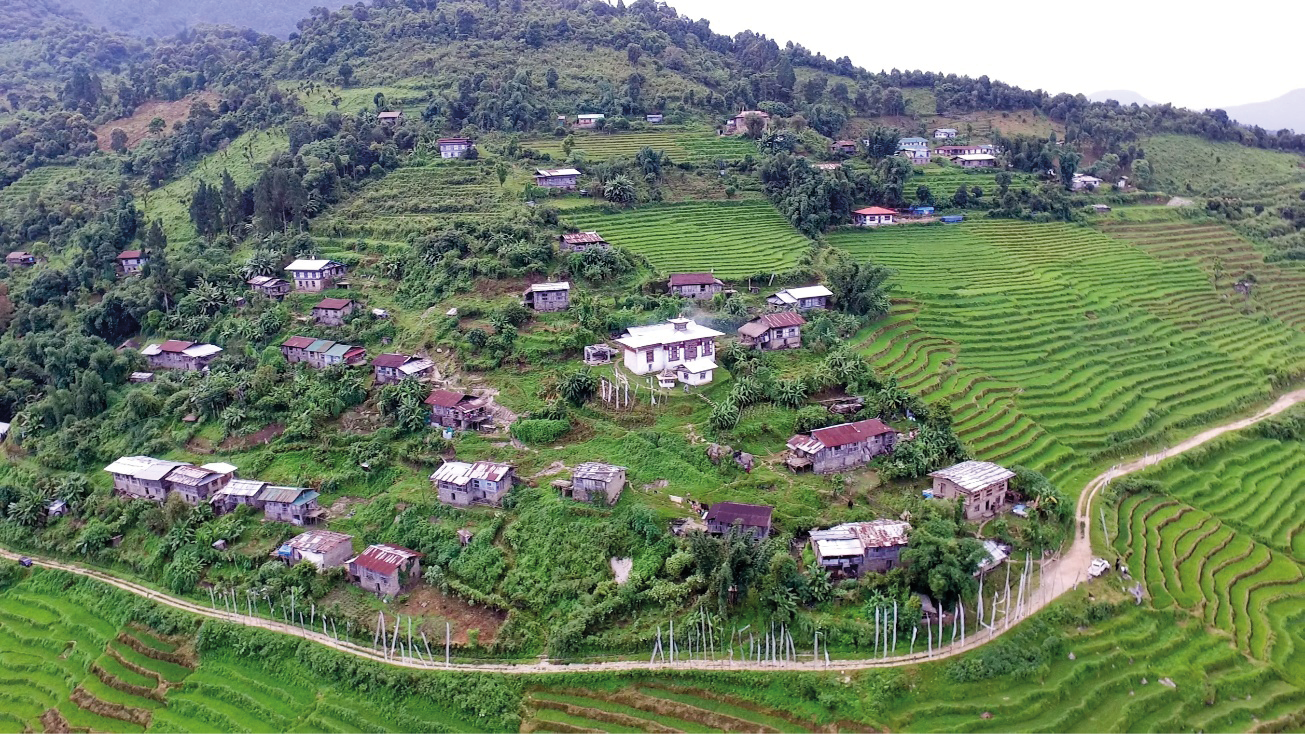
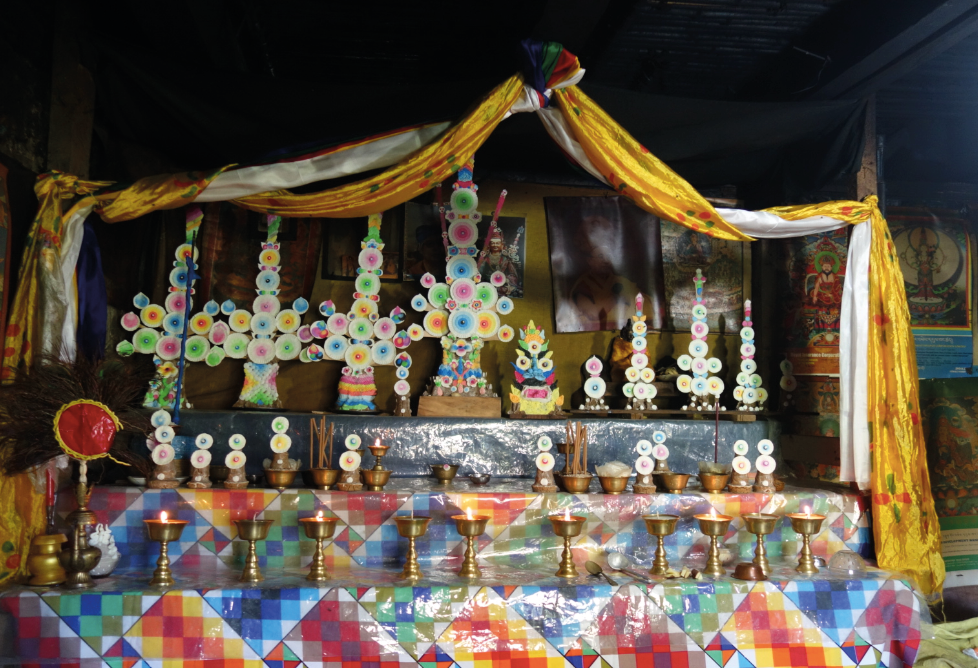
When I first visited Bongo village in South-west Bhutan in late 2017, I was immediately struck by its elaborate Buddhist material culture (Figure 1). At the heart of the village stood a temple richly adorned with impressive statues and ritual paraphernalia, collectively referred to as sku srung thugs rten,1 or ‘supports for Buddhist practice’ (see Maki 2017). This stood in glaring contrast to the modest temple of my village in Central-west Bhutan, where ritual life was far less ostentatious and devoid of such grandeur. Bongo’s religious infrastructure appeared to be not only materially impressive, but also organisationally sophisticated. The village had its own resident lama (bla ma) appointed by the district monastic body and a cadre of locally trained Buddhist priests (called chos pa).2 As a child, I recall how difficult it was for families in my village to mobilise monks from the district monastery for annual rituals, a logistical and financial burden that Bongo residents did not face due to the ready supply of local priests. The villagers also attributed great antiquity to their temple and took pride in the belief that their temple was very old and sacred. Such a claim was largely absent in my home village, where the temple’s state of disrepair could not have supported such a claim.
Over the course of my year-long stay (2017–2018) in the village, during which I conducted ethnographic research on its ritual culture for my Ph.D. dissertation, it became clear to me that this grand Buddhist material and ritual culture was of fairly recent provenance, despite the ascription of antiquity by its community members (see Chophel 2020 for a fuller account of the two ethnographies drawn upon in this article). Inspired by the social theorist and philosopher Zygmunt Bauman’s (2004) notion of ‘wasted lives’, this article examines the social transformations that fostered the community’s enthusiastic embrace of Buddhist institutions and practices while simultaneously displacing older ritual traditions, redirecting scarce resources and diminishing the value attached to certain lives and livelihoods. For some villagers like old pastoralists, ritualists and others in vulnerable positions, these changes were experienced so acutely that they likened their own lives to forms of waste. Drawing on two ethnographic accounts, I show how the emergence of a new Buddhist moral economy rendered pastoral livelihoods increasingly redundant while symbolically and materially laying to waste the local ritual traditions that had long sustained them. These transformations had profound consequences for those whose social worlds were reordered. The concentration of labour and material resources in the construction and maintenance of an impressive Buddhist temple and its ritual economy contributed to the impoverishment of some of the village’s most vulnerable households. At the same time, a number of discerning and nonconforming villagers started critiquing the scale of ritual expenditure, arguing that such conspicuous religious consumption generated excess and waste in ways that contradicted the Buddhist ideal of moderation.
Through this ethnographic case of Bongo, this article shows how societies undergoing paradigmatic shifts grapple with waste both as a tangible material concern and as a discursive tool for understanding and managing social change. I examine how Buddhist ritual expansion, driven by affluence and ‘prestige-oriented consumption’, simultaneously produces and conceals waste, not only materially but also morally and socially, by activating fertile imaginaries of waste. In doing this, the article seeks to contribute to the study of waste in contemporary Buddhist societies. It asks: How does Buddhism precipitate a waste crisis within its institutional and communal practices? In what ways does Buddhism influence the economic priorities of the community? To what extent does the community’s growing affluence shape Buddhist practices? And how are such transformations experienced by those most affected? Finally, how are these changes voiced, moralised or resisted through everyday language?
To answer these questions, I engage with the interdisciplinary field of Discard Studies and particularly its semantic turn (McKee 2015, Wang 2019, Thurlow 2022, Reno 2022), which conceptualises waste as a product of discursive categorisation – a label applied through language, morality and hierarchy. This literature demonstrates that waste is not self-evident but constructed through acts of naming, sorting and differentiation. I also engage with Bauman’s (2004) notion of ‘wasted lives’, which are produced through formal systems of exclusion: economic, bureaucratic and legal. Expanding this framework, my ethnography focuses on how these formal systems interact with the everyday, informal techniques of exclusion – the moral semantics through which people, practices and things are rendered expendable. I argue that waste in the Bhutanese Buddhist context must be understood not only as a material residue but also as a moral and linguistic heuristic – a framework through which people negotiate shifting social, religious and economic realities. Attending to how waste is talked about – how it is named, moralised or sidelined – offers a critical lens for understanding the disorientation that accompanies rapid socio-religious change.
This article is organised into three sections. I begin with a conceptual discussion of waste and its analytical value for my ethnography – from Bauman’s (2004) conception of modernity’s human waste to the linguistic and moral perspectives developed within Discard Studies. I then show how these frameworks resonate ethnographically in Bongo, where older pastoralists and ritualists experience their lifeworlds and practices as wasted under the new Buddhist moral economy. These ‘wasted lives’ are not simply metaphors but lived conditions of redundancy in which people find themselves rendered obsolete by changing social values and practices. Finally, I turn to the community’s own semantics of waste, the connotative metaphors and denotative speech acts through which villagers diagnose, rationalise or resist these transformations and ambiguities.
When I began fieldwork in Bongo, waste and excess did not immediately strike me as Buddhist concerns. Although ritual leftovers, discarded offerings and lavish feasts were ubiquitous, I initially regarded them as byproducts of ritual life rather than as part of a Buddhist problematic. Only later, while working on the WASTE project, which studied waste in Buddhist communities (see the introduction to this special collection), did I begin to see these materials and their discursive lives as consequential. This belated recognition highlights a central insight of Discard Studies. Waste is not self-evident but must be made visible through ethnographic attention under diverse socio-political conditions. As Catherine Alexander and Patrick O’Hare (2023) note, wastes become visible or invisible through classification regimes in which they are categorised by someone for some purpose and have political and material consequences. Waste, then, is a moral project. As Crispin Thurlow (2022) argues, waste is not simply metaphorical but a central register through which people navigate social, moral and material life. It names what is excessive, inappropriate or dangerous. Trine Brox (2023) extends this argument through the paired ideas of ‘waste trajectories’ (how waste is handled and where it ends up) and ‘waste imaginaries’ (our moral and affective beliefs about belonging, order and relation).
My ethnography concerns pastoralists and ritualists whose livelihoods have become superfluous under new religious and economic orders. Their displacement resonates with Bauman’s (2004) notion of ‘wasted lives’. Through his analysis of the design of socio-economic structures, the problem of the excess of certain population groups, the global spread of these populations and the modern culture of excess and waste, he argues that modernity’s rational order-making – through bureaucratic governance, economic planning, urban development and other management techniques – produces its own forms of disorder and redundancy. For him, redundancy is not just poverty but non-relationality, a condition of being unneeded, uncounted and unincorporable. The concept of wasted lives thus captures modernity’s human surplus: refugees, the unemployed, homeless, Indigenous and other people rendered disposable by global systems of production and governance. Bauman’s insight that large-scale structural transformations produce redundancy as an intrinsic consequence of their design provides a valuable lens for understanding how similar processes have reshaped livelihoods and social value in Bongo. While Bauman’s (2004) metaphor of waste and exclusion is analytically generative, it is also conceptually and ethically fraught. I therefore treat Bauman’s framework as simply a heuristic, drawing on it to illuminate the experiences of Bongo’s pastoralists while also showing, throughout this article, where their trajectories diverge from his sometimes cynical prognosis of structural change.
Such caution against the indiscriminate use of waste as an analytic is also raised by Max Liboiron and Josh Lepawsky (2022) who warn against collapsing all forms of discarding, whether recycling or genocide, into a single moral logic of ‘getting rid’ of the undesirables. Although both involve segregation and purification, conflating them as equivalent obscures their distinct historical, political and moral contexts. The sorting of recyclables and the annihilation of people are not comparable because each emerges from different systems of power and meaning. Liboiron and Lepawsky, therefore, insist on distinguishing between the ethics of cleanup (management, separation and order) and the ethics of purification (totalising erasure and exclusion). This critique highlights a key flaw in Bauman’s universalising, Douglasian treatment of waste as a byproduct of modernity’s purification process. His metaphor of wasted lives flattens the diverse moral economies and cosmologies through which waste acquires meaning. In places like Bongo, where notions of waste intertwine with Buddhist and indigenous cosmologies, ritual economies and hierarchies of merit, discarding is not simply about the elimination of the redundant but also about situated negotiations of purity, morality, value and resources. Following Liboiron and Lepawsky, I therefore extend Bauman’s metaphor by grounding it in the ethnographic and cosmological specificities of Bongo, positing waste as a meaningful and culturally-mediated category rather than a universal condition of redundancy produced by modernity.
Lucy Bell (2018) similarly calls for extending Bauman’s analysis beyond the frameworks of Western modernity and Enlightenment rationality to include alternative waste regimes and imaginaries in the Global South. Drawing on Carol Wolkowitz (2007), Bell argues that, rather than treating dirt and waste primarily as symbolic construction of dirt in culture, we must examine how power relations, social strategies and material constraints shape lived experiences of exclusion and impurity. In this view, waste is not only a metaphor for marginality but a condition produced through unequal access to economic resources and ritual authority. Exclusion operates not only through formal state mechanisms but also through everyday moral and linguistic practices. In Bhutanese contexts, such dynamics are expressed through subtle ritual and discursive acts, classifications, metaphors and speech that delineate who belongs and who is rendered out of place within shifting moral and religious economies.
Attending to how people talk about waste thus reveals how it is socially and morally produced. This article engages with interdisciplinary approaches to language and waste, showing how semantics both reflect and shape imaginaries of societal transformation. Thurlow (2022: 389) describes waste as a ‘register of being’, emphasising that language does not merely represent but creates waste through descriptive and classificatory power. Joshua Reno (2022: 4) similarly argues that waste-making is a moral project rooted in cultural notions of taboo, dirt and personhood, noting that ‘waste situations generate specific linguistic genres or registers of discourse’. In other words, language can create waste and waste, in turn, generates new speech genres.
Drawing on what Reno (2022) calls the ‘sociolinguistics of waste’, I examine how, in moments of social disorientation, waste semantics become a moralising and classificatory tool. Semantics, which is the study of how words, phrases and sentences convey meaning, provides a method for analysing how waste language encodes cultural values, hierarchies and systems of classification. I attend to both the denotative meanings (literal or referential) and connotative meanings (contextual, moral and affective). As someone not trained in formal linguistic techniques, I approach semantics ethnographically, focusing on how my interlocutors use language to make sense of changing worlds. I distinguish between two interrelated modes of waste semantics in Bongo, namely waste metaphors and speech acts of waste. The former are connotative, idiomatic and metaphorical expressions used to make sense of moral and material disorder – for example, the imagery of empty villages resulting from unmanaged societal excesses. The latter are denotative, discursive and performative acts that classify, marginalise or moralise people and practices – for example, when an old pastoralist is called a waste of life and blamed for being out of tune with societal change. Hence, people can employ waste metaphors and speech acts both separately and simultaneously for the purpose of moralising and rationalising the Buddhist ritual economy.
In terms of waste metaphors in Bongo, waste is seen as an existential concern. Villagers fear that unmanaged wastefulness could lead to the wasting away of lives (mi tshe bar stong), households (gung stong), villages (gyus stong) and even the country (rgyal stong). In Bongo, the phrase stong (the state of being empty) resonates with the etymology of the word ‘waste’, which has been traced by Kevin Lynch (1990: 146): ‘Waste comes from the Latin vastus, meaning unoccupied or desolate, akin to the Latin vanus (empty or vain), and to the Sanskrit word for wanting or deficient [sunyata]’. Thus, waste metaphors connotatively articulate moral sensibilities attuned to both material and symbolic excess and their devastating consequences. Waste can occur as a noun (phyags snyigs – rubbish; rag ro – discard), verb (chud zad gtang ni – to let something go to waste; ’phro brlag gtang ni – to be wasteful) and adjective (mi tshe bar stong – a wasted life; tshad dang ’gal – disproportionate or wasteful). Apart from describing the state of the community, these waste idioms and metaphors also instruct moral behaviour, shaping what people value, avoid or preserve.
Complementing such waste metaphors are the speech acts of waste – discursive practices that classify and marginalise people through moralised language. Emily McKee’s (2015) analysis of ‘trash talk’ in Israel shows how speech acts frame certain populations as inherently disorderly and dirty, hence legitimising their exclusion. To call something or someone ‘waste’ is never neutral; therefore, a speech act involves moral labour that encodes moral hierarchies and regimes of value and waste. Competence in such regimes becomes a form of symbolic capital. In Bongo, similar discursive dynamics operate, such as talking down through moralised language those seen as clinging to outdated livelihood and ritual practices. Such trash talks have the effect of normalising marginalisation, demonstrating how waste discourse enacts social sorting.
In analysing Bongo’s moral economy of waste, I therefore draw on both metaphors of waste (expressions or imaginaries) and speech acts of waste (performative classifications). This dual attention to material and discursive waste extends Discard Studies beyond the analysis of garbage into symbolic and ritual domains. I argue that wastefulness is no longer external to Buddhist practice but increasingly internal to it, manifested through ritual consumption, institutional expansion and moral classification. In this sense, I take up Liboiron and Lepawsky’s (2022: 3) call for a ‘broad and systematic approach’ to valuation and disposability. Waste is not only what is thrown away but also what is rendered socially or spiritually obsolete, with profound consequences for those so designated. In Bongo, institutional Buddhism has displaced older pastoral and ritual traditions, producing a sense of moral ‘wasting’ and existential anxiety (mi tshe bar stong) among those whose knowledge and practices no longer fit within dominant religious economies. The fear of becoming ‘trash-in-waiting’ (Spelman 2016: 4), or what Bauman (2004: 97) calls a ‘spectre of redundancy’, is pervasive in Bongo.
The ethnographic cases that follow – the displaced herder and the overburdened ritual patrons – illustrate how waste, both material and imaginary, participates in the making and unmaking of Buddhist lifeworlds. However, these dynamics are not unique to Bongo. Across Buddhist societies, institutional Buddhism increasingly intersects with the new consumeristic political economy in ways that challenge its ascetic ideals. Studies of Tibetan and Himalayan communities show how monastic institutions subordinate local ritual specialists, producing asymmetrical religious economies (Chophel, Gerke and Thinley 2025). Katia Buffetrille (2019) calls this process ‘Buddhicisation’, where the forces of modernisation manifest not only through the developmental state but also through the institutionalisation of Buddhism as a moral and material order. Apart from its characteristic secular elements like public infrastructure and monetised economy, modernity here entrenches Buddhist principles and institutions into different aspects of people’s lives.3 Sherry Ortner (1995) calls such phenomena in the Himalayas ‘religious upgrading’, whereby community elites incorporate Buddhist doctrinal and institutional practices into community lives.
Contemporary Buddhism is also deeply enmeshed in capitalist infrastructures. Across Asia, prosperity cultures transform merit into social and economic capital (Brox 2022). Jane Caple (2022) terms such dynamics as ‘prestige-oriented consumption’, where lay patrons compete to fund grand monasteries, a practice amplified by state developmentalism and market economies (Jixiancairang 2018, Brox 2023). Such investments deepen class divides and impose unsustainable moral and financial pressures on local communities. My ethnography contributes to this emerging field by examining how villagers in Bongo confront the contradictions of Buddhist modernity, of moderation and excesses, through language. In the ethnographic cases that follow, waste metaphors and speech acts reveal the moral dimensions of material change. I argue that these metaphors and speech acts become both classificatory and reflexive; they normalise social order as well as becoming internal mechanisms of social critique.
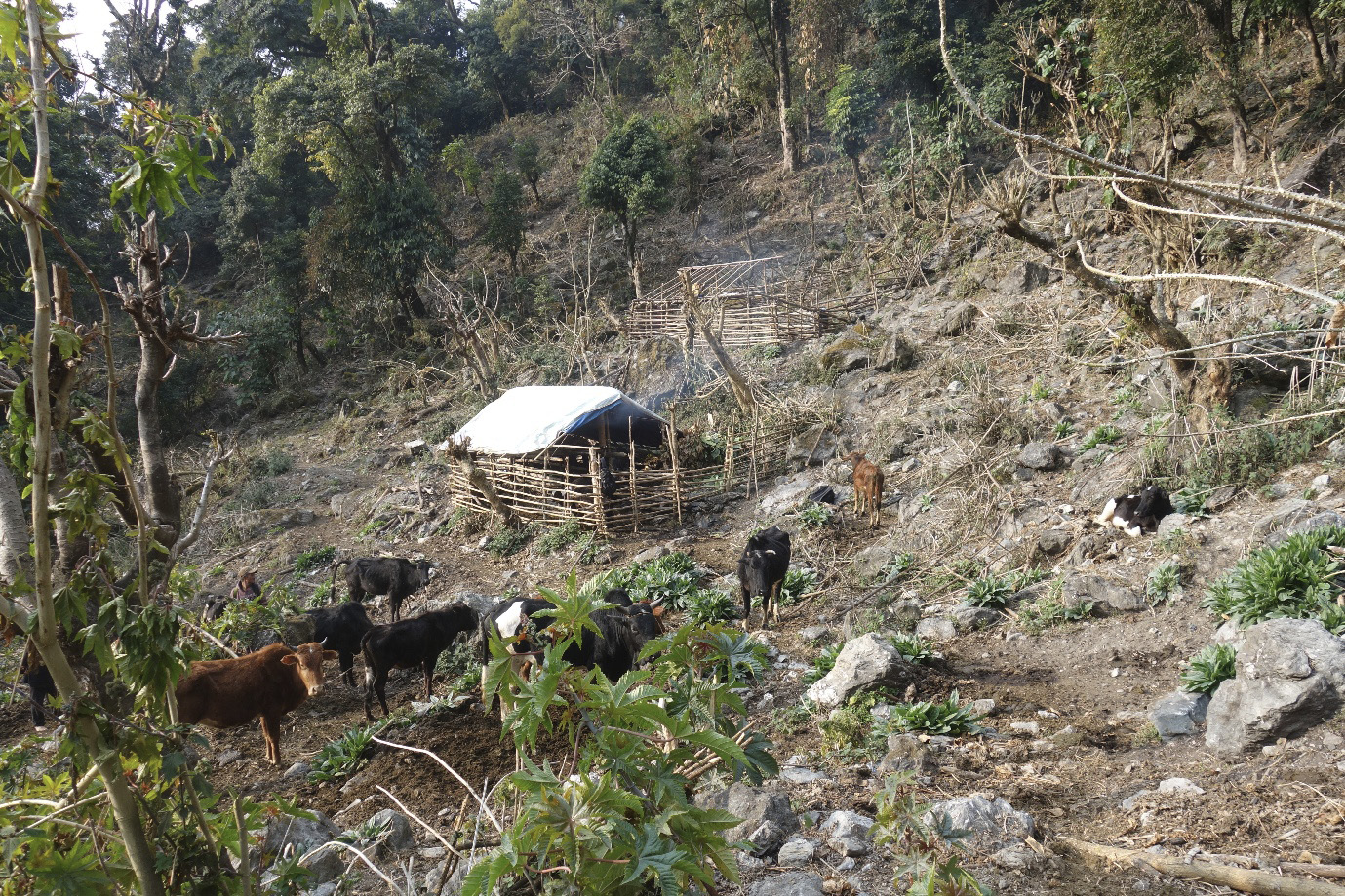
Of all the people I encountered during my fieldwork in Bongo, the person who left the deepest impression on me was Ap Pemba,4 an aging pastoralist widely perceived by his fellow villagers as a maverick – an eccentric man out of tune with the times. When I first met him in February 2018, he was at his cattle station deep in Bongo’s surrounding subtropical forests (Figure 2). Though he spent most of his life away from his community, even well into his sixties, he retained a sharp wit and quick tongue; his speech was peppered with jokes, aphorisms and often self-deprecating reflections. One comment from that first meeting still echoes vividly in my memory, ‘My life has been a waste’ (nga’i mi tshe ’di bar stong yar so yi). At first, the statement struck me as paradoxical. Ap Pemba was seemingly self-sufficient, deeply attuned to the rhythms of his herd and the forest and embodied a form of rugged dignity. However, his remark hinted at a more profound register of value, which was a moral and existential reckoning with obsolescence.
To understand Ap Pemba’s sense of being ‘wasted’ is to understand how entire ways of life, along with their moral and ritual foundations, can become redundant within new social orders. Reno (2018: 8) invites us to ask, ‘waste in what sense’? Reno uses a tripartite framework of what he calls the ‘senses of waste’ – ecological (organic discard or decay), utilitarian (industrial by-product) and moral-political (symbolic classification tied to taboo and exclusion). This tripartite model finds resonance in Bongo, where waste operates primarily as a moral-political category that organises belonging, value and personhood. In Ap Pemba’s case, waste is not literal discard or residue but a moral-political state of redundancy, a livelihood and personhood rendered superfluous to the community’s emerging economic and religious orders. To call one’s life ‘a waste’ in this sense is not to confess a personal failure but to register displacement – to inhabit a life that no longer fits one’s new moral economy.
To gain a better understanding of Ap Pemba’s current condition, we must turn to the geography and history of his community. Bongo sits in Bhutan’s southwestern foothills near the border with India, a region historically imagined as a periphery, both geographically and culturally. In the Bhutanese historical narratives, such frontier zones were long referred to as mtha’ ’khob, literally meaning ‘uncivilised borderlands’. As recently as 2005, articles were appearing in the national newspaper which documented the extensive prevalence of animal sacrificial rituals in Bongo (Wangchuk 2005). Hence, labels like mtha’ ’khob function much like what McKee (2015) describes as ‘trash talk’, becoming speech acts that denotatively conflate people and landscapes with disorder and moral deficiency. Thus, Buddhist trash talk rationalises and legitimises the reform or exclusion of the mtha’ ’khob. Over time, such denotative and classificatory language seeps into local consciousness. Elders in Bongo often speak with embarrassment about pre-Buddhist rituals involving animal sacrifice or spirit propitiation, describing them as sdig pa’i bya ba (sinful deeds). These moralised framings do not simply describe change; they become self-fulfilling prophecies, producing the very hierarchies they name.
When I asked older residents about past rituals, they often recounted them with ambivalence. ‘Whenever there was a sickness in the village, we used to sacrifice a rooster because the Buddha’s teachings were not available to us as they are now’, one old man told me. Such a statement performs a discursive distancing, an attempt to situate oneself on the right side of moral progress by disavowing older practices. Through such discourse, the entire belief system, which was once integral to the community’s understanding of reciprocity and protection, is reframed as a primitive waste in need of cleansing by Buddhist reform.
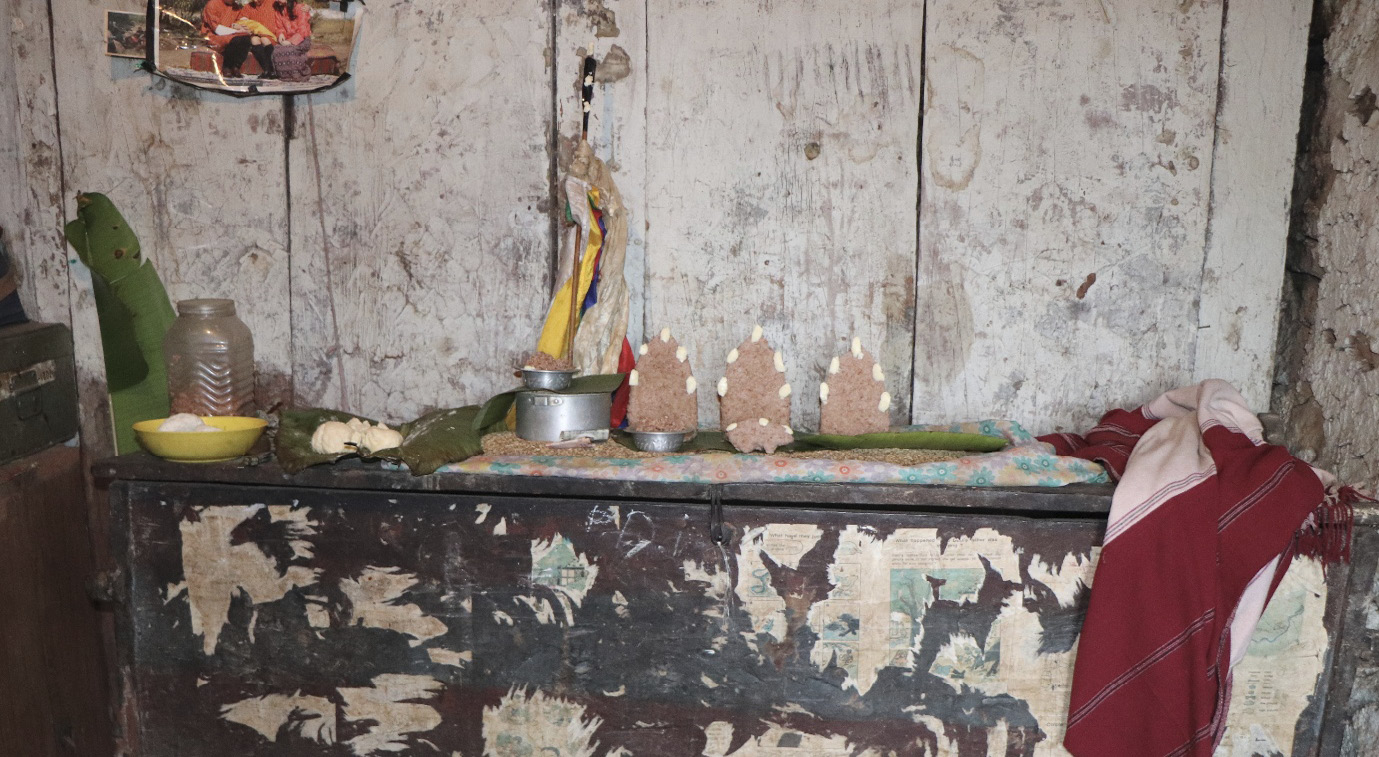
Before the rise of settled agriculture a few decades earlier, Bongo’s primary livelihood was cattle herding, supplemented by porterage for the state and small-scale trade across the southern border. Pastoralism shaped not only the economy but also the moral and cosmological order. The centrality of livestock in Himalayan economies has also been noted by Nancy Levine (2019: 161–62), who argued that ‘herd management [together with other situated agricultural practices] provided a kind of economic infrastructure for cultural beliefs and values’. The landscape of Bongo was alive with territorial deities (yul lha), subterranean spirits (klu) and martial protectors (btsan) who granted fertility, fortune and protection (cf. Pommaret 2004). The rituals sustaining these relationships were performed by local ritualists whose knowledge linked the social and ecological worlds through offerings and invocations (Figure 3).
Among the ritualists I met were Ap Penjor, an officiant of the klu rituals, and Ap Naphey, officiant of the dgra lha (warrior deity) rituals. Both were elderly and their practices were reduced to a handful of annual rites performed for a few remaining believers. Their rituals represent an old order with offerings crafted from flour, butter and milk, which are products of the pastoral economy. These offerings were displayed on stone pedestals in a corner of the house or outdoors, in contrast to Buddhist rituals, which were performed in the household’s grand altar. While oral accounts suggest that animal sacrifices were once common, by the time of my fieldwork in 2018, such offerings had been replaced entirely by vegetarian substitutes, a shift prompted by Buddhist critiques of animal sacrifice and ritual impurity. However, each ritual that I witnessed still served as an archive of communal history. Ritual invocations traced the deities’ journeys through networks of near and far mountains and valleys, reaffirming kinship and belonging through memorialised place names and ancestral ties. As Erik Moran and Catherine Warner (2016) described in the context of Himalayan rituals, such ritual geographies embody ‘social memory’, ensuring the intergenerational transmission of values, cosmology and belonging. To lose them is not merely to lose a ritual repertoire, but to lose an entire language of relating to the land and its more-than-human lifeworld.
By the time of my fieldwork in 2018, Bongo was no longer the marginal, forest-fringed settlement it once was. With around fifty households and over 500 residents, the village had a primary school, a health post, farm roads and mobile connectivity. It had also long benefited from access to formal education, being one of the first villages in the country to receive a modern school. This granted some villagers early entry into the bureaucratic and economic circuits of the Bhutanese state. These developments in turn reoriented local aspirations. Government employment, formal education and cash cropping became the new hallmarks of success and once central livelihoods like herding had become anachronistic, associated with material poverty, backwardness and ritual impurities.
Pastoralism had, by the time of my fieldwork, become economically untenable. Forest regulations restricted grazing lands because local cattle breeds were classified as unsuitable for the new animal husbandry practices. Further, new cash crops like cardamom brought the promise of higher returns. Paddy cultivation, once uncommon in this region, spread as households sought to align themselves with the symbolic prestige of rice, the food of elites (Penjore 2011). Both these material and symbolic shifts required families to redirect labour from migratory herding to settled agriculture, rendering the pastoral livelihood redundant. In the idiom of Bongo, someone who resists this shift is labeled as ’chol lo, which denotes him as eccentric, obstinate and foolhardily non-compliant. Apart from being a descriptive term, it carried moral weight. To be ’chol lo is to be misaligned with the moral order of progress. In this sense, herders like Ap Pemba and the ritualists like Ap Penjor and Ap Naphey were doubly marginalised – economically useless and moral-ritually impure, living embodiments of what Reno (2018) calls moral-political waste.
The effects of this moral and economic reordering are thus not merely structural but deeply affective. As the village’s fortunes rose through education, salaried employment and Buddhist merit-making, Ap Pemba’s life became an embodiment of what was being left behind. His once-valued cattle station became a derelict of time. ‘You see, these cows are my companions’, he told me, ‘but now people laugh at them. Who needs cows when everything can be bought in the shops, guilt and labour free?’ His witticism was self-deprecating and tinged with pain. His sense of wasted life was not simply about material loss; it was also about inhabiting a social world in which he was no longer deemed meaningful.
Thurlow (2022), reflecting on the discarding of his deceased father’s belongings, argues that rubbishing not only affects things but also affects the people bound up in those things. The same could be said for Ap Pemba. As the moral landscape of Bongo shifted, the material and symbolic discarding of pastoralism also entailed the emotional and existential discarding of those who embodied it. Waste metaphors, such as wasted life, empty household and worthless cattle, circulated as everyday language through which people sorted moral worth and modern belonging. The transformation from pastoral reciprocity to Buddhist developmentalism does not merely replace one economy with another; it replaces one moral universe with another. Within this universe, merit accrues through monetary donation to temples and not through the reciprocal care of animals, forests and deities. The resulting exclusion is not enforced by state power but enacted through ordinary moral discourse – through hearsay, humour and the semantics of waste.
For Pemba, remaining in the forest with his herd was an act of resistance, a refusal to conform to the new order of value. But it also pitted him against the new world order around him. As younger men left for government jobs or cash-crop farming, he found himself with few social equals. When I asked whether he wished his children would continue herding, he shook his head and said, ‘No, they will have an easier life. Mine is already spent and emptied.’ When Ap Pemba used such expressions of emptiness, he acknowledged that his life had been hollowed out by social change. However, his resignation carried both sorrow and pride. To call his life wasted was, paradoxically, to assert its difference – a way of revealing the cost of modernity while not entirely disavowing it.
The Tibetologist Giuseppe Tucci (1970/1980) argued that Himalayan societies are governed by dpe, ideal types that structure the moral imagination. Hence, when a governing model and its associated metaphors collapse, those who embody them experience existential disorientation. Ap Pemba’s desolation emerges precisely from such a collapse of existing models. The pastoralist as dpe and metaphor of self-sufficiency, resourcefulness, reciprocity and moral uprightness has been replaced by the educated, salaried and modern Buddhist community man. His life is now not only materially precarious, but also semiotically misaligned with the new social language of value and worth.
Bongo’s moral and semantic constructions of waste find strong resonance with Bauman’s (2004) wasted lives. Figures like Ap Pemba, whose ritual and economic roles are rendered obsolete by new moral orders, embody localised forms of redundancy analogous to Bauman’s global outcasts. Where Bauman sees globalisation producing refugees and people experiencing home- and job-lessness, Buddhist modernity and the new moral economy of Bongo have produced ritual and moral outcasts. Instead of being accidental, the ‘wasting’ of Ap Pemba’s livelihood is a local articulation of a similar global process – the moralisation of redundancy under changing systems of value. By pairing Ap Pemba’s case with Bauman’s outcasts, we can see that such marginalisation is not a tragic anomaly, but a part of the systemic and semiotic logic of modernity, and one that reappears across contexts, from European refugees to Bhutanese ritualists. My ethnography therefore contributes to globalising the problem of waste.
This section of my ethnography has sought to demonstrate that the disorientating moral and semantic shifts around waste are not isolated but resonate with modernity’s wider politics of disposability. By attending to the semantic and affective registers through which waste is articulated, particularly as a denotative adjective (as in likening Ap Pemba’s lifeworld to waste), we gain insight into how individuals like Ap Pemba come to embody discarded ways of life. Drawing on the work of Reno (2018), this section explored the moral-political construction of waste. In the next section, I turn to waste as actual material and ritual excesses (Brox 2022) generated by Bongo’s contemporary moral economy, and the social and economic burdens they impose.
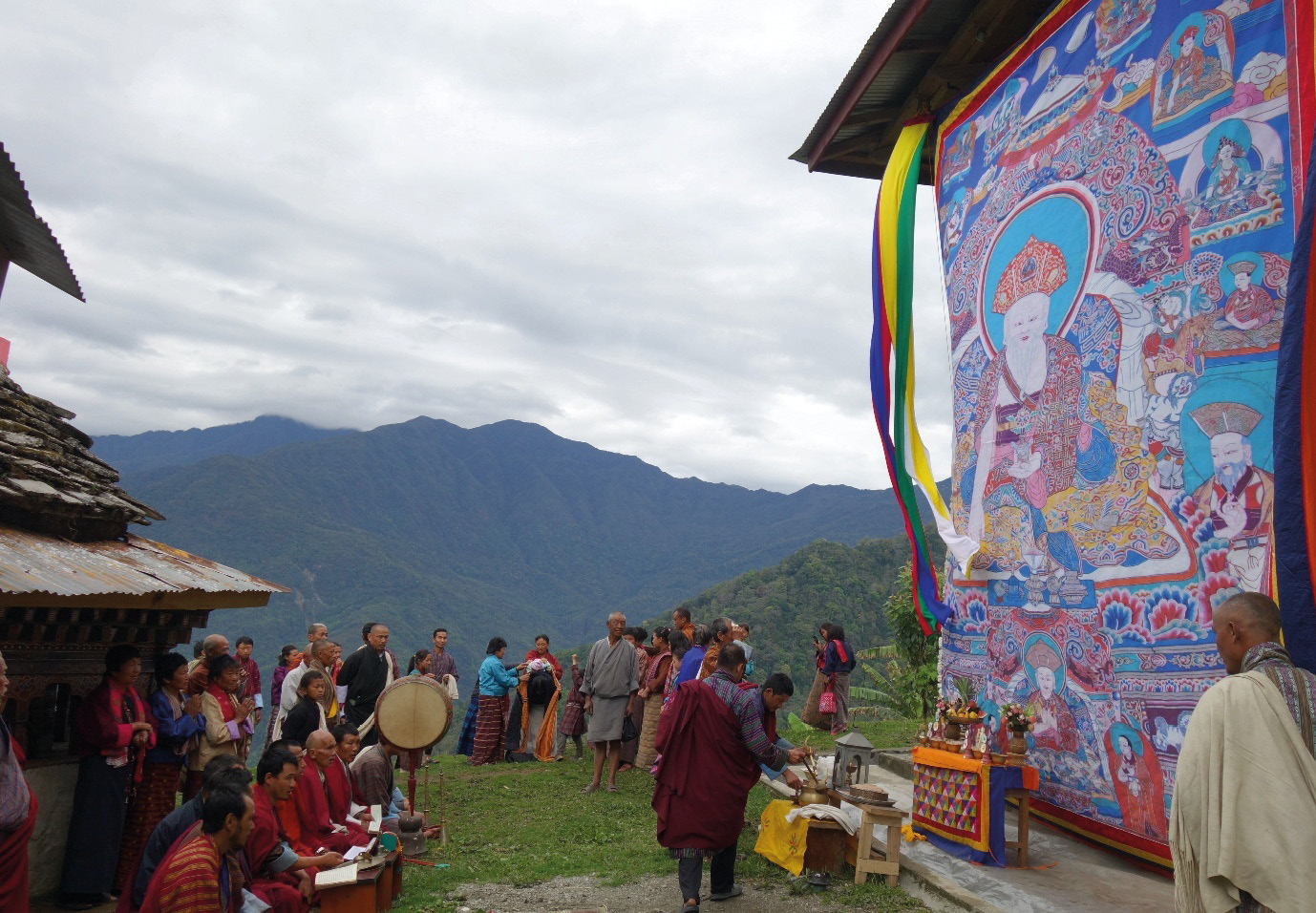
When I was leaving Ap Pemba’s cattle station, his friend, Ap Serpo, was preparing to transport his stock of dairy products to Bongo village. But they were not destined for the market or for household consumption. Instead, they were earmarked for a forthcoming village ritual, one of many events in the village’s ritual calendar (Figure 4). Months of milking, processing and preservation were condensed into just a single bamboo basket, a sight that brought out a stark reality. Traditional livelihoods such as the remnant cattle herding could no longer materially sustain the demands of a contemporary Buddhist moral economy. Once the economic backbone of subsistence and religious life, pastoral practices were now nostalgically preserved but materially inadequate for the community’s new ritual economy.
This disparity between the diminishing productive capacity of subsistence livelihoods and the escalating scale of ritual consumption reflects a deeper transformation in Bongo’s spiritual and economic orientation. At the heart of this transformation stands the village temple, an impressive structure that has come to dominate both the landscape and social imagination of the community. Having undergone material, ritual and organisational expansion over the past four decades, the temple now houses an impressive array of Buddhist artefacts like statues, scriptures, frescoes, tapestries and silverware. The earliest written record, a 1982 catalogue, lists only four annual rituals. A decade later, in 1992, this number had risen to six. By 2018, Bongo’s account book (ma rtsa tho yig) documented eleven annual ceremonies, many of which spanned multiple days and required extensive material resources. Among others, such expansion is evidence of growing religiosity and indexes profound social change. As George van Driem (1994) has described, such catalogues serve as ‘vernacular registers’ – local archives that chart the evolution of communal life. They also document a crucial shift. As Buddhist rituals have multiplied and become increasingly elaborate, the means of provisioning them have transitioned from agrarian and pastoral subsistence to a monetised, consumption-oriented economy. What was once sustained by local farm and forest products is now financed through cash incomes, government salaries and increasing debt.
At the time of my fieldwork, the local Buddhist economy generated new forms of both socio-moral prestige and financial strain. Returning to Reno’s (2018) ‘senses of waste’, we might locate this phenomenon within the domain of utilitarian waste, manifested in surplus, excess and inefficiency of the local economy. However, it also carries the weight of ‘moral-political waste’; the symbolic devaluation of persons and livelihoods under new regimes of value. Brox (2022) offers an important analytic bridge through her theorisation of ‘waste as excess’ in Buddhist economies, where the very pursuit of merit can create a moral ambiguity. She argues that waste is not only about the discarded or the unnecessary, but also about the socially excessive, those expenditures and offerings that threaten to transgress moral and material boundaries. In Bongo, both dimensions were vividly present: the overconsumption of ritual materials and the moral unease surrounding those who could not keep up.
Unlike old monastic institutions in Tibet or other parts of Bhutan, which held land endowments and were sustained by corvée labour (Childs 2004), Bongo’s temple lacked any independent means of support. Its ritual economy depended entirely on contributions (zhal ’debs) from villagers and some recently established endowments (gsar sgrub ma dngyul) to fund respective rituals. As Astrid Hovden (2013) observed in her study of Himalayan monastic institutionalisation, the growing frequency and scale of rituals often reflected both communal prosperity and spiritual ambition, but they could also burden the very communities that sustained them. This paradox was palpable in Bongo, where religious generosity and material exhaustion existed together.
One major ritual that I observed in 2018 – a five-day fasting ceremony (smungs gnas) – epitomised this tension. The ritual was co-sponsored by two patrons: Penjor, a government mechanic living in a nearby town, and Nima, a local builder. They had relatively stable incomes, but the demands of the ritual far exceeded what the local agriculture could provide. Nearly all provisions like grains, vegetables, oil, dairy and even alcoholic beverages had to be purchased from the nearby town. Twelve priests and over two dozen lay congregants required lodging, meals and honorariums throughout the course of the ritual. Moreover, substantial ritual offerings from grains, dairy and other exotic products were made throughout the ceremonies (Figure 5). Some of these offerings were consumed later by people but most were ritually disposed of.
The community had established a ritual endowment fund, which was meant to cover all the expenses. However, the interest that the fund generated was invariably insufficient to cover them. Hence, instead of functioning as a sustainable endowment, the fund operated more like a credit system, compelling future sponsorship to replenish previous deficits. When a sponsor failed to return the principal fund, they were compelled to take on another round of sponsorship. Penjor experienced this cycle firsthand. Unable to return the endowment’s capital after the 2018 ceremony, he was compelled to serve as the sole sponsor for the following year. This obligation coincided with his planned retirement, forcing him to allocate a significant portion of his pension fund towards ritual expenses. Similarly, Chethem, a single mother, found herself entrapped in this ritual economy of devotion and debt. After her son defaulted on a loan from the ritual fund, which was used to purchase a vehicle, the moral burden of repayment shifted to her. Unable to return the capital in full, she was required to sponsor one of the temple’s annual rituals, leading to a form of coerced generosity that preserved the family’s moral standing in the community but brought them material hardship.
In these stories, we witness waste in its most tangible form: offerings that exceed optimal usage, food that is consumed symbolically but discarded materially and capital that circulates inefficiently while burdening the vulnerable. It is clear that these are not incidental byproducts of an escalating ritual life but are constitutive of it. The moral economy in Bongo thus produces multiple layers of waste: utilitarian, moral-political and affective. These extractive dynamics are accompanied by equally complex moral narratives. As Reno (2022: 5) notes, waste economies are shadowed by an ‘ever-present specter of dehumanization’. When ritual obligation overrides personal viability, villagers become caught in what might be called a sacrificial economy. Villagers continue to engage in forms of what John Scanlan (2005: 22) would term ‘dangerous or troubling’ use of resources. Yet the community’s discursive response often deflects the blame through speech acts onto individuals rather than the structures, thereby individualising perceived failures.
Elders frequently invoke aphorisms to discipline perceived excess: ‘Wasting wealth is not the same as giving alms, and indulging a child is not the same as caring parenthood’ (rgyu ’phro brlag btang par sbyin par men / bu lang shor btang par bces phrug men). Such sayings moralise economic exhaustion as personal failure, reframing structural strain as individual improvidence. These speech acts rationalise the ritual economy and moralise waste, where denotative linguistic acts of labelling – wasteful, excessive, disproportionate – classify not only practices but also people. Through this vernacular moral economy, waste becomes a noun, verb and adjective. Furthermore, waste becomes something one can have, make or become, thus acting as a powerful metaphor which alerts people to its potential fallouts. Everyday conversations about ritual spending operate as waste registers – semantic mechanisms that categorise behaviours and values. In Bongo, villagers describe extravagant offerings as tshad dang ma mthun ma (disproportionate) or log spyod (misuse) – idioms that both critique and correct excess. Speech acts thus serve a dual function: they reinforce a collective ethics of moderation while diagnosing the moral anxieties of a community grappling with new forms of religious affluence.
At village meetings, these moral tensions were publicly staged. After the annual communal festival (see Chophel 2020 for details), residents gathered to review the temple’s accounts and recruit sponsors for the following year. Public generosity was lauded and those who pledged large sums were celebrated for their devotion and civic virtue. As Caple (2022) observed in the context of contemporary Tibet, such ceremonies of giving were also competitive arenas where spiritual merit merged with social capital. In Bongo, the same capital logic prevailed. Sponsorship brought prestige, and the inability to sponsor invited embarrassment, creating a social mechanism that ensured generosity even when financial means were limited. While some villagers expressed pride in Bongo’s religious vitality, others viewed the mounting expenditure with unease. Discerning elders often lamented, ‘there is no measure anymore’ (tshad med song), referring to how ritual obligation had overtaken prudence and proportionality. Through these metaphors, we glimpse the community’s internal effort to recalibrate its moral compass – to distinguish generosity from waste and merit from vanity.
As Unni Wikan (1996) reminds us through her study of an ex-nun in Bhutan who experienced her life as a series of ‘falling apart’ under societal stress, ethnography must attend not only to systems of obligation but also to their affective toll. The stories of Penjor and Chethem reveal how ritual economies produced not only material exhaustion but also existential disorientation. Debt and obligation eroded both financial stability and one’s sense of worth and belonging. The very system designed to generate merit and cohesion risked transforming its adherents into residues of a coercive moral order. For native ethnographers in Bhutan like me, documenting these transformations becomes an ethical witnessing of social change and its casualties (see Brox 2026 for a discussion on ethical witnessing).
When seen through a contextual and ethnographic lens, the wastefulness of Bongo’s ritual economy cannot be reduced to simple moral failure or economic mismanagement. It is symptomatic of a broader transformation in Bhutan’s rural worlds, where modern Buddhist practices, developmental aspirations and the pursuit of merit have converged to produce new social anxiety and moral strain. In this context, waste operates simultaneously as substance, symbol and social commentary; dairy and grains withdrawn from household consumption, idioms that chastise and moralise, and lives caught between reverence and redundancy. Thus, studying waste is not merely about identifying what is discarded, but also about understanding what societies choose to value, preserve or sacrifice in the name of the sacred, and the processes through which such choices are materialised. Waste thus becomes a mirror of modern Buddhist economies, reflecting both their vitality and cost.
In Bongo, the convergence of economic and Buddhist modernity has generated a profound moral unease. On the one hand, it has accelerated the erosion of older livelihood traditions and the marginalisation of the people associated with them; on the other, it has encouraged increasingly lavish rituals and debt-financed generosity, provoking anxieties about imbalance, excess and sustainability. This ambivalence has fostered a growing concern that the pursuit of religious merit and new moral values produces not only spiritual benefit but also material waste, moral exhaustion and social exclusion. The ethnography of Bongo’s emerging Buddhist moral economy reveals a central paradox: the very rituals that materialise devotion, accumulate merit and confer social prestige simultaneously contribute to the dismantling of older cultural practices, entrench an extractive system of religious endowments, and undermine the livelihoods and solidarities that once anchored community life.
Within this tension, waste becomes an incisive analytic. It is not merely an aftermath of systemic change, ritual expenditure or economic exchange but a register of moral disorder, a language through which people articulate fatigue, critique excess and make sense of transformation. Waste semantics in Bongo perform both social critique and moral policing; they simultaneously articulate discontent and reinforce hierarchy in a delicate balance that some fail to strike. However, the moral critique embedded in these discourses is rarely directed at institutions. Blame is often redirected toward individuals, thereby individualising and pathologising structural issues.
Bringing Bauman’s (2004) ‘wasted lives’ into dialogue with Discard Studies has helped illuminate these dynamics. Bauman’s insight that modern systems produce their own human surplus resonates deeply in Bongo, where figures like Ap Pemba embody local forms of redundancy. However, unlike Bauman’s global outcasts, who were rendered invisible by capitalistic and bureaucratic systems, Bongo’s wasted lives remain morally legible. While Bauman (2004: 86) claims that modern outcasts are, ‘once rejected, forever rejected’, misfits in Bongo are discussed, pitied and often rehabilitated within local semantics of waste that make visible the human costs of change. In this sense, Bongo’s structures both reproduce and contest the disposability of lives.
Waste is not just a structural residue of modernity in Bongo’s Buddhist life, but a moral compass embedded in it, an outcome of the reorganisation of value, virtue and proportion. By grounding Bauman’s metaphor of ‘wasted lives’ in the specific context of Bongo, this ethnography shows that wasting is not simply an impersonal byproduct of secular modernity, but a moral and ritual recalibration that reshapes how people understand worth, balance and belonging. Waste arises when the economies of merit and generosity exceed what is materially or socially sustainable. Therefore, my ethnography localises and moralises Bauman’s metaphor, illustrating that wasted lives are not only produced by modern systems but also actively interpreted, debated and at times redeemed through vernacular ethics. Buddhicisation and ritual purification remain a potent force in the community. But people who appeared to be ‘wasted’ retain forms of agency through moral language, witticism and subtle acts of resistance that challenge the inevitability of being marginalised and wasted.
For a Bhutanese ethnographer, these moral languages of waste are not abstract data but a compelling call for reflection and action. Having grown up within similar moral worlds, I recognise in them an ethical labour of interpretation, the effort to name imbalance without abandoning their moral economies. Talking about waste becomes a mode of reckoning with change, a way of making sense of what is being lost and what might yet be redeemed. Waste ethnography, as proposed by Brox (2026), calls for an ethical mode of witnessing, as also discussed by Gay Hawkins (2006) who called for imagining more sustainable and just ways of managing waste materials and societal fallouts. It can allow us to attend to the moral labour through which people navigate disorientation and the loss of meaning, as well as hope; to see critique not only as an academic inquiry but also as practical solidarity with people who are at the margins of society and whose lives are in danger of being wasted.
What is at stake, then, is not only the fate of mavericks like Ap Pemba or debt-burdened patrons such as Chethem, but the sustainability of a moral economy increasingly stretched between devotion and depletion. Waste in Bongo reveals both the vitality and the vulnerability of Buddhist modernity. More broadly, the study of waste in Bongo points to an ethical and planetary lesson. The global crisis of waste – ecological, economic and moral – cannot be solved by better technology and management efficiency alone. It demands a rethinking of proportion, obligation and restraint. Bongo’s semantics of waste, expressed in lament, witticism and moral counsel, remind us that meaningful critique can emerge from within everyday language as much as from academic theories of waste. This ethnography is both a warning to live within the limitation of resources and an invitation to reimagine devotion and sustainability within Buddhist and other forms of modernity.
Dendup Chophel
Marie Skłodowska-Curie Actions Fellow
Department of Cross-Cultural and Regional Studies
University of Copenhagen
Karen Blixens Plads 8, Building 10,
DK-2300 Copenhagen S
https://orcid.org/0000-0001-9834-6971
I am grateful to the leaders and people of Bongo for inviting me into their community and granting me gracious permission to document their life stories. The fieldwork for this article was conducted during my doctoral studies at The Australian National University where I received two separate scholarships; ‘ANU HDR Fee Merit Scholarship (HFMS) 2017’ (for course fees) and ‘ANU University Research Scholarships (URS) 2017’ (for stipends). This article was conceived and written during my postdoctoral fellowship on the project ‘Waste: Consumption and Buddhism in the Age of Waste’, which is supported by the Velux Foundation (grant number: 34934) at the Department of Cross-Cultural and Regional Studies, University of Copenhagen. I would like to thank Paulina Kolata, Jane Caple, Sierra Humbert and Erica Baffelli for commenting on earlier drafts of this article. I would like to specifically thank Trine Brox and Jørn Borup for generously reviewing and editing several drafts of my article, and Elizabeth Williams Ørberg for her meticulous copyediting.
Alexander, C. and P. O’Hare. 2023. ‘Waste and its disguises: Technologies of (un)knowing’. Ethnos 88 (3): 419–43. https://doi.org/10.1080/00141844.2020.1796734
Bauman, Z. 2004. Wasted Lives: Modernity and its Outcasts. Cambridge, England: Polity Press.
Bell, L. 2018. ‘Place, people and processes in waste theory: A global South critique’. Cultural Studies 33 (1): 98–121. https://doi.org/10.1080/09502386.2017.1420810
Brox, T. 2022. ‘Introduction: A framework for studying Buddhism and waste’. In T. Brox and E. Williams-Oerberg (eds), Buddhism and Waste: The Excess, Discard and Afterlife of Buddhist Consumption, pp. 1–30. London, New York and Dublin: Bloomsbury Academic. https://doi.org/10.5040/9781350195561.0006
Brox, T. 2023. ‘Tibetan Buddhism in the age of waste’. Journal of the American Academy of Religion 91 (4): 820–35. https://doi.org/10.1093/jaarel/lfae041
Brox, T. 2026. ‘Waste Ethnographies: An Introduction’, Worldwide Waste 9: 15–25. https://doi.org/0.3197/whpww.63857928646682
Buffetrille, K. 2019. ‘The increasing visibility of the Tibetan “borderlands”’. In S. Gros (ed.), Frontier Tibet: Patterns of Change in the Sino-Tibetan Borderlands, pp. 85–113. Amsterdam: Amsterdam University Press. https://doi.org/10.5117/9789463728713-2
Caple, J. 2022. ‘Generosity’s limits: Buddhist excess and waste in Northeast Tibet’. In T. Brox and E. Williams-Oerberg (eds), Buddhism and Waste: The Excess, Discard and Afterlife of Buddhist Consumption, pp. 31–52. London, New York and Dublin: Bloomsbury Academic. https://doi.org/10.5040/9781350195561.0007
Childs, G. 2004. ‘Culture change in the name of cultural preservation’. Himalaya: The Journal of the Association for Nepal and Himalayan Studies 24 (1): 31–42.
Chophel, D. 2020. The Picnic Makers of Bongo: Developing Rituals and Ritualising Developments in a Transitioning Frontier Bhutanese Community. Ph.D. thesis, The Australian National University. https://doi.org/10.25911/QV2E-J324
Chophel, D., B. Gerke and S. Thinley. 2025. ‘Practices laid to waste: Narratives of healing and ritual transformation in a Bhutanese village’. Copenhagen Journal of Asian Studies. https://doi.org/10.22439/cjas.v43i1.7628
Hawkins, G. 2006. The Ethics of Waste: How We Relate to Rubbish. Lanham, Boulder, New York, Toronto, Oxford: Rowman & Littlefield Publishers, Inc. https://doi.org/10.5040/9798216401278
Hovden, A. 2013. ‘Who were the sponsors? Reflections on recruitment and ritual economy in three Himalayan village monasteries’. In C. Ramble, P. Schweiger and A. Travers (eds). Tibetans who Escaped the Historian’s Net: Studies in the Social History of Tibetan Societies, pp. 209–30. Katmandu: Vajra Books.
Jixiancairang. 2018. Tibetan Pre-Death Ritual (gson chos): A Practice of Merit Accumulation in a Tibetan Community in Reb gong, Amdo. Ph.D. Thesis, University of Oslo.
Levine, N.E. 2019. ‘A multifaceted interdependence: Tibetan pastoralists and their animals’. Études mongoles et ibériennes, centrasiatiques et tibétaines 50: 1–20. https://doi.org/10.4000/emscat.3822
Liboiron, M. and J. Lepawsky. 2022. Discard Studies: Wasting, Systems and Power. Cambridge, MA, and London: The MIT Press. https://doi.org/10.7551/mitpress/12442.001.0001
Lopez, D.S., Jr (ed.) 2002. A Modern Buddhist Bible: Essential Readings from East and West. Boston, MA: Beacon Press.
Lynch, K. 1990. Wasting Away. San Francisco: Sierra Club Books.
Maki, A. 2017. ‘A visual transmission: Bhutanese arts and artists from the 17th–19th centuries’. In K. Ura, D. Penjore and C. Dem (eds), Mandala of the 21st Century Perspectives: Proceedings of the International Conference on Tradition and Innovation in Vajrayana Buddhism, pp. 102–21. Thimphu, Bhutan: The Centre for Bhutan Studies.
McKee, E. 2015. ‘Trash talk: Interpreting morality and disorder in Negev/Naqab landscapes’. Current Anthropology 56 (5): 733–52. https://doi.org/10.1086/683198
McMahan, D. 2008. The Making of Buddhist Modernism: New York: Oxford University Press. https://doi.org/10.1093/acprof:oso/9780195183276.001.0001
Moran, A. and C. Warner. 2016. ‘Introduction: Charting Himalayan histories’. Himalaya: The Journal of the Association for Nepal and Himalayan Studies 35 (2): 32–40.
Ortner, S.B. 1995. ‘The case of the disappearing shamans, or no individualism, no relationalism’. Ethos: Journal of the Society for Psychological Anthropology 23 (3): 355–390. https://doi.org/10.1525/eth.1995.23.3.02a00040
Penjore, D. 2011. ‘Rows of auspicious seats: The role of bzhugs gral phun sum tshogs pa’i rten ‘brel ritual in the founding of the first Bhutanese state in the 17th Century’. The Journal of Bhutan Studies 24 (Summer): 1–41.
Pommaret, F. 2004. ‘Yul and Yul lha: The territory and its deity in Bhutan’. Bulletin of Tibetology 40 (1): 39–67.
Reno, J. 2018. ‘What is waste?’ Worldwide Waste: Journal of Interdisciplinary Studies 1 (1): 1–10. https://doi.org/10.5334/wwwj.9
Reno, J. 2022. ‘Does waste make language?’. Journal of Sociolinguistics 26 (3): 1–8. https://doi.org/10.1111/josl.12556
Scanlan, J. 2005. On Garbage. London: Reaktion Books.
Spelman, E.V. 2016. Trash Talks: Revelations in the Rubbish. New York: Oxford University Press. https://doi.org/10.1093/acprof:oso/9780190239350.001.0001
Thurlow, C. 2022. ‘Rubbish? Envisioning a sociolinguistics of waste’. Journal of Sociolinguistics 26 (3): 386–403. https://doi.org/10.1111/josl.12559
Tucci, G. 1980 [1970]. The Religions of Tibet (G. Samuel, trans.). Berkeley and Los Angeles: University of California Press.
van Driem, G. 1994. ‘Language policy in Bhutan’. In M. Aris and M. Hutt (eds), Bhutan: Aspects of Culture and Development, pp. 87–106. Kiscadale Asia Research Series No.5. Stirlingshire. Scotland: Paul Strachan-Kiscadale Ltd.
Wang, B. 2019. ‘Sacred trash and personhood: Living in daily waste-management infrastructures in the Eastern Himalayas’. Cross-Currents: East Asian History and Culture Review 30: 101– 119. https://cross-currents.berkeley.edu/e-journal/issue-30/wang
Wangchuk, R. 2005. ‘Bonism and shamanism: An integral part of Bongop culture’. Kuensel, 6 April 2005.
Wikan, U. 1996. ‘The nun’s story: Reflections on an age-old, postmodern dilemma’. American Anthropologist 98 (2): 279–89. https://doi.org/10.1525/aa.1996.98.2.02a00050
Wolkowitz, C. 2007. ‘Linguistic dirtiness or really dirty? Dirt in social theories’. In B. Campkin and R. Cox, eds. Dirt: New geographies of cleanliness and contamination. (London: I.B. Tauris), pp. 15-24.
1 Names of people and places are written based on phonetic spellings commonly used in Bhutan. All other words and phrases in Dzongkha, Bhutan’s national language, have been transliterated following the Wylie convention and have been italicised.
2 A bla ma is an accomplished Buddhist monk who has attained a pre-designated degree of Buddhist learning and practice, which makes him eligible to use this title. In Bongo’s case, the village bla ma is appointed by the official monk body of the district of Chhukha, under which Bongo falls. In contrast to the bla ma, the village chos pa does not undergo formal monastic education and is locally trained to perform rituals. Therefore, I have translated chos pa as ‘priest’ in this article. I have used the term ‘ritualist’ for officiants of non-Buddhist rituals. These ritualists do not undergo structured training in the way that Buddhist bla ma and priests do.
3 Lopez (2002) and McMahan (2008) describe modern Buddhism, or Buddhist modernism, as a development within Buddhism that integrates elements of Western modernity, such as rationality, ethics, mindfulness, science, creativity, activism and inclusivity. However, in many Asian contexts, emerging Buddhist movements have assumed more expansive and extractive forms of development. These correspond to what Buffetrille (2019) calls ‘Buddhicisation’, the spread of Buddhism into traditionally non-Buddhist communities through highly ritualised, institutionally complex and socially expansive practices. In such settings, Buddhism often operates in concert with economic modernisation, reflecting the material and spiritual growth ambitions of local elites. It is this latter, expansive form of Buddhist modernity, which is the premise of analysis in this article.
4 Ap is a generic prefix used for older men in Bhutan. All names of people are pseudonyms.