Sorting the Eco-Citizen: Household Waste and Governmentality in Singapore
Rémi de Bercegol  Laeek Ahemad Siddiqui Frédéric Landy Reza Syam Pratama and Hwee Leng Goh
INTRODUCTION
In contemporary Singapore, sorting waste is not merely a practical task; it is also one of the everyday acts through which residents are expected to demonstrate ecological responsibility and civic participation. This logic is clearly visible in the Singapore Green Plan 2030, launched in February 2021, which seeks to ‘galvanise a whole-of-nation movement’ and to turn Singapore into a ‘global city of sustainability’ (MSE n.d., a). Framed as a collective national effort, the plan renews a longer political history in which environmental order has been built through the governance of everyday conduct, dating back to the post-independence era of the 1960s and the launch of the ‘Keep Singapore Clean’ campaign by Prime Minister Lee Kuan Yew on 1 October 1968. The campaign sought to mobilise citizens around public hygiene and transform Singapore into a ‘clean city’ (Lee 1968). Today, the city-state’s sustainability strategy extends this concern with cleanliness and order to energy efficiency, carbon reduction and environmental responsibility. It is underpinned by a high-performing sociotechnical infrastructure within a meticulously planned urban system, where environmental conduct is closely linked to urban management.
To ensure the smooth functioning of the city, the Singaporean government emphasises the individual responsibility of citizens in responding to environmental challenges. The Green Plan’s green citizenry pillar accordingly commits the government to working with Singaporeans and partners to ‘co-deliver and co-create solutions’ for a more sustainable Singapore (MSE n.d., b). This approach envisions the emergence of an ‘ideal’ Singaporean citizen, expected to be concerned with their ecological footprint. Yet this vision stands in tension with Singapore’s traditional governance model, described as a form of ‘authoritarian environmentalism’ (Han 2017), historically characterised by a strong paternalistic state imposing top-down policies with limited civic participation. Residents are increasingly invited to participate, but their participation often takes place within a state-defined framework of acceptable environmental conduct. In this sense, everyday waste routines also operate as a subtle mechanism for ‘sorting’ citizens according to their capacity to perform environmentally responsible behaviour. What, then, constitutes an ‘eco-citizen’? Why do some residents appear more able than others to appropriate and perform these ecological expectations in everyday life?
This article uses the notion of ecological citizenship to examine these tensions, but it does so with caution. Ecological citizenship is a broad concept, often associated with duties that extend beyond formal political rights and beyond the scale of the nation-state (Dobson 2003). It is closely related to debates on cosmopolitan and planetary citizenship, where environmental responsibility extends to distant others, future generations and non-human life (Steward 1991, Christoff 1996, Valencia Sáiz 2005). Ecological citizenship therefore raises a problem of scale: it connects domestic routines and local environments to wider geographies of responsibility (Massey 2004). In Singapore, household waste sits precisely at this intersection. It is presented as part of a national and planetary sustainability agenda, but it is enacted through ordinary domestic routines such as sorting, storing, depositing, recycling, reducing, donating or composting.
This scalar tension is central to the argument of the article. Following Dobson’s distinction between managerial environmentalism and a more demanding ecological politics, one may ask whether Singapore’s waste regime produces ecological citizens in a strong sense, or rather environmental citizens disciplined into caring for their immediate surroundings. Properly sorting waste at home may contribute to a cleaner neighbourhood and to the smooth functioning of the waste system, but it does not necessarily imply a broader questioning of consumption, incineration, producer responsibility or the externalisation of environmental burdens. Local environmental discipline may therefore coexist with a much larger ecological footprint.
For this reason, the article does not claim to measure ecological citizenship in all its possible forms. It focuses instead on waste-related ecological citizenship: the practices, responsibilities and dispositions through which residents participate in Singapore’s state-organised waste regime. This is not treated as a universal moral virtue, but as a socially and materially situated capacity whose performance can involve compliance, negotiation or refusal.
The contribution of this article is threefold. First, it brings together debates on ecological citizenship, environmental governmentality and everyday waste practices to analyse how environmental responsibility is produced where infrastructure and behavioural discipline are closely intertwined. Second, it contributes to the literature on Singaporean environmental governance by showing how waste management extends the city-state’s long-standing concern with cleanliness, order and infrastructural efficiency into the register of ecological responsibility. Third, it offers an empirical account of differentiated ecological citizenship by constructing an Ecological Citizenship Index (ECI) from survey data, while using qualitative interviews to interpret how residents understand, negotiate or contest responsibility for waste.
Building on this framework, the article asks how residents are differently positioned in relation to state-defined ecological expectations, and how education, gendered domestic labour, work constraints, housing conditions and neighbourhood infrastructures shape their practical capacity to perform waste-related ecological citizenship. The first section reviews work on individual waste practices, environmental governmentality and ecological citizenship. The second section analyses Singapore’s waste governance as a sociotechnical assemblage combining infrastructural efficiency with civic mobilisation. The third section presents the mixed-methods research design, the construction of the ECI and the survey results. The final section discusses what these findings imply for understanding ecological citizenship in Singapore as a socially differentiated and materially conditioned form of environmental conduct.
THE ECOLOGICAL CITIZEN
The figure of the ecological citizen cannot be separated from the ordinary practices through which environmental responsibility becomes visible, measurable and morally evaluated. Waste is particularly important in this respect. It is at once a material object, a public management problem, a domestic routine and a moral sign through which residents may be judged as responsible or irresponsible. Before examining the Singaporean case, this section situates the article within three bodies of scholarship: work on waste as an everyday practice and site of individual responsibility; Foucauldian approaches to environmental governmentality; and debates on ecological citizenship as a socially differentiated and materially conditioned capacity.
Waste, everyday practices and individual responsibility
Waste has become one of the most immediate domains through which environmental responsibility is translated into everyday life. Unlike more distant ecological problems, household waste is tangible, repetitive and spatially proximate. It accumulates in kitchens, corridors, bins, chutes and collection points, where it must be sorted, stored, deposited and removed. Waste therefore connects large-scale ecological concerns to ordinary domestic gestures.
The literature on waste shows that rubbish is never merely a technical matter of disposal. It is also an ethical and affective object. Hawkins (2006) argues that waste confronts individuals with the material consequences of consumption and with their own habits of discard. Waste does not simply disappear once thrown away; it reveals relationships between consumption, responsibility, cleanliness and social judgement. Waste practices are therefore embedded in moral expectations about what a responsible person should do with the residues of everyday life.
This moralisation is especially visible in recycling. Recycling is often presented as a simple and positive act through which individuals can contribute to environmental protection. Yet MacBride (2012) shows that this focus may reproduce a narrow ‘can-do’ ideology centred on consumers, while leaving broader questions of production, packaging, corporate responsibility and material flows less visible. Similarly, Reno (2016) shows that disposal infrastructures shape how people understand distance, responsibility and the disappearance of waste. The more efficient the infrastructure, the easier it becomes to forget the social and environmental afterlives of what has been discarded.
Taken together, these works suggest that household waste practices should not be analysed only as individual behaviours. They are situated at the intersection of domestic routines, infrastructures, moral norms and political economies of disposal. Sorting waste may be an act of environmental care, but it may also be a limited form of responsibility if it leaves unquestioned the systems that produce waste in the first place. This point is central for understanding ecological citizenship in Singapore. The question is not simply whether residents sort, recycle or reduce waste, but how such practices are framed as civic duties, how residents appropriate or contest them, and how their capacity to perform them depends on social and material conditions.
For this reason, the article approaches waste-related ecological citizenship as a situated field of practice. Everyday gestures such as sorting, donating, composting, using recycling bins or reducing consumption become meaningful because they are embedded in a wider regime of expectations, infrastructures and responsibilities. They make ecological responsibility visible at the household scale, while also revealing the limits of an environmental politics centred primarily on individual conduct.
Environmental governmentality and Singapore’s managed environmentalism
If waste practices are moralised at the scale of everyday life, they are also produced through broader governmental rationalities. Environmental responsibility does not emerge spontaneously from individual conscience; it is shaped by institutions, infrastructures, campaigns, regulations and forms of knowledge that define what counts as proper environmental conduct. Foucauldian approaches to environmental governmentality are therefore useful because they shift attention from environmental values alone to the processes through which subjects are encouraged to govern themselves in environmentally responsible ways.
Luke’s notion of ‘environmentality’ highlights how environmental problems can be translated into techniques of management, surveillance and behavioural normalisation (Luke 1999). Environmental governance operates not only through coercion, but also through education, persuasion, incentives, measurement and the production of responsible subjects. Agrawal’s work on ‘environmental subjects’ similarly shows how people come to understand themselves as environmentally responsible through historically and institutionally situated practices (Agrawal 2005).
More recent work extends this perspective to sociotechnical infrastructures. Gabrys (2014) shows that smart and sustainable urban projects can delimit citizenship to practices of sensing, monitoring and managing environmental data. Citizens are not only asked to care for the environment; they are enrolled into technical systems that make environmental conduct observable and governable. Banerjee (2003) similarly warns that dominant discourses of sustainable development often transform nature into an ‘environment’ to be managed through economic and administrative rationalities, rather than challenging the logics of growth and accumulation. These insights are important for the present article because Singapore’s waste regime depends precisely on the articulation of infrastructure, behavioural norms and everyday participation.
This framework is particularly relevant to Singapore, where environmental governance has long been inseparable from the production of urban order. Since independence, cleanliness, hygiene and greening have been central to the political imagination of the city-state. Singapore’s transformation into a ‘garden city’ and later a ‘city in a garden’ was not only an aesthetic or ecological project; it was also a governmental project aimed at producing a disciplined, healthy and orderly urban society. This is why scholars have described Singapore’s environmental trajectory as a form of ‘authoritarian environmentalism’ in a developmental state (Han 2017).
Singaporean environmental governance should not, however, be reduced to top-down coercion. Since the 2000s, the state has promoted participatory forms of environmental engagement. Neo and Chua (2017) show how community gardens can function as ‘spaces of responsibility’, while Neo (2021) points to the post-political character of participation, in which citizens are mobilised to act environmentally without contesting the broader parameters of urban development and environmental policy.
Seen through this lens, household waste management becomes a key site where Singapore’s environmental state acts upon conduct. Residents are not merely users of waste infrastructure; they are expected to complete the system through everyday cooperation. The ‘eco-citizen’ is thus produced at the intersection of state campaigns, domestic routines, housing design, waste technologies and moral expectations. This does not mean that residents passively absorb state norms. As the survey and interviews show, they may appropriate, negotiate, ignore or contest these expectations. Yet their possibilities of doing so are structured by a highly managed urban environment in which ecological responsibility is made both ordinary and governable.
Ecological citizenship as a situated and differentiated capacity
The concept of ecological citizenship helps move beyond a narrow understanding of environmental action as a matter of individual preference or behavioural choice. In Dobson’s formulation, ecological citizenship refers to obligations arising from the ecological consequences of one’s actions, including duties toward distant others, future generations and non-human life (Dobson 2003). It therefore exceeds conventional civic participation and connects local conduct to broader forms of cosmopolitan and planetary responsibility (Steward 1991, Christoff 1996, Valencia Sáiz 2005).
Yet the breadth of the concept also raises an analytical difficulty. Ecological citizenship can refer to reducing one’s carbon footprint, protecting biodiversity, contesting toxic infrastructures, supporting climate justice, recycling domestic waste or caring for neighbourhood environments. These practices may all be ecological, but they enact different forms of citizenship. A household routine such as sorting waste does not have the same political meaning as a mobilisation against toxic dumping, a campaign for producer responsibility or a critique of overconsumption.
Ecological citizenship is therefore often caught between two political registers. On the one hand, it can be framed as an individual moral duty: citizens are asked to behave responsibly, reduce consumption, recycle, compost, avoid littering and internalise the environmental consequences of their actions. On the other hand, critical work on environmental justice, the ‘environmentalism of the poor’ (Martinez-Alier 2002) and ‘bourgeois environmentalism’ (Baviskar 2003) emphasises that ecological problems are also produced by infrastructures, markets, corporations, states and unequal relations of power (Schlosberg 2007). When responsibility is framed primarily as an individual matter, the structural production of waste and environmental harm may become less visible.
This distinction is important for analysing waste-related ecological citizenship in Singapore because visible compliance should not be equated with ecological virtue. Anantharaman (2014), in her study of household waste management in Bangalore, shows that pro-environmental practices among privileged residents are enabled by collective arrangements involving domestic workers and waste workers, whose labour can disappear from accounts centred on individual ecological citizenship. The Singapore case adds a different emphasis: unequal ecological participation is produced not only through social relations of labour, but also through housing design, neighbourhood infrastructure, work rhythms and the state-defined distribution of responsibility. We therefore use waste-related ecological citizenship to denote the socially differentiated capacity to perform the forms of environmental responsibility made visible and expected within Singapore’s waste regime. The concept is not a moral ranking; it asks who can perform these expectations, through what resources and infrastructures, and with what room for negotiation or refusal.
WASTE GOVERNANCE IN SINGAPORE
Waste governance in Singapore combines two closely connected logics. The first is infrastructural: waste must be rapidly collected, transported, incinerated, recycled, exported or landfilled in a city-state where land scarcity makes disposal a strategic problem. The second is governmental: residents are expected to cooperate by adopting proper waste routines, avoiding littering, using recycling facilities and reducing waste at source. Singapore’s waste regime therefore depends not only on highly engineered disposal systems, but also on everyday civic discipline.
Singapore’s waste regime can be read as part of a broader eco-modernisation trajectory, in which environmental problems are addressed through planning, technological optimisation and behavioural adjustment rather than by fundamentally questioning production and consumption (Wang 2024). For the present argument, the key issue is how this model meets residents at the level of everyday waste practices.
Waste infrastructure: from evacuation to household interfaces
Singapore’s waste system developed around a centralised sanitation model of collection and evacuation, progressively integrated into public housing, urban planning and environmental regulation (Table 1). This infrastructure remains crucial to the city’s cleanliness, but for household ecological citizenship the relevant interfaces are more immediate: bins, chutes, collection points and the spatial organisation of residential estates. This sanitary regime has colonial antecedents (Yeoh 2003).
Table 1. Institutional management of sanitation in Singapore.
|
Institution |
Year of creation |
Core functions |
Supervisory ministry |
|---|---|---|---|
|
NEA (National Environment Agency) |
2002 |
Regulation, waste collection, incineration, recycling campaigns |
Ministry of Sustainability and the Environment (MSE) |
|
URA (Urban Redevelopment Authority) |
1974 |
Urban planning and integration of environmental infrastructure |
Ministry of National Development (MND) |
|
PUB (Public Utilities Board) |
1963 |
Water supply, wastewater management, drainage systems |
Ministry of Sustainability and the Environment (MSE) |
|
HDB (Housing and Development Board) |
1960 |
Public housing development, implementation of recycling chutes |
Ministry of National Development (MND) |
Source: compiled by the authors from NEA, HDB, government archives and official policy documents.
Table 2. Historical overview of documented dumping grounds and landfills in Singapore.
|
Dumping ground / landfill |
Opening |
Closure |
|---|---|---|
|
Kolam Ayer Lane |
1952 |
1967 |
|
Tampines |
by 1968 |
1975 |
|
Koh Sek Lim |
by 1968 |
1975 |
|
Choa Chu Kang |
by 1968 |
1976 |
|
Lorong Halus |
1970* |
1999 |
|
Lim Chu Kang |
1976 |
1992 |
|
Semakau |
1 April 1999 |
Operational; projected to reach capacity around 2035 |
* Lorong Halus: the National Library Board gives 1970 as the opening date. The National Heritage Board reports refuse disposal in the area in the 1950s and expansion in 1967. The earliest disposal date remains uncertain.
Source: compiled by the authors from NEA, HDB, government archives and official policy documents.
Table 3. Waste-to-energy incineration plants in Singapore.
|
Facility |
Commissioned |
Capacity (tonnes/day) |
Power capacity (MW) |
Operator |
Status |
|---|---|---|---|---|---|
|
Ulu Pandan |
1979 |
1,100 |
16 |
NEA |
Closed (2009) |
|
Tuas |
1986 |
1,400 |
30 |
NEA |
Closed (2022) |
|
Senoko |
1992 |
2,310 |
56 |
Keppel Seghers |
Operational |
|
Tuas South |
2000 |
3,000 |
80 |
NEA |
Operational |
|
Keppel Seghers Tuas |
2009 |
800 |
22 |
Keppel Seghers |
Operational |
|
TuasOne |
2021 |
3,600 |
120 |
MHIEC Eco Creation |
Operational |
Source: compiled by the authors from NEA, HDB, government archives and official policy documents.
The central coordinating body is the National Environment Agency (NEA), created in 2002. In 2023, Singapore generated about 6.86 million tonnes of solid waste, of which 3.55 million tonnes were recycled; domestic waste accounted for about 1.89 million tonnes (NEA 2024). On an island of roughly 735 square kilometres with more than six million inhabitants (Department of Statistics Singapore 2024), disposal has long been constrained by land scarcity, pushing the system toward incineration and offshore landfill. Table 2 and Table 3 summarise the successive landfill sites and the waste-to-energy plants that have carried this model.
Yet this infrastructural success has limits. Incineration does not eliminate waste; it transforms it. Bottom ash, fly ash and other residues still require disposal, and these residues are transported to Semakau Landfill. International assessments of waste-to-energy technologies show that post-incineration residues may still represent a significant share of the original waste mass or volume, depending on the waste stream and technology used (Astrup et al. 2015). The Singaporean model therefore rests less on the disappearance of waste than on its compression, transformation and displacement to specialised sites.
Semakau Landfill embodies this spatial displacement. Located about eight kilometres south of mainland Singapore, it was created by joining Pulau Semakau and Pulau Sakeng (also known as Pulau Seking). NEA presents it as an engineered landfill designed to contain leachate and avoid marine pollution (NEA n.d.). Residents of Pulau Sakeng were resettled before the project was developed (Cornelius n.d.), and the site is expected to reach capacity by 2035.
Singapore’s waste infrastructure therefore produces a powerful urban effect: it keeps waste moving, compressed, contained and largely out of sight. This has been central to the city-state’s success in maintaining cleanliness and public order. But it also sustains a politics of waste in which the problem is framed less as the structural production of disposable materials than as the efficient management of residues after consumption. Rather than simply solving waste, the infrastructural regime reorganises its visibility, location and responsibility.
Civic mobilisation: cleanliness campaigns, recycling and behavioural responsibility
Alongside infrastructural evacuation, Singapore’s waste regime has long relied on civic mobilisation. From the early postcolonial period onwards, public cleanliness was framed as both sanitary necessity and civic duty. Anti-littering campaigns, recycling programmes and waste-reduction initiatives have repeatedly taught residents that the city’s infrastructures depend on everyday cooperation.
This civic mobilisation has deep roots. The 1968 ‘Keep Singapore Clean’ campaign linked cleanliness, public health, discipline and national development (Lee 1968). Later programmes, including Clean and Green Week and Clean and Green Singapore, extended this logic by connecting hygiene, greening, recycling and environmental responsibility (Table 4).
Table 4. List of sanitation campaigns in Singapore.
|
Year |
Event/programme |
Description |
|---|---|---|
|
1958 |
Keep Your City Clean |
First anti-littering campaign |
|
1960 |
Operation Clean-Up |
Public housing sanitation initiative |
|
1968 |
Keep Singapore Clean |
Launched by PM Lee Kuan Yew |
|
1990 |
Clean and Green Week |
Fusion of hygiene and urban greening efforts |
|
2001 |
National Recycling Programme |
Blue bin initiative in residential areas |
|
2007 |
Clean and Green Singapore (CGS) |
Broader scope: biodiversity, recycling, climate change |
|
2019 |
Zero Waste Masterplan |
30% reduction in waste sent to landfill per capita per day by 2030 |
|
2021 |
Singapore Green Plan 2030 |
Integrated roadmap for long-term sustainability |
Source: compiled by the authors from NEA, HDB, government archives and official policy documents.
Over time, the language of public cleanliness was rearticulated through sustainability. The National Recycling Programme, launched in 2001, introduced blue recycling bins in residential estates and made sorting infrastructure part of household life. In newer HDB developments, centralised recycling chutes and pneumatic collection systems further embed disposal into residential buildings. The Sustainable Singapore Blueprint, Zero Waste Masterplan and Green Plan 2030 later reframed these practices through the language of resource efficiency, circularity and waste reduction. Yet the underlying governmental logic remains similar: residents are encouraged to internalise responsibility and perform it through everyday routines.
The Zero Waste Masterplan sets a goal of the amount of waste sent to Semakau per capita per day by thirty per cent by 2030 and extending the landfill’s lifespan. These objectives acknowledge the limits of an incineration-centred model, but they also translate infrastructural pressures into expectations that residents and businesses reduce and sort more effectively (Government of Singapore 2019a).
Responsibility is not placed only on households. The Resource Sustainability Act (Government of Singapore 2019b), mandatory packaging reporting and extended producer responsibility for selected streams such as e-waste broaden obligations beyond residents. Yet household conduct remains central to the public visibility of waste governance through bins, labels, recycling instructions, school programmes and estate-level initiatives.
Residents are rarely invited to deliberate on the overall direction of the waste regime. They are mainly encouraged to cooperate with an already defined system by performing the correct gestures within it. In Swyngedouw’s terms, this resembles a post-political arrangement in which ecological issues are translated into management, consensus and behavioural correction (Swyngedouw 2009).
The civic dimension is therefore ambivalent. Campaigns and recycling programmes embed environmental concern in ordinary life, yet participation remains strongly structured by state-defined norms and infrastructural priorities. The ‘good’ ecological citizen is primarily the resident who cooperates with the system and performs the expected routines of disposal, sorting and reduction.
This framing guides the empirical analysis. If waste-related ecological citizenship is recognised through participation in these routines, differences between residents cannot be interpreted simply as differences in environmental morality. The capacity to sort, store, reduce or recycle is mediated by housing design, domestic space, time constraints, work rhythms, education, gendered labour and neighbourhood infrastructure.
INVESTIGATING WASTE-RELATED ECOLOGICAL CITIZENSHIP IN SINGAPORE
This section examines the social and material factors shaping waste-related ecological citizenship in Singapore. It does so through an Ecological Citizenship Index (ECI) constructed from survey items on waste-related practices, perceived responsibility and environmental awareness. As argued above, the index is not intended to measure ecological citizenship in all its possible forms, but to capture a situated form of participation in Singapore’s waste regime.
Methodology: mixed methods, sampling and data collection
This article is an output of the SPACE project, funded by the National Research Foundation, Singapore (NRF2020-ITC003-0001), and received ethical approval from Singapore Management University (SMU-IRB Approval Number: IRB-23-034-A025(323)). The study is based on a mixed-methods design combining a quantitative household survey with qualitative interviews.
The quantitative component relies on an in-person household survey of 672 Singapore citizens and permanent residents, conducted between December 2024 and January 2025 by Blackbox Research Pte Ltd. Respondents were drawn using a stratified random sampling design based on the Department of Statistics Singapore Sampling Frame 2023. Stratification was used to ensure adequate representation across key demographic groups (Table 5). To improve the representation of ethnic minorities, Malay and Indian households were over-sampled by 3.0 and 7.5 percentage points respectively relative to their proportions in the DOS sampling frame (Lysaght et al. 2021).
Table 5. Demographic profile of the respondents.
|
Variables |
Sample |
Population (Department of Statistics, 2024) |
|
|---|---|---|---|
|
Sex Ratio (Males per 1,000 Females) |
937 |
948 |
|
|
Ethnicity |
Chinese |
61.96% |
74.35% |
|
Malay |
17.83% |
13.49% |
|
|
Indian |
14.86% |
8.96% |
|
|
Others |
5.35% |
3.21% |
|
Source: Singapore Ecological Survey 2024–2025; Department of Statistics Singapore (2024).
Interviewers used a random door-to-door approach. When several eligible respondents were present, the last-birthday method selected the target respondent. In HDB estates, interviewers worked systematically through assigned blocks; condominiums and landed properties were approached where access permitted. After three unsuccessful contact attempts or refusal, a replacement household was selected from the immediate right of the original unit. Restricted access to condominiums and landed properties meant that most completed interviews were conducted in HDB units.
The qualitative component consists of 54 semi-structured interviews conducted between 2022 and 2025 with residents (40) and local actors (14) involved in or affected by waste-related practices across different housing contexts and neighbourhoods. Interviews explored household waste routines, recycling, perceptions of responsibility, domestic constraints, neighbourhood infrastructures and environmental campaigns. Used as contextual and interpretive material, they illuminate the meanings, frustrations and negotiations accompanying the quantitative patterns identified through the survey.
All participants were informed about the purpose of the research, and participation was voluntary. Interview data were anonymised, and names used in the article are pseudonyms unless otherwise stated. Combining survey and interview material allows the analysis to identify statistical patterns while also interpreting how residents understand, negotiate or contest waste-related responsibility in everyday life.
Constructing the Ecological Citizenship Index
To analyse differentiated participation in Singapore’s waste management system, the study constructs an Ecological Citizenship Index (ECI) from survey items capturing three dimensions of waste-related ecological citizenship: household waste practices, perceived responsibility and environmental awareness. The index should be understood as an empirical tool for measuring a specific, situated form of ecological citizenship linked to household waste. It does not claim to capture all possible forms of ecological citizenship, such as climate activism, anti-consumerist practices, environmental justice mobilisation or critical opposition to state-defined waste policies.
The first dimension captures routine waste-related practices undertaken by respondents. It includes the reported frequency of sorting domestic and kitchen waste, composting, using recycling bins, donating old items to charities and selling waste items to local vendors or door-to-door collectors. These practices indicate participation in waste reduction, reuse and recycling at the household or neighbourhood scale.
The second dimension measures perceived responsibility for waste management. Respondents were asked to assess the responsibility of different actors, including residents, private contractors, conservancy workers, municipal authorities and building management. This dimension is interpreted with caution. A stronger attribution of responsibility to residents does not necessarily mean a more complete ecological citizenship. It indicates the extent to which respondents internalise the idea that waste management is partly a civic and household responsibility. Conversely, assigning greater responsibility to the state, contractors, producers or building managers may reflect not indifference, but a more institutional or structural understanding of waste governance.
The third dimension captures environmental awareness and engagement. It includes awareness of waste-related initiatives, motivation to reduce waste and conscious efforts to limit waste generation. These items help distinguish routine compliance from a broader awareness of waste as an environmental issue, while remaining focused on the specific field of household waste rather than ecological citizenship as a whole.
Most items were originally measured on five-point Likert scales, ranging from never to always, or from least responsible to most responsible. For index construction, responses were dichotomised into binary indicators. For behavioural items, responses of always, often and sometimes were coded as 1, while rarely and never were coded as 0. For responsibility items, responses of moderately responsible, responsible and most responsible were coded as 1, while least responsible and less responsible were coded as 0. For awareness and motivation items, affirmative responses were coded as 1 and negative responses as 0. Variables were recoded where necessary so that higher values consistently indicated stronger engagement with the waste-related practices, responsibilities or awareness measured by the survey.
All binary indicators were standardised, and principal component analysis (PCA) was used to reduce dimensionality and assess whether the selected items formed a coherent composite index. The first principal component captured the largest share of common variance and was used to construct the ECI. Factor loadings for retained items were positive and substantively meaningful, suggesting that waste-related practices, perceived responsibility and environmental awareness together capture a consistent field of participation in Singapore’s waste regime. The resulting factor scores were normalised for ease of interpretation. For comparative analysis, the continuous index was classified into three categories (low, medium and high) based on tertiles of its distribution.
Higher ECI values therefore indicate stronger engagement with the specific waste-related practices and responsibilities measured in the survey. They should not be read as a moral ranking of citizens or as a comprehensive measure of ecological commitment. This interpretive caution is important for the analysis that follows: the index makes it possible to compare patterns of waste-related ecological citizenship across social groups, but these patterns must be understood in relation to the unequal social, domestic and infrastructural conditions under which residents are asked to perform ecological responsibility.
Although developed for Singapore, the ECI is not intended as a fixed Singapore-specific scale. Its three analytical dimensions (everyday practices, attributed responsibility and environmental awareness) can in principle be adapted to other urban contexts. What is transferable is therefore the multidimensional framework rather than the precise list of items, which reflects Singapore’s infrastructures and institutional arrangements. Comparative applications would need to recalibrate behavioural indicators to locally relevant waste systems and validate the resulting measure in each setting. The responsibility dimension is arguably the most promising for comparison, since the distribution of responsibility across states, producers, contractors, informal workers and households varies considerably between waste regimes.
Results: differentiated patterns of waste-related ecological citizenship
Table 6 summarises the profile of the 672 respondents. The sample is nearly gender-balanced (51.6% women), predominantly Chinese (61.9%) and mostly Singapore citizens (86.0%). HDB 4-room and 5-room/executive flats account for most respondents, and all five regions are represented.
Table 6. Sociodemographic profile of the survey respondents, Singapore Ecological Survey 2024–2025.
|
Socioeconomic Characteristics |
(%) |
N |
|
|---|---|---|---|
|
Age groups |
18–25 |
10.0 |
67 |
|
26–35 |
17.6 |
118 |
|
|
36–45 |
18.0 |
121 |
|
|
46–55 |
19.2 |
129 |
|
|
56–65 |
16.2 |
109 |
|
|
66 and above |
19.0 |
128 |
|
|
Gender |
Male |
48.4 |
325 |
|
Female |
51.6 |
347 |
|
|
Ethnicity |
Chinese |
61.9 |
416 |
|
Malay |
17.9 |
120 |
|
|
Indian |
14.9 |
100 |
|
|
Others |
5.4 |
36 |
|
|
Citizenship |
Citizen |
86.0 |
578 |
|
PR |
14.0 |
94 |
|
|
Marital status |
Single/engaged |
30.2 |
203 |
|
Married |
60.7 |
408 |
|
|
Widowed/Divorced/Separated/Refuse to answer |
9.1 |
61 |
|
|
Education level |
No education/Primary |
14.0 |
94 |
|
Secondary/‘N’/‘O’ Levels |
30.2 |
203 |
|
|
ITE/ITC/NTC/‘A’ Levels/HSC/IB Diploma |
9.7 |
65 |
|
|
Polytechnic Diploma/Professional Qualification and Diploma |
20.8 |
140 |
|
|
Bachelor’s/Postgraduate Diploma/Certificate |
25.3 |
170 |
|
|
Employment status |
Employee (Permanent) |
53.3 |
358 |
|
Employee (Temporary) |
8.5 |
57 |
|
|
Employer/Own account worker |
3.9 |
26 |
|
|
Unemployed/Retired/Homemaker/NSF |
28.1 |
189 |
|
|
Student/Others |
6.3 |
42 |
|
|
Occupation |
White collar |
52.1 |
350 |
|
Blue collar |
8.2 |
55 |
|
|
Not working |
36.0 |
242 |
|
|
Others |
3.7 |
25 |
|
|
Gross monthly household income |
Below $2,999 per month |
22.3 |
150 |
|
$3,000–$4,999 per month |
16.7 |
112 |
|
|
$5,000–$6,999 per month |
15.2 |
102 |
|
|
$7,000–$9,999 per month |
16.7 |
112 |
|
|
$10,000 and above per month |
14.7 |
99 |
|
|
Refused / Not sure |
14.4 |
97 |
|
|
Type of housing |
HDB 1-room |
3.6 |
24 |
|
HDB 2-room |
6.7 |
45 |
|
|
HDB 3-room |
21.9 |
147 |
|
|
HDB 4-room |
38.8 |
261 |
|
|
HDB 5-room/exec flat |
29.0 |
195 |
|
|
Number of members in the household |
1–2 members |
21.6 |
145 |
|
3–4 members |
54.3 |
365 |
|
|
5–6 members |
19.3 |
130 |
|
|
7 or more |
4.8 |
32 |
|
|
Region |
North |
23.1 |
155 |
|
Central |
17.3 |
116 |
|
|
East |
23.1 |
155 |
|
|
West |
14.3 |
96 |
|
|
Northeast |
22.3 |
150 |
|
|
Total |
672 |
||
Source: Singapore Ecological Survey 2024–2025
.
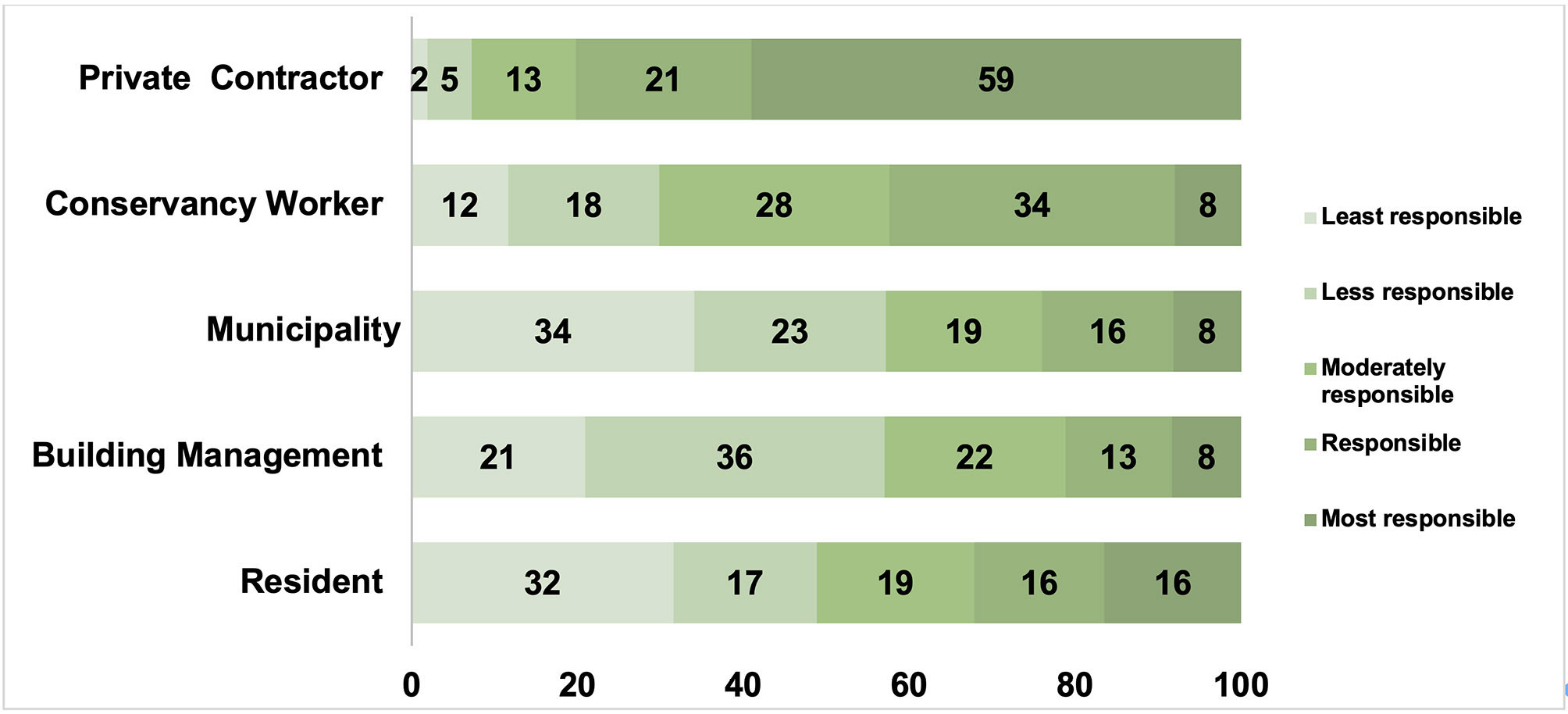
Before analysing the ECI, Figure 1 shows that responsibility is distributed across several actors. Private contractors are rated most responsible, followed by conservancy workers, while residents occupy an intermediate position: 32 per cent consider them least responsible, and an equal share responsible or most responsible. Waste responsibility is therefore not understood solely as an individual matter, reinforcing the need to interpret this ECI dimension cautiously.
Bivariate cross-tabulations first examined associations between the ECI and selected socioeconomic characteristics, with chi-square tests reported in Appendix 1. Multivariable regression models then estimated adjusted percentages classified as low, medium or high ECI while controlling for other covariates. Table 7 reports these estimates, with the clearest differences appearing by education, gender, employment or occupation, housing type and region.
Education shows the strongest and most consistent gradient. More than half of respondents with no education or only primary education are classified in the low ECI category (52.7%), while only 16.4% reach the high category. By contrast, among respondents with a bachelor’s degree or higher, 40.2% fall into the high category and 24.7% into the low category. Gender differences are also visible: women are more likely than men to be classified in the high ECI category (35.7% compared with 26.6%), while men are more concentrated in the low category. Employment and occupation also matter, with blue-collar workers showing lower ECI levels than white-collar workers and some non-working categories.
Housing type and region reveal the importance of material and spatial conditions. Residents of smaller public housing units, especially HDB 1-room and 2-room flats, are more likely to fall into the low ECI category, whereas residents of larger HDB 5-room or executive flats are more likely to be classified as high. Regional differences are also pronounced. Respondents from the Northeast display the most favourable profile, with 46.7% classified as high ECI and only 20.1% as low. By contrast, respondents from the Central and West regions are more concentrated in the low category.
By comparison, ethnicity, citizenship status, marital status, household size and current household income display more limited or less consistent associations with the ECI once other variables are taken into account. This does not mean that waste-related ecological citizenship is socially neutral. Rather, the results suggest that social differentiation operates less through ethnicity or income alone than through education, occupation, gendered domestic routines, housing conditions and neighbourhood infrastructures.
Taken together, these findings indicate that waste-related ecological citizenship in Singapore is not simply a matter of environmental conviction or individual morality. It is patterned by unequal social and material conditions that shape residents’ practical capacity to perform the waste-related behaviours, responsibilities and forms of awareness measured by the ECI. The following discussion interprets these patterns through three analytical themes: the limits of culturalising explanations, unequal capacities to comply with ecological expectations and the infrastructural production of waste-related citizenship.
DISCUSSION: CONTESTED ECOLOGICAL CITIZENSHIP IN SINGAPORE
The statistical results clarify how environmental expectations enter residents’ everyday lives in Singapore, and how unequally residents are positioned to respond to them. Waste management is a revealing lens because it translates abstract ecological concerns into repeated routines: sorting, storing, disposing, recycling, reducing and sometimes composting. These routines are not performed in a social vacuum; they depend on domestic space, work schedules, educational resources, gendered household labour and neighbourhood infrastructures.
The discussion develops three arguments. First, variables often invoked in everyday discourse, such as ethnicity, citizenship status and current household income, do not strongly structure the ECI. Second, clearer gradients emerge along education, gender, employment and occupation, pointing to unequal cognitive, temporal and practical resources for engaging with waste-related norms. Third, housing conditions and neighbourhood infrastructures appear central, suggesting that ecological citizenship is produced not only through awareness campaigns and moral appeals, but also through the material organisation of everyday environments.
Limited effects of ethnicity, citizenship status and income
The findings first caution against culturalising explanations of waste-related conduct in Singapore. Cleanliness can easily be moralised as a property of supposedly responsible or irresponsible ethnic, migrant or income groups. Rather than reproducing such assumptions, the survey allows us to test whether these categories actually structure measured waste-related ecological citizenship.
Table 7. Adjusted percentages of persons by Ecological Citizenship Index and selected background characteristics, Singapore Survey 2024–2025.
|
Socioeconomic Characteristics |
Low |
Medium |
High |
|
|---|---|---|---|---|
|
Age groups |
18–25 |
40.56(25.60, 55.53) |
33.76(29.32, 38.19) |
25.68(13.39, 37.96) |
|
26–35 |
33.92(25.63, 42.21) |
34.52(30.86, 38.18) |
31.57(23.84, 39.29) |
|
|
36–45 |
35.61(27.73, 43.49) |
34.43(30.71, 38.14) |
29.96(22.97, 36.96) |
|
|
46–55 |
37.72(30.12, 45.33) |
34.21(30.44, 37.98) |
28.06(21.61, 34.52) |
|
|
56–65 |
30.67(22.88, 38.46) |
34.47(30.75, 38.18) |
34.86(26.21, 43.52) |
|
|
66 and above |
29.51(21.31, 37.71) |
34.37(30.54, 38.20) |
36.12(26.60, 45.65) |
|
|
Gender |
Male |
39.14(34.25, 44.04) |
34.31(30.70, 37.91) |
26.55(22.34, 30.76) |
|
Female |
29.54(25.30, 33.78)*** |
34.74(31.13, 38.35) |
35.72(31.12, 40.32)*** |
|
|
Ethnicity |
Chinese |
35.18(30.93, 39.42) |
34.62(31.04, 38.21) |
30.2(26.23, 34.18) |
|
Malay |
32.09(24.88, 39.30) |
34.7(31.11, 38.29) |
33.21(25.71, 40.70) |
|
|
Indian |
32.81(24.97, 40.66) |
34.71(31.12, 38.29) |
32.48(24.70, 40.25) |
|
|
Others |
32.24(18.75, 45.73) |
34.7(31.11, 38.29) |
33.06(19.38, 46.74) |
|
|
Citizenship |
Citizen |
34.62(31.02, 38.22) |
34.79(31.20, 38.38) |
30.59(27.05, 34.14) |
|
PR |
30.56(21.87, 39.24) |
34.78(31.18, 38.38) |
34.66(25.63, 43.70) |
|
|
Marital status |
Single/engaged |
36.14(29.25, 43.03) |
34.7(31.08, 38.33) |
29.16(22.84, 35.47) |
|
Married |
32.1(27.74, 36.46) |
34.88(31.28, 38.47) |
33.02(28.62, 37.43) |
|
|
Widowed/Divorced/Separated/Refuse to answer |
40.36(29.02, 51.69) |
34.09(30.01, 38.17) |
25.55(16.31, 34.80) |
|
|
Education level |
No education/Primary |
52.65(41.79, 63.51) |
30.93(25.47, 36.40) |
16.42(10.00, 22.84) |
|
Secondary/‘N’/‘O’ Levels |
37.58(31.16, 43.99)** |
35.54(31.78, 39.29) |
26.89(21.24, 32.53)*** |
|
|
ITE/ITC/NTC/‘A’ Levels/HSC/IB Diploma |
31.09(21.37, 40.81)*** |
35.99(32.25, 39.73)** |
32.92(22.91, 42.94)*** |
|
|
Polytechnic Diploma/Professional Qualification and Diploma |
28.82(22.06, 35.58)*** |
35.85(32.08, 39.62)** |
35.33(27.91, 42.75)*** |
|
|
Bachelor’s/Postgraduate Diploma/Certificate |
24.72(18.20, 31.25)*** |
35.11(31.27, 38.95) |
40.17(32.35, 47.99)*** |
|
|
Employment status |
Employee (Permanent) |
29.76(23.63, 35.89) |
34.96(31.29, 38.64) |
35.28(28.50, 42.05) |
|
Employee (Temporary) |
30.82(20.91, 40.73) |
35.03(31.36, 38.71) |
34.15(23.65, 44.64) |
|
|
Employer/Own account worker |
23.5(10.25, 36.75) |
33.71(28.13, 39.30) |
42.79(25.17, 60.40) |
|
|
Unemployed/Retired/Homemaker/NSF |
42.79(31.32, 54.26) |
33.7(29.12, 38.28) |
23.51(15.01, 32.01) |
|
|
Student/Others |
44.61(23.98, 65.25) |
33.22(26.54, 39.90) |
22.16(7.26, 37.07) |
|
|
Occupation |
White collar |
36.66(29.53, 43.79) |
34.15(30.12, 38.17) |
29.19(23.81, 34.58) |
|
Blue collar |
44.77(31.83, 57.72) |
32.64(27.64, 37.64) |
22.59(13.14, 32.04) |
|
|
Not working/Others |
29.25(21.84, 36.65) |
34.12(29.90, 38.34) |
36.63(27.02, 46.24) |
|
|
Gross monthly household income |
Below $2,999 per month |
33.9(26.26, 41.53) |
34.82(31.22, 38.43) |
31.28(23.60, 38.96) |
|
$3,000–$4,999 per month |
30.93(23.72, 38.15) |
34.81(31.16, 38.46) |
34.26(26.62, 41.89) |
|
|
$5,000–$6,999 per month |
33.86(26.04, 41.68) |
34.82(31.19, 38.46) |
31.32(23.78, 38.85) |
|
|
$7,000–$9,999 per month |
35.54(27.69, 43.38) |
34.72(31.04, 38.41) |
29.74(22.63, 36.84) |
|
|
$10,000 and above per month |
31.94(23.56, 40.31) |
34.84(31.23, 38.46) |
33.22(25.08, 41.36) |
|
|
Refused / Not sure |
38.81(30.29, 47.32) |
34.33(30.55, 38.10) |
26.86(19.59, 34.14) |
|
|
Type of housing |
HDB 1-room |
46.03(27.25, 64.81) |
32.87(26.35, 39.38) |
21.1(7.89, 34.31) |
|
HDB 2-room |
41.83(28.57, 55.09) |
34.01(29.46, 38.56) |
24.16(13.79, 34.53) |
|
|
HDB 3-room |
31.42(24.85, 38.00) |
35.16(31.51, 38.81) |
33.42(26.55, 40.28) |
|
|
HDB 4-room |
36.12(30.85, 41.39) |
34.97(31.33, 38.62) |
28.91(24.10, 33.71) |
|
|
HDB 5-room/exec flat |
29.88(24.12, 35.63) |
35.08(31.45, 38.71) |
35.04(29.11, 40.98) |
|
|
Number of members in the household |
1–2 members |
31.24(24.18, 38.30) |
34.74(31.12, 38.36) |
34.02(26.49, 41.55) |
|
3–4 members |
36.07(31.57, 40.57) |
34.62(31.03, 38.21) |
29.31(25.13, 33.50) |
|
|
5–6 members |
31.64(24.47, 38.81) |
34.76(31.17, 38.35) |
33.6(26.39, 40.81) |
|
|
7 or more |
34.39(20.78, 48.01) |
34.73(31.08, 38.38) |
30.87(17.92, 43.83) |
|
|
Region |
North |
34.95(28.24, 41.66) |
35.95(32.19, 39.70) |
29.11(22.96, 35.25) |
|
Central |
42.81(34.52, 51.10) |
34.56(30.52, 38.59) |
22.63(16.27, 28.99) |
|
|
East |
33.95(27.48, 40.43) |
36.01(32.28, 39.74) |
30.04(23.84, 36.23) |
|
|
West |
43.78(34.80, 52.77) |
34.29(30.08, 38.50) |
21.92(15.25, 28.60) |
|
|
Northeast |
20.05(14.92, 25.17)*** |
33.21(29.13, 37.30) |
46.74(39.38, 54.10)*** |
|
Source: Singapore Ecological Survey 2024–2025; authors’ calculations.
Note: Adjusted percentages calculated with logistic regression. Confidence intervals in parentheses: *p < 0.1; **p < 0.05; ***p < 0.01
The survey results challenge these culturalising interpretations. Ethnicity has no statistically significant effect in the model (Table 7), with broadly similar shares of ‘High ECI’ across groups: Chinese respondents at 30.2%, Malay respondents at 33.21%, Indian respondents at 32.48% and other groups at 33.06%. The data therefore separate racialised perceptions of cleanliness from measured waste-related practices: what appears in everyday discourse as a cultural problem is not confirmed by the survey as a determinant of ecological citizenship.
A similar point applies to citizenship status. Public discourse sometimes implies that Singapore citizens are more responsible than newcomers, permanent residents or foreign workers. Such attributions have circulated periodically in the national press (Boh 2015). Yet the model shows no major difference between Singapore citizens and permanent residents, suggesting that ecological citizenship cannot be reduced to civic status or national belonging.
Finally, current household income does not appear to be a strong determinant of waste-related ecological citizenship. This finding nuances the ‘affluence hypothesis’ often tested in cross-national research on environmental concern (Gelissen 2007). In the survey, the share of respondents classified as ‘High ECI’ remains relatively comparable across income categories: 31.28% for households earning below SGD 2,999, 34.26% for SGD 3,000–4,999, 31.32% for SGD 5,000–6,999, 29.74% for SGD 7,000–9,999 and 33.22% for SGD 10,000 or more. This result is consistent with work showing that the relationship between economic resources and environmental concern is neither mechanical nor uniform across contexts (Fairbrother 2013).
The point is not that ecological citizenship is socially neutral. Rather, the results suggest that social differentiation operates less through ethnicity, citizenship status or income alone than through the practical capacities that allow residents to understand, appropriate and perform waste-related routines. This shifts the analysis away from moral or cultural explanations and toward the social and material conditions that make ecological conduct easier for some residents than for others.
These results do not make the politics of cleanliness disappear; they relocate it. If neither ethnicity, citizenship status nor income accounts for measured waste-related practices, the question becomes which residents are equipped to keep their immediate environment orderly, and at what cost. Cleanliness is not evenly producible: it depends on kitchen space, storage, chute maintenance, estate upkeep and proximity to recycling facilities. Perceptions that code certain areas as dirty may thus attribute to populations what should also be analysed in relation to the material and institutional conditions through which cleanliness is maintained. The following sections turn to those conditions.
Unequal capacities to comply: education, work constraints and gendered responsibility
The second set of findings points to the unequal capacities through which residents understand, appropriate or resist waste-related expectations. Education is the clearest gradient: respondents with no education or only primary education are much less likely to reach a ‘High’ ECI score (16.42%) than those with a bachelor’s degree or postgraduate qualification (40.17%; Table 7). This echoes wider research showing that environmental concern and pro-environmental orientations are partly structured by socio-structural factors, with education often playing a key role (Dietz et al. 1998, Gelissen 2007). In Singapore, education may function less as a direct measure of ecological values than as a proxy for unequal access to the cognitive, linguistic and practical resources through which residents interpret environmental campaigns, understand recycling instructions and translate them into household routines.
Occupational position further complicates the picture. Employers and own-account workers display the highest proportion of ‘High ECI’ respondents (42.79%), while blue-collar workers are less likely to reach high ECI levels (Table 7). This pattern is consistent with research showing that pro-environmental conduct is shaped not only by values, but also by situational constraints such as time pressure, fatigue and work-related limitations (Melo et al. 2018). Waste sorting and recycling cannot therefore be treated as costless gestures. They require time, attention, space and a willingness to assume responsibility for additional domestic tasks.
The interviews show how such constraints may become explicit claims about responsibility. As one employee explained:
It’s not my problem to sort waste. I already work hard all day, I pay my taxes, and in the evening I’m tired: it’s the government’s responsibility, and the cleaners’ responsibility, to do it; they are paid for that, not me (resident interview in Sengkang, September 2022).
This statement should not be read as a simple lack of ecological concern. It expresses a contested understanding of responsibility: for some residents, sorting waste appears as an unfair transfer of labour from institutions and paid workers onto already time-constrained households. Assigning responsibility to the state, cleaners, contractors or building management may therefore reflect not indifference, but a different view of how waste governance should be organised. Waste-related ecological citizenship is not only performed; it is also negotiated and sometimes refused.
This returns to Anantharaman’s (2014) observation that accounts of ecological citizenship can erase the labour that makes privileged environmental practices possible. Singapore presents a somewhat different configuration: part of this labour is institutionally organised through conservancy workers, private contractors and increasingly automated collection systems, and residents explicitly recognise these actors when attributing responsibility for waste management (Figure 1). The responsibility dimension of the ECI therefore records where residents locate the boundary between their own environmental obligations and those assigned to paid workers and institutions, while the gendered pattern discussed below points to the unpaid labour that remains within the household.
Age plays a secondary role. Younger respondents are more concentrated in the lower ECI category, while older respondents show somewhat higher proportions in the higher category (Table 7). This may reflect life-cycle differences in available time rather than generational attitudes, consistent with evidence that age effects on environmental behaviour are modest and contingent (Wiernik et al. 2013, Geys et al. 2021).
Finally, gender differences suggest that waste-related ecological citizenship is entangled with the gendered division of domestic labour. Women are more likely than men to fall into the ‘High ECI’ category (35.72% compared with 26.55%; Table 7). This pattern resonates with research on gender differences in environmental concern and behaviour (Zelezny et al. 2000), but it should not be interpreted only as evidence of stronger ecological values among women. Recycling and waste routines are also domestic tasks, often linked to cooking, cleaning, household organisation and care work. In this respect, waste-related ecological citizenship may partly rest on already feminised forms of labour.
This complicates the apparently positive figure of the ‘good’ eco-citizen. A higher level of participation in waste routines may indicate ecological engagement, but it may also reflect the unequal distribution of unpaid domestic work. As Oates and McDonald (2006) argue, recycling and household waste practices are embedded in the gendered division of labour. In Singapore, ecological responsibility is therefore filtered through existing domestic arrangements: the ‘eco-citizen’ is often also the person who already manages the household routines through which ecological responsibility becomes practicable.
Taken together, these findings show that waste-related ecological citizenship is not distributed according to environmental conviction alone. It is shaped by education, work rhythms, available time, fatigue and gendered domestic responsibilities. These factors do not merely influence attitudes; they structure the practical capacity to comply with, negotiate or resist the ecological expectations embedded in Singapore’s waste regime.
Infrastructure, housing and neighbourhood effects: the material production of eco-citizenship
The strongest spatial findings concern housing type and neighbourhood effects. Waste is materially cumbersome: it must be stored, sorted, moved and deposited somewhere. Domestic space is therefore not a neutral background to ecological citizenship, but one of its conditions of possibility. International research has repeatedly shown that insufficient storage space acts as a barrier to waste sorting at source (Strydom 2018, du Toit and Wagner 2020). In high-density Singapore, this constraint is particularly salient. As one mother living in Punggol explained:
Since we moved to this new HDB, it’s much better for me: we have more space, the kitchen is big, we have pre-sorting chutes on the landing, and the children do it: it’s not very complicated. In the previous flat it was very small and a bit run-down, and we had sealed the chutes in the kitchen; we didn’t use them, it smelled bad, and even cockroaches came out! (resident in Punggol, April 2025)
Housing type and size thus emerge as important variables. The share of respondents classified as ‘High ECI’ rises from 21.10% in HDB 1-room flats to 35.04% in HDB 5-room or executive flats, while the ‘Low ECI’ category declines from 46.03% to 29.88% (Table 7). This association should not be read as a simple income effect, since household income itself does not emerge as a strong predictor in the model. Rather, flat size captures part of the enabling capacity of domestic space and building infrastructure: kitchen layout, storage possibilities, chute configuration, maintenance and proximity to recycling facilities.
This finding resonates with studies showing that building design, governance, convenience and distance to facilities shape recycling participation (Ando and Gosselin 2005, Hendrickson and Wittman 2010, Miafodzyeva and Brandt 2013). Research on high-density residential settings similarly shows that reducing the distance to disposal points or improving access to collection facilities can increase recycling and composting participation (DiGiacomo et al. 2018, Lakhan 2016). Sociospatial analyses of recycling also treat waste practices not simply as individual choices, but as routines enacted through locally organised ‘spaces for waste’ (Glad 2018). The same injunction to ‘sort waste’ therefore has different practical meanings depending on whether it is performed in a cramped flat with limited storage, a poorly maintained chute or a larger apartment with convenient recycling access.
Neighbourhood effects point in the same direction. Respondents in the North-East display the highest share of ‘High ECI’ scores, at 46.74%, compared with 22.63% in the Central region and 21.92% in the West (Table 7). This geography cannot be reduced to individual attitudes. It reflects the cumulative effects of recent urbanisation, family-oriented settlement and the concentration of visible sustainability infrastructures in newer estates. Punggol, located in the North-East, was explicitly developed by HDB as Singapore’s first Eco-Town, with the vision of becoming ‘a Sustainable Waterfront Town of the Tropics’ (HDB n.d., a).1 Punggol Northshore was later developed as HDB’s first smart and sustainable district, introducing smart-enabled homes, environmental modelling, Smart Lights, Smart Fans and other devices intended to make everyday life more resource-efficient (HDB 2021).
This infrastructural logic also extends to waste collection itself. In newer HDB estates, the Pneumatic Waste Conveyance System (PWCS) automates refuse collection through chute-based systems and provides residents with a cleaner and more hygienic waste-collection environment (HDB n.d., d). In Punggol, this system forms part of a broader eco-planning repertoire that combines smart-enabled homes, environmental modelling, energy-efficient devices, blue-green amenities and automated waste infrastructures. Such technologies do not mechanically produce ecological citizens. Rather, they reorganise the practical conditions under which waste routines are performed: sorting, depositing and removing waste become embedded in the built environment itself.
Figure 2 illustrates this planning logic through Treelodge@Punggol, HDB’s first eco-precinct (HDB n.d., c). The project functioned as a demonstration site for greener public housing, incorporating solar photovoltaics, regenerative lifts, rainwater collection, eco-decks, green roofs and a centralised refuse chute dedicated to recyclable waste. With recycling points at every level, the system lowers the practical threshold for recycling by embedding waste sorting into the ordinary rhythms of residential life.
The North-East also contains some of Singapore’s most visible experiments in eco-planning, including blue-green amenities and newer smart-sustainable public housing. Such features should not be treated as direct causes of ecological behaviour. Rather, they form part of a residential environment in which sustainability is unusually visible and materially embedded. This interpretation remains tentative, especially as HDB’s Green Towns Programme extends similar measures across existing towns by 2030 (HDB n.d., b). Evidence from Singapore suggests that green-building features are associated with pro-environmental behaviour (Zhang and Tu 2021).
The broader point is that waste-related eco-citizenship is materially scaffolded. HDB architectures, collection equipment, chute systems, recycling points, neighbourhood infrastructures and eco-urbanist interventions facilitate certain practices while making others more difficult. The determinants identified in the survey (education, occupation, gender, housing conditions and location) reveal unequal relations to infrastructure, disposable time, work constraints and domestic labour. Eco-citizenship is therefore shaped not only by injunctions to behave responsibly, but by environments that make some behaviours more practicable than others.
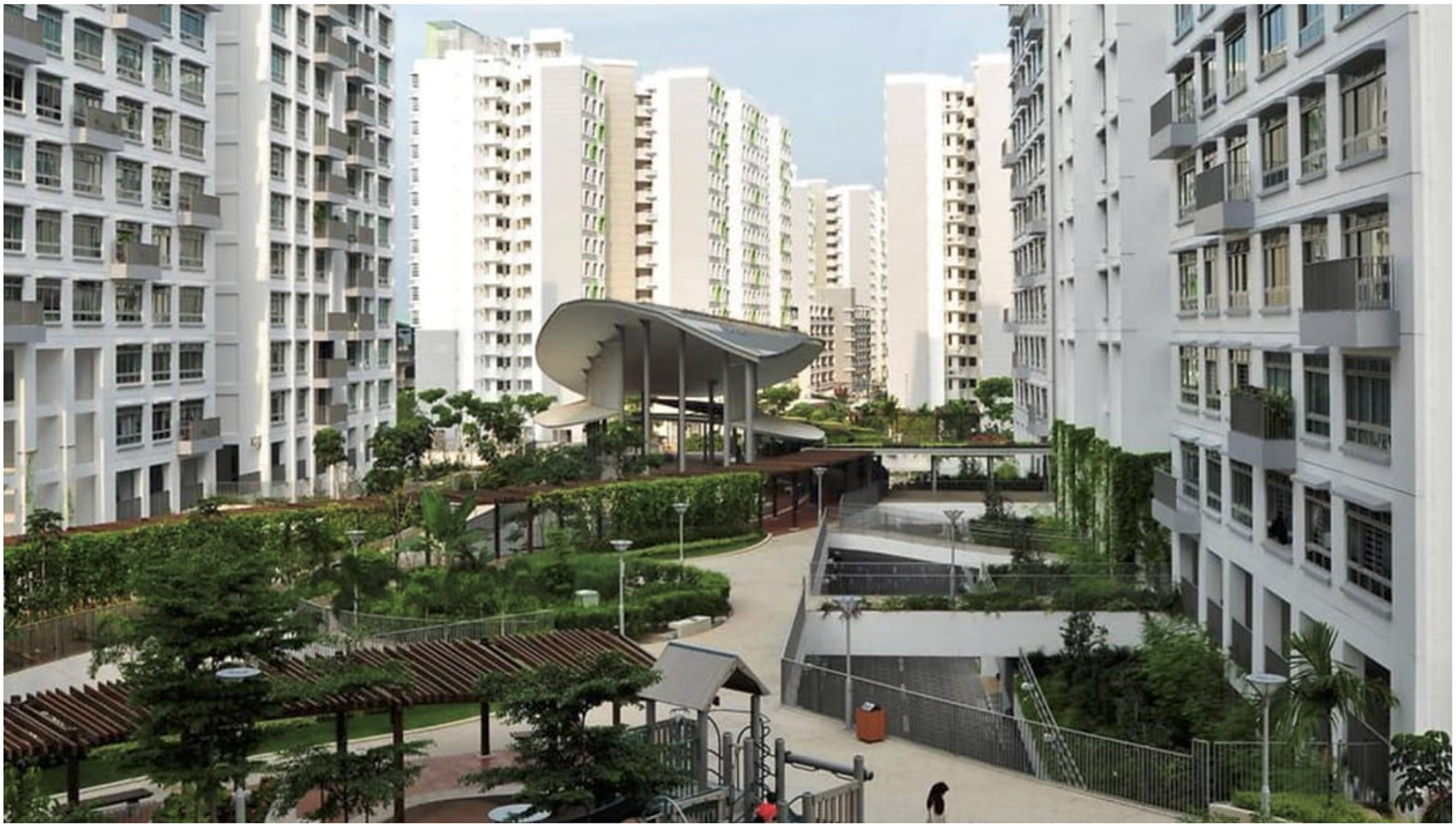
Figure 2. Treelodge@Punggol eco-precinct. Source: Housing & Development Board, Green Home, Healthy Living: An Eco-Lifestyle Experience at Treelodge@Punggol (HDB n.d., c).
CONCLUSION
Often presented as a model of urban order and sustainability, Singapore has built a highly efficient sociotechnical regime for the collection, evacuation, incineration, recycling and disposal of waste. Yet the effectiveness of this regime depends not only on infrastructure. It also depends on residents’ participation in ordinary practices that allow the system to function smoothly: sorting, depositing, reducing, recycling and sometimes composting waste. Household waste management is therefore one of the everyday sites through which ecological citizenship is made visible, measurable and governable.
This article has argued that ecological citizenship in Singapore should not be understood as a universal moral disposition or as a simple measure of environmental virtue. The Ecological Citizenship Index developed here captures a specific and situated form of waste-related ecological citizenship: residents’ engagement with household waste practices, perceived responsibility and environmental awareness within Singapore’s state-organised waste regime. A high ECI score does not necessarily indicate a politically radical ecological citizenship, just as a lower score does not necessarily imply indifference to environmental issues. Rather, the index reveals how differently residents are positioned to perform the waste-related responsibilities expected of them.
The findings show that waste-related ecological citizenship is not primarily structured by ethnicity, citizenship status or current household income. This challenges culturalising explanations that associate cleanliness or ecological responsibility with particular communities, migrant groups or income categories. Instead, clearer inequalities emerge through education, work constraints, gendered domestic labour, housing conditions and neighbourhood infrastructures. Some residents appear more able to act as ‘eco-citizens’ not simply because they hold stronger environmental values, but because they are better equipped to understand, appropriate and perform the routines through which ecological responsibility is recognised.
The article therefore contributes to debates on environmental governmentality by showing that responsibilisation depends not only on environmental norms but also on unequal capacities to enact them. Singapore’s waste regime addresses residents through shared expectations, yet the practical cost of compliance varies across households and neighbourhoods. Ecological citizenship is thus produced at the intersection of governmental norms and everyday infrastructures, leaving room for compliance, negotiation and refusal.
Singapore’s environmental model is therefore ambivalent. Ecological responsibility is framed largely through behavioural compliance and infrastructural efficiency, with residents encouraged to cooperate with an already defined system. Our data do not examine the full political economy of production and consumption, but they show how this framing can leave structural dimensions of waste generation less visible.
Thinking ecological citizenship through waste shifts attention from moral evaluations of individual conduct to unequal conditions of participation. In Singapore, sorting waste is part of an ecological order whose demands are easier for some residents to perform than others. A critical approach must ask who can participate, through which infrastructures and at what cost.
ACKNOWLEDGEMENTS
This research was supported by the SPACE project (Shaping Public Adaptive Capacity For Environmental Infectious Diseases), hosted by CNRS@CREATE and funded by the National Research Foundation, Prime Minister’s Office, Singapore under its Campus for Research Excellence and Technological Enterprise (CREATE) programme (NRF2020-ITC003-0001).
The authors are deeply grateful to all the respondents who generously participated in the survey, provided valuable information, and shared their time for this research. Their contributions were essential for the successful completion of this study. The authors also sincerely thank the survey agency Blackbox for conducting the survey and collecting the data for this project.
Author affiliations
Rémi de Bercegol
Research Fellow, Centre national de la recherche scientifique (CNRS), France; Head of the Department of Social Sciences, French Institute of Pondicherry, India
Email: Remi.debercegol@cnrs.fr
https://orcid.org/0000-0002-6319-6691
Laeek Ahemad Siddiqui
Research Scientist, Centre for Demography of Gender, International Institute for Population Sciences, Mumbai, India
Email: siddiqui.laeek@gmail.com
https://orcid.org/0000-0002-1449-772X
Frédéric Landy
Emeritus Professor, Université Paris Nanterre, Mosaïques, UMR LAVUE, Nanterre, France
Email: flandy@parisnanterre.fr
https://orcid.org/0000-0002-7975-0650
Reza Syam Pratama
Research Engineer, National University of Singapore, Singapore
Email: rezasyam@u.nus.edu
Hwee Leng Goh
Research Assistant, CNRS@CREATE, Singapore Email: goh.hweeleng@gmail.com
https://orcid.org/0009-0000-9947-2187
REFERENCES
Agrawal, A. 2005. Environmentality: Technologies of Government and the Making of Subjects. Durham, NC : Duke University Press. Crossref
Anantharaman, M. 2014. ‘Networked ecological citizenship, the new middle classes and the provisioning of sustainable waste management in Bangalore, India’. Journal of Cleaner Production 63: 173–83. https://.doi.org/10.1016/j.jclepro.2013.08.041
Ando, A.W. and A.Y. Gosselin. 2005. ‘Recycling in multifamily dwellings: Does convenience matter?’ Economic Inquiry 43 (2): 426–438. Crossref
Astrup, T.F., D. Tonini, R. Turconi and A. Boldrin. 2015. ‘Life cycle assessment of thermal waste-to-energy technologies: Review and recommendations’. Waste Management 37: 104–15. Crossref
Banerjee, S.B. 2003. ‘Who sustains whose development? Sustainable development and the reinvention of nature’. Organization Studies 24 (1): 143–80. Crossref
Baviskar, A. 2003. ‘Between violence and desire: Space, power and identity in the making of metropolitan Delhi’. International Social Science Journal 55 (175): 89–98. Crossref
Boh, S. 2015. ‘Why is littering still a problem in Singapore?’ The Straits Times, 10 February. https://www.straitstimes.com/singapore/environment/why-is-littering-still-a-problem-in-singapore (accessed 22 August 2026).
Christoff, P. 1996. ‘Ecological citizens and ecologically guided democracy’. In B. Doherty and M. de Geus (eds), Democracy and Green Political Thought: Sustainability, Rights and Citizenship, pp. 151–69. London: Routledge.
Cornelius, V.R. n.d. ‘Pulau Seking’. Singapore Infopedia, National Library Board. https://www.nlb.gov.sg/main/article-detail?cmsuuid=21302018-f13a-4d20-9889-d3edb1f3b1b7 (accessed 22 August 2026).
Department of Statistics Singapore. 2024. Population in Brief 2024. National Population and Talent Division, Strategy Group, Prime Minister’s Office. https://www.population.gov.sg/files/media-centre/publications/Population_in_Brief_2024.pdf (accessed 22 August 2026).
Dietz, T., P.C. Stern and G.A. Guagnano. 1998. ‘Social structural and social psychological bases of environmental concern’. Environment and Behavior 30 (4): 450–71. Crossref
DiGiacomo, A., D.W.-L. Wu, P. Lenkic, B. Fraser, J. Zhao and A. Kingstone 2018. ‘Convenience improves composting and recycling rates in high-density residential buildings’. Journal of Environmental Planning and Management 61 (2): 309–31. Crossref
Dobson, A. 2003. Citizenship and the Environment. Oxford : Oxford University Press. Crossref
Du Toit, J. and C. Wagner. 2020. ‘The effect of housing type on householders’ self-reported participation in recycling’. Smart and Sustainable Built Environment 9 (4): 395–412. Crossref
Fairbrother, M. 2013. ‘Rich people, poor people, and environmental concern: Evidence across nations and time’. European Sociological Review 29 (5): 910–22. Crossref
Gabrys, J. 2014. ‘Programming environments: Environmentality and citizen sensing in the smart city’. Environment and Planning D: Society and Space 32 (1): 30–48. Crossref
Gelissen, J. 2007. ‘Explaining popular support for environmental protection: A multilevel analysis of 50 nations’. Environment and Behavior 39 (3): 392–415. Crossref
Geys, B., T.-R. Heggedal and R.J. Sørensen. 2021. ‘Popular support for environmental protection: A life-cycle perspective’. British Journal of Political Science 51 (3): 1348–55. Crossref
Glad, W. 2018. ‘Spaces for waste: Everyday recycling and sociospatial relationships’. Scottish Geographical Journal 134 (3–4): 141–57. Crossref
Government of Singapore 2019a. Zero Waste Masterplan. Ministry of the Environment and Water Resources. https://www.towardszerowaste.sg/zero-waste-masterplan/ (accessed 22 August 2026).
Government of Singapore 2019b. Resource Sustainability Act 2019. Singapore Statutes Online. https://sso.agc.gov.sg/Act/RSA2019 (accessed 22 August 2026).
Han, H. 2017. ‘Singapore, a garden city: Authoritarian environmentalism in a developmental state’. The Journal of Environment & Development 26 (1): 3–24. Crossref
Hawkins, G. 2006. The Ethics of Waste: How We Relate to Rubbish. Lanham, MD: Rowman & Littlefield. Crossref
Hendrickson, D.J. and H.K. Wittman. 2010. ‘Post-occupancy assessment: Building design, governance and household consumption’. Building Research & Information 38 (5): 481–490. Crossref
Housing & Development Board (HDB). 2021. ‘Live smart in future-ready towns’. HDB Annual Report 2020/2021. https://assets.hdb.gov.sg/about-us/news-and-publications/annual-report/2021/live-smart.html (accessed 22 August 2026).
Housing & Development Board (HDB). n.d., a. ‘Punggol’. https://www.hdb.gov.sg/about-us/our-towns-and-estates/punggol (accessed 22 August 2026).
Housing & Development Board (HDB). n.d., b. ‘Green Towns Programme’. https://www.hdb.gov.sg/about-us/our-role/create-smart-and-sustainable-homes/green-towns-programme (accessed 22 August 2026).
Housing & Development Board (HDB). n.d., c. Green Home, Healthy Living: An Eco-Lifestyle Experience at Treelodge@Punggol. E-book, available via https://www.hdb.gov.sg/cs/infoweb/about-us/our-role/smart-and-sustainable-living/punggol-ecotown/treelodgepunggol (accessed 22 August 2026).
Housing & Development Board (HDB). n.d., d. Waste Management: Pneumatic Waste Conveyance System (PWCS). https://www.hdb.gov.sg/about-us/our-role/smart-and-sustainable-living/hdb-greenprint/waste-management (accessed 22 August 2026).
Lakhan, C. 2016. ‘Out of sight, out of mind: Issues and obstacles to recycling in Ontario’s multi-residential buildings’. Resources, Conservation and Recycling 108: 1–9. Crossref
Lee, K.Y. 1968. ‘The “Keep Singapore Clean” campaign: Speech by the Prime Minister, Mr Lee Kuan Yew, at the opening ceremony at the Singapore Conference Hall’. National Archives of Singapore, 1 October. https://www.nas.gov.sg/archivesonline/data/pdfdoc/lky19681001.pdf (accessed 22 August 2026).
Luke, T.W. 1999. ‘Environmentality as green governmentality’. In É. Darier (ed.), Discourses of the Environment, pp. 121–51. Oxford : Blackwell.
Lysaght, T., A. Ballantyne, H.J. Toh, A. Lau, S.-M. Ong, O. Schaefer, M. Shiraishi, W. van den Boom, V. Xafis and E.S. Tai. 2021. ‘Trust and trade-offs in sharing data for precision medicine: A national survey of Singapore’. Journal of Personalized Medicine 11 (9): 921. Crossref
MacBride, S. 2012. Recycling Reconsidered: The Present Failure and Future Promise of Environmental Action in the United States. Cambridge, MA : MIT Press. Crossref
Martinez-Alier, J. 2002. The Environmentalism of the Poor: A Study of Ecological Conflicts and Valuation. Cheltenham : Edward Elgar Publishing.
Massey, D. 2004. ‘Geographies of responsibility’. Geografiska Annaler: Series B, Human Geography 86 (1): 5–18. Crossref
Melo, P.C., J. Ge, T. Craig, M.J. Brewer and I. Thronicker. 2018. ‘Does work-life balance affect pro-environmental behaviour? Evidence for the UK using longitudinal microdata’. Ecological Economics 145: 170–81. Crossref
Miafodzyeva, S. and N. Brandt 2013. ‘Recycling behaviour among householders: Synthesizing determinants via a meta-analysis’. Waste and Biomass Valorization 4 (2): 221–35. Crossref
Ministry of Sustainability and the Environment (MSE). n.d., a. ‘Singapore Green Plan 2030’. https://www.greenplan.gov.sg/ (accessed 22 August 2026).
Ministry of Sustainability and the Environment (MSE). n.d., b. ‘Green Citizenry’. https://www.greenplan.gov.sg/green-citizenry/ (accessed 22 August 2026).
National Environment Agency (NEA). 2024. Annex B: 2023 Waste Statistics and Overall Recycling Rate Table. https://www.nea.gov.sg/docs/default-source/media-files/news-releases-docs/annex-b_2023-waste-and-recycling-statistics.pdf (accessed 22 August 2026).
National Environment Agency (NEA). n.d. ‘Semakau Landfill’. https://www.nea.gov.sg/our-services/waste-management/waste-management-infrastructure/semakau-landfill (accessed 22 August 2026).
Neo, H. 2021. ‘The post-politics of environmental engagement in Singapore’. In P. Jobin, M.-s. Ho and H.-H.M. Hsiao (eds), Environmental Movements and Politics of the Asian Anthropocene. pp.109-138. Singapore : ISEAS–Yusof Ishak Institute. Crossref
Neo, H. and C.Y. Chua. 2017. ‘Beyond inclusion and exclusion: Community gardens as spaces of responsibility’. Annals of the American Association of Geographers 107 (3): 666–81. Crossref
Oates, C.J. and S. McDonald. 2006. ‘Recycling and the domestic division of labour: Is green pink or blue?’ Sociology 40 (3): 417–33. Crossref
Reno, J.O. 2016. Waste Away: Working and Living with a North American Landfill. Oakland, CA : University of California Press. Crossref
Schlosberg, D. 2007. Defining Environmental Justice: Theories, Movements and Nature. Oxford : Oxford University Press. Crossref
Steward, F. 1991. ‘Citizens of planet Earth’. In G. Andrews (ed.), Citizenship, pp. 65–75. Dagenham : Lawrence and Wishart.
Strydom, W.F. 2018. ‘Barriers to household waste recycling: Empirical evidence from South Africa’. Recycling 3 (3): 41. Crossref
Swyngedouw, E. 2009. ‘The antinomies of the postpolitical city: In search of a democratic politics of environmental production’. International Journal of Urban and Regional Research 33 (3): 601–20. Crossref
Valencia Sáiz, Á. 2005. ‘Globalisation, cosmopolitanism and ecological citizenship’. Environmental Politics 14 (2): 163–78. Crossref
Wang, J. 2024. Reimagining the More-Than-Human City: Stories from Singapore. Cambridge, MA : MIT Press. Crossref
Wiernik, B.M., D.S. Ones and S. Dilchert. 2013. ‘Age and environmental sustainability: A meta-analysis’. Journal of Managerial Psychology 28 (7–8): 826–56. Crossref
Yeoh, B.S.A. 2003. Contesting Space in Colonial Singapore: Power Relations and the Urban Built Environment. Singapore : Singapore University Press. Crossref
Zelezny, L.C., P.-P. Chua and C. Aldrich. 2000. ‘New ways of thinking about environmentalism: Elaborating on gender differences in environmentalism’. Journal of Social Issues 56 (3): 443–57. Crossref
Zhang, D. and Y. Tu. 2021. ‘Green building, pro-environmental behavior and well-being: Evidence from Singapore’. Cities 108: 102980. Crossref
1 A key structuring feature of this project was the 4.2 km Punggol Waterway, presented by HDB as Singapore’s first man-made waterway developed by the agency and as running through the entire Punggol Eco-Town (HDB n.d., a).
APPENDIX 1. ECOLOGICAL CITIZENSHIP INDEX BY BACKGROUND CHARACTERISTICS, SINGAPORE 2024–2025
|
Socioeconomic Characteristics |
Low |
Medium |
High |
Total |
chi-2 test (χ2) |
|
|---|---|---|---|---|---|---|
|
Age groups |
18–25 |
47.8 |
26.9 |
25.4 |
67 |
Pearson chi2(10) = 11.7838 Pr = 0.300 |
|
26–35 |
28.8 |
35.6 |
35.6 |
118 |
||
|
36–45 |
29.8 |
34.7 |
35.5 |
121 |
||
|
46–55 |
30.2 |
35.7 |
34.1 |
129 |
||
|
56–65 |
36.7 |
36.7 |
26.6 |
109 |
||
|
66 and above |
37.5 |
35.2 |
27.3 |
128 |
||
|
Gender |
Male |
38.5 |
32.9 |
28.6 |
325 |
Pearson chi2(2) = 5.5036 Pr = 0.064 |
|
Female |
30 |
36.3 |
33.7 |
347 |
||
|
Ethnicity |
Chinese |
32.9 |
36.5 |
30.5 |
416 |
Pearson chi2(6) = 3.0442 Pr = 0.803 |
|
Malay |
39.2 |
30 |
30.8 |
120 |
||
|
Indian |
33 |
32 |
35 |
100 |
||
|
Others |
33.3 |
36.1 |
30.6 |
36 |
||
|
Citizenship |
Citizen |
34.8 |
35.6 |
29.6 |
578 |
Pearson chi2(2) = 5.3725 Pr = 0.068 |
|
PR |
29.8 |
28.7 |
41.5 |
94 |
||
|
Marital status |
Single/engaged |
36.5 |
33 |
30.5 |
203 |
Pearson chi2(4) = 3.7281 Pr = 0.444 |
|
Married |
31.9 |
35.3 |
32.8 |
408 |
||
|
Widowed/Divorced/Separated/Refuse to answer |
41 |
36.1 |
23 |
61 |
||
|
Education level |
No education/Primary |
54.3 |
26.6 |
19.1 |
94 |
Pearson chi2(8) = 46.9298 Pr = 0.000 |
|
Secondary/‘N’/‘O’ Levels |
35.5 |
42.9 |
21.7 |
203 |
||
|
ITE/ITC/NTC/‘A’ Levels/HSC/IB Diploma |
35.4 |
32.3 |
32.3 |
65 |
||
|
Polytechnic Diploma/Professional Qualification and Diploma |
32.9 |
30.7 |
36.4 |
140 |
||
|
Bachelor’s/Postgraduate Diploma/Certificate |
21.8 |
33.5 |
44.7 |
170 |
||
|
Employment status |
Employee (Permanent) |
30.7 |
34.1 |
35.2 |
358 |
Pearson chi2(8) = 16.5072 Pr = 0.036 |
|
Employee (Temporary) |
28.1 |
47.4 |
24.6 |
57 |
||
|
Employer/Own account worker |
30.8 |
26.9 |
42.3 |
26 |
||
|
Unemployed/Retired/Homemaker/NSF |
39.2 |
34.9 |
25.9 |
189 |
||
|
Student/Others |
50 |
26.2 |
23.8 |
42 |
||
|
Occupation |
White collar |
28.3 |
35.1 |
36.6 |
350 |
Pearson chi2(4) = 16.5004 Pr = 0.002 |
|
Blue collar |
49.1 |
32.7 |
18.2 |
55 |
||
|
Not working/Others |
38.6 |
34.5 |
27 |
267 |
||
|
Gross monthly household income |
Below $2,999 per month |
38.7 |
36.7 |
24.7 |
150 |
Pearson chi2(10) = 14.4098 Pr = 0.155 |
|
$3,000–$4,999 per month |
34.8 |
31.3 |
33.9 |
112 |
||
|
$5,000–$6,999 per month |
35.3 |
32.4 |
32.4 |
102 |
||
|
$7,000–$9,999 per month |
33.9 |
31.3 |
34.8 |
112 |
||
|
$10,000 and above per month |
21.2 |
39.4 |
39.4 |
99 |
||
|
Refused / Not sure |
38.1 |
37.1 |
24.7 |
97 |
||
|
Type of housing |
HDB 1-room |
54.2 |
41.7 |
4.2 |
24 |
Pearson chi2(8) = 21.7263 Pr = 0.005 |
|
HDB 2-room |
42.2 |
35.6 |
22.2 |
45 |
||
|
HDB 3-room |
36.7 |
28.6 |
34.7 |
147 |
||
|
HDB 4-room |
36.4 |
33.7 |
29.9 |
261 |
||
|
HDB 5-room/exec flat |
24.6 |
39.5 |
35.9 |
195 |
||
|
Number of members in the household |
1–2 members |
31.7 |
42.8 |
25.5 |
145 |
Pearson chi2(6) = 9.7391 Pr = 0.136 |
|
3–4 members |
37.3 |
31.5 |
31.2 |
365 |
||
|
5–6 members |
28.5 |
33.8 |
37.7 |
130 |
||
|
7 or more |
31.3 |
37.5 |
31.3 |
32 |
||
|
Region |
North |
33.5 |
34.2 |
32.3 |
155 |
Pearson chi2(8) = 38.0789 Pr = 0.000 |
|
Central |
46.6 |
31.9 |
21.6 |
116 |
||
|
East |
33.5 |
36.8 |
29.7 |
155 |
||
|
West |
42.7 |
38.5 |
18.8 |
96 |
||
|
Northeast |
20 |
32.7 |
47.3 |
150 |
||
|
Total |
34.1 |
34.7 |
31.3 |
672 |
||
Source: Singapore Ecological Survey 2024–2025.