Alejandro Solano-Ugalde, Pilar Egüez Guevara and Agustina Arcos-Torres
Uses of Native and Exotic Palms in Ecological Restoration: Lessons From the Mashpi Shungo Reserve, Ecuador (2009–2024)
PLANT PERSPECTIVES 3/2 - 2026: 394–404
doi: 10.3197/whppp.63876246815937
Open Access CC BY 4.0 © The Authors
For its outstanding biodiversity Ecuador has been designated as one of ten megadiverse countries. Due to its location on the equator, it enjoys many climates, soils and diverse geological processes. In Ecuador, palms represent the group of native plants with the greatest diversity of uses per species. At the Mashpi Shungo Reserve in the Ecuadorian northwest, the authors have been working to restore degraded areas using regenerative practices through diverse agroforestry systems. We have explored working with a diversity of palms. To date, eighteen species of palms of 36 varieties have been used in restoration, which we have integrated with about 300 species of other plants. In this manuscript we report the mostly edible uses of these palms, focusing on the current and potential uses of two palm species, Bactris gasipaes and Salacca zalacca.
KEYWORDS
Palms, Ecuador, uses, Chontaduro, Salak
Palms have been present on the planet for about fifty million years and, somewhat surprisingly, records allow us to estimate that their centre of origin was in what is now the Arctic (Henderson et al. 2019). Today, however, the greatest diversity is found in tropical areas around the world, with the highest diversity concentrated in America and Asia (Riffle et al. 2012). Throughout human evolutionary history, palms have appeared in historical records for more than 5,000 years; for example, the use of date palms is documented in ancient civilisations such as Mesopotamia (Sallon et al. 2008).
There are species that have adapted to climates as diverse as their growth patterns. Therefore, there are palms in dry forests and rainforests, and palms that grow from sea level to the high Andes. At these different altitudes, there are palms known as rattan (around 600 species), which mainly grow in the form of lianas and have thorns that allow them to ‘climb’ from the floor of the rainforest to the tops of huge trees, reaching heights close to the upper canopy. There are also undergrowth palms that have become famous as ornamental plants in indoor gardens in homes and buildings (mainly the genus Chamaedorea spp). Others are more common in the middle and upper strata, such as the famous açaí palms (Euterpe oleraceae and E. precatoria), which produce an edible pulp with high levels of antioxidants that have earned them a place among the plants known today as ‘superfoods’. Reaching the canopy of the cloud forest are the Andean palms known as wax palms (Ceroxylon spp), which grow to a height of around forty metres, making them the tallest palm trees in the world (Ballik and Beck 1990, Henderson et al. 2019).
In Ecuador, palms represent the group of native plants with the greatest diversity of uses per species, with up to 27 different uses in the case of the fibre palm (Aphandra Natalia –Henderson et al. 2019). Complementarily, not only are there many uses per species, but 105 of the 136 palm species reported in Ecuador have some use (Valencia et al. 2013).
Given this significant diversity of uses and their presence in most of Ecuador’s climatic zones, in this manuscript we analyse the use of a variety of palms in the ecological restoration project where we have been working for the past twelve years on integrated management for conservation purposes, noting some progress in terms of the use of palms as non-timber forest products. We conducted an inventory of the types of palms cultivated in our farm. We present a description of each according to its current and potential uses. Subsequently we focus on two specific types of palms, one native and one exotic, and report the novel approaches to its cultivation and use that we have successfully achieved at our farm in the Mashpi Shungo reserve.
We work in the Mashpi Shungo Reserve, located in northwestern Ecuador, which is part of the Chocó Andino Biosphere Reserve. Mashpi Shungo is 56 hectares, protecting an important remnants of foothill rainforest and is located within the Metropolitan District of Quito, Parish of Pacto, Mashpi River Valley. The altitude ranges from 500 to 650 metres above sea level, with a tropical rainy climate and approximately 3,000 millimetres of annual rainfall.
Over the last fifteen years, an ecological restoration project with agroecological objectives has been underway in the areas of Mashpi Shungo reserve that were degraded – approximately five hectares – using permaculture techniques that mainly include organic farming, agroforestry and zoning. Successional agroforestry, analogue forestry and syntropic agriculture have been used on the agroforestry plots.1
As part of the ecological restoration systems, eighteen palm species in thirteen different genera were inventoried, of which ten are native palms and eight are exotic. We decided to use exotic species because they are plants with interesting potential (soil restoration, food sovereignty, habitat, etc). According to several agroforestry systems, such as analogue forestry and syntropic agriculture, ‘foreign’ plants are not seen as a potential danger because they are never planted in monocultures. Rather, they are considered opportunities to associate and involve species that can grow in a diverse, healthy production system and fulfil ecological functions appropriate to the local context.
With respect to which palms to use in ecological restoration with an aim at ensuring agroecological production, several factors should be considered. Many palm trees take several years to grow and yield fruit: for example, in our experience, Salak can take up to four years and Chontaduro up to six. Once established and growing, the next logical step is to plan what to do onceproduction begins. In small-scale projects, the great majority of farmers are pushed to sell their produce to middlemen, making it difficult to obtain a fair revenue. We experienced the same situation in diverse agroforestry. To overcome this, at Mashpi Shungo Reserve we have established an artisanal workshop to add value to the produce on site, create local jobs and establish a more direct channel of commercialisation. In the following, we provide a couple of examples in relation to two species of palm tree we are working more intensively with, Chontaduro (Bactris gasipaes) and Salak (Salacca zalacca).
This is a tall to emergent palm tree, with fruits commonly eaten boiled in many parts of the neotropics, especially in countryside and jungle environs (Gonzales et al. 2022). In the areas surrounding our farm in Mashpi Shungo, it is used very differently. Chontaduro is densely planted, with the aim of harvesting as a very young plant to extract the heart of the palm, usually produced in large monocultures and highly dependent on agrotoxics (Freile 2020). Upon establishing the project, we were told by neighbours that we should follow this example. Aware of the negative impacts of this conventional plantation method, we decided to use this plant in a polyculture to demonstrate that it can be produced agroecologically without negative impacts and many benefits to the soil, the wildlife and the people. In the early years we did extract the heart of palm and processed it on site, introducing a new product to the market, i.e. a regenerative heart of palm. After a few years of managing, and once other companion trees started producing fruits, mainly native cacao, we decided to allow the Chontaduros to grow and express themselves naturally, achieving a greater size, bringing stratification to the agroforestry system, while generating shade, pumping nutrients from deeper in the soil and producing fruits
These fruits are very important for food sovereignty and are a great source of nutrients, in the shape of good fats, vitamins and fibre. We then learned how to preserve the cooked fruits, in a water and salt solution like that used to preserve the heart of the palm. The super abundant fruit production of the Chontaduro tree has served another unexpected function in the agroecological system; we noticed that, when fruiting, the local fauna prefers this crop over other star crops such as cacao.
Another edible product of great interest is the animal protein one can obtain when pruning one of the trunks of the palm. There is a beetle commonly known as Chontacuro (Rhynchophorus palmarum) that makes its life cycle on the rotten trunk. The harvesting needs to take place on a waning moon; after 45 days the beetle grubs are ready for harvest. The beetle grubs have been consumed traditionally by local populations in various regions of Ecuador.
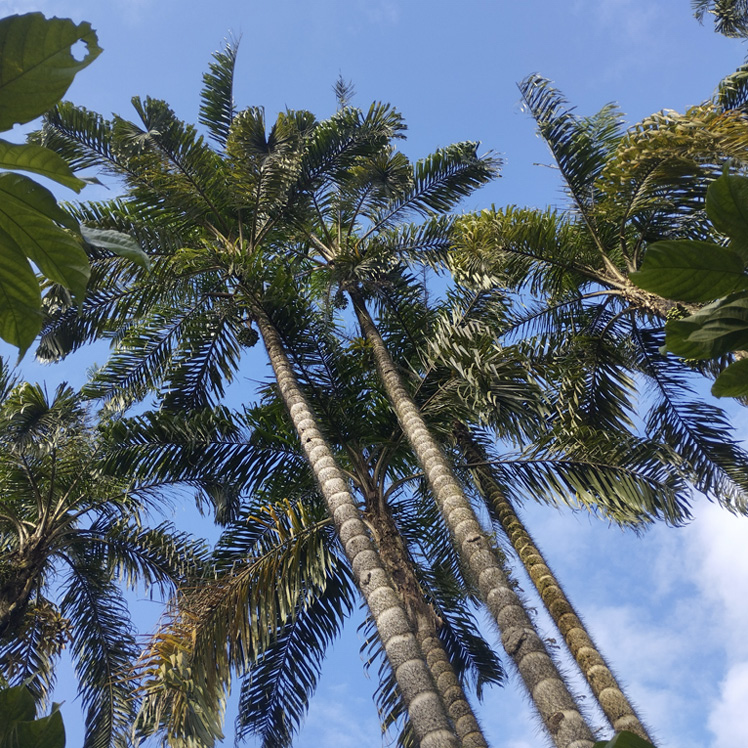
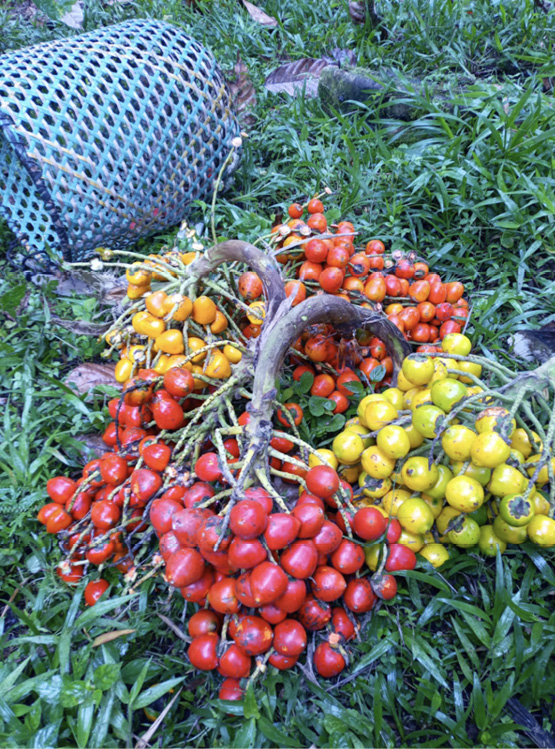
Figure 1.
Chontaduro trees (left), chontaduro fruit (right). Photo credit: Mashpi Chocolate.
Other uses we have explored involve the processing of the cooked fruits into flour, first cooking, then dehydrating and finally grinding into powder. We have used the flour in bread, soups and porridges. Other possibilities include using it for animal feed. More research is needed with respect to the potential uses of the Chontaduro fruit.
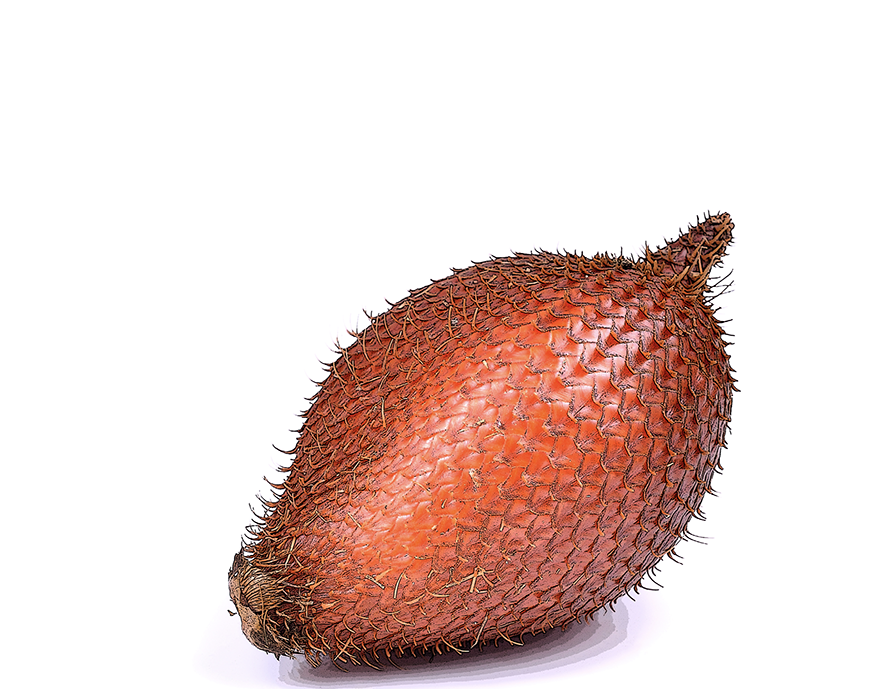
This dense and trunkless palm tree was introduced from Bali to Ecuador nearly twenty years ago by seed savers and fruit enthusiasts Jaime West and Mimi Foyle (West and Solano 2021). The fruit of this species is commonly known as ‘snake fruit’ and is very attractive for its skin scales resembling a snake; however the fruit doesn’t last long once harvested. The fruit has a dense and crunchy texture and its flavour has been described as a mix between pineapple and pear. We decided to dehydrate it and then cover it with chocolate made on the farm from the cacao intercrop with the Salak fruits. This product is an innovation and a good way to extend the shelf life of the fruit, allowing it to reach a wider public, using chocolate to tell the story of the integrated agroecological production system of our farm. The demand for the fruit is growing both locally, being sold at roadside shacks as well as in some organic markets in the capital. In the case of the processed chocolate-covered Salak we have also commercialised it in international markets, both in the USA and Europe.
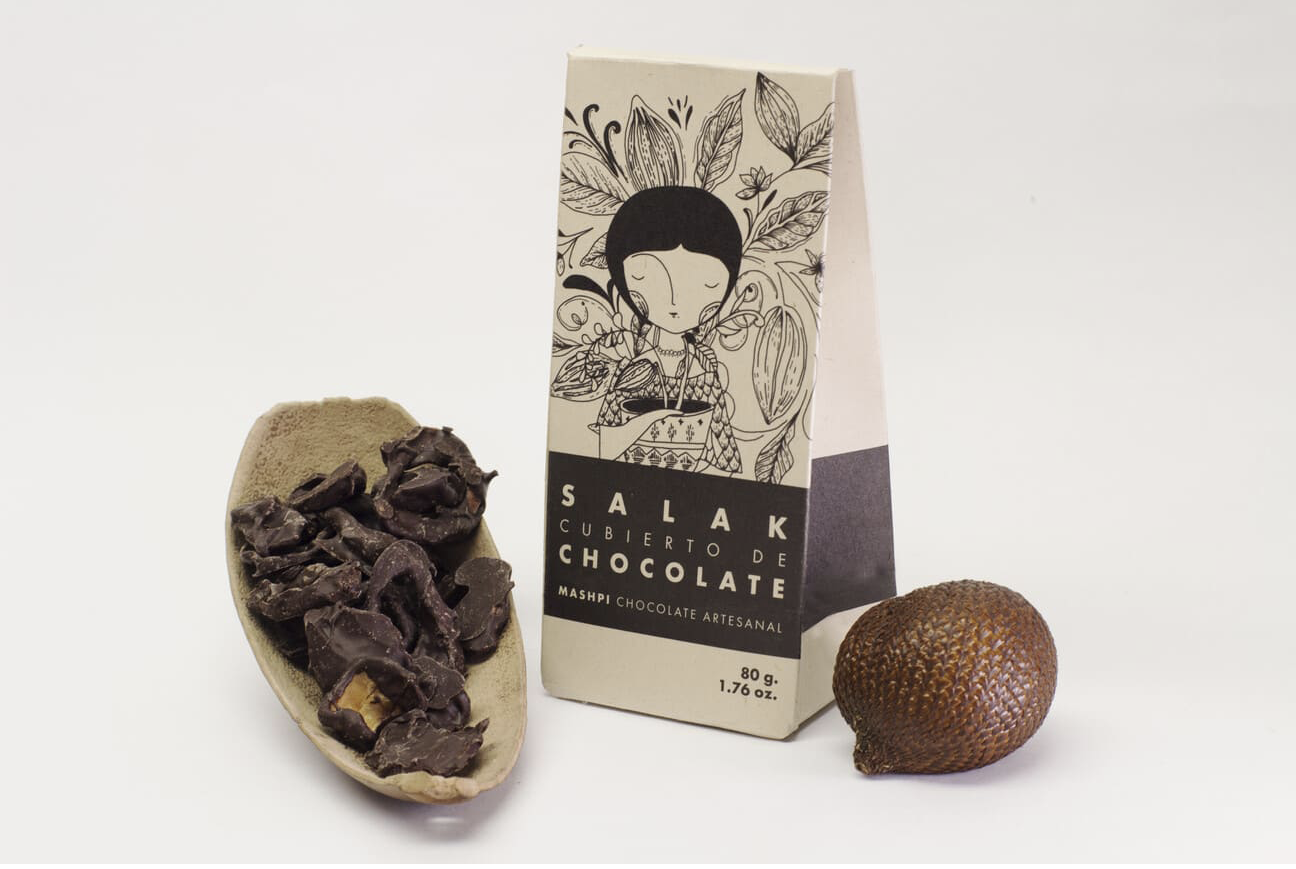
Figure 2.
Chocolate covered, dried Salak (left), Salak whole fruit (right). Photo credit: Mashpi Chocolate.
Palm trees offer both opportunities and challenges. As we have reported in this essay, there are many current and potential uses for Chontaduro. However, we have experience that, at least in Ecuador, a racial stigma is attached to the fruit, as it is an ancestral food commonly looked down upon by lighter-skinned urban elites for being consumed by Indigenous people and countryside communities. Such stigmas rooted in colonialism have prevented the broader public from benefitting from this and other heritage foods for centuries. In recent decades, the rebranding or refashioning of traditional foods within urban and global dietary and health trends as ‘superfoods’ has created unwanted impacts. These range from the proliferation of myths and unfounded beliefs about the adequate, presumably ‘better’, preparation or consumption of these foods, to the overexploitation of resources by certain chefs and the food/wellness industry. In addition, there are unfair advantages gained by the latter over the local keepers, both Indigenous and mestizo communities, of the knowledge that has made these culturally meaningful foods available to us today. Thus, the solution to de-stigmatising Chontaduro doesn’t only lie in making its fruit trendy, but rather in educating the population to break with the racial stigmas rooted in the colonial mindset, and working with conscious and committed change agents, be it local cooks, chefs, health professionals or local authorities, to educate the public on the health, social and cultural value of traditional foods such as Chontaduro.
For example, in countries like Costa Rica, one can find small carts with boiled Chontaduro fruits ready to pick and take home, similar to how chestnuts are consumed in parts of North America. This practice could well be applied in other countries to encourage consumption, stimulating a deeper interest in plants in general and, more specifically, in culturally significant foods derived from palms and the diverse potential uses that palms can offer.
Similarly, working with exotic species of palms poses challenges and opportunities. Our farm in the Ecuadorian northwest, along with nearby ally farms from the Seed Savers Network of Ecuador, has been the centre of dispersion of this relatively new crop. Salak is now being cultivated mostly for self-consumption on farms in the coast of Esmeraldas, Manabí and the Amazon region. We have pioneered the promotion of its cultivation in agroforestry models and innovated its uses in Ecuador, particularly through our chocolate-covered dry Salak fruit. The challenge with new crops, and in particular new fruits, is a certain degree of resistance from consumers to unconventional products. Using a vehicle such as chocolate is a strategy to introduce components of our diverse agroforestry, emphasising yet little-known natives but also using exotics, to shine together with some better-known crops like cacao.
Finally, we see the need to highlight the different impacts created by methods of production of various species of palm trees. Large monocultures such as the aforementioned heart of palm, and the African oil palm, are detrimental to the common good and to both producers and consumers. The most preoccupying threats created by global monocrop cultivation of palms are the loss of soil fertility, poor water quality and quantity. In contrast, agroecological restoration practices are effective not only in regenerating soils and water cycles but also for the vitality of the crops that is then passed on to the producers/consumers, significantly contributing to improving the quantity and quality of life on the planet (West and Solano 2023).
As a common part of the natural landscape, we need to understand how to integrate palms in our productive systems such that the natural and cultural heritages are both protected, managed and respected.
Balick, M.J. and H. Beck. 1990. Useful Palms of the World: A Synoptic Bibliography. New York: Columbia University Press.
Correa-Neto, N.E., N. Maranhao-Messerschmidt, W. Steenbock and P. Facina-Monnerat. 2016. ‘Agroforesting the world from the machete to the tractor: Generating agroforestry praxis in a network’. Cooperafloresta. http://www.cooperafloresta.com.br (accessed 14 August 2025).
Freile, J.F. 2020. ‘Lo que duele del palmito: Historias de vida de un cultivo tropical’. Ecuador Terra Incognita 120: 8–16.
González-Jaramillo, N., N. Bailon-Moscoso, R. Duarte-Casar and J.C. Romero-Benavides. 2022. ‘Peach palm (Bactris gasipaes Kunth.): Ancestral tropical staple with future potential’. Plants 11: 3134. https://doi.org/10.3390/plants11223134
Henderson, A., G. Galeano and R. Bernal. 2019. Field Guide to the Palms of the Americas. Princeton: Princeton University Press.
Riffle, R.L., P. Craft and S. Zona. 2012. The Encyclopedia of Cultivated Palms. Second edition. Portland, OR: Timber Press.
Sallon, S., E. Solowey, Y. Cohen, R. Korchinsky, M. Egli, I. Woodhatch and M. Kislev. 2008. ‘Germination, genetics, and growth of an ancient date seed’. Science 320 (5882): 1464. https://doi.org/10.1126/science.1153600
Senanayake, R. 1987. ‘Analog forestry as a conservation tool’. Tiger Paper. Bangkok: FAO.
Steenbock, W., L. da C.e Silva, R.O. da Silva, A.S. Rodrigues, J. Perez-Cassarino and R. Fonini. 2013. Agrofloresta, ecologia e sociedade [Agroforestry, ecology and society]. Curitiba, PR: Kairós.
Valencia, R., R. Montúfar, H. Navarrete and H. Balslev (eds). 2013. Palmas ecuatorianas: Biología y uso sostenible. Quito: Publicaciones del Herbario QCA, Pontificia Universidad Católica del Ecuador.
West, J. and A. Solano. 2021. Libro vivo de la tropicultura. Proyecto Factorías del Conocimiento en la Mancomunidad del Chocó Andino. Quito: Fundación Imaymana, AEXCID, AUPEX.
West, J. and A. Solano. 2023. Libro vivo de la tropicultura. Vol. 2. Proyecto RestaurAcción – Bosque Modelo Chocó Andino. Quito: Fundación Imaymana, Gobierno de Canadá.
Alejandro Solano-Ugalde is a naturalist, field ornithologist and permaculturist. He has published research on the natural history of Ecuador’s mainland avifauna, and is recognised for his active role in ecological restoration, teaching agroforestry and regenerative agriculture.
Email: jhalezion@gmail.com
Pilar Egüez Guevara, Ph.D. is an Ecuadorian cultural anthropologist, researcher, educator and award-winning filmmaker. She specialises in the anthropology of food, with a focus on documenting, analysing and preserving traditional, ancestral food systems and medicinal wisdom across Latin America.
Email: pilareguez@gmail.com
https://orcid.org/0009-0008-5878-8722
Agustina Arcos-Torres is an Ecuadorian permaculturist, conservationist, regenerative agriculturist and syntropic farming teacher and researcher. She works in ecological restoration, food sovereignty, soil restoration and fine chocolate crafting in the Chocó Biosphere Reserve.
Email: aguchis@gmail.com
1 Successional agroforestry is a productive design that mimics natural ecological succession, gradually replacing pioneer species with secondary and climax species to maintain constant productivity and regeneration (Steenbock et al. 2013). Analogue forestry is the planning of agricultural systems that reproduce the form, structure and dynamics of a local natural ecosystem to achieve sustainability and resilience (Senanayake 1987). Syntropic agriculture is managing crops so that they produce their own fertiliser through high density of prunable species, generating organic matter, light control and rejuvenation of the system (Correa-Neto et al. 2016).