Andrés Caicedo
‘Oil Palm Has Godfathers; Coconut Doesn't Have Mourners’: The Racialised Politics of Plant Health and Pest Control in Tumaco, Colombia
PLANT PERSPECTIVES 3/2 - 2026: 363–388
doi: 10.3197/whppp.63876246815935
Open Access CC BY 4.0 © The Author
The South American Palm Weevil (Picudo negro) is my ethnographic entry point to study the racialised relations between oil palm and coconut palm in Tumaco, a municipality located on the Colombian South Pacific Coast. Oil palm agricultural scientists, small farmers and companies, and coconut palm experts and growers have blamed picudo negro as the primary culprit for the most damaging plant diseases affecting these trees in Colombia: bud rot disease (oil palm) and red ring disease (coconut palm). They have caused the near collapse of both oil and coconut crops in Tumaco. By following picudo negro's traces, this paper argues that plant health measures to treat coconut and oil palm diseases operate as racialised technologies. Even though oil and coconut palms in Tumaco share the fact of undergoing lethal epidemics, they have experienced ruin, death, mourning, treatment and reparation differently. While oil palm plantations have received much attention, care and research from experts and national institutions, coconut palm ecologies have experienced systematic abandonment. I thus examine how the salvation of the oil palm, as the most ‘promising’ national (mono)crop, entails the erasure and eradication of the black ecologies, agriculture and knowledge stemming from the coconut palm trees.
Coconut palm, oil palm plantations, red ring disease, bud rot disease, picudo negro
I.
As we walked through Doña Violeta’s oil palm crops, a buzzing sound intermittently disrupted our conversation.1 While she showcased her cherished palms, which were the first she had cultivated, she gestured to the path leading to her Huerta, a diverse garden featuring avocado, plantains, cherry trees, herbs, chirarán, chillangua and some naidi palm trees. The buzzing persisted, but I refrained from investigating it further. When I asked why la huerta was separate from the palms, she said, ‘La Palma can’t grow well with other crops. She likes her own things – her space, water, and light; she doesn’t want to share!’2 I tried to suppress a laugh, recalling another grower’s sentiment: ‘La Palma is a jealous plant’. However, the buzzing grew louder, prompting me to ask, ‘What is that buzz? Did you hear it?’ Doña Violeta eagerly pointed upward, exclaiming, ‘Look! He’s over there!’ I finally spotted the source of the noise: a large picudo, or weevil. ‘It’s such a relief to find him’, she remarked solemnly. ‘When there are many, you lose your hearing to the buzzing, your eyes dart everywhere, and they even hit your head.’ I pressed on, ‘So, is he a picudo?’ “’Yes, the infamous picudo negro – the plague! It’s been a while since I’ve seen one here. It’s not catastrophic – just one. I need to set more traps.’ I paused, taking in the presence of the pest. ‘The plague is re-emerging’, she sighed. ‘It’s everywhere now.’ This exchange unfolded in 2023 amidst the rural landscape of Tumaco.
II.
We sat in front of the home of Amelia, a Black peasant who, at more than eighty years old, professed her enduring love for the land. It was a hot day in Las Delicias village, but a refreshing breeze provided some relief. Our group included five people: Amelia; Alfonso; his nephew, who lived in the house next door; and Iván, Amelia’s son, a researcher and professor from urban Tumaco about an hour away. Sol, one of Amelia’s daughters-in-law, joined us; she and Alfonso rise early each morning to tend to their oil palm crops. The front of Amelia’s house lacked barriers, surrounded instead by a garden of flourishing plants. If you stood before the front door, turned left, walked a few metres away from the sidewall, then turned right and continued for at least twelve metres, you would reach the backyard, where the back door was visible to the right. Many plants thrived in this vibrant space that Amelia called her garden, including a remarkably tall palm with a slender trunk that wasn’t an oil palm. In a moment of silence, I asked, ‘What kind of palm is that?’ Iván redirected my question: ‘Why has the picudo negro appeared in Tumaco? Do you know why, Andrés?’ I admitted, ‘I have no idea.’ He replied,
The wood fever and subsequent monocrops, like banana and oil palm, destroyed their habitats, uprooting countless naidi palms. Now, this creature has to seek new homes – guess where? In other palms! Not just oil palms, but coconut palms too!
His tone was sober and slightly upset. Amelia added, ‘I still remember that brutal sound … the repetitive, dry echo of trees falling like dominoes.’ Alfonso then looked at Amelia and said, ‘Do you also remember the chainsaw, aunt? It didn’t stop! That wild Brum Brum Brum … It’s the worst human invention.’
III.
I waited for Emilio and Jairo, who were not far away. Moments ago, they had paused to greet a friend we encountered on our path, which offered a much-needed relief for my weary legs after almost two hours of walking along a narrow road lined with oil palm fields belonging to both small-scale peasants and large enterprises. While I waited, I found myself missing Alicia’s garden, which I had visited the previous week. Two ideas from our earlier conversation lingered in my mind. First, I noted how deforestation has transformed Tumaco’s landscapes and livelihoods into a pervasive and violent aural experience. What does a plantation sound like? I wondered, gazing at the rows of oil palms before me. This question intrigued me, but I hesitated to delve deeper, aware of the many other ‘research questions’ awaiting my attention. Second, I reflected on how deforestation undermined Tumaco’s insect ecology, particularly impacting naidi palms, a native tree cherished by both people and insects, especially the picudo negro. The former enjoyed their delicious, small purple fruits, while the latter found habitat among their fronds. I wanted to explore the picudo negro’s lifeways further – a pest considered one of the primary vectors of bud rot disease, deemed dangerous to oil palms by scientists, companies and growers alike. Scientific journals and bulletins from the National Center for Oil Palm Research frequently reiterate that Rhynchophorus palmarum is ‘a pest of great economic importance’. (Aldana et al. 2010: 5–8). When Emilio and Jairo returned, I shared my thoughts on the interconnectedness of deforestation, naidi palms and the picudo negro. Jairo smiled and recounted, ‘Andrés, once, I was in a meeting with a biologist from Nariño University who said he tracked a picudo negro he captured on an oil palm field. The next day, someone found it 300 kilometres away in a chontaduro palm!’ Astonished, I exclaimed, ‘Wow, that’s an impressive journey!’ Laughing, Emilio added, ‘No way! That’s incredible, hermanito! Just imagine how he sprinted farther away when he lost his home!’
IV.
In June 2023, I spoke with Ronald and Alberto – Ronald, a Black peasant dedicated to cultivating coconut and cacao, and Alberto, an agricultural forest engineer and consultant who works primarily with small growers. We discussed how palm oil has dominated agriculture in Tumaco, leading to the marginalisation of agrarian alternatives. ‘There is only room for oil palms; consequently, there is only economic and scientific support for them’, Ronald asserted, highlighting the struggles cacao and coconut farmers face to defend their livelihoods in the region. Alberto was prepared to add to this, but Ronald gestured for his permission to continue: ‘Did you know, Andrés, that coconut has suffered five deaths in Tumaco? We, the coconut growers, have survived five pandemics, five extinctions.’ My confusion prompted me to ask, ‘What do you mean?’ He explained, ‘The red ring disease, caused by the picudo negro, has decimated our palms five times, yet we have never received any condolences from state officials or scientists.’ I expressed my shock, admitting I was unaware of this history. He concluded, ‘The picudo has flown from oil palm to coconut palms and has ruined everything. However, in Tumaco, oil palm has godfathers, while coconut has no mourners.’
***
I could write extensively about the knowledge shared by Black growers regarding the picudo negro, deforestation, oil palms, native forests and naidi palms. As I wove these stories into coherent narratives – my methodological and ethical responsibility as a researcher – I realised that oil palm soundscapes were just one part of a broader narrative. These stories, integral to the plantations, emerged through anecdotes, memories and rumours, layered with emotions. Generosity and trust were central to their expression. A mix of humility, accountability, excitement and gratitude shapes this note. The stories of coconut growers are not just data but vivid connections with the people I met, many of whom became friends. They embody ethics, intimacy and relationships, forming the backbone of this essay and driving my research. They taught me that beneath the oil palm shadows – echoing Diana Ojeda’s and Sophie Chao’s metaphor - other palm worlds, ecologies and species persist in Tumaco.
***
Building on the spatial metaphor by Diana Ojeda (2016) and Sophie Chao (2022a; 2022b; 2022c) this paper examines what unfolds in the shadow of the oil palm in Tumaco. While plantation logics never fully homogenise the spaces they occupy, I trace the racialised intersections of coconut and oil palm in the region. Drawing on multispecies studies, I explore how non-human life, particularly the South American palm weevil (picudo negro) and the plant diseases red ring and bud rot, shape this relationship. They serve as ethnographic entry points to understand how the coconut palm asserts its presence against oil palm’s dominance. Equally important are the agrarian experiences of coconut growers, which both echo and challenge scientific papers, bulletins, and reports from Colombian agricultural institutions. This paper thus engages with Black peasants’ narratives on the picudo negro and its entanglement with oil palm plantations and coconut crops.
In Colombia, agricultural scientists, farmers and palm experts attribute the most devastating plant diseases to the picudo negro: bud rot (pudrición del cogollo, PC) in oil palms and red ring disease in coconuts. Though both palms and their growers in Tumaco endure lethal epidemics, their experiences of ruin, mourning and recovery differ. Since the early 2000s, bud rot in oil palm has attracted extensive media coverage, scientific attention, financial aid and government support. Coconut, by contrast, has long faced neglect. Institutional documents not only minimise the repeated crises of the coconut palm but also blame Black peasants for the spread of red ring disease, racialising them as ‘negroide africano’ and ‘primitive farmers’ and attributing disease proliferation to their supposed ignorance and lack of discipline rather than to structural or environmental causes (ICA 1973, ICA 1975, Plaza Mora 1976, 1977).
This article advances one central claim. Plant health measures in Tumaco are not only technical responses to plant disease. They are a political field in which value, protection and treatment are unevenly distributed across plants and across the people who cultivate them. When bud rot threatens oil palm, institutions mobilise funding, research and public concern to protect the crop. When red ring disease devastates coconut palms, the crisis is minimised and responsibility is often placed on Black peasants and growers who cultivate them. I trace this asymmetry through the movements of the picudo negro and through the repeated crop deaths that coconut growers describe as ‘pandemics’. By following the insect between oil palm plantations and coconut groves, the paper shows how the protection of oil palm has often coincided with the neglect of coconut ecologies and the blaming and criminalisation of the Black peasants who cultivate them.
Here, the term politics is used in two related senses. First, it refers to institutional frameworks that govern plant health. These include phytosanitary policies, scientific research programmes, eradication campaigns and the allocation of public and private resources to protect particular crops. Second, the term also refers to the racialised narratives through which responsibility, blame and value are assigned to plants and to the communities who cultivate them. In Tumaco, these two dimensions are deeply connected. Decisions about which crops deserve protection, funding and scientific attention are inseparable from historical narratives that portray some agricultures as modern and productive while casting others as backward, irresponsible or disorderly.
The unruly presence of the coconut palm and its growers reveals multiple affordances in Tumaco. Crucially, Black peasants refuse the reduction of their homes to a landscape of violence and oil palm monoculture, a narrative long advanced by national agricultural campaigns, sociological reports, media, military officials and NGOs (Fedepalma 2002, 2014). At the same time, national agricultural experts and institutions have often portrayed coconut cultivation as chaotic and backward, framing Black coconut growers as the source of phytosanitary disorder. Thus, the national campaign against red ring disease often operates as a dual eradication effort: an explicit war on the weevil and an implicit effort to discipline or erase Black coconut cultivation.
The analysis unfolds in two parts. First, I introduce the central protagonists of this story: the black palm weevil, oil palm and coconut palm, and the plant diseases that have most afflicted them, bud rot and red ring disease. Second, I present conceptual and ethnographic contributions to the racialised affordances within the oil palm: the coconut-palm entanglement in Tumaco, as well as the agrarian and ontological significance of the coconut palm as unruly Black ecology.
2. The South American palm weevil and the palms
Picudo negro
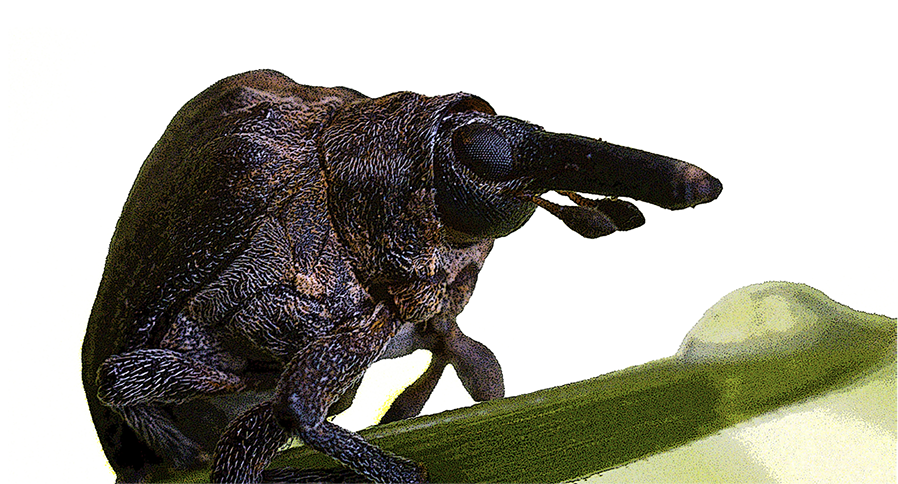
The South American Palm Weevil (Rhynchophorus palmarum), or picudo negro, has been central to Colombia’s oil palm agroindustry since the late twentieth century. Small and black, measuring 10 to 15 millimetres, it raises alarm among scientists, growers and workers (Aldana et al. 2010, 2010a; Aldana 2015; Quintero 2010). Widely recognised as the primary vector for the devastating bud rot disease, the picudo negro affects all four oil palm zones in Colombia: Northern, Central, Eastern and Western, the latter along the South Pacific Coast. This paper focuses on the Western zone, where bud rot surged in the early twenty-first century, nearly decimating the oil palm industry. Tumaco, at the heart of this region, has become a key research site for experts investigating the disease and its connection to the picudo negro.
This rising scientific interest in the picudo negro and Tumaco’s role as a research hub are rooted in a broader history. Since the 1960s, the Afro-Colombian port city has been a focal point for government officials, investors and experts establishing commercial oil palm plantations (Prieto 2016, Serrano 2021). Here, efforts to sustain ‘productive’ crops have centred on pest and disease prevention. In Tumaco, the picudo negro is not only a vector for bud rot but also the primary cause of red ring disease, which has devastated the coconut palm, vital for Black peasants in the region for over sixty years.
The picudo negro uses its wings for travel, with its sense of smell guiding its feeding and reproduction. Often seen as a scavenging arthropod, it primarily feeds on decaying plant matter (ICA 1978; Aldana et al. 2010, 2010a; Aldana 2015; Lohr 2016; Quintero 2010; Sanchez 1967). Experts and local farmers note that the odour from diseased palms – whether affected by red ring or bud rot – attracts the weevil. Diseased coconut and oil palms thus become its habitat, food source and site for reproduction. The weevil feeds on the palms, laying its eggs inside, where larvae and pupae develop before emerging as adults (ICA 1978; Aldana et al. 2010, 2010a; Aldana 2015; Lohr 2016; Quintero 2010; Sanchez 1967). By inhabiting these palms, the weevil accelerates their decline and becomes a key vector for spreading red ring and bud rot. ‘He carries the pest in his paws and beak’, a coconut farmer shared with me. ‘When the oil palms started dying from PC (bud rot) in 2005, that bug appeared in swarms, and it came again to our coconut, and it died again.’ He paused and then added: ‘That was the fourth extinction.’
The picudo negro thus connects the divergent health and disease narratives of both oil and coconut palms in Tumaco. Though geographically distant, oil palm plantations and coconut groves are intricately linked. Oil palms have been planted at higher altitudes, away from the coast, near rivers and in forested zones, while coconut growers tend to settle along shores, mangroves and marine ecologies. The weevil bridges these spaces, carrying oil palm pests into coconut plantations and vice versa. The tension between oil and coconut palms reflects a dynamic geography, marked by the insect’s flight through seas, swamps, rivers, forests and hills. As local farmers often say during our conversations: ‘Tumaco is not only oil palm and violence; we are more than a simple monoculture.’
Scientific expertise and the palms
Oil palm trees arrived in Tumaco in 1960 through the Instituto de Fomento Algodonero (IFA), or Cotton Development Institute (Prieto 2016, Serrano 2021). Funded by the Colombian state in the late 1950s, the IFA sought to expand the oil industry. While cotton dominated, the institute also supported beans, corn, sesame and, later, coconut and oil palm (Ferrand 1959, 1964, 1951). National agricultural records show that oilseed promotion aimed to drive industrialisation, rural development, state territorial control and private land ownership. In particular, establishing oil palm in Tumaco required collaboration among government officials, national institutions, European scientists, private investors and Colombian experts in what institutional documents at the time described as colonización empresarial. Prieto (2016) and Serrano (2021) analyse this language to show how state agencies, private capital and technoscientific expertise worked together to reorganise land, labour and agricultural production around oil palm plantations in the region. Framed as a backward, impoverished and predominantly Black region in need of development, Tumaco was seen as an ideal site for Africa’s ‘promising’ oil palm due to its perceived resemblance to Central and West Africa (Ferrand 1959, 1964, 1951). By the late 1970s and early 1980s, thousands of oil palms had taken root, reinforcing racialised and colonial legacies dating back to the nineteenth century and continuing extractivist cycles from gold mining to tagua and timber (Leal and Restrepo 2003).
National and foreign experts have been crucial in promoting oil palm cultivation. Following a mission by Maurice Ferrand, an FAO agricultural expert, the IFA and other institutions launched scientific campaigns that positioned Tumaco as Latin America’s top site for oil palm monoculture. The 1960 founding of El Mira Experimental Farm exemplified this focus, continuing research on plant health and breeding. Since the 1960s, publications, bulletins and advertisements have analysed Tumaco’s ecology, noting its ‘natural features’ as drivers of pest and disease emergence. Bud rot, detected in the late 1970s and initially dismissed, became a major concern by the 2000s as experts and companies struggled to contain it. Meanwhile, pests like the picudo negro, responsible for red ring disease in coconut palms, gained attention. By the late 1980s, as bud rot grew more persistent, experts partnered with oil palm companies and large cultivators to establish the Oil Palm Research Center Corporation (Cenipalma, Corporación Centro de Investigación en Palma de Aceite) to investigate and contain the epidemic. Scientific research has long emphasised ‘good agricultural practices’ to control pests and plant diseases in oil palm plantations (Pérez Rojas 2012, Sanz Scovino 2016). Yet, from the 1960s to the late 1990s, most studies overlooked Tumaco’s social, economic and cultural dynamics, as well as local agricultural knowledge and labour practices. This contrasts with other agrarian programmes, such as the coconut palm initiatives under the IFA’s Program for the Promotion of Plant Oils.
Tumaco’s present historical geography is shaped by tensions between oil palm and other crops. I examine how coconut and oil palm interact and conflict through plant diseases, insects and phytosanitary measures imposed by biologists, phytologists and agricultural engineers. Over the past forty years, red ring and bud rot have had unequal effects on these palms. Red ring has primarily devastated coconut palms since the mid-twentieth century, generating repeated crises for Black smallholders. Bud rot, by contrast, nearly collapsed the oil palm industry in the early twenty-first century.
Coconut palms were present in Tumaco by the mid-twentieth century, as shown by agricultural records and interviews with Black campesinos, though neither the records nor locals can pinpoint their exact arrival. This contrasts with detailed genealogies for oil palms, documented by institutions like the Colombian Agricultural Institution (ICA), IFA and Colombian Agrarian Reform Institute (Incora), which trace their origins and dissemination routes. In contrast, coconut palms receive little attention; agricultural authorities focus instead on the ‘cultural’ and ‘ethnic’ factors they associate with coconut farming, framing it as a ‘primitive’ smallholder activity linked to backwardness and recurrent phytosanitary crises like red ring disease and the black palm weevil. Historical records from the ICA and IFA depict coconut palms as tied to unreliable and dangerous ecologies and knowledge, with the black palm weevil seen as thriving in these ‘unruly’ environments (ICA 1973, 1975, 1978; Plaza Mora 1976, 1977; Sanchez 1967, 1975).
In the archival materials I analyse, agricultural officials rarely describe coconut cultivation through explicit language of race. Instead, they frequently refer to ‘ethnic’ or ‘cultural’ factors when explaining the spread of red ring disease and the persistence of the picudo negro. I read this wording as a bureaucratic way of doing racial work. Within these documents, plant disease is framed as the consequence of the behaviour, habits and discipline of coconut growers, who are portrayed as lacking the hygiene, order and technical knowledge required for modern agriculture. Coconut plots are described as disorganised environments where infected palms are not removed, debris is poorly managed and farmers fail to follow phytosanitary recommendations. In this narrative, the health of coconut palms becomes tied to the presumed conduct of the Black peasants who cultivate them. (ICA 1973, 1975; Plaza Mora 1976, 1977).
At the same time, this cultural vocabulary does not fully conceal the racial logic that underlies it. Several of the same documents that attribute disease to ‘ethnic practices’ also employ explicit racial labels, including terms such as negroide africano, linking coconut cultivation to ideas of backwardness, irresponsibility and disorder. (ICA 1973; 1975; Plaza Mora 1976, 1977). The coexistence of these vocabularies is significant. References to culture allow institutional discourse to present its judgments as neutral technical expertise, while the occasional use of racial terminology reveals the hierarchy embedded in those assessments. For this reason, I do not treat ‘ethnic’ and ‘racial’ as synonyms. Rather, I analyse how the language of culture operates as a proxy through which racial assumptions circulate within agronomic and bureaucratic discourse, shaping how responsibility for plant disease is assigned to Black coconut growers in Tumaco.
Furthermore, although institutional agricultural archives occasionally link deforestation to the spread of the picudo negro and red ring disease, this connection is seldom emphasised. In contrast, small coconut growers consistently note the relationship between forest destruction and the weevil’s spread. Leal and Restrepo emphasise that the extractive wood cycle devastated Tumaco’s forests until the mid-twentieth century (Leal and Restrepo 2003). This not only eradicated thousands of hectares for the timber industry but also disrupted local ecologies. For instance, the destruction of the naidi palm, a native species that once housed the picudo negro, forced the weevil to seek new habitats, such as the coconut and oil palms. Consequently, the coconut palm and oil palm, particularly the former, began to fulfill this ecological role.
This interconnectedness is displayed in the ‘five pandemics’ mentioned by Ronald earlier in this essay. The first pandemics began in the early 1960s, coinciding with deforestation for timber and the establishment of early oil palm plantations. Ronald and Alberto stress, ‘You cannot understand one without the other.’ The fourth and fifth pandemics, in the early 2000s and 2020s, align with the expansion of oil palm cultivation. Oil palms succumbed to bud rot, which fueled a surge in picudo negro populations. However, another factor links the oil palm crises and the recurrence of coconut crop extinctions in the twenty-first century.
A key phytosanitary measure against bud rot involved eradicating diseased palms and replanting disease-resistant species. This process attracted government, financial institutions and agricultural corporations. However, farmers, technicians and experts noted a significant issue in handling debris from felled palms. Jairo and Emilio explained that the remains should be burned, ‘not only because the bud rot disease can survive in them, but because the debris “is a feast for the black palm weevil; it’s its best banquet”.’ Instead, much of the debris was left to decay, which led to a rapid reproduction of the weevil. As a result, ‘all those new bugs had to look for food and a home, and that’s where the coconut palm and we, the coconut farmers, pay the broken plates again because the red ring reappeared’, Jairo remarked.
In addition to the factors linked to oil palm plantations, the deaths of coconut crops reveal a significant issue: a lack of institutional support. Ronald expresses frustration, saying, ‘Coconut is the crop of the poor; it is the crop of the blacks of Tumaco.’ He adds, ‘It is a crop that neither the government nor the wealthy care about, as the plight of the Black community in Tumaco has historically gone unnoticed by presidents in Bogotá.’ By contrast, crises in oil palm have triggered major financial and scientific responses, including the creation of Cenipalma in 1991, now Latin America’s leading palm oil research centre. As Ronald poignantly notes, ‘in Tumaco, oil palm has godfathers, while coconut has no mourners.’
Why have oil palm crops received financial rescue while coconut palms face neglect and decay? In the following section, I explore these racialised dynamics, drawing from critical agrarian studies, black feminism, disability studies and multispecies studies.
3. The unruly presence of the coconut palm
Space, health and racial affordances
The growth of oil palm plantations in Colombia presents a spatial paradox. While linking specific rural areas to global markets, it also connects various towns across the country, as palm monoculture spreads to almost all regions. The mobility of oil palm experts, workers and their agricultural practices reflects this paradox. Yet, the uniform landscapes of oil palm plantations are far from simple. Scholars like McKittrick (2006, 2013), Wynter (1971), Carney (2001, 2021), Wolford (2021), Thomas (2019) and Berman-Arévalo (2019) show how plantation logic – despite its homogeneity – has been persistently contested by local struggles for land, territory and food sovereignty. In Tumaco, the sterile rows of oil palms are disrupted by other plants and ecologies like coconut, cocoa and plantain, which resist the overwhelming expansion of monoculture. This essay builds on the ‘plot vs. plantation’ framework, showing how racialised narratives and practices around plant health in Tumaco mediate tensions between these two forces. The movements of the black palm weevil between crops exemplify how the spatiality of oil palm plantations exceeds their geographical boundaries, interlinking different ecologies and livelihoods.
Narratives of plant health and disease in Tumaco are embedded in a web of racialised ecological disablement. The crises faced by coconut growers stem from a combination of financial, governmental and technoscientific discourses that have ignored, persecuted and punished Black coconut ecologies in Tumaco. I draw on Sunaura Taylor’s concept of ecological disablement to show that the cyclical damage from red ring disease is not just a biological condition, but the result of decades of policies prioritising ‘profitable’ crops like oil palm over ‘undesirable’ and ‘irresponsible’ agricultures. While experts frame oil palm as a transformative project for Tumaco, they simultaneously scapegoat Black coconut farming for plant diseases and pests. According to these experts, the crisis is due to ‘cultural’ and ‘ethnic’ factors, namely that coconut growers are Black peasants (ICA 1973,1975; Plaza Mora 1976, 1977). This view portrays them as incapable of sound economic decisions, dismissing science-based practices and locked in a tradition of harvesting rather than farming (ICA 1973, 1975; Plaza Mora 1976, 1977).
This web of ecological disablement has fostered a politics of care, determining who deserves assistance and who, as Judith Butler (2010) and Alexander Weheliye suggest, is deemed undeserving of life. The stark contrast between media coverage of oil palm disease outbreaks and those affecting coconut crops is revealing. This disparity is mirrored in scientific research, institutional support and financial rescue efforts. Bud rot in oil palms, especially since the 2000s, has garnered significant media attention, funding and scientific focus on eradicating diseased palms and replacing them with resistant species. In contrast, the fate of the coconut palm is almost oppositional, as encapsulated by Ronald in our conversations: ‘oil palm has godfathers; coconut doesn’t have mourners’. This reflects not only a framework where the coconut is seen as ‘an ungrievable life’, a life ‘that cannot be mourned because it has never counted as a life at all’ (Butler 2010: 38), but also frames the coconut’s diminished value through capital. Having ‘godfathers’ implies both ethical recognition and emotional support, as well as, notably, economic sponsorship.
Judith Butler’s concept of ungrievable life helps clarify how political orders distribute recognition, care and urgency unevenly. In Frames of War, Butler argues that certain forms of loss become publicly intelligible while others remain largely unnoticed or fail to register as losses at all. In Tumaco, the governance of plant disease reveals a similar distribution of attention. Oil palm epidemics mobilise state agencies, research programmes and financial infrastructures, while the destruction of coconut groves rarely triggers comparable responses. Butler’s framework therefore helps describe how recognition and institutional concern become unevenly allocated, shaping which ecological losses appear as crises and which are treated as peripheral or inevitable.
Black studies further clarifies the racial histories embedded in these dynamics. Scholars such as Saidiya Hartman (2017) and Alexander Weheliye (2014) have shown that modern regimes of value have long rendered Black life fungible and differentially recognisable. Hartman (2017) demonstrates how plantation economies treated enslaved people as interchangeable units of labour and capital, where suffering could be commodified and enjoyed simultaneously. As she points out, Black suffering has often circulated publicly as spectacle. Alexander Weheliye (2014) similarly argues that the distribution of humanity, recognition and wellbeing has historically been organised through racial hierarchies that determine whose lives are protected and whose subjugated and neglected. In Tumaco, these insights help illuminate why the devastation of coconut agriculture rarely produces the same urgency or institutional concern that accompanies crises in oil palm plantations. Coconut cultivation is embedded in Black territorial life, labour and subsistence, yet the losses associated with it remain marginal within state and scientific frameworks of agricultural value. When coconut palms disappear without sustained institutional intervention, the absence of meaningful response reflects broader histories in which the wellbeing of Black agrarian worlds has been treated as peripheral to the priorities of agricultural development.
The treatment of bud rot in oil palm plantations catalysed large capital flows, enriching major corporations, yet simultaneously undermining the lives of coconut palms and their growers. Drawing on Nirmala Erevelles’ work (2011), I frame bud rot not merely as a biological ailment, but as a material process where plant impairment becomes a fetishised promise, more a symbol of potential profit than a lack. The spread of bud rot within the oil palm industry is driven by exchange value – investment, profit and capital accumulation. But this is only part of the story. As Erevelles suggests, impairment under transnational capitalism creates not just fetishised commodities, but material conditions that harm and degrade life and health. In Tumaco, the treatment of bud rot embodies a process that debilitates coconut ecologies, reactivating red ring disease and precipitating the cyclical extinction of the coconut palm. Following Jasbir Puar’s (2009, 2017) and Julie Livingston’s (2009, 2017) work, I use ‘debilitating’ to describe the ongoing production of plant epidemics and ecological disablement in Tumaco, where the extinction of the coconut palm is a continuous cycle of harm. Thus, the spread of bud rot in the oil palm sector highlights how plant health measures intersect with a political economy that transforms plant disease into a commodity, all while perpetuating harm to Black coconut agriculture and its growers.
Oil palm agribusiness in Tumaco exemplifies racial capitalism, as scholars like Robinson (2000) and Melamed (2011, 2015) define it: the material and ideological co-constitution of race and capital. In Tumaco, the state, scientific experts and investors have leveraged Blackness as a key signifier to develop oil palm plantations and integrate capitalist logic into local economies.
Long before the arrival of oil palm plantations, Tumaco had already been incorporated into successive cycles of resource extraction. The environmental historian Claudia Leal (2018) shows that the Pacific lowlands have repeatedly been represented by national elites as a territory rich in natural resources but insufficiently developed by its inhabitants due to their supposedly racial, cultural and socio-economic inferiority (Leal 2018). At the same time, since the nineteenth century, extractive cycles organised around gold mining, tagua extraction, timber exploitation and marine harvesting have structured the integration of the region into national and global markets (Leal 2018, Leal and Restrepo 2003). Tumaco was imagined as abundant yet underused, while Black and Indigenous populations were portrayed as lacking the discipline or knowledge required to transform that abundance into productive agriculture. Such representations helped legitimise repeated interventions by state agencies, scientists and investors who presented new extractive projects as necessary forms of development, such as the above-mentioned corporate colonisation (colonización empresarial). Leal (2018) conceptualised this broader pattern through the concept of racialised landscape: a resource-rich space cast as backward through racialised claims of Black inferiority that legitimise occupation and extraction.
Oil palm plantations thus emerged in Tumaco within this longer history of extraction and racialised representations of the territory. As a local peasant and intellectual explained to me during fieldwork, oil palm operates as ‘an accumulation of racial and economic violences, a continuum of dispossession and extraction of value in Tumaco’ (Fieldwork Interview 2023). From this perspective, palm plantations do not simply introduce a new agricultural activity. They reorganise earlier extractive dynamics. Landscapes once shaped by forest livelihoods, small-scale cultivation and coastal economies become increasingly structured around monoculture plantations and industrial processing plants. The expansion of oil palm therefore transforms not only land use but also the organisation of labour, value and authority in the region.
These transformations are particularly visible in the alliances between oil palm companies and small growers. Tumaco occupies a distinctive place within the Colombian palm oil industry. Among the five oil palm regions in the country, it is the one where a large share of production comes from small growers rather than large estates. For this reason, oil palm institutions often present Tumaco as an example of how oil palm development can incorporate small farmers, especially Black campesinos, into the agro-industrial economy (Fedepalma 2016). Yet the structure of these alliances reveals a deeply unequal relationship, as some inhabitants told me during my research. Small growers cultivate and harvest the fruit but do not control the extraction plants, which are owned by the five oil palm companies in the region. Without access to processing infrastructure, growers must sell their fruit under the prices and standards imposed by these companies. At the same time, the labour structure of the industry reproduces clear racial hierarchies. Field labour, harvesting and maintenance are overwhelmingly performed by Black workers, while managerial, administrative and technoscientific positions remain largely occupied by blanco-mestizo professionals.
A final dimension of racial capitalism in Tumaco appears in the uneven distribution of plant health initiatives across different crops. When disease threatens oil palm plantations, a dense institutional network mobilises to protect the industry. Government agencies, banks, insurance companies, research centres and private firms invest resources in controlling bud rot, financing eradication programmes and developing resistant varieties. The health of oil palm becomes a matter of national economic concern. The situation is markedly different for coconut cultivation. Despite the devastating effects of red ring disease on coconut groves and on the livelihoods of Black peasants who cultivate them, comparable institutional responses rarely emerge. There are no large-scale rescue programmes, no major insurance mechanisms and little sustained scientific investment. Instead, coconut growers are frequently blamed for poor management or for supposed cultural deficiencies. In this contrast, the organisation of land, labour, capital and plant health reveals how some plantations attract investment, scientific attention and institutional rescue, while coconut groves and the Black agrarian worlds attached to them remain largely without comparable support.
These dynamics are not only economic arrangements but racialised ways of organising land, labour and life within the oil palm economy. In Tumaco, Blackness becomes a flexible category through which the industry organises production, blame and value. At different moments, Black peasants appear as labourers who sustain plantation work, as small growers incorporated into development programmes, and as subjects blamed for agrarian disorder or poor agricultural practices. These shifting positions show how Blackness is continuously reorganised to stabilise the palm economy and its institutional narratives. These plantations echo the racialised legacies explored by Black feminist scholars on the connections between race, labour and capital (Jackson 2020, King 2019, Hartman 1997, 2019). In collaboration with the state, the industry has transformed Blackness into a mutable commodity, enabling control and commodification of oil palm trees, land, people and even pests within global supply chains. Here, I follow Zakiyyah Iman Jackson’s notion of plasticity, where Blackness is seen as infinitely mutable and can be managed and exchanged without limit (2020: 11). The expansion of oil palm, with its focus on plant health measures to combat bud rot, codifies spaces and bodies as malleable commodities for capital accumulation.
Coconut: Refusing fungibility
Nonetheless, it is important to note that Blackness itself is not inherently a fetishised object. As both Black scholars and Tumaqueños peasants have taught, Blackness defies the intent to make it fungible. Coconut ecologies, agriculture and livelihoods in the region refuse the logics of fungibility and accumulation that structure oil palm expansion. When we say that the coconut palm has refused financial, governmental and agricultural campaigns, we mean that coconut ecologies are not simply reactions to power but represent spatial and historical ways of inhabiting Tumaco in an entirely different manner. Black scholars have conceptualised refusal as a mode of living, embodying, experimenting with, desiring and practising Blackness – one that exceeds fungibility and goes beyond merely opposing it (Fuentes 2016, King 2019, Hartman 1997, 2019).
Unlike oil palms, coconut palms were never the focus of large-scale initiatives. This imbalance reflects institutional enthusiasm for oil palms and a persistent view of coconut palms as unruly, shaped by perceptions of both the picudo negro pest and the ‘negroide africano’ farmer. Why has the oil palm been championed while the coconut palm not only remains comparatively marginalised but, when it appears, is defamed?
Based on coconut growers’ knowledge and lessons, I argue that coconut ecologies in Tumaco carry a form of unruliness that, in contrast to the fungible character of oil palm plantations, refuses agribusiness logic and its racialised practices of commodification and environmental disablement. Amid the coconut palms, Blackness becomes an act of living otherwise: creating forms of collective labour, cropping systems, food practices, and relational ontologies that bind human bodies with coconut palms.
One reason for this difference lies in the material organisation of the two crops. Oil palm in Tumaco is embedded in a national and international commodity chain. Its fruit must be processed in industrial extraction plants owned by a small group of companies that control processing, pricing and commercialisation. These companies are connected to banks, insurance mechanisms and research institutions such as Cenipalma, which support the sector through scientific programmes and public investment. Because oil palm production depends on this infrastructure of processing, finance and export-oriented markets, plant disease in oil palm becomes a matter of national economic concern. Coconut cultivation follows a different logic. Coconut groves are mostly managed by small growers and circulate primarily through local economies rather than through stable export chains. In some cases, growers organise small associations to process and sell coconut products together, including coconut oil, cocadas, ice creams and other foods made from the fruit. These products occasionally reach buyers in other regions of the country, especially in central Colombia, but these commercial connections remain irregular and unstable rather than forming a permanent market. As one coconut grower in Tumaco explained to me, these initiatives depend on finding occasional buyers rather than on a fixed commercial infrastructure. Without industrial processing plants or stable export contracts, coconut agriculture has received far less institutional investment and scientific attention. These differences help explain why oil palm diseases mobilise research programmes and financial resources while coconut epidemics are often treated as marginal problems.
These material differences also shape how coconut growers understand the palm and its history in Tumaco. In my interviews, growers repeatedly referred to what they call a ‘previous coconut’, the coconut of their ancestors. They could not identify a specific moment when the palm arrived, but they were certain that it has long been part of Black territorial life along the coast. ‘I don’t know when it arrived, but I know it is part of my blood and feeds on our work’, Doña Manuela told me. Doña Graciela similarly recalled climbing coconut palms since childhood and described them as a presence that had always existed in her family’s land. These accounts do not function as missing historical data. They express another way of situating history through kinship, labour and long relations with coastal land.
Institutional records from the mid-twentieth century provide only partial confirmation of this longer presence. Agricultural reports produced during the early promotion of oilseeds in Tumaco occasionally mention coconut as an already-existing crop adapted to local ecological conditions. Yet these documents rarely treat coconut cultivation as a development project worthy of sustained research. Instead, as I mentioned in the first section of this paper, coconut appears mainly in discussions of plant disease, especially red ring and the picudo negro. This asymmetry is significant. Oil palm enters the archive as a planned agricultural future supported by scientific expertise and state investment. Coconut enters as a preexisting Black crop that becomes visible to institutions largely through disease and blame. Situating coconut within this longer historical terrain helps clarify why growers narrate the palm through memory and ancestry rather than through the institutional timelines that structure the history of oil palm in Tumaco.
During my fieldwork, coconut farmers emphasised the collective nature of coconut farming. Unlike oil palm plantations, planting coconuts is typically not an individual task or paid labour. As Doña Manuela explained, ‘You can call your neighbors, friends, and close relatives to help you clear the land, plant, and manage drainage.’ This mutual assistance is grounded in the practice of ‘Mano Cambiada’, which means, in Doña Manuela’s words, that ‘you lend me your hand, and then I lend you mine’. Ronald also highlighted the role of ‘Mingas’, collective agreements within the community to share tasks. For example, they may spend a week planting coconuts on a neighbour’s farm, fostering community bonds through collective labour. ‘Thanks to the coconut, we work together as a community’, he said. Coconut farming not only strengthens collective efforts but also supports the organisation of agricultural associations and small businesses focused on production and distribution.
Coconut farmers also emphasised that, unlike oil palm, the coconut is essential not just as a crop but as a fundamental food. ‘You can pick a coconut from the palm and eat it just like that or drink its water ... or use it as cooking oil, for coconut rice, fish encocado, lemonade, or delicious cocadas’, Doña Manuela shared. Ronald added, ‘With coconut, you can make thousands of dishes. That’s why it’s so important to us. It’s the foundation of our diet and food sovereignty.’ The coconut’s versatility extends beyond food: Doña Graciela, an influential woman coconut grower, noted that coconut oil is used for lubricating tools, caring for machetes and even as a beauty product for hair and skin, and some even use it as a natural deodorant.
The coconut palm also involves epistemological practices, the creation of temporalities and the formation of interdependent ontologies between plants and humans. Growers describe this relation through ancestral memory and long histories of labour with the palm. ‘I don’t know when it arrived, but I know it is part of my blood and feeds on our work’, says Doña Manuela. Ronald and Doña Graciela refer to it as ‘the palm of the blacks’ or ‘the black tree’. Graciela recalls, ‘I’ve always been perched in the branches of my coconut palms; I was born in those branches.’ This view aligns with Katherine McKittrick’s (2006) and Suzanne Roussi-Césaire’s3 works, allowing for a Blackness that emerges from the co-constitution of plant and human lives. It is an interspecies ontology where the boundaries between human corporeality and coconut palms blur. It is embodied, situated in lived experiences, like Graciela’s. It is an ontology rooted in the body, in the fleshy, lived experience of Blackness.
This formulation does not imply a biological affinity between Black bodies and plants. Rather, it refers to relations formed through everyday practices in a coastal territory where food, labour and land are closely intertwined. Coconut palms appear in cooking, in household economies and in the daily work of tending groves and processing fruit. Scholars working on Black ecologies have emphasised that such relations should not be read as evidence that Black life is naturally closer to nature. Tiffany Lethabo King (2019), for instance, develops the figure of the shoal to describe coastal spaces where land and sea meet and where different forms of life gather without collapsing into one another. The shoal is not a metaphor for harmony. It is a way of thinking about relations that remain partial, shifting and historically situated. Alexis Pauline Gumbs (2020) approaches interdependence through practices of listening and attention to marine mammals in Undrowned. She reflects on breath, care and collective life by thinking with whales and dolphins, showing how different forms of life can illuminate one another while still remaining distinct.
Black ecologies scholarship also helps situate these relations within coastal landscapes shaped by water, mangroves and estuarine life. J.T. Roane’s work (2018) on Black ecologies in the tidewater examines how Black communities along the Atlantic coast developed ecological practices in environments defined by marshes, tidal rivers and coastal wetlands. Roane shows that these landscapes were not empty nature but places where fishing, oyster harvesting, rice cultivation and small-scale agriculture were organised through intimate knowledge of tides, soils and aquatic species. Black ecological life in these regions therefore involved continuous interaction with plants, animals and shifting coastal environments. His work demonstrates how coastal ecologies are shaped by situated and historical experiences of the communities who live and work within those landscapes.
In Tumaco, coconut growers describe relations with the palm in similarly grounded ways. Those relations appear in everyday cooking practices and in the preparation of foods made from coconut. They also appear in the use of coconut oil to care for machetes and tools and in the daily labour of climbing palms, harvesting fruit and processing coconuts in household spaces. These practices show how coconut palms are woven into everyday forms of work, food and territorial life, without turning that relation into a biological or essential connection between Blackness and nature.
These everyday practices also shape how the history of the palm in Tumaco is remembered and narrated. As mentioned earlier, growers refer to what they call the ‘previous coconut’, the coconut of their ancestors. For this reason, the inability to pinpoint the coconut palm’s arrival does not indicate ignorance. Rather, it underscores a critical ontological dimension of Black ecologies. The palm neither precedes nor follows Tumaco’s formation. Instead, it functions as a vital artery of the territory. As Doña Violeta shared with me, ‘Since I can remember, since my ancestors can remember, the coconut has always been in Tumaco.’ After a breath, she added, ‘The coconut is the unifying force for us, the blacks. It is like the heart that pumps us and takes care of us.’
Aldana de la Torre, R.C., J.A. Aldana de la Torre, O.M. Moya, T.Pretelt, P. Bozzi, P., Navia, E… and G. Martínez. 2010. Biología, hábitos y manejo de Rhynchophorus palmarum L. (Coleoptera: Curculionidae) (Boletín Técnico No. 23). Centro de Investigación en Palma de Aceite - Cenipalma. https://www.cenipalma.org.
Aldana de la Torre, R.C., H. Gomes de Oliveira, Centro de Investigación en Palma de Aceite Cenipalma and Servicio Nacional de Aprendizaje SENA. 2010. Implementación de técnicas de manejo de Rhynchophorus palmarum. Cenipalma. http://repositorio.fedepalma.org/handle/123456789/107675
Aldana de la Torre, R.C., J.A. Aldana de la Torre, O.M. Moya and A.E. Bustillo Pardey. 2015. El Anillo rojo en palma de aceite. Boletines técnicos, (36): https://publicaciones.fedepalma.org/index.php/boletines/article/view/11070
Berman-Arévalo, E. 2019. ‘Mapping violent land orders: armed conflict, moral economies, and the trajectories of land occupation and dispossession in the Colombian Caribbean’. The Journal of Peasant Studies 48 (2): 349–67.
https://doi-org.libproxy.berkeley.edu/10.1080/03066150.2019.1655640
Butler, J. 2010. Frames of War : When is Life Grievable?. London: Verso.
Carney, J.A. 2001. ‘Black rice’. In Black Rice. Cambridge, MA: Harvard University Press.
Carney, J.A. 2021. ‘Subsistence in the Plantationocene: Dooryard gardens, agrobiodiversity, and the subaltern economies of slavery’. The Journal of Peasant Studies. 48 (5): 1075–99.
Chao, S. 2022a. In the Shadow of the Palms: More-than-human Becomings in West Papua. Durham, NC: Duke University Press.
Chao, S. 2022b. ‘(Un)worlding the Plantationocene: Extraction, extinction, emergence’. eTropic 21 (1): 165–91.
Chao, S. (2022c) ‘Plantation’, Environmental Humanities 14 (2): 361–66.
Erevelles, N. 2011. Disability and Difference in Global Contexts: Enabling a Transformative Body Politic. New York: Palgrave Macmillan.
Fedepalma. 2002. ‘Plan Colombia le apuesta a la palma de aceite’. El Palmicultor (September).
Fedepalma. 2014. ‘La palma es la salvación; la coca, no’. El Palmicultor (April).
Fedepalma. 2016. Palmicultura en Tumaco: Acciones prioritarias para su reactivación y desarrollo sostenible. Propuesta de Fedepalma (Versión 5). Fedepalma.
Ferrand, M. 1959. Informe sobre la misión en Colombia del 1 de julio de 1958 al 30 de junio de 1959. IFA. Colombia
Ferrand, M. 1964. General Information on Oil-palm Cropping in the Tropics: Possibilities of the Colombian Agricultural Sector. IFA. Colombia
Fuentes, M.J. 2016. Dispossessed Lives: Enslaved Women, Violence, and the Archive. Pitssburgh: University of Pennsylvania Press. http://www.jstor.org/stable/j.ctt1c5chbv
Gumbs, A.P. 2020. Undrowned: Black Feminist Lessons from Marine Mammals. Chico, CA: AK Press.
Hartman, S.V. 2019. Wayward Lives, Beautiful Experiments: Intimate Histories of Social Upheaval (First ed.). New York: W.W. Norton & Company.
Hartman, S. 1997. Scenes of Subjection: Terror, Slavery, and Self-Making in Nineteenth-Century America. New York: Oxford University Press.
Instituto de Fomento Algodonero. Boletín de Divulgación. 16 and 17 (Sept. / Oct. 1959).
Incora. Proyecto de colonización con base en plantaciones de palma africana. Bogotá, noviembre 5 de 1962. p. 1. (mimeographed document).
Instituto de Fomento Algodonero. Estudios para el cultivo de la Palma en el Pacífico Nariñense, sección de Oleaginosas. Boletín de extensión 7 (Dec. 1963).
Instituto de Fomento Algodonero. Posibilidades para el cultivo de la Palma en Colombia. Sección de Oleaginosas. Boletín de extensión 4 (Dec. 1960).
Instituto Colombiano Agropecuario (ICA), Instituto Colombiano de la Reforma Agraria, & Caja de Crédito Agrario Industrial y Minero. 1973. Subproyecto integrado de sanidad y producción del coco [Report]. Bogotá, Colombia.
http://hdl.handle.net/20.500.12324/23900
Instituto Colombiano Agropecuario. 1975. Coco: Enfermedades de las plantas, planificación y flujo de la información [Report]. Instituto Colombiano Agropecuario.
Instituto Colombiano Agropecuario. 1978. Programa de oleaginosas perennes Informe de progreso 1978–1979. Instituto Colombiano Agropecuario.
Jackson, Z. 2020. Becoming Human. Matter and Meaning in an Antiblack World. New York: New York University Press.
King, T. L. 2019. The Black Shoals: Offshore Formations of Black and Native Studies. Durham NC: Duke University Press.
Leal, C. and E. Restrepo. 2003. Unos bosques sembrados de aserríos: Historia de la extracción maderera en el Pacífico colombiano. Colciencias – ICANH, Colección Clío, Convenio Universidad de Antioquia – Universidad Nacional de Colombia, Sede Medellín, Facultad de Ciencias Humanas y Económicas.
Leal, C. 2018. Landscapes of Freedom: Building a Postemancipation Society in the Rainforests of Western Colombia. Tucson: University of Arizona Press.
Livingston, J. 2005. Debility and the Moral Imagination in Botswana. Bloomington: Indiana University Press.
Lohr, B.L. 2016. Manual de cría del picudo negro de las palmas, Rhynchophorus palmarum. Corporación Colombiana de Investigación Agropecuaria - AGROSAVIA.
McKittrick, K. 2006. Demonic Grounds: Black Women and the Cartographies of Struggle. Minneapolis: University of Minnesota Press.
McKittrick, K. 2013. ‘Plantation futures’. Small Axe 17 (3): 1–15.
Melamed, J. 2015. ‘Racial capitalism’. Critical Ethnic Studies 1 (1): 76–85.
Melamed, J. 2011. Represent and Destroy: Rationalizing Violence in the New Racial Capitalism. Minneapolis: University of Minnesota Press.
Ojeda, D. 2016. ‘Los paisajes del despojo: Propuestas para un análisis desde las reconfiguraciones socioespaciales’. Revista Colombiana de Antropología 52 (2): 81–100.
https://doi.org/10.22380/2539472X38
Pérez Rojas, P.A. (Comp.) 2012. Guía de prácticas agrícolas en el cultivo de palma de aceite ya establecido. Federación Nacional de Cultivadores de Palma de Aceite (Fedepalma). https://www.fedepalma.org
Plaza Mora, J.E. 1976. Cocos nucifera: Control de enfermedades y medios de comunicación de masas [Report]. Instituto Colombiano Agropecuario. http://hdl.handle.net/20.500.12324/23900
Plaza Mora, J.E. 1977. Cocos nucifera: Control de enfermedades e infecciones por nematodos [Report]. Universidad Nacional de Colombia.
Prieto, G. 2016. ‘Colonización empresarial y concentración de tierra: El cultivo de palma en Tumaco (1960–1990)’. Unpublished Ph.D. thesis, ICANH.
Puar, J.K. 2017. The Right to Maim: Debility, Capacity, Disability. Durham NC: Duke University Press.
Puar, J.K. 2009. ‘Prognosis time: Towards a geopolitics of affect, debility and capacity’. Women and Performance: A Journal of Feminist Theory 19 (2): 161–72.
Quintero, J. 2010. ‘Dinámica de captura de adultos de Rhynchophorus palmarum L. (Coleóptera: Curculionidae) en la red de monitoreo de la Zona Occidental’. Palmas 31: 17–27.
Roane, J.T. 2018. ‘Black ecologies in the Atlantic world: From the swamp to the shoal’. Environmental History 23 (3): 542–67.
Roussi-Césaire, S. 2009. [1943] ‘1943: Le surrealisme et nous’. In D. Maximin (ed.) Le grand camouflage. Écrits de dissidence (1941–1945), pp. 76–83. Paris: Éditions du Seuil.
Roussi-Césaire, S. 2009. [1945] ‘Le grand camouflage’. In D. Maximin (ed.) Le grand camouflage. Écrits de dissidence (1941–1945), pp. 84–94. Paris: Éditions du Seuil.
Roussi-Césaire, S. 2009. [1942] ‘Malaise d’une civilisation’. In D. Maximin (ed.) Le grand camouflage. Écrits de dissidence (1941–1945), pp. 67–75. Paris: Éditions du Seuil.
Roussi-Césaire, S. 2009. [1942] ‘Misère d’une poésie. Jhon-Antoine-Nau’. In D. Maximin (ed.) Le grand camouflage. Écrits de dissidence (1941–1945), pp. 63–66. Paris: Éditions du Seuil.
Robinson, C.J. 2000. [1983]) Black Marxism: The Making of the Black Radical Tradition. Chapel Hill, NC: University of North Carolina Press.
Sánchez Potes, A. 1967. El anillo rojo (radinaphelenchus cocophilus) del cocotero en la zona de Tumaco (Nariño) / por Alberto Sánchez Potes. Bogotá: Instituto de Fomento Algodonero.
Sánchez Potes, A. 1975. El cultivo del cocotero. Bogotá: Instituto Colombiano Agropecuario.
Sanz Scovino, J.I. 2016. ‘Las mejores prácticas agroindustriales para una excelente palmicultura colombiana’. Revista Palmas. https://publicaciones.fedepalma.org
Serrano Zapata, A. 2021. The Power of Oil Palm: Violence, Inequality and Alternatives in Colombia. Ph.D. diss. University of Wisconsin-Madison.
Taylor, S. 2024. Disabled Ecologies: Lessons from a Wounded Desert. Oakland: University of California Press. https://doi.org/10.2307/jj.14416319
Thomas, D.A. 2019. Political Life in the Wake of the Plantation: Entanglement, Witnessing, Repair. Durham, NC: Duke University Press.
Weheliye, A.G. 2014. Habeas viscus: Racializing Assemblages, Biopolitics, and Black Feminist Theories of the Human. Durham NC: Duke University Press.
Wolford, W. 2021. ‘The Plantationocene: A Lusotropical contribution to the theory’. Annals of the American Association of Geographers 111 (6): 1622–39.
Wynter, S. 1971. ‘Novel and history, plot and plantation’. Savacou 5: 95–102.
Andrés Caicedo is a Ph.D. candidate in Society and Environment in the Department of Environmental Science, Policy, and Management at the University of California, Berkeley. He holds designated emphases in Women and Gender Studies and Science and Technology Studies. His work intersects multispecies studies, science and technology studies, critical agrarian studies, and feminist and queer theory. His research examines how techno-scientific agricultural interventions, gendered and racialised labour regimes, and everyday encounters of plants, microorganisms and humans converge in Colombian oil palm plantations. His doctoral dissertation uses the plant disease Bud Rot as an ethnographic entry point to explore how plant health protocols, gendered narratives of plant reproduction and racial discourses of plant improvement shape plantation labor regimes.
Email: andresc@berkeley.edu
https://orcid.org/0000-0001-5283-2376
1 At the request of the inhabitants, farmers and workers of Tumaqueño, who have made my work possible during these last four years, I replace their identities with pseudonyms in this essay. Likewise, I do not mention the actual names of the plantations, villages and rural areas where coconut plantations and coconut crops are located.
2 All the quotations I use in this text from local inhabitants’ words come from interviews I carried out during fieldwork between 2022 and 2024. Whenever I use their literal words, I will explicitly point out in quotations and with a pseudonym that I am referring to what was said by one of them.
3 All the items in the bibliography.