Perdana P. Roswaldy
PLANT PERSPECTIVES 3/2 - 2026: 346–362
doi: 10.3197/whppp.63876246815934
Open Access CC BY 4.0 © The Author
While many large-scale agricultural companies have adopted technocratic instruments as a part of their commitments to good agricultural practices (GAP) and sustainability, overuse of agrochemicals (pesticides and inorganic fertilisers) remains a largely unresolved issue. Detrimental to both agricultural workers and the ecosystem, concerns about toxic agrochemicals have increased among activists and scholars. Yet, the damage has been done and pesticide effects on the ecosystem and people are almost irreversible as extractive agricultural systems such as monoculture expand. Drawing from ethnography and focus group discussions among Indonesian oil palm plantation workers, I show how the irrefutable use of pesticides in the palm oil complex highlights the gendered dimension of the reproduction of the plantation economy and ecosystem. I conclude that the imperative use of agrochemicals functions as a patriarchal device that deepens workers’ exploitation, land dispossession and the capitalist production of nature in the plantation economy.
Agrochemicals, workers, palm oil, bodies
 ‘Can we produce palm oil without these pesticides?’ asked Maria, an oil palm plantation worker at an occupational safety workshop for oil palm plantation and mill workers in 2022.1 Such a question is worth US$67.3 billion, the total revenue of the global palm oil economy. It comes from a deep-seated personal concern; Maria had two consecutive miscarriages, and they both occurred when she worked on plantations. After listening to a facilitator detailing the impacts of agrochemicals on women’s sexual reproductive health, she began to worry that her work with toxins caused her miscarriages. ‘At first, my body was itchy, then I gradually became easily lightheaded.’ She also noticed that more of her peers suffered from ‘evil’, ‘untreatable’ illnesses such as cancer and seizures. ‘Older workers (above 50 years old) complained that their bodies were stiff, they had tremors’, observed Maria, an indication that the workers might have Parkinson’s disease, an illness that many scientists have correlated to pesticide exposure. When asked if she wore protective suits that could prevent the effects, she shrugged. ‘It’s so hot in the plantation, I cannot wear it. Either I’ll die because of cancer, or I’ll die because of heat.’
This article investigates agrochemical uses in Indonesia’s oil palm plantations and their role in reproducing the violence and the exploitation of women workers that ultimately sustain the palm oil economy. The government of Indonesia and plantation companies often boast that palm oil has supported the country’s economic development. However, palm oil expansion costs not only Indonesia’s rainforests, but also workers’ welfare and, even less discussed, women workers’ bodies and health. In 2025, the Ministry of Manpower found estimated that there are at least sixteen million workers both in plantations and mills, confirming the narrative that palm oil provides jobs.2 Palm oil labour is physically demanding and mentally taxing. Workers harvest fresh fruit bunches from the palm trees every two weeks, and each bunch could weigh up to 150 pounds. To keep up with this rapid production, plantation companies douse their trees with agrochemicals, a task predominantly performed by women workers. Women spray pesticides and apply fertilisers for seven hours per day over six to ten hectares of oil palm trees.
Existing research has shown the impacts of pesticide drift and exposure on women workers; such work critically highlights the precarity of women’s labour, often overlooked in understanding risk in plantations. This article furthers such findings by centring the gendered dimension of agrochemicals and their role in sustaining the political economy and the ecology of labor on plantations. Drawing from ethnography and focus group discussions among women plantation workers and farmers, I find that agrochemical use corresponds to how monoculture exploits patriarchal division of labour and women’s bodies for its growth. I conclude that the imperative use of agrochemicals illuminates how the plantation economy relies upon women’s double deaths: the suffering from long-term agrochemicals that impede their reproductive health and the gridlock of violent ecosystems fumed by toxins that worsen their life quality.
Between 2021–2024, I conducted ethnography of oil palm plantations in two provinces in Indonesia (Riau, North Kalimantan); I also attended focus group discussions with them in West Java and West Kalimantan, provided by my professional involvement in the Transnational Palm Oil Solidarity (TPOLS), a network and a hub for workers, activists and scholars who work towards just transition in global palm oil governance. Findings from TPOLS fieldwork and my research were discussed in the space I co-founded with a group of women researchers, plantation workers and activists, called the Indonesian Palm Oil Womxn Educational Group. Women plantation workers in this space provided inputs following their everyday work and organising experiences to centre their labour in the plantations’ ecosystem of toxins.
Women workers are the primary informants in this article because oil palm plantations disproportionately employ women in agrochemical work. There were a few (two) plantation companies that deployed men exclusively for agrochemical work, and they shared roughly the same occupational concerns, albeit with different effects. However, even in the male-dominated maintenance work, male workers admitted that they still brought their wives to work with them, as the demand to spray and dust six to ten hectares within seven hours was unrealistic. These women were thus unregistered workers, offering ‘free’, unpaid labour, and still being affected by the toxins.
Despite various conventions3 on agrochemical use, rural women working in agriculture rarely become the centre of safety campaigns, and even when they finally become ‘a crucial policy target’, the focus remains on best practices and policies that reduce the harm of agrochemicals (Chiavaroli 2024: 1561; Navas 2023). Many feminists have criticised approaches that overtly focus on occupational hazards and technical interventions, which tend to depoliticise agrochemicals. Focusing on providing solutions only for the impact, in other words, neutralises agrochemicals as a political tool (Cusworth 2023, Vélez-Torres and Vanegas 2022). Not only is the use of herbicides and pesticides born out of irresponsible policies, but it illuminates the multiscalar political economy that depends on intoxicating soil, water and farm workers. The latest scholarship of ‘global pesticide complex’, or the global political economy of production and consumption of agrochemicals, highlights how toxins have historically accumulated the built and constitution of modern agriculture, leading to ‘pesticide-land nexus’ (Guthman and Werner 2026, Werner 2026).
The disproportional agrochemical effect on women and the neglect of their care thus highlight the ‘devaluation’ of women’s bodies that are rendered less worthy of being protected and yet still maintained to prolong both the plantation economy and the dependence on pesticides (Ojeda 2021, Mansfield et al. 2024). This article centres on the role of agrochemicals in reproducing injustice in reproductive work that women disproportionately perform (Mollett and Faria 2013, Collard and Dempsey 2017). By highlighting women’s labour and agrochemical landscape in oil palm plantations, I aim to integrate body politics and women’s environmental health into the study of plantations instead of treating plantation labour and health implications of such labour separately from the plantation economy (Guthman and Mansfield 2013, Chiavaroli 2024). After all, the depoliticisation of agrochemicals hides how much they have historically aided the expansion of agribusiness interests in monoculture at the expense of women’s bodies and labour. I focus on how disciplining women workers and their bodies in Indonesia’s oil palm plantations helps reproduce the monoculture ecosystem.
Agrochemical landscape within Indonesia’s palm oil labour
The use of toxic agrochemicals is widespread in oil palm plantations, but rarely becomes a highlight in many campaigns that criticise the oil production, particularly in Indonesia, where even the problems of wages for plantation workers are barely addressed. Although there is a regulation for agrochemical use in oil palm plantations, the rampant use of prohibited agrochemicals (for example, paraquat) rarely becomes the core issue in anti-palm oil campaigns. The majority of workers who spray and dust agrochemicals, at least in Indonesia’s oil palm plantations, are women, thus reinforcing the patriarchal gendered division of labour that confines them to underpaid care or maintenance work (Sinaga 2021, 2024). Most of these women are also casual or temporary workers, a status that prevents them from accessing appropriate and necessary health infrastructure to respond to and mitigate the risk in working with dangerous substances (Sinaga 2025, 2023; Kinasih 2024). Hence, the risk of toxin exposure is disproportionately shouldered by women workers in oil palm plantations.
Women workers usually start their day at dawn, as the plantation company’s truck picks them up to the meeting area in the middle of plantations for ‘morning check-in’ and the estate managers remind everyone of the daily work target. Typically, sprayers are expected to finish two to three gallons of liquid toxins and a sack of fertiliser, or spread agrochemicals across eight to ten hectares within seven working hours. The workers are highly specialised in making agrochemical ‘cocktails’, but they are often unaware of what the mixture contains. Per regulation, workers have the right to know if the ingredients can pose risks for them but, on the ground, they often neither realise the danger nor receive any thorough information. When women workers asked about the details of the agrochemicals, the estate managers either avoided the questions or lied about the hazards that might occur by playing down the effects.
Generally, oil palm plantations deploy this set of agrochemicals:
|
Agrochemicals Typically Used in Oil Palm Plantations |
|
Pesticides/Herbicides/Insecticides
|
|
Fertilisers
|
Table 1.
Lists of General Agrochemicals Used in Oil Palm Plantations
Source: Women workers’ workshop and reading group, 10 February 2025; interviews with plantation field managers and supervisors, 1 February 2023.
At the end of their shift, dusters and sprayers will clean themselves, but often there are no cleaning facilities in the plantations, so they rely on their water jugs, a nearby irrigation canal or a river. The lack of safe facilities for workers in oil palm plantations makes wild animal encounters, often deadly, common. Two of my male informants in Riau encountered wild Sumatran tigers and almost lost their limbs. Another worker in West Kalimantan recalled frequent sightings of crocodiles in the river where she usually drew water to clean herself after spraying pesticides. However, they mostly encounter poisonous snakes: the Javan spitting cobra, the pit viper and the banded krait. Encountering poisonous snakes could be fatal, as hospitals are often more than an hour’s drive away and rarely have antivenom. Simultaneously, the cleaning practice poisons the river ecosystem surrounding plantations.
Altogether, labour in oil palm plantations is dangerous and toxic: full of hazards, undercompensated and beyond the reach of occupational safety regulations. Occupational safety frameworks can barely address the challenges faced by many rural labourers, as the regulations are mainly adapted from urban and industrial workplaces. Furthermore, confining labour conditions to safety issues alone ignores the structure that sustains the toxic cycle of labour. Feminist scholars note that women plantation workers have become the supporting component of the palm oil economy, particularly through reproductive work exploited by plantations (Chatterjee 2001, Tilley 2020, Elmhirst et al. 2015), even as care work is ‘toxic’ (Sinaga 2024) in both its literal and figurative senses. The following analysis will foreground the service of agrochemicals in disciplining and furthering the exploitation of women workers and their bodies to support Indonesia’s palm oil economy.
Women workers and body politics of plantations
Delilah woke up at 4:30 a.m. to prepare for her family’s day before her own: her children’s breakfast, her husband’s equipment to clear and harvest some plots in the plantation today and, if they were lucky enough to pull some money this month, two of her children would bring lunch boxes filled with instant noodles, rice and small portions of vegetables. By 6:00 a.m. at the latest, she and Maria would go with their four fellow maintenance workers to spray around ten hectares of oil palm trees.4 They could not leave the area until their daily target was met, or they risked threats from their overseers (mandor) and having their daily payment cut. Perpetual cuts increase the risk of termination. Yet ten hectares of land were too much for Delilah, Maria and other women in the group, so they often worked unpaid overtime, as the quota took precedence over the excess uncompensated labour.
Women are central to Indonesia’s oil palm cultivation, especially in the daily maintenance. Their work ranges from spraying agrochemicals and weeding to manual watering when the plantations do not use automatic water sprayers. The patriarchal assumption of ‘women’s nimble fingers’ found across agro-industries in the Global South finds a home once again in Indonesia’s oil palm plantations: women are biologically designed to work better in jobs that require meticulous attention to detail, and they eventually dominate and ‘feminise’ the industry (Krupa 2022, Sanmiguel-Valderrama 2007). Women plantation workers must carry a sixteen-litre jug of agrochemicals and, more often than not, they do not wear hazmat suits due to the unbearable heat.5 Thus, their bodies absorb the toxins emitted by agrochemicals, increasing the risk of intoxication and contamination. Other dangers also arise from their deadly encounters with those considered ‘pests’ in plantations, such as stinging insects, snakes and even tigers and crocodiles in some places (Riau and West Kalimantan). Yet, these risks are not even considered collateral from which women can receive protection. Furthermore, the status of their health insurance is generally not guaranteed; the best they have is Indonesia’s national healthcare (Badan Penyelenggara Jaminan Sosial Ketenagakerjaan), whose services are limited and not tailored to occupational risks in farm labour.
Patriarchal gender repertoires operate through interactions between the environment and the labor landscape on plantations, resulting in a disproportionate impact on women (Sinaga 2025: 3). Scholars have identified politics of death in plantation lives, in which non-human entities and human bodies, especially women workers, are rendered disposable (Chao 2022: 362; Singh 2006). Beyond the category of ‘woman’, however, lie the mechanisms of extraction that depend on remaking bodies and plantation ecosystems. By remaking, I refer to the process of corporeal and ecological dispossession, specifically of women plantation workers. From the dispossession of women’s bodies to the plantation logic and economy that depends on agrochemicals, they also contribute and are integrated into the perpetual toxicity in plantations.
‘Cheap labour’ often denotes such disposability and, for women, this disposability operates through invisibilisation (women as individual beings dissolved into a ‘household’) and hyper-exploitation (lower wages, even unpaid labour, and unclear employment status). Here, agrochemicals further the disposability and the dispossession of women workers’ bodies through their daily toxic encounters. Furthermore, most women plantation workers are either non-permanent or simply unregistered. Desi, a young woman worker in Plantation A of District B in North Kalimantan said:
It feels like my body has no value or meaning [tidak berharga, gak ada artinya ‘gitu]. I carry these pesticides. I worry if I will ever get clean from these toxins (racun), and then I have to go home, then my children would hug me, I have to sleep next to my husband. Will they be okay?6
Just like Maria, Desi suffered from a miscarriage that rendered her paralysed both mentally and physically. Her midwife urged her to have a total bed rest for at least a week, yet rest was something she could not afford. Three days after her miscarriage, she returned to work to help her husband spray and clear the palm trees, even though Desi was not officially employed by the company.
From waking up at 4:30 am, suffering multiple miscarriages, and their physical exhaustion, women’s bodies and labour blend into the political and economic rhythm of plantations. What happened between women and plantations, and the subsequent environmental and health degradation that the former suffered, is not simply a rupture between human-nature, or a mere alienation of labour in plantations. Rather, the rupture is simultaneously mediated through and dispossesses their labouring bodies (Harcourt 2013, Yap 2008). Labour is both and reciprocally social and ecological (Moore 2011: 9); labour time adheres to the palm’s biweekly harvest, as the harvest time also depends on workers’ labour time and, for lack of better words, quality. In the case of women plantation workers, such a relation also exploits the ‘naturalisation’ of women’s work that renders their labour and bodies appropriable, hence women’s unregulated and unclear employment status, and unpaid casual labour in plantations (Mies 2014, Mies and Salleh 1990).
The naturalisation of women’s labour in oil palm plantations creates this rather predatory relationship between the trees and the women workers. As palm trees continue to live and produce, women become sicker and are unable to conceive. Furthermore, women have also become the toxic landscape on which the operation of oil palm plantations has relied. In August 2023, TPOLS partnered with the Department of Public Health at a local polytechnic in South Sumatra and collected lactation samples from eleven women plantation workers. All their breast milk contained, mercury and/or copper – all heavy minerals that constitute agrochemicals. Plantations thus reterritorialise and take over women’s bodies as part of their reproduction, extracting women’s labour and bodies to sustain themselves. This also poses a problem for the families, as toxins transfer to children and other family members who may not be working in plantations through lactation or sexual activities. The contamination affects women and their families in the long term, making it generational, as children will carry the toxins. The dispossession thus transcends biological, temporal and spatial boundaries.
The growth of palm tree plantations thus hinges on the deterioration of workers’ quality of life, particularly among women workers, given their uneven burden of social (re)productive work. Their frail health and labour super-exploitation are not merely a consequence of an extractive business or environmentally-unfriendly business decisions, but rather a prerequisite for the plantation economy. The persistent problem of ‘ghost workers’ (buruh siluman) or uncounted women’s labour illuminates the tautological reasoning of plantation labour (Sinaga 2021): plantation companies will not make women permanent workers because they assume women’s inability to work long-term, which eventually comes from the accumulated agrochemical exposures. The disposability of women’s bodies in plantations, however, cannot simply be resolved by technocratic means, including better wages as compensation for the contamination. The dispossession of women’s life quality, age and bodies also corresponds to the capitalist reproduction of the environment that begets the endurance of plantation toxic ecosystems.
The reproduction of toxic landscape
The exploitation of women’s labour through agrochemicals extends beyond wage theft and the deepening of precarious employment in agriculture. It highlights how gendered labour facilitates the reproduction of capitalist ecosystems, or the alteration of ‘nature’ that sustains plantation economies (Moore 2003). In other words, agrochemical exposure among workers not only boosts production but also shortens labour’s life expectancy and generates profits for plantation companies. Furthermore, toxins directly maintain and reproduce an inhabitable and violent ecosystem that prolongs the plantation economy and creates a vicious cycle that traps women workers’ worsening health and dying soil. If plantations, according to Ferdinand Braudel, are a ‘capitalist invention par excellence’, then it is imperative to understand capitalism beyond its political economic goal (Braudel 1992: 63); it is also a corporeal and an ecological quest. Agrochemical use in monocropping is an example of this, as such chemicals are ‘an integral feature’ of vulnerable crops that eventually demand more toxin inputs to grow (Scott 1998: 269). Hence, agrochemicals are not a simple, readily replaceable variable in plantation metrics; they actively build plantations.
For women workers, their laborious tasks on oil palm plantations also reshape their ecology and encounters with nature. Pinned down to plantations by way of their labour and the effect of agrochemicals, women’s bodies become a part of plantation extractive and constitutive territories. Monocropping requires a disciplined and standardised ecological rhythm, embedded in the women workers’ bodies and their labour. The ecosystem of plantations requires no other plants to grow or compete with them. Oil palm is a primary example of such a cultivation. Highly water-intensive, both environmentalists and plantation inhabitants confirm that it is difficult for other dry, hard crops (e.g., coconut, corn, peanuts) to survive. Thus, plantations are ecologically limited to support alternative dietary means. Delilah complained that she ‘cannot plant anything’ because ‘the (palm) trees absorb all the water’, making it impossible to grow their own food.
The restriction on planting means that families on plantations are highly dependent on food from outside the plantations, which could increase prices and, in turn, their meal expenses. For women workers particularly, it also means the loss of their private spaces. Feminists and scholars of plantations have noted that women on plantations grow their own plots as a means of resistance, and that owning a ‘plot’ has historically been an act of resistance against the expansion of plantations (Jegathesan 2017, Wynter 1971). Yet, the character of oil palm trees and the draconian standardisation of oil palm plantations shrink that spatial and political possibility. Even when not explicitly staged as a resistance, a plot of one’s own still serves as a rehabilitative practice for women working in agriculture who demarcate their own land from the circuit of exchange value in plantations.
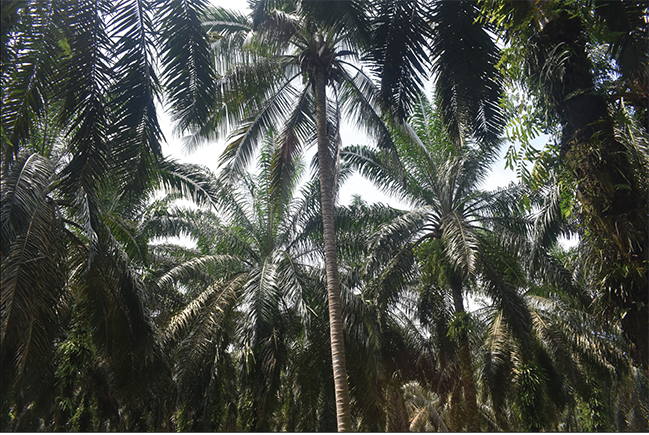
Figure 1.
A single, small coconut palm tree, surrounded by a bunch of oil palm trees. The coconut tree is thin, and it has not borne any fruit since it was planted 30 years ago. Source: author, 18 July 2021.
The limitations of food production also force women to seek alternatives on their own. When allowed, some women explained that they ate the individual fruit from the bunches. I say ‘allowed’ as some plantation companies reinforce strict rules that even individual fruits must be collected and sent to mills, instead of letting workers make use of them. Others identify edible plants that grow in plantations, even though companies categorise them as weeds or invasive species (e.g., fiddleheads and straw mushrooms). The mushrooms are available in pressed fresh fruit bunches once the oil has been extracted. Such options are seen as more feasible and better than expensive and unhealthy processed or instant foods, especially for women workers with children:
Mimi and Riri, the two young girls (eight and seven years old, respectively) who accompanied their mothers spraying toxins in plantations, taught me about a certain pakis (fiddleheads) plant that they loved to eat for dinner. They took me to a dry ditch, and we squatted there for 15 minutes to collect the plant. The fiddleheads are thin, but they convinced me that it was delicious and ‘made your tummy full’. Their mother, Darti, agreed. She added, ‘It’s better than feeding them instant noodles all week’.7
Two forms of degradation occur here: soil degradation causes nutrient losses that prevent women from producing their food and reduces the quality of plantations, rendering their lives unsustainable. Agrochemicals and women’s labour thus become agents of metabolic shift in women’s bodies: their malnutrition and exhaustion, all of which transform into the everyday life of plantations and constitute them (Barua 2025: 147–49). On the ecological front, agrochemicals and the nature of palm trees, which are highly water-intensive, increase heat and force the soil to retain more carbon, rendering the ground infertile and too dry to grow other plants. The situation exemplifies ‘robbing the soil’ and workers in its strictest sense (Marx 1990: 638).
Even as women can forage for their food to an extent, they still expressed concerns about the ‘cleanliness’ of these vegetables and mushrooms, as they have now understood agrochemical exposure and pesticide drift. The dispossession in plantations is thus cyclical and layered: from bodies that are contaminated and maimed, to ecosystems that cannot heal such contaminated and bruised bodies. In a way, the loss of nutrients and the lack of plots also function as other forms of land dispossession; the land no longer belongs to the workers who cultivate it, and neither does it provide for or sustain the sustainable lives of workers. From toxins, dry soil, unbearable heat, and undernourishment to food deserts, plantations enforce a violently toxic ecosystem that depends on the disposability and dispossession of bodies and environment.
No one could answer Maria’s question at the start of this article, either because it is technically too complicated to invent non-hazardous agrochemicals, or because the workers deep down understand that the answer is ‘no’: palm oil needs toxins to sustain it. Investigating how agrochemicals facilitate labour relations between women workers and oil palm plantations highlights the reproduction of the violent ecosystem. Agrochemicals do not just injure the everyday lives of women workers; they also help perpetuate the dispossession that women must suffer and survive at multiple levels. The dispossession by means of agrochemicals is gendered and layered, starting with women’s own bodies, which are rendered disposable and whose life quality is perpetually worsened by the toxic ecosystems that they are mandated to create through their labour. Yet their bodily dispossession also corresponds to the environmental degradation that creates the capitalist ecosystem of plantations. This layered dispossession is not merely an effect or consequence of a bad business policy; rather, it supports the worldmaking of the plantation economy.
Barua, Maan. 2025. ‘Metabolic geographies: Work, shifts and politics’. Progress in Human Geography 49 (2): 145–63. https://doi.org/10.1177/03091325241311914.
Braudel, Fernand. 1992. Civilization and Capitalism, 15th–18th Century, Vol. II: The Wheels of Commerce. California: University of California Press.
Chao, Sophie. 2022. ‘Plantation’. Environmental Humanities 14 (2): 361–66. https://doi.org/10.1215/22011919-9712423.
Chatterjee, Piya. 2001. A Time for Tea: Women, Labor, and Post/Colonial Politics on an Indian Plantation. Durham, NC: Duke University Press.
Chiavaroli, Chiara. 2024. ‘Gendering toxic contamination: Toxic risks, bodies, and pregnancies in gold mining and coca farming communities in the Bajo Cauca Region’. Antipode 56 (5): 1560–80. https://doi.org/10.1111/anti.13051.
Collard, Rosemary-Claire and Jessica Dempsey. 2017. ‘Politics of devaluation’. Dialogues in Human Geography 7 (3): 314–18. https://doi.org/10.1177/2043820617736602.
Cusworth, George. 2023. ‘Metabolic agricultural ethics: Violence and care beyond the gate’. Progress in Environmental Geography 2 (1–2): 58–76. https://doi.org/10.1177/27539687231155224.
Elmhirst, Rebecca, Mia Siscawati and Bimbika Sijapati Basnett. 2015. ‘Navigating investment and dispossession: Gendered impacts of the oil palm “land rush” in East Kalimantan, Indonesia’. Land Grabbing: Perspectives from Southeast Asia 0–0. https://www.eur.nl/sites/corporate/files/CMCP_69-Elmhirst_et_al.pdf.
Guthman, Julie and Becky Mansfield. 2013. ‘The implications of environmental epigenetics: A new direction for geographic inquiry on health, space, and nature-society relations’. Progress in Human Geography 37 (4): 486–504. https://doi.org/10.1177/0309132512463258.
Guthman, Julie and Marion Werner. 2026. ‘Embedded pesticide use: Exploring the pesticide‐land nexus’. Journal of Agrarian Change e70075. https://doi.org/10.1111/joac.70075.
Harcourt, Wendy. 2013. Body Politics in Development: Critical Debates in Gender and Development. London: Zed Books Ltd.
Jegathesan, Mythri. 2017. ‘Black feminist plots before the Plantationocene and anthropology’s “regional closets”’. Feminist Anthropology.
Kinasih, Salma. 2024. Menjalar Dalam Diam: Kesehatan Dan Keselamatan Kerja Di Perkebunan Sawit. Transnational Palm Oil Labor Solidarity.
Krupa, Christopher. 2022. A Feast of Flowers: Race, Labor, and Postcolonial Capitalism in Ecuador. Philadelphia: University of Pennsylvania Press.
Mansfield, Becky, Marion Werner, Christian Berndt et al. 2024. ‘A new critical social science research agenda on pesticides’. Agriculture and Human Values 41 (2): 395–412. https://doi.org/10.1007/s10460-023-10492-w.
Marx, Karl. 1990. Capital: Volume I. Harmondsworth: Penguin.
Mies, Maria. 2014. Patriarchy and Accumulation on a World Scale: Women in the International Division of Labour. London: Zed Books Ltd.
Mies, Maria and Ariel Salleh. 1990. ‘Woman, nature and the international division of labour’. Science as Culture 1 (9): 73–87. https://doi.org/10.1080/09505439009526280.
Mollett, Sharlene and Caroline Faria. 2013. ‘Messing with gender in feminist political ecology’. Geoforum 45: 116–25.
Moore, Jason W. 2003. ‘Capitalism as world-ecology: Braudel and Marx on environmental history’. Organization & Environment 16 (4): 514–17. https://doi.org/10.1177/1086026603259091.
Moore, Jason W. 2011. ‘Transcending the metabolic rift: A theory of crises in the capitalist world-ecology’. The Journal of Peasant Studies 38 (1): 1–46. https://doi.org/10.1080/03066150.2010.538579.
Navas, Grettel. 2023. ‘”If there’s no evidence, there’s no victim”: Undone science and political organisation in marginalising women as victims of DBCP in Nicaragua’. The Journal of Peasant Studies 50 (4): 1569–92. https://doi.org/10.1080/03066150.2021.2024517.
Ojeda, Diana. 2021. ‘Social reproduction, dispossession, and the gendered workings of agrarian extractivism in Colombia’. In Ben M. McKay, Alberto Alonso-Fradejas and Arturo Ezquerro-Cañete (eds), Agrarian Extractivism in Latin America. New York: Routledge. https://www.taylorfrancis.com/chapters/edit/10.4324/9780367822958-5/social-reproduction-dispossession-gendered-workings-agrarian-extractivism-colombia-diana-ojeda.
Sanmiguel-Valderrama, Olga. 2007.’The feminization and racialization of labour in the Colombian fresh-cut flower industry’. Journal of Developing Societies 23 (1–2): 71–88. https://doi.org/10.1177/0169796X0602300205.
Scott, James C. 1998. Seeing like a State: How Certain Schemes to Improve the Human Condition Have Failed. New Haven: Yale University Press.
Sinaga, Hariati. 2021. ‘Buruh Siluman: The making and maintaining of cheap and disciplined labour on oil palm plantations in Indonesia’. In Maria Backhouse et al. (eds), Bioeconomy and Global Inequalities: Socio-Ecological Perspectives on Biomass Sourcing and Production. Cham: Springer International Publishing.
Sinaga, Hariati. 2023. ‘Perawatan Yang Beracun: Kerja Perawatan Perkebunan Dan Reproduksi Sosial Dalam Perkebunan Monokultur Sawit’. Jurnal Perempuan 28 (3): 217–33.
Sinaga, Hariati. 2024. ‘Intersectional perspectives on land relations of oil palm plantations: A decolonial feminist approach on Indonesia’s bioeconomy’. Forest Policy and Economics 159 (February): 103124. https://doi.org/10.1016/j.forpol.2023.103124.
Sinaga, Hariati. 2025. ‘“To cleanse our bodies of poison with poison”: The ecological and reproductive paradox of monoculture oil palm plantations’. Sustainability: Science, Practice and Policy 21 (1): 2532213. https://doi.org/10.1080/15487733.2025.2532213.
Singh, Nikhil. 2006. ‘The afterlife of fascism’. South Atlantic Quarterly 105 (1): 71–93. https://doi.org/10.1215/00382876-105-1-71.
Tilley, Lisa. 2020. ‘“A strange industrial order”. Indonesia’s racialized plantation ecologies and anticolonial estate worker rebellions.” History of the Present 10 (1): 67–83. https://doi.org/10.1215/21599785-8221425.
Vélez-Torres, Irene and Diana Vanegas. 2022. ‘Contentious environmental governance in polluted gold mining geographies: The case of La Toma, Colombia’. World Development 157 (September): 105953. https://doi.org/10.1016/j.worlddev.2022.105953.
Werner, Marion. 2026. ‘Global pesticide complex’. The Journal of Peasant Studies 53 (3): 702–19. https://doi.org/10.1080/03066150.2025.2547373.
Wynter, Sylvia. 1971. ‘Novel and history, plot and plantation’. Savacou 5 (1): 95–102.
Yap, Alia Christine. 2008. Remembering Bodies: Subject Formation in the Neo -Plantation Narrative. Ph.D. diss. University of California, Berkeley. https://www.proquest.com/docview/304696622/abstract/6E609BF435B543A7PQ/1.
Perdana ‘Pepe’ Roswaldy is an environmental sociologist and Assistant Professor of Sustainability at Monash University, Indonesia.
Email: perdana.putri@monash.edu
https://orcid.org/0009-0008-6466-382X
1 Transnational Palm Oil Labor Solidarity Workshop on Occupational Hazards and Environmental Impacts of Oil Palm Plantations, Bogor, 17–19 Sept. 2022.
2 ‘Pekerja Sawit Capai 16,5 Juta Orang, Kemnaker Dorong Linkungan Kerja Layak’, HaiSawit, 10 Sept. 2025. https://haisawit.co.id/news/detail/pekerja-sawit-capai-165-juta-orang-kemnaker-dorong-lingkungan-kerja-layak
3 Basel, Rotterdam and Stockholm conventions, among others.
4 Ethnographic observation in District S, Riau. 16 July 2021.
5 The protection is also rarely a full suit; it is often no more than a collection of an apron, a pair of rubber gloves, a helmet, plastic goggles and a K94 mask (N95 on good days; but it’s never a gas mask).
6 Ethnography interview in District S, Riau. 12 July 2023.
7 Ethnographic observation in District S, Riau. 18 July 2023.