Vanessa Villegas Solórzano
PLANT PERSPECTIVES 3/2 - 2026: 288–303
doi: 10.3197/whppp.63876246815931
Open Access CC BY 4.0 © The Author
The chonta palm – Bactris gasipaes – is a part of the identity of the Afro-descendant communities that inhabit the Pacific coastlands of Panama and Colombia through southern Ecuador. Its fruit, chontaduro, was fundamental for the food sovereignty of those who made this area their home after escaping slavery and continues to be a nutritional source with multiple uses in regional cuisines. The wood stock of the palm is used in the construction of chonta marimbas, emblematic instruments of traditional Afro folk music. Both in the elaboration of chonta marimbas and in the culinary uses of chontaduro there is a great knowledge and intangible cultural heritage of the Afro communities of these three countries, knowledge that binds them together and transcends international borders. The article addresses this heritage with the aim of contributing to the understanding of how biased race and class issues have affected both culinary culture and music making.
Bactris gasipaes, chontaduro, chonta marimba, chonta palm, peach palm, Afro-descendant communities, music, Pacific music, food sovereignty, intangible cultural heritage, racism
Chontaduro is arrival in Cali, in the Valle del Cauca Department in Colombia. Although there are certainly better places to eat it, the ones sold at the airport are those everyone yearns for after months of being disappointed with those you find in Bogotá. The taxi ride to Cali from the airport is always accompanied by a small bag of chontaduros to provide taste to the landscape.
(Nicole Chapaval Ventura - Personal Communication)
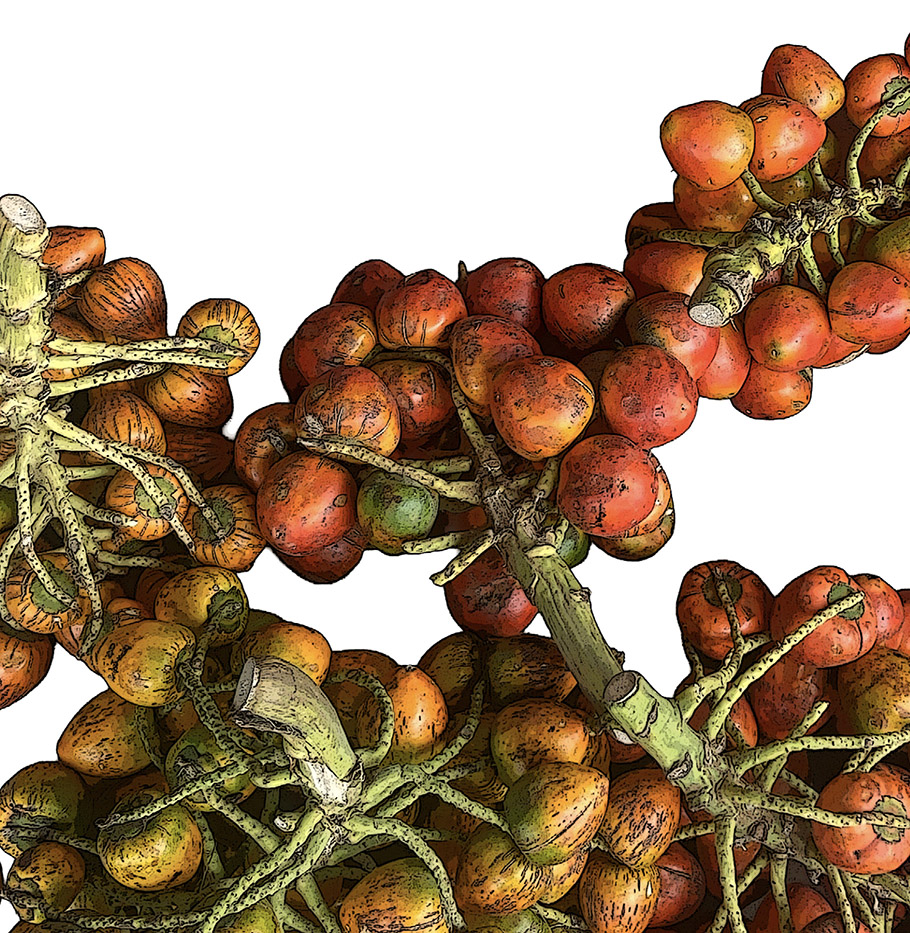
 Chontaduro1 with honey and salt. That’s what returning home tastes like to people raised on Colombia’s Pacific coast. That’s the taste of home, of the bond with the homeland, the taste of the territory. And this fruit, in addition to being nutritious – classified in the twenty-first century as a superfood – condenses a part of the cultural identity of this rich and diverse region. The people of the Colombian Pacific find in its bright colours – red, orange, yellow and green – a compass, a beacon that marks for them the certitude of their place of origin.
The cultural identity of the Colombian-Ecuadorian-Panamanian Pacific coast – known in Colombia as the Pacific region – is also found in its music, in the sounds of the chonta marimba. The marimba as a percussion instrument comes from the African continent and, in the Pacific region, it marks the rhythm of life. For a large part of the population but mostly for Afro-descendants, the marimba and its music are present at births, baptisms, birthdays, celebrations, parties and, of course, farewells and wakes. In Afro communities the sound of the marimba remains a life companion from the very beginning to the end. And chonta, the wood from which its keyboard is made, comes from the same plant that produces the fruit that tastes like home: the chonta palm.
Thus, a large part of the cultural identity of this region inhabited by Indigenous peoples, Afro-descendant communities and mestizo populations stems from the same tree: the peach palm (Bactris gasipaes Kunth). This South American palm tree that was already culturally significant for pre-Hispanic communities acquired new dimensions thanks to the contributions of Africans who arrived in this part of the American continent after being kidnapped from their homeland and enslaved.
This text reflects on the cultural value, both tangible and intangible, of the peach palm for the inhabitants of the Pacific region as an important food source, which, for the Afro-descendant peoples, represents much more. It is an ecosystemic symbol, a conection to their spiritual life and a key part of one of their most representative musical expressions. There is also the question of the interaction of Afro-descendant communities with other communities in the expansion and consolidation of the peach palm as part of the cultural heritage of the region.
The biogeographic region of Chocó is the area located between the sea and the Andes mountain range in northern South America, stretching from Ecuador through Colombia to Panama. The Andes mountain range receives moisture from the Pacific Ocean and condenses it, transforming it into one of the rainiest areas in the world,2 with impressive watersheds rich in nutrients and equally powerful tributaries.
Although the Amazon and the biogeographic region of Chocó are separated by a vast mountain range, they share certain characteristics that link and connect them. This connectivity is documented, for example, in the passage of animals and in the distribution of plant species, and also because this corridor has been used as an outlet to the Pacific coastline by human communities since pre-Hispanic times.
Origins and domestication of the chonta palm
Both the Amazon Basin and the biogeographic region of Chocó pose a double challenge in the face of Western values of scientific certitude and its principles, when tracing archaeological remains or written sources. On the one hand, the environmental conditions of both regions make it very difficult for plant remains to survive for several years, as everything degrades easily. On the other hand, the communities that lived and still live there have ways other than writing to record their knowledge and history, including oral tradition, festivities and musical expressions that reflect not only their cosmogony and knowledge, but also their relationship with the environment.
The fact that certainties elude Western academia’s gaze offers no ground to an assumption that there is no evidence of knowledge about the use of a species. Learning to read at the margins, to cross-reference information with other disciplines and to recognise the profound knowledge of the territory held by the different peoples who inhabit it is essential to providing a more just, if not a more complete, approach.
Having that in mind, the peach palm is one of the many plant species that seems to confirm the interconnectivity of the Amazon basin, the Andes and the biogeographic region of Chocó. Initial estimates indicate that the domestication of Bactris gasipaes Kunth occurred in the Amazon basin around 2000 bce (between 4000 and 3000 bp, according to González-Jaramillo et al.). However, as shown later, domestication may have occurred much earlier, as suggested by the earliest archaeological remains of this plant that have been found in present-day Costa Rica, dating from between 2300 to 1700 bce (González-Jaramillo et al. 2022).
There are several reasons to mention domestication, firstly because there is an evident morphological differentiation between domesticated and wild species. In domesticated species, the fruits are larger and the stems of the palm trees appear to have fewer thorns. The second reason is how difficult it is for Bactris gasipaes Kunth to reproduce without human assistance (Clement 1988). Domestication, researchers claim, coincides with the establishment of the first sedentary communities in the Amazon basin we know of to date.
Information gathered by researchers of Amazonian communities (Sosnowska and Kujawska 2014, Patiño 1992, Clement 1988) points out that the stories and legends that comprise the cosmogonies of some Amazonian peoples in southern Colombia, Ecuador, Brazil and Peru mention that, after eating a fruit from the peach palm, it is essential to save the seed to later plant it near home. This very simple agricultural instruction, embedded in the myths that constitute the history of these peoples, highlights the cultural and nutritional relevance of the peach palm. At the same time, it allows us to see the sophistication of the relationships between communities and ecosystems.
Whatever the reasons for its domestication, this must have happened early in the occupation of the tropical lowlands, because the difference between the primitive pejibayes3 (e.g., G. microcarpa, fruit size 4.4 g) and the most advanced landraces (e.g., Putumayo, 100.8 g) is enormous … A change of this magnitude takes considerable time and requires specific breeding conditions, since pejibaye is allogamous. (Clement 1988)
That being said, in the scientific literature on Bactris gasipaes Kunth, doubts are usual about whether or not pre-Hispanic communities ate chontaduro directly as fruit. It is claimed that it was used to produce chicha (a fermented beverage), but few people in academia dare to affirm its consumption direct as a fruit. The fear of declaring such use may have two explanations, one would be that in order to be eaten by humans, chontaduro requires to be boiled in water for at least thirty minutes. Following, there is a lack of scientific evidence (archaeological remains or written sources) to demonstrate that such sophisticated processing occurred in Amazonian communities in pre-Hispanic times. Doubts – if not biased interpretations – raised by Western scholars about the knowledge-base of pre-Hispanic communities are rooted in prejudice. They find it hard to accept that such ‘primitive’ peoples may have had such a sophisticated level of knowledge.
Fortunately, Latin American researchers with an ethnobotanical approach, such as Clement and Patiño, have said it clearly. Patiño stated in 1963: ‘Bactris gasipaes has been an important crop for human nutrition since pre-Hispanic times’. And Sosnowska and Kujawska summarised it this way:
Bactris gasipaes (peach palm), which is domesticated at population level, may
have been one of the staple plants in the Amazon. This inference is based on its
degree of domestication (Clement 1988) and its importance to many societies, as seen in their myths, legends and festivities (Patiño 1992).
According to the cosmogony of some Amazonian communities, the peach palm may be of equal importance to corn and cassava. Some even claim that the image of the tree of life and abundance is a peach palm, precisely because every single part of it has a use or, as Patiño claimed, ‘no part of it goes to waste’ (Patiño 1963).
In the pre-Hispanic communities of the Amazon, the peach palm was a source of excellent quality wood used for construction, but its main value lay in its hardness, which was ideal for making hunting tools such as arrows and bows. As a food, what is most certain is that its fruits were used to make chicha, which, depending on the fermenting time, could acquire a considerable alcoholic strength. The fruit was also consumed boiled and roasted and it is speculated – given the fruit’s rapid fermentation – that it was dried and turned into flour before fermentation occurred, which was then used to make a bread reminiscent of casabe, made from bitter yuca.4 From the heart of the palm and its shoots, hearts of palm were obtained, which were also a rich and nutritious food. The palm leaves were used to roof dwellings and weave fishing baskets. In this case, there was also an added advantage: when immersed in water, the leaves of Bactris gasipaes release a substance that numbs fish, making them easier to catch. The trunk’s spines were used as needles – useful in sewing clothing as well as for other purposes – the root provided a remedy for intestinal parasites, and the fallen old dead palm trees were the ideal organic matter for mojojoyes – the larvae of various species of Phyllophaga beetles – which are considered a jungle delicacy and a rich source of protein (Patiño 1963, Clement 1988).
Simply put: it is a perfect plant in every sense.
Pre-Colombian uses of pejibaye (Bactris gasipaes) as reported by Patiño (1963)5
|
Roots |
medicine (vermicide) |
|
Stem |
bows, arrows, fishing poles, harpoons, flooring and panelling for habitations |
|
Spines |
needles |
|
Leaves |
thatch, basketry |
|
Heart of palm |
vegetable |
|
Flowers (male) |
ingredient in flavorings |
|
Fruits (cooked) |
direct consumption, fermented to make chicha (a nutritious, slighly alcoholic beverage), ground and dried to make flour, cooked with meat or fish, etc |
|
Seed |
direct consuption as nut |
Upon their arrival in what is now Costa Rica, the Spanish conquistadors found Bactris gasipaes Kunth crops in that part of the continent. The presence of a species so far removed from its place of origin reveals at least two things: the aforementioned interconnectedness of the regions and the peoples who inhabited them, and the cultural importance of this species for pre-Hispanic communities6.
Once the conquistadors began to advance inland into the Americas, especially in northern South America, the presence of the peach palm was notable. It was found in populated areas and markets both in the Central Andean valleys and in the biogeographic region of Chocó. It was a culturally significant, colourful and highly valued species. This is how chronicler Pedro Cieza de León records it in his ‘Chronicle of Peru’, written between 1541 and 1550, upon arriving in the lands of ‘the chieftain Nutibara and his dominion, and of other chieftains subject to the city of Antiocha’, present-day Antioquia Department (state), Colombia:
Many beautiful rivers originate from the tops of the mountains; their banks were filled with fruits of all kinds, including very long, slender, and thorny palm trees. At the top of these trees, a bunch of fruit called pixivaes grows. This fruit is large and very useful, because it is used to make bread and wine. If you cut open the palm tree, you can extract a good-sized, tasty, and sweet heart of palm. (Illera (comp.) 2012)
The arrival of the Afro-descendant population
The Spanish conquistadors quickly learned the potential of the central valleys in present-day Colombia, especially the Cauca River valley, for agricultural crops. It began with rice, and shortly afterward, sugarcane. To this end, there was a large movement of enslaved people brought by force from Africa, who, by the end of the colonial period, had become the majority in what was then the Gobernación (Province) of Popayán.
The 1789 census transcribed by Francisco de Silvestre indicates that this Gobernación [of Popayán] had 64,463 inhabitants, of whom more than 35,000 were Black, distributed between 22,979 free people and 12,241 slaves. They were concentrated in the valleys of the Cauca and Patía rivers and in the towns along the Pacific coast. (Patiño Ossa 2012)
Added to this was the fact that the natural barriers of the biogeographic region of Chocó made it a possible, even desirable, destination for those who escaped slavery or achieved freedom. Thus, Afro-descendant settlements emerged along the riverbanks, and in the estuaries of the Pacific coast, which coexisted through market and cultural exchanges.
The Afro-descendant population found in the biogeographic region of Chocó a territory where they could live in freedom, building small towns along the banks of mighty rivers and understanding the jungle. A place where they could live in motion, where they could ‘live sabroso’.
In her book Vivir sabroso. Luchas y movimientos afroatrateños en Bojayá, Chocó, Colombia, Natalia Quiceno emphasises that moving, inhabiting and travelling along the rivers, or as she puts it, ‘being in motion’, is part of the territoriality and, therefore, of the identity of an important portion of the Afro-descendant communities in this part of the continent (Quiceno Toro: 2016: 232). In this ‘being in motion’, in which family networks are distributed and rooted along watersheds, rivers of course act as highways along which people circulate, as well as essential goods for the body and the spirit: plantains, chontaduros (peach palm fruit), music (marimbas), and viche (a sugarcane distillate made by the Afro-descendant communities of the Colombian Pacific). This way of life, ‘in motion’, but also in freedom and dignity, is the basis of ‘vivir sabroso’, a spiritual notion of profound wellness linked to the territory and the Afro-descendant identity of the Pacific.
Collective memory and cultural identity
The Afro-descendant population shaped the cultural identity of this particular region in many ways. Perhaps one of the most obvious contributions is in the kitchens, which, Patiño Ossa insists, were ‘the domain of Black women’. In the biogeographic region of Chocó, for example, the plantain (Musa spp.) was brought to the Americas as a food staple for enslaved people, and acquired a prominence that remains. But perhaps a key point in determining the presence of the plantain among the Afro-descendant populations in the Americas – and here is a point that links it to the peach palm, as will be shown later – is that this plant represented the connection to Africa, to the land from which these people or their relatives had been forcibly removed. Thus, the plantain represented the celebrated ‘warmth of home’ in food, the tastes and aromas that allowed people an imagined return home, to childhood and better times, to the native land. Likewise, for Afro-descendant communities, the presence of a plantain tree in the yard of their dwellings or in the village meant a sense of belonging, a ‘this is now my land, I am now from here’.
When the black man says marimba and guasá
his voice has the color of seaweed and mangroves,
the sweet provocation of the chontaduro,
the insinuating sway of the palm trees
the yellow of gold
and the feeling of nostalgia for Africa
(Mary Grueso Romero)7
The collective memory of Afro-descendant communities in Colombia allowed them to establish close ties to their land through various plant species. Many of these species – as is the case with plantains or rice and sugarcane – were based on the direct connection between these and Africa, while others were an adaptation based on the resemblance of some American species to plants with similar characteristics that were culturally significant on the African continent.
While for those with a twenty-first-century perspective this comparison may seem forced to the point of arguing that they find no resemblance in either the shape of the palm or in the shape of the fruit, collective memory – as will be seen with the marimba – is a powerful tool. It is something that allows peoples to build invisible bridges, bonds that are sometimes impossible for outsiders to imagine.
Such is the case of Bactris gasipaes Kunth, whose fruits may resemble the fruits of African oil palm Elaeis guineensis.8 And as Atinmo and Taiwo Bakre (2003) mention, like the peach palm, the African oil palm is also considered by various peoples in Africa as a ‘tree of life’ because each of its parts is of use and has representations in both the tangible and the intangible culture. I argue that there is a possibility that the physical resemblance of the fruits of both palms, combined with the cultural importance of the American species for local communities – which resonated with the uses and knowledge borne by African peoples around oil palm on that continent – is what may have opened the gates for Afro-descendant peoples in the biogeographic region of Chocó to adopt Bactris gasipaes Kunth as their own, thus tending another layer of connection with their new land and a new dimension to the cultural value of the peach palm.
The marimba appears as this new layer of meanings and collective memory for those who inhabit the biogeographic region of Chocó. Music holds a special place in the spiritual life of peoples, and the Afro-descendant communities of the biogeographic region of Chocó are no exception. In many cases, the only link these peoples had in common was having arrived enslaved. They did not speak the same languages, nor did they share identical traditions. Music played a key role into bringing social cohesion among them, fostering the creation of a new collective cultural identity among peoples of very diverse origins. The collective memory of the Afro-descendant peoples preserved the memories of songs, rhythms, tunes and musical instruments that moved from continent to continent and acquired new forms and meanings, an example of the resilience, power and identity of intangible cultural heritage.
The Afro-descendant peoples of the Pacific coast, using their collective memory and recalling the instrument they played on the other side of the Atlantic, began to build marimbas with the wood of the Bactris gasipaes. The handling of chonta wood – which must be cut during the waning moon and dried for months to acquire the hardness that makes it so special – possibly stems from the exchange of knowledge with Indigenous communities who perfectly mastered these techniques, which are also essential to guarantee the instrument’s durability in a region where humidity is often above eighty per cent. But let me be clear: among the many uses that pre-Hispanic communities gave to chonta wood, no evidence of its application in musical instruments has been found so far. And contemporary Indigenous communities in the biogeographic region of Chocó do not build marimbas nor play them. This is Afro-descendant knowledge and it appears to be a shift made by Afro-descendants in the use of peach palm.
Thus, the recreation of the African marimba with wood native to this side of the Atlantic gave rise to the chonta marimba, the identifying sound of the biogeographic region of Chocó or as the people of the region play and chant in homage to the man who was a great marimba player:
Mr. Justino García, was a very popular man;
with a marimba in his hand, he made the shoreline tremble;
how it sounded, how it sounded, how that marimba resounded
(Inés Granja 1981)9
The sound of the chonta marimba travels down rivers, often in boats to attract fish, often as part of festivals held on the water, as is the case with amphibious cultures, and often to bid farewell to the dead. The spiritual meaning of its music is deep; it is attached to life and death. Along the coast, they say the marimba is attuned to the jungle, and that much of its spiritual power resides there.
Cooked and eaten with chonta palm
In the city of Cali, they say the best chontaduros are found around hospitals and health centres. Relatives and friends often make a mandatory stop at street stalls before visiting sick people to eat them, as tradition and taste dictate, with honey and salt. On the one hand, if the trip has been long, the chontaduros will give them the energy they need to regain their strength. On the other hand, bringing a small bag of these fruits to those recovering in hospital is, in addition to a rich and nutritious food, a wish for a speedy recovery accompanied by the multiple vitamins and antioxidants chontaduro provides.
Acknowledgement of the valuable nutritional properties of chontaduro dates back to pre-Hispanic times (remember the teachings about saving the seed to be planted close to home), and it allowed Afro-descendant communities to achieve food sovereignty as they began to settle in these lands. Along the Pacific coast, plantain and chontaduro converged to establish roots and identity, primarily in traditional cuisines. However, unlike plantains, which are pretty popular in regional and nationwide recipes, even to some extent transcending class and racial divides, chontaduro remained a niche food, closely linked to the region, but especially to racialised communities. The fact that plantains arrived in the Americas through Spanish colonizers – although they were not initially intended for themselves, but rather for their enslaved people – may have modified the cultural significance of this species, which was then no longer associated exclusively with racialised people. Chontaduro, by contrast, was often disparagingly categorised in Colombia as ‘food for Blacks and Indians’ or even ‘food for the poor’.
And perhaps this connection with racialised and impoverished people explains its disrepute. There is a clear contrast between the abundance of chronicles that record the presence and importance of this fruit in markets since the sixteenth century – not only in the biogeographic region of Chocó but also throughout much of the Andes and the Colombian Caribbean – and the scant trace of chontaduro to be found in regional or nationwide cookbooks, at least until the early 2000s (except as part of the props in photos of local cuisine).
The movement to recognise culinary traditions as intangible cultural heritage – which in Colombia dates back to 2006 – began to change that logic.10 In 2024, chontaduro flour was ‘discovered’ as a gluten-free food while the nutritional value of a single chontaduro is being compared to that of one egg. Chontaduro chips are increasingly found in stores, and Colombian restaurants include the fruit in several dishes, either as a side or as a main ingredient in their recipes. The reclaiming of the chontaduro has also been possible thanks to the enormous cultural and symbolic value this fruit holds, which has resisted the structural racism present in the region.
The chontaduro of the Pacific is yet another survivor of the coastlands. The plant is affected by both aerial spraying [of glyphosate] and by pests. It is still cultivated thanks to the persistence of coastal farmers who refuse to let go of the connection that the peach palm provides them between their culture and their music. Peach palm guarantees them food sovereignity and a sustainable economy.
(Andrés Ramírez Urbano – Personal Communication)
Conclusions: Does identity fit into a plant?
The chonta palm is an essential species for the peoples who inhabited and continue to inhabit northern South America: it has been food, home, celebration, identity and a bond with their territory. It represents resistance and resilience, transformation and connection. However, as shown throughout this text, when addressing the history, domestication and cultural value of this plant, Western academia has dismissed the knowledge of the diverse peoples of the Amazon and the biogeographic region of Chocó. In contrast, it has favoured archaeological, archaeobotanical and written sources, which, as mentioned above, are scarce in this region simply because communities have other ways of recording their history and cosmogony.
Deep science and environmental knowledge also reside in oral, musical, botanical, architectural and culinary expressions as well as in other manifestations of cultural heritage. Understanding this offers a broader and more comprehensive view of the importance and meanings of Bactris gasipaes, the territories where it grows and the peoples to whom it is linked, those with whom its symbolic and cultural value has been consolidated. However, to do so, it is necessary to rid ourselves of colonial and racist biases.
The Indigenous communities of northern South America were essential in domesticating the species and safeguarding the knowledge and symbolism surrounding the peach palm, which in pre-Hispanic times was already important in daily life as well as in the spiritual dimension. The Afro-descendant peoples of the biogeographic region of Chocó recognised in the peach palm a connection to their place of origin that allowed them to set roots in this, their new territory. In this way, they strengthened their ties of ancestry and their bonds to Africa which are the essence of their cultural identity. Through these, they were able to create new layers of knowledge, equally powerful and culturally significant, such as the use of chonta wood for the construction of marimbas. Eating and dancing with Bactris gasipaes is inherently a symbol of resistance. It has defied structural racism, stigmatisation and persecution thanks to communities that have safeguarded this knowledge. They are the women and men who sell chontaduros, who cook with the fruit of the chonta palm and who compile recipes in their songs or memorise woodworking procedures, who celebrate the chontaduro and dance with the sound of the marimba.
The day I was born
Laughter and sorrow were born
Also were born dance and song
And was born love with the poem
There were born canchimalá [Ariopsis simonsi], piangua [Anadara tuberculosa]
And also prawn and shrimp were born
There were born borojó [Borojoa patinoi], chontaduro [Bactris gasipaes Kunth]
And also naidí [Euterpe oleracea] and milpesos [Oenocarpus bataua] were born
(Zully Murillo)11
Bactris gasipaes is a fundamental part of ‘vivir sabroso’, the concept of life wellness in Afro-descendant communities in the Colombian Pacific, which, again, consists of living freely and with dignity and sovereignty. The importance of this species to food sovereignty, spiritual life and the enjoyment of life of the racialised peoples of the biogeographic region of Chocó, places it at the centre of a reflection on how racial prejudices affect foodstuff, as well as how it affects science and academia, both of which have for decades hesitated to give the plant species its rightful place.
Atinmo, T. and A. Bakre. 2003. ‘Palm fruit in traditional African food culture’. Asia Pacific Journal of Clinical Nutrition 12: 350–54.
Clement, C.R. 1988. ‘Domestication of the pejibaye palm (Bactris gasipaes): past and present’. Advances in Economic Botany 6: 155–74.
González-Jaramillo, N. et al. 2022. Peach palm (Bactris gasipaes Kunth.): Ancestral tropical staple with future potential. Plants 11 (22): 3134.
https://doi.org/10.3390/plants11223134
Illera, C.H. 2012. Nuestras cocinas desde el Nuevo Reino de Granada (siglo XVI) hasta la República (siglo XIX) a la luz de algunos cronistas y viajeros. Biblioteca de cocinas tradicionales de Colombia. Ministerio de Cultura de Colombia.
Dirección de Patrimonio Ministerio de Cultura de Colombia. 2011. Convención y política de salvaguardia del Patrimonio Cultural Inmaterial. Ministerio de Cultura de Colombia.
Patiño, V.M. 1963. Plantas Cultivadas y Animales Domésticos en América Equinoccial. I. Frutales. Cali, Colombia: Imprensa Departamental.
Patiño, V.M. 1992. ‘An ethnobotanical sketch of the palm Bactris (Guilielma) gasipaes’. Principes 36 (3): 143–47.
Patiño, V.M. 1989. ‘Comportamiento de plantas nativas colombianas bajo cultivo: situación actual del cultivo del chontaduro’. Revista de la Academia Colombiana de Ciencias 17 (65) 259–64.
Patiño Ossa, G. 2012. Fogón de negros. Cocina y cultura de una región latinoamericana. Biblioteca de cocinas tradicionales de Colombia. Ministerio de Cultura de Colombia.
Quiceno Toro, N. 2016. Vivir Sabroso: luchas y movimientos afroatrateños, en Bojayá, Chocó, Colombia . Bogotá, Colombia: Universidad del Rosario.
Sosnowska, J. and M. Kujawska. 2014. All useful plants have not only identities, but stories: The mythical origins of the peach palm (Bactris gasipaes Kunth) according to the Peruvian Asháninka’. Trames: A Journal of the Humanities and Social Sciences 18 (2).
https://doi.org/10.3176/tr.2014.2.05
Vanessa Villegas Solórzano has a BA in Philosophy and an MA in Cultural Policies and Projects Management. She has been part of editorial and writing teams for the arts and for cultural magazines. Vanessa has been a book editor for more than fifteen years and she also has worked as ghost writer. She does research on food and foodways from a Latin American and decolonial perspective. She is the creator of the podcast Carreta de Recetas, about cooking, gender, politics and culture. She is a frequent guest speaker at courses and conferences with emphasis on food and gender matters. Vanessa is the Editor of the Latin American foodways website Comestible.info.
Email: manesita@gmail.com
1 In this text I will use the term chontaduro to refer to the fruit of the chonta palm (peach palm or Bactris gasipaes Kunth). Other common names this fruit receives are: pejibaye, pupuña (pupunha), pipire, pijuayo, pixbae, pixivae, cachipay, pifá, pibá, chima, tembe, chonta, kiri.
2 Annual precipitation has been estimated at 13,300 mm3 per year.
3 Pejibaye is another name for the peach palm and its fruit. When a species is relevant to human communities, the possibility of multiple ways of naming it increases. The linguistic argument also cited by Clement becomes relevant here: when a plant is culturally significant, there are words to name each of its parts in detail.
4 Bitter yuca or manioc are identified as the toxic varieties of the genus Manihot. Amazonian communities’ deep knowledge of their land, as well as the foods produced there, led the people of this part of the world to develop a sophisticated method for cooking and transforming poisonous manioc into nutritious food.
5 Taken from Clement 1988.
6 The dating of 2300–1700 bce for the earliest archaeological remains of Bactris gasipaes – cited in the text by González-Jaramillo – leads to doubt either about the date of domestication estimated in by González-Jaramillo or about the dating of the remains found in Costa Rica, since they are too close to each other.
7 Cuando el negro dice marimba y guasá
su voz tiene el color de las algas y el manglar,
la dulce provocación del chontaduro,
el insinuoso vaivén de las palmeras
el amarillo del oro
y el sentimiento de nostalgia del África (Mary Grueso Romero)
8 ‘A palm fruit, the ‘tree of life’: it has an outer edible layer, the mesocarp; then a layer of shell, inedible, and the kernel inside, edible. The solution to this puzzle summarizes the botanical and cultural characteristics of the palm fruit’ (Atinmo and Taiwo Bakre 2003).
9 Señor Justino García, un hombre muy popular;
con su marimba en la mano puso a temblar el litoral;
cómo sonaba, cómo se oía, cómo retumbaba esa marimba.
Canción ‘Homenaje a Justino García’. Words and music by Inés Granja (1981).
10 ‘It is often pointed out that, alongside increasing economic globalization and the expansion of lifestyles in modern industrialized society, processes of cultural homogenization have been taking place, often resulting in unwanted losses of linguistic and cultural heritage, such as musical, craft, and culinary traditions, folk medicine, and traditional knowledge of biodiversity’. Heritage Directorate of the Ministry of Culture of Colombia (2011).
11 El día que yo nací
Nació la risa y la pena
Y la danza y la canción
Y el amor con el poema
La canchimalá, la piangua
Langostino y camarón
El borojó, el chontaduro
Nacieron naidí y el mil pesos
(Zully Murillo)