Theresa Ventura
PLANT PERSPECTIVES 3/2 - 2026: 266–287
doi: 10.3197/whppp.63876246815930
Open Access CC BY 4.0 © The Author
This photo essay filters the Philippine copra industry through the lens of the cropscape, a mode of understanding the multiple assemblages and timescales by which rooted plants become mobile. One key story in this assemblage is Imelda Marcos's Tahang Pilipino – a model ‘Filpino home’ purportedly built exclusively out of coconut materials at the dawn of her husband's martial law regime and today popularly known as a ‘the Coconut Palace’. By approaching the Tahanang as a mid- to late-twentieth century iteration of a longer visual culture of coconut palm extraction, we see how Imelda Marcos’s imagined coconut future was deeply rooted in the extractive logics of a Euro-American colonialism that divided the globe into a temperate North and tropical South. The Tahanang Pilipino, I argue, modernised and nationalised a colonial history by naturalising the Philippines as a producer of tropical commodities for global consumption.
Coconuts, palms, Philippines, United States, history
 The Cultural Center of the Philippines Complex (CCP) sits on land reclaimed from Manila Bay. First Lady Imelda Marcos designed the complex in 1966 to be a statement about the country’s place in the world and, by implication, her husband Ferdinand’s leadership. Its two theatres and a film centre were to serve as a repository for the otherwise linguistically and ethnically diverse archipelago’s shared national heritage. A massive hotel and a convention centre announced that the Philippines was open to international business and investment. The Tahanang Pilipino – a model provincial home built almost entirely out of coconut – signaled that palm agriculture was the business in which to invest. Colloquially known as the ‘Coconut Palace’, the Tahanang put the palm to work.
The Palace captures the coconut palm’s (Cocos nucifera) material and aspirational labours on behalf of the Marcos regime. It showcased the potential of coconut as a building material and of Filipino labourers as skilled craftspeople. An estimated 2,450 trunks were rendered into timber and shingling. Hundreds of thousands of smoothed and polished shells provided decorative inlays on doors, walls, and a 36-foot-long dining table made of coconut wood. A chandelier composed of 101 shells flanked by two imposing wooden stairways greeted visitors upon entry (Figure 1). The seven guestrooms on the second floor, each representing the craft and flora of a region, signaled national unity despite a communist insurgency in rural Luzon and a separatist movement in Muslim-majority Mindanao. The largest and most gilded of these was the Ilocos Room, birthplace of Ferdinand (Lico 2003: 117–19). The inverted trunks serving as exterior columns – 122 in total – had been bred and engineered for the Palace by the Philippine Coconut Authority and the United Nations Coconut Wood Utilization Project (CWUP) headquartered in Mindanao’s Zamboanga peninsula (Figure 2). The wood, named Imelda madera in honor of its patron, symbolised the first family’s power over the plant and over human life even in the furthest and most rebellious provinces.
Despite popular resistance to the World Bank and IMF loans funding that the CCP mounted and to the regime of martial law imposed by her husband in 1972 on the premise of fighting communism and separatism, Imelda still declared the Tahanang ‘an architectural masterpiece, reflective of the Filipino people’s culture and their loftiest aspirations free from the vestiges of colonialism. It is a repository of native materials to show the Filipinos and the world that the Philippines is truly a rich country’ (Marcos 1981, quoted in Lico 2003: 117). Yet, as architectural historian Diana Martinez notes, its official opening was timed to coincide with the 1979 UN Conference on Trade and Development at the CCP. The Tahanang Pilipino ‘was only the most symbolic gesture of the Philippines’ willingness and ability to support an agenda oriented toward the development of a trade economy’ (Martinez 2022: 117).1
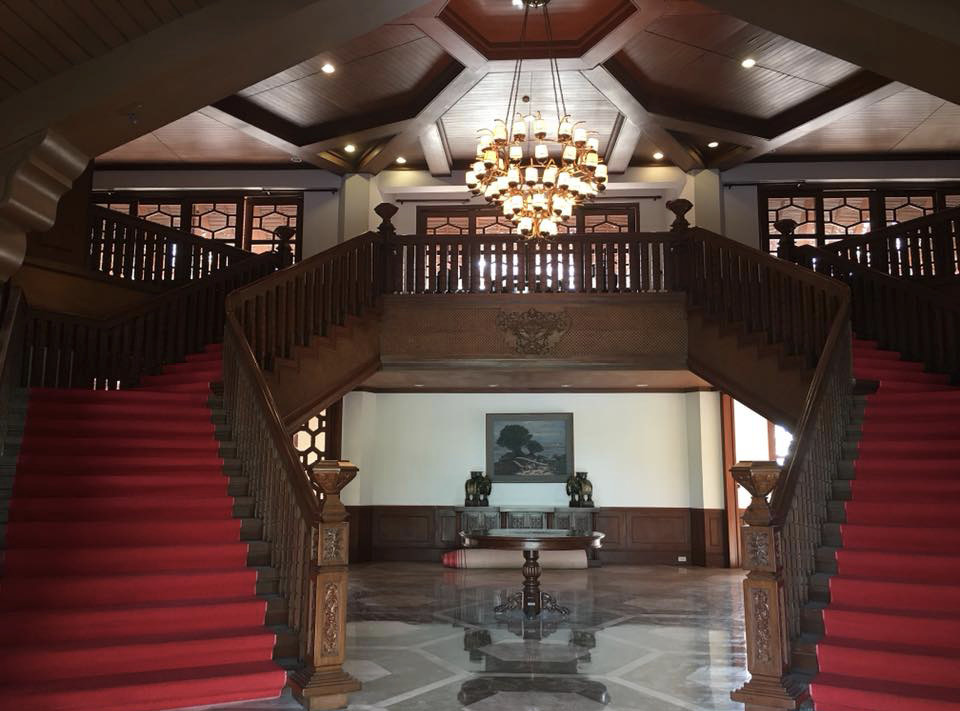
Figure 1.
Interior lobby of hardwood staircases and the 101-coconut shell chandelier. Tahanang Pilipino, Cultural Center of the Philippines Complex, Manila.
Photograph from https://buildeee.com/articles/the-coconut-palace
Pushing beyond the symbolic, this essay treats the Tahanang Pilipino as a mid- to late-twentieth century iteration of a longer visual culture of coconut palm extraction. Imelda Marcos’s imagined coconut future was deeply rooted in the extractive logics of a Euro-American colonialism that divided the globe into a temperate North and tropical South. Colonial tropicality, write Felix Driver and Luciana Martins, invoked a visual code that framed the people and nature of the Global South as latent frontier resources for an ever-expanding industrial capitalism (Driver and Martins 2005). In the American colonial Philippines, invocation of these visual codes justified and guided Indigenous dispossession, the punitive relocation of racialised labour and the felling of forests for plantation agriculture, as processes of enclosure and ecological disruption that are constitutive of frontier zones.2 In an age of otherwise intense imperial competition, it also facilitated inter-imperial exchange among the Euro-American resource managers who built colonial states and understood their work as improvement. The plantation photography of colonial commissioner and resource entrepreneur Dean Conant Worcester, planter manuals, and treatises of economic botany explored here were key components of how complex landscapes became knowable, manageable, and reproducible. Indeed, during the US occupation (formally 1898–1946), copra – the dried endosperm or meat of the coconut from which oil is pressed – became the archipelago’s third largest export. The coconut’s transformation from a local crop that shielded small growers from the precarities of commercial agricultural to a contemporary driver of inequality is a testament to the world-making power of the extractive gaze.
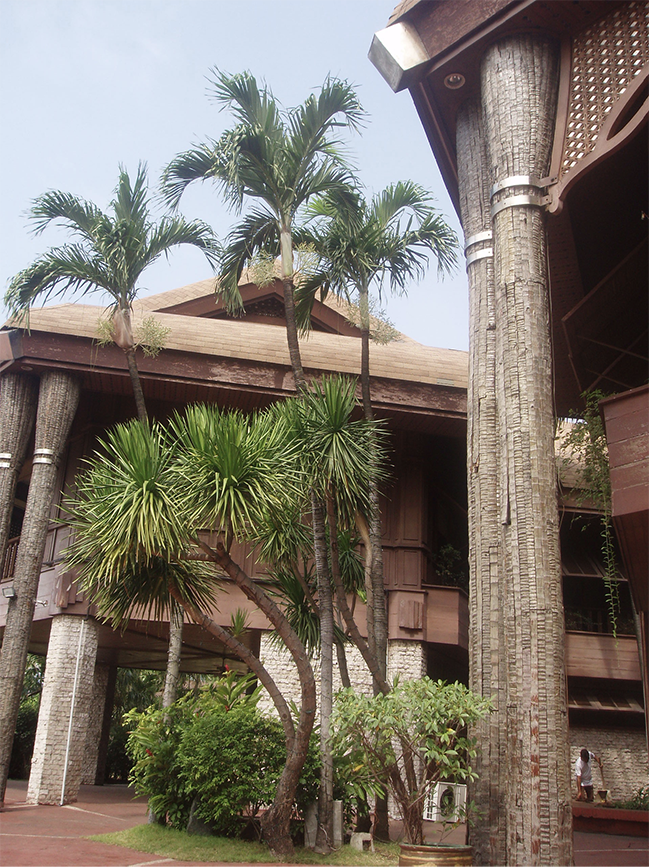
Figure 2.
Four of the 122 exterior columns made from the Philippine Coconut Authority and the United Nations Coconut Wood Utilization Project’s Imelda madera.
Photographed by the author in Manila, 2007.
The extractive gaze and the coconut cropscape
The imperial division of the globe between a temperate, industrial north and a tropical equator was the conceptual foundation of the coconut cropscape, here broadly defined as the biological, environmental, and social contexts in which crops are simultaneously embedded and made movable (Bray et al. 2023: 4). For American expansionists in 1898, the occupation and annexation of the Philippines promised movement from a North American to a world superpower. The islands were a stepping-stone across the Pacific toward an imagined China market but also a place from which to funnel yet unknown tropical resources to US factories and consumers. To this end, botanists, agronomists and veterinarians flanked the invading army as it waged a brutal war of occupation that took upwards of 250,000 Philippine lives. Colonial Bureaus of Agriculture, Forestry, and Lands were established during the war and acted as adjuncts of the United States Department of Agriculture (USDA), with staff circulating between the Philippines and Washington DC. USDA Secretary James Wilson advised his counterpart in the Philippine colonial government, the agronomist Frank Lamson Scribner, that his bureau should focus on ‘fibers, coffee, rubber, spices, and such things as we cannot produce should have most attention’ (Wilson 1903: 7). President William McKinley’s December 1900 State of the Union Address presented resource colonialism as an agricultural education beneficial to Filipinos, ‘so that their peoples may be helped to produce the tropical products now so extensively brought into the United States’ (McKinley 1900). Decades before the Tahanang Pilipino, the Agricultural Pavilion at the 1901 Pan-American Exposition represented this resource colonialism in its architecture. Grapevines and coconut palms hung above the entrance arch and draped the plaster moldings.
Inter-imperial exchange with European botanists in Dutch Java and British Ceylon encouraged Americans in the Philippines to turn their attention to coconuts and copra. Bureau of Agriculture (BA) employees traversed a copra commodity chain that connected Oceania and the Indian Ocean to industrial centres in the North Atlantic.3 William Lyon, a California forester turned economic botanist for the BA, reported that chemists in Marseilles had ‘produced from the cocoanut (sic) a series of food products whose manufacture has revolutionized the industry and placed the business of the manufacturer and of the producers upon a plane of prosperity never before enjoyed’ (Lyon 1903: 6). This revolutionary product was oleomargarine, the shelf-stable butter substitute made from vegetable fats. British chemists were fast turning the comestible into a combustible. When heated under pressure with an alkali such as lye, coconut oil’s high lauric acid content converts into nitroglycerin at a rate 25–30 per cent higher than other high lauric acid vegetable oils (United States Senate 1942). Coconut-derived glycerin would be used as a flamethrower in the first world war. The palm’s fibres, husks and kernels, rendered into charcoal, became filler in gas masks.
The Philippine coconut cropscape took more material form with the American movement of Tagalog-speaking war prisoners from Manila to the Iwahig Penal Colony on the southern island of Palawan. Penal relocation served the dual ends of easing dangerous prison overcrowding in Manila and asserting formal US over an area the Spanish had claimed but did not rule. The remains of a failed Spanish penal colony in the Iwahig River Valley housed the first 61 prisoners arriving in 1904. Lyon, working with the Bureau of Prisons, scouted locations for experimental farms on which to put prisoners to work. These prisoners, who were predominantly insurgents from rural Luzon, drew upon their own knowledge of planting commodity and subsistence crops, thereby making the prison a space of exchange. They likely knew coconuts as an insurance crop, a low maintenance tree whose fruit, bark, and sap provided foods and vinegars, medicine and building materials (Tiglao 1983: 181–272). Coconut saplings thrived in the Iwahig Valley’s sandy soils and circulating ground water, leading Lyon to call for more clear cutting for planting. Prisoners bore the risks of the ensuing ecological disruption. Mosquito displacement, stagnant waters and periodic flooding led to frequent malaria and dysentery outbreaks (‘Heavy rainfall’ 1910). Endemic beriberi, a vitamin B1 deficiency, signaled the chronic undernourishment through which prisoners worked. Iwahig’s death rate was over 25 per cent in the first two years of its founding (White 1928). Unrest ensued. The Constabulary suppressed an organised outbreak of 100 prisoners in 1905, while others fled to the mountainous interior, seeking refuge with Indigenous Tagbanwa. An illicit trade in sex, food and favours, meanwhile, took shape between prisoners and a small community of older settlers around Iwahig’s bay, a palimpsest of previous Spanish colonisation attempts to occupy the island (White 1928: 245).
Prison officials drew on women’s care labour and plant knowledge to pacify prisoners. Families were encouraged to send seed packets from north to south, perhaps welcomed as familiar and future sustenance in an envelope or, at the least, shade cover for the coconut seedlings prisoners were set to planting. Iwahig’s 1904 Creation Act also allowed for the reward of good behaviour with the arrival of prisoner families, a ‘privilege’ that ‘may be revoked at any time by order of the Superintendent of the Colony’ (Iwahig Creation Act 1904). Marriage, family labour and ultimately the promise of a homestead on prison grounds motivated good behaviour. The presence of families, and a mandate to finance the prison through the sale of its agricultural products, allowed Americans to frame Iwahig as ‘one of the greatest penal reforms’, to quote one newspaper, a prison yet ‘an absolutely free community’ (‘Iwahig colony is one of greatest penal reforms’ 1911). By 1926, Iwahig was ‘said to be the largest penal colony in the world’, home to over 1,200 prisoners whose families spread out over 100,000 acres. A second penal farm, San Ramon in Mindanao, began receiving prisoners in 1907 (Lyon 1903).4 It would soon house 600 prisoners, mostly Bangsamoro Muslims from Mindanao and Sulu, on 1,415 acres (Alzate 1925: 20–22). By the 1920s, the total acreage of Philippine land planted to coconuts for copra exports had tripled from 406,000 acres to 1.166 million (Snodgrass 1928: 200). Plantation photography and planting manuals derived from prison labour attracted the copra investments funding this transformation.
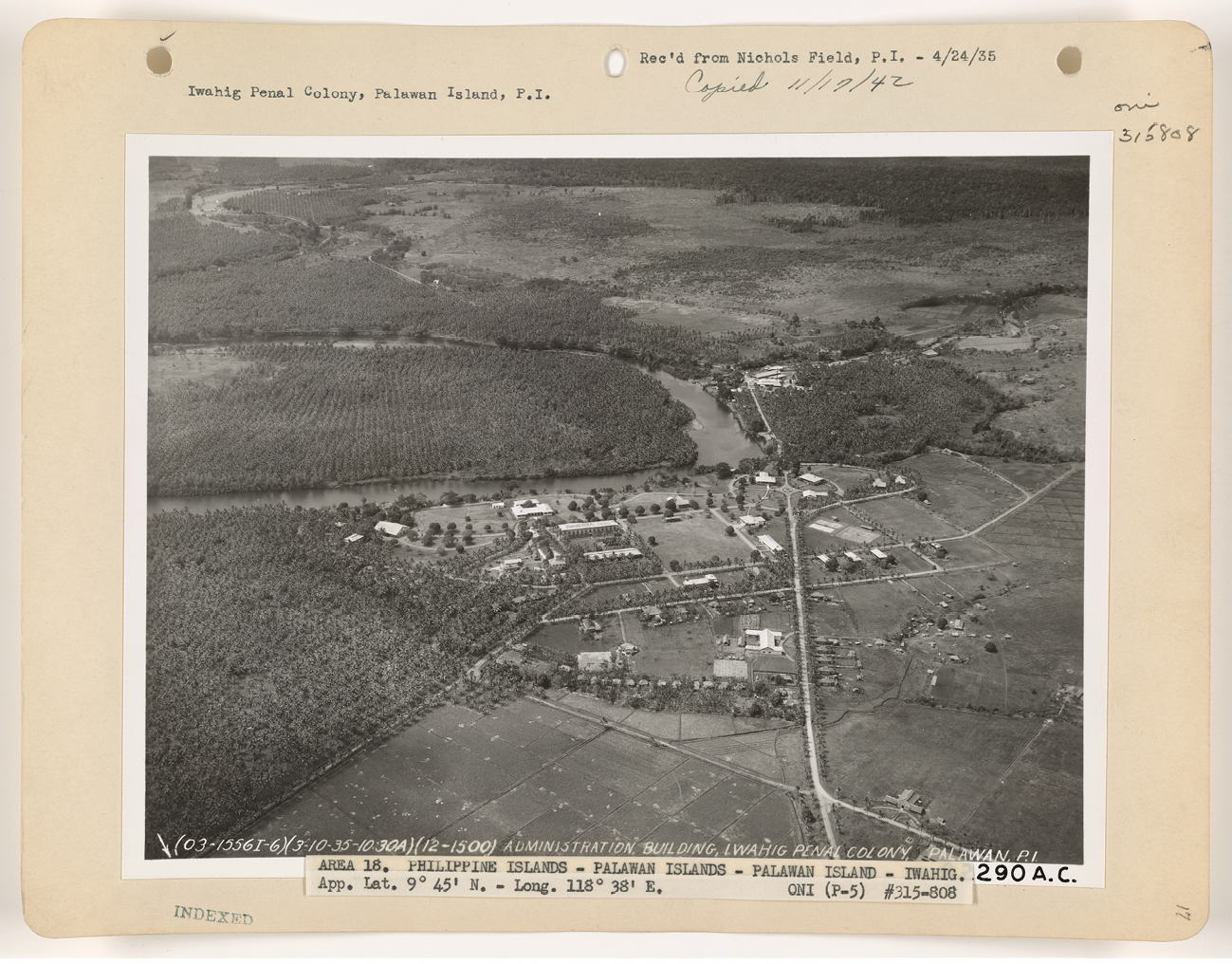
Figure 3.
Administration Building, Iwahig Penal Colony, 1935. Source: US NARA. Public domain.
Inasmuch as newspaper sources boasted of Iwahig’s carceral innovations, prisoners are largely absent from the plantation photography soliciting investment in copra. Aerial photography, writes Theo Reeves-Evison in regard to mineral extraction, depopulated landscapes, ‘creating an imaginary resource frontier of ‘wild and empty spaces where discovering resources, not stealing them, is possible’ (Reeves-Evison 2024: 605). The above aerial photograph, dated 1935 and stored at the US National Archives and Records Administration (Figure 3), shows just a few central buildings bordered by agroforest to the left and cleared fields to the right. The redirected Iwahig River weaves between at least five distinct agroforest zones. Devoid of people, the image communicates a tropics not in a state of wild anticipation but instead already ‘conquered’ by economic botany for capitalist production.
Yet the coconut palm’s pervasiveness, together with its ability to reseed without tending and to fruit sparsely or prolifically in concert with its ecology, required ground-level extractive photography that documented its disciplining to the pace and profit of industrial temporality. To the Euro-American investor, coconut trees were sources of future copra profits: the more nuts, the more profits. More trees, however, did not necessarily mean more nuts. Spacing at distances between twenty and thirty feet apart and constant pruning did. Inter-imperial exchange informed subsequent spacing experiments at Iwahig and a second plantation prison, the San Ramon Prison Farm in Mindanao. BA farm machinery agent Thomas P. Hanley reported that a chance train ride from Colombo to Kandy placed him ‘in the acquaintance of an educated Singhalese’ who owned a plantation ‘upon which he made coconut growing a specialty’. The unnamed informant shared that spacing the trees 25 to thirty feet apart generated more nuts than if the trees were planted closely together (Hanley 1902: 630). Edwin Copeland, San Ramon’s chief botanist, carved out zones for spacing experiments, directing prisoners to plant trees at varying distances and depths, the growth of which he monitored and compared to old groves. By the end of the experiment, he had determined that seedlings be placed in holes at least twelve to thirteen inches wide and deep at distances no closer than 32 feet, with the land in between planted with soil-enhancing cover-crops and additional pruning serving to encourage further year-round fruiting (Copeland 1914: 135–36).
Dean Conant Worcester’s San Miguel Estate photography captured this ground-level engineering in the form of before and after images. Worcester was a University of Michigan-trained ornithologist who turned his previous collecting trips to the Philippines into a long and contentious career as a colonial administrator. Adept with a camera, his photographs of upland Indigenous Peoples represented the country as divided between Malay lowlanders and savage hill peoples – a visual – representation that in turn buttressed the assumption that an ethnically-united Philippine nation capable of independence was as yet non-existent.5 The below San Miguel images are carefully preserved in an album sent to his brother in Vermont. Yet they were widely reproduced in BA-investment guides aimed at attracting outside capital to fund copra processing plants. In Figure 4, Worcester lays out a standard visual trope of wild, untamed nature. The estate, he captions, contained thousands of young ‘neglected’ trees, which had been ‘swamped in vegetation’. By the fifth and sixth images, the brush around the trees had been cleared and the old grove trees were now in a ‘fine condition’.
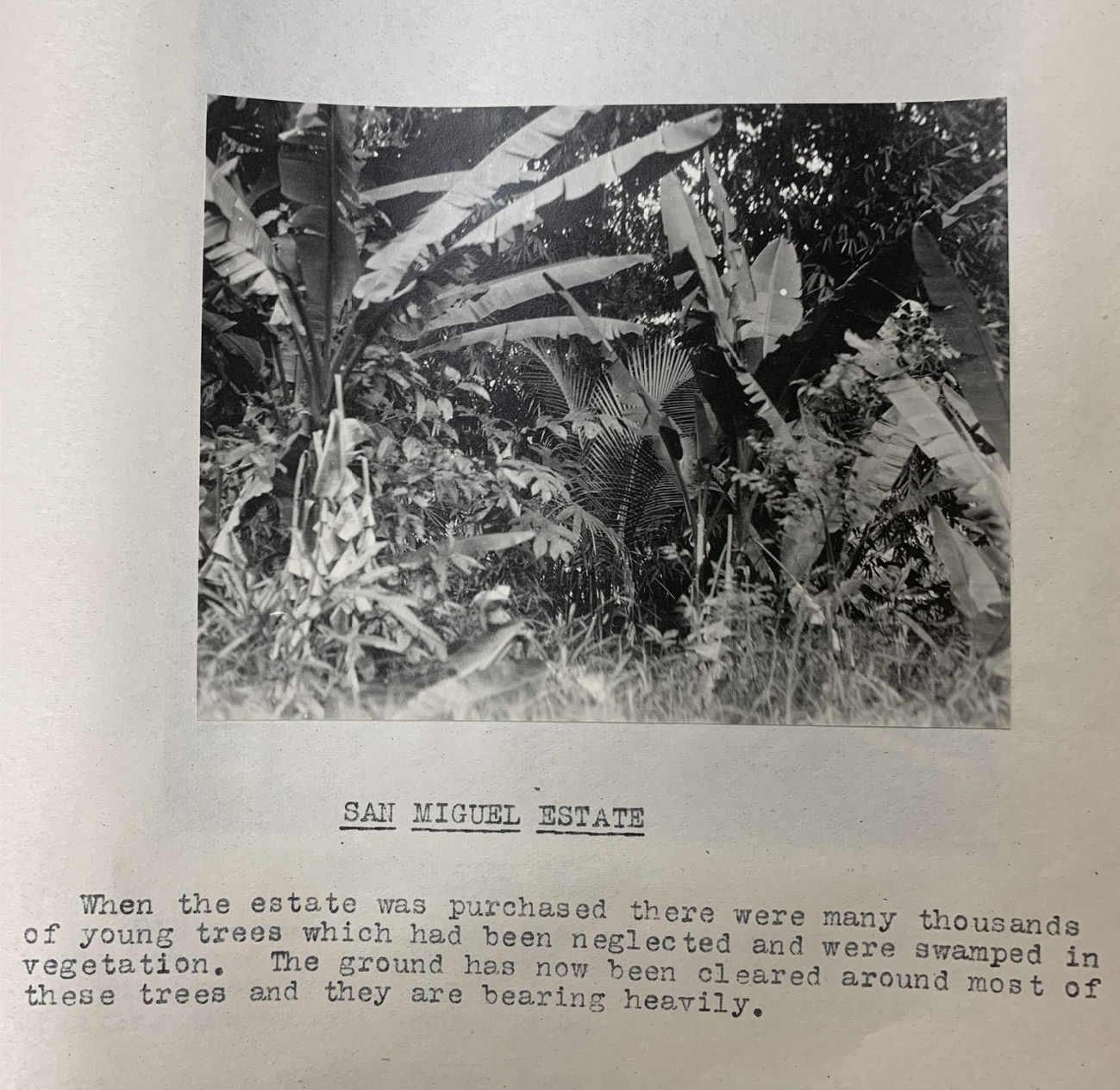
Figure 4.
Before Image of the San Miguel Estate. Folder 57: Letters to George Worcester (brother), April 22, 1922, 1921–1923, Dean C. Worcester Papers.
Source: courtesy of Thetford Historical Society, Vermont.
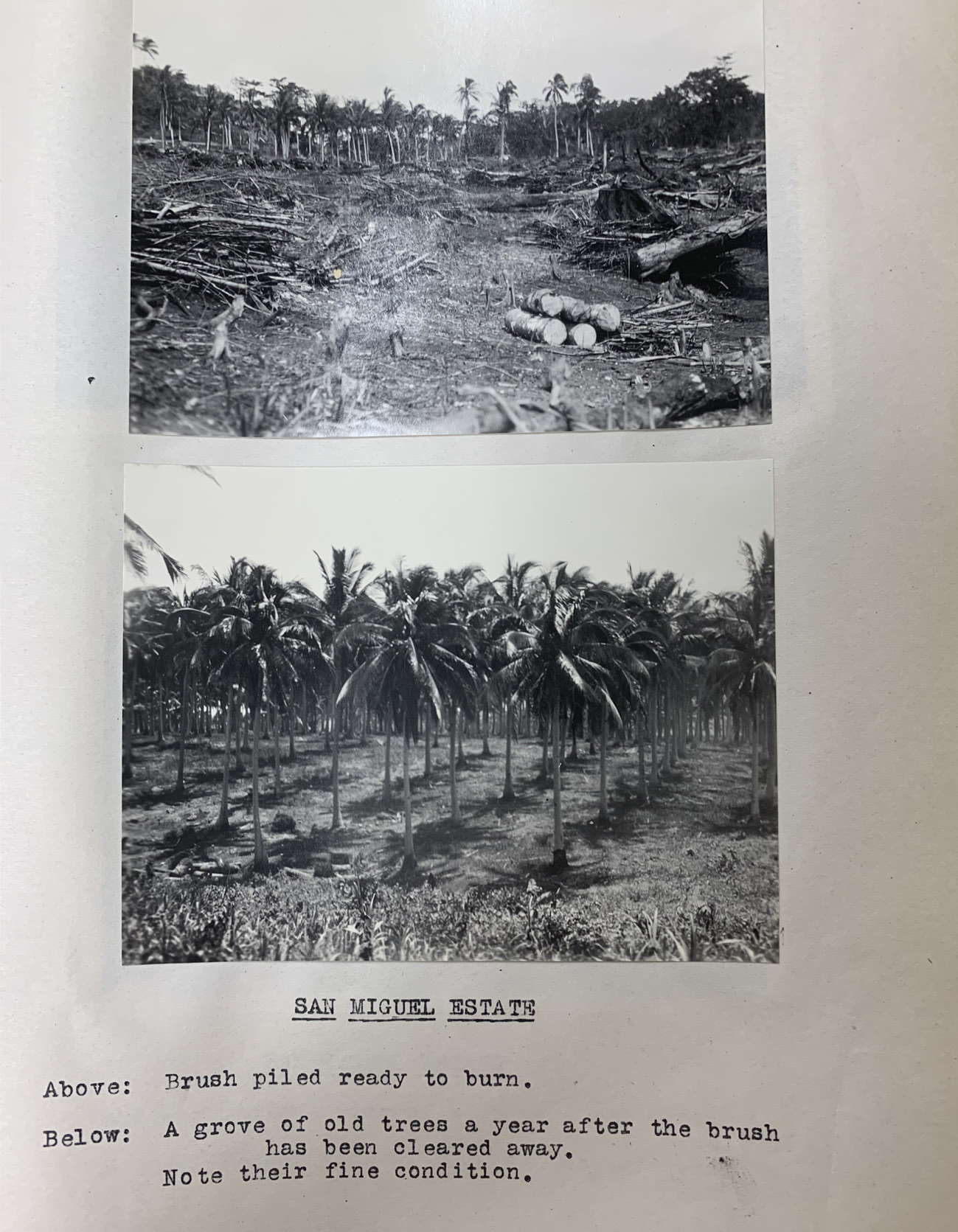
Figure 5.
After Image of the San Miguel Estate, with the Caption ‘A grove of old trees a year after the brush has been cleared away. Note their fine condition’. Folder 57: Letters to George Worcester (brother), April 22, 1922, 1921-1923, Dean C. Worcester Papers.
Source: courtesy of Thetford Historical Society, Vermont.
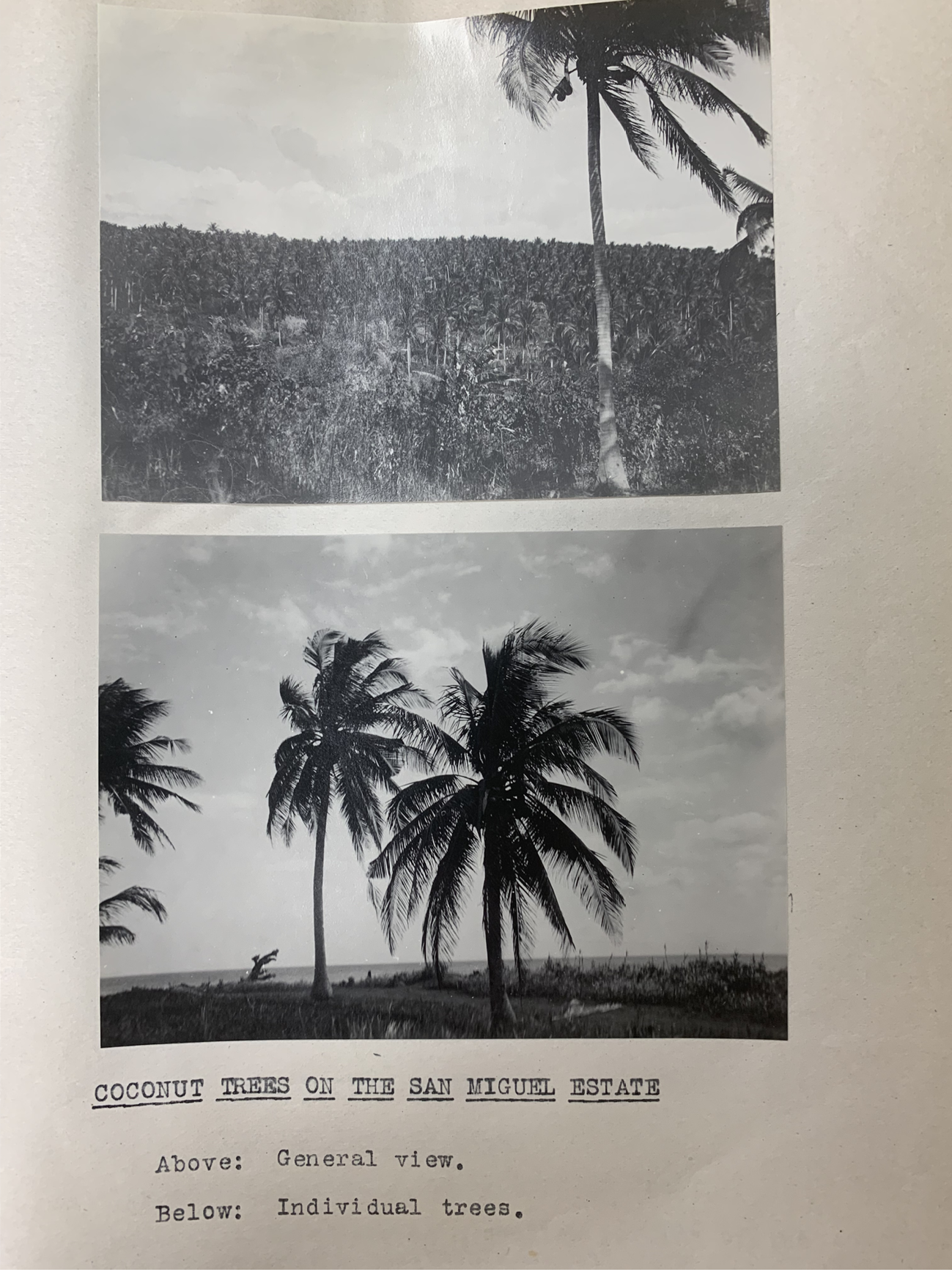
Figure 6.
Dean C. Worcester’s San Miguel Estate. Folder 57, Dean C. Worcester Papers.
Source: courtesy of Thetford Historical Society, Vermont.
Before and after photography (Figures 4, 5 and 6) of overgrown fields razed for ordered planting did not simply document temporal change. The images were a means through which Americans contrasted their agriculture to that of the ‘native planter’ with whom they competed. The so-called native planter was a broad slur, inclusive of the small farmer for whom coconuts were an insurance crop to occasionally sell to representatives of processing plants, and of wealthier Philippine-born landowners. Indeed, the copra commodity frontier was a site of contestation and competition between Americans and the elite landowning families who sought control over its trade. Cebuano tycoon Vicente Madrigal, son of a Spanish father and Philippine mother, who, like other landed elite, embraced a national Filipino identity, opened a competing oil refining facility near Worcester’s. A promise from the Philippine National Bank to compel a Manila-based shipper to buy from Madrigal at an inflated price allowed him to offer local growers and pickers higher prices than those paid by Worcester (Mojares 1985).
Americans were quick to manufacture and document Philippine failures to follow scientific palm cultivation, marking scientific agriculture as a possession and trait of their own. A 1911 report on ‘coconut conditions in Laguna’, a province south of Manila, by BA employee O.W. Barrett, neatly summarises the American colonial attitude toward small cultivators, coconuts and cash in the Philippines. Trees were a means to the ends of turning nuts into copra and coconut oil for export. Any planting that did not maximise nut yield violated the principles of economic botany. Laguna, from Barrett’s perspective, was in dire straits. Palms planted too close to one another raced toward the sun, their tall trunks discouraging high nut yield, ‘probably not more than one-third of the normal amount for mature trees when well-spaced’ (Barrett 1911: 152). The area’s ‘native planters’ were ‘getting only about 30 to 40 percent of the proper income from their plantations’. This, Barrett insisted, was their own fault:
And since there appears to be very little or no loss from insects or fungus pests, and since the soil and the climate appear especially well suited for this culture, I firmly believe that said loss is due to the faulty system of planting, and to the lack of cultivation and live legume mulching in the plantations (Barrett 1911: 153).
The specimen view in Figure 7 reveals the engineered tree of the prison cropscape. J.B. Cooley, a former San Ramon warden now employed as a field manager on Worcester’s San Miguel Estate, squats with a measuring tape at the base of what is purported to be a ‘typical coconut tree’ after scientific agriculture. Its bottom trunk is swollen, a sign of ‘healthfulness and vigor’ manifest in the ‘heavy load of fruit’ atop. Copeland’s 1914 planter manual, The Coco-nut, identified the Philippines as ‘ideal coconut country’ but emphasised that the stout high yield palm of the specimen view was reproducible anywhere (Copeland 1914: x). In this sense, and exemplifying what Moritz Von Brecius calls a ‘mobile plantation’, the prison cropscape was always meant to be reproducible – a situated place that, through the dissemination of planter manuals and the practices of scientific agriculture, was meant to be replicated in new spaces (Brescius 2025).

Figure 7.
‘San Miguel Estate, Typical Coconut Tree’. Base of tree showing a swollen portion of the trunk which indicate healthfulness and vigor. Folder 57, Dean C. Worcester Papers.
Source: courtesy of Thetford Historical Society, Vermont.
Despite the absence of prisoners and labourers in plantation photography, their presence and power haunts the images. Especially interesting is a 1916 photograph of San Ramon’s ‘coconut grove’ (Figure 8). The trees are planted at distances of approximately twenty feet in neat rows, allowing officials to pave a road wide enough for carriages and cars down the main corridor. The road also allowed overseers to surveil pickers from some distance, policing especially the tapping of tree flowers for sap with which to make tuba, a potent and forbidden palm alcohol that was said to discourage nut production and therefore the transformation of maximum crops into maximum cash.
Moving to the post Second World War period, Oscar K. Moore’s map of the coconut zone for Economic Botany attests to the mobility of the Philippine cropscape (Figure 8). Moore places the Philippines at the centre of a 2500-mile radius of coconut production. Industrial demand for copra recovered after the war but the prewar plantation coconut cropscape in the now independent Philippines had changed. The interwar period saw the departure of Americans, many of whom, like Worcester, had sold their holding companies to Lever Brothers decades earlier. At the behest of an American diary and seed oil lobby that blamed Depression prices on Philippine copra, the US imposed a three cent per pound processing tax and two cent excise tax on all copra and coconut oil imported to the US in 1930. The monies raised were returned to the Philippines Commonwealth treasury on the condition that it could not fund the production of copra, coconut oil and other allied coconut products, thus creating an uncompetitive market for US processors and finishers.
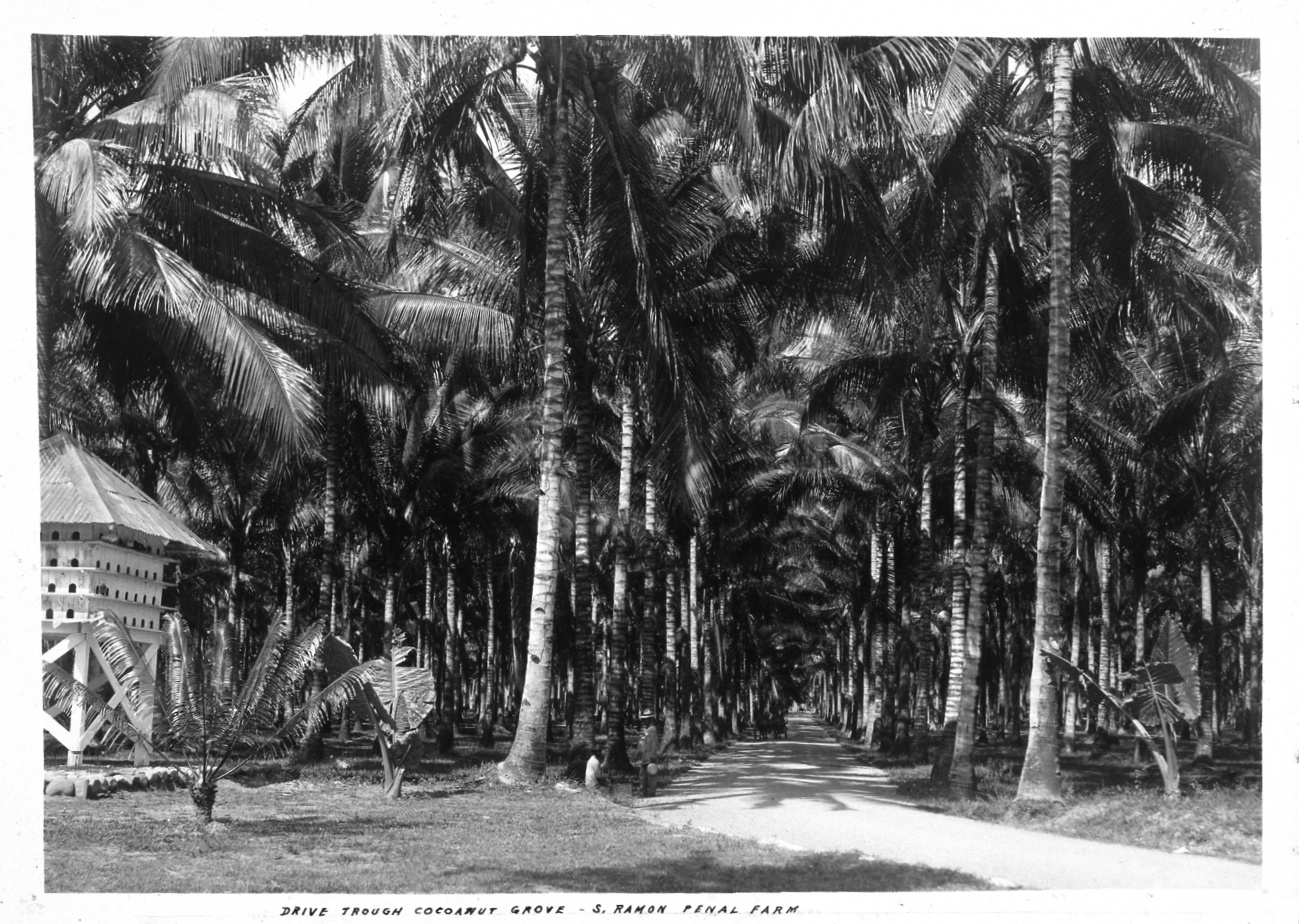
Figure 8.
Drive through cocoanut grove, S. Ramon Penal Farm. Philippines Zamboanga City, ca. 1916.
Source: https://www.loc.gov/item/2011648770/, public domain.
Moore’s bull’s-eye, reminiscent of an aerial bombing maps, hinted at new and more dangerous applications to come. As the dairy lobby tarred coconut oil as inedible, chemists homed in on glycerin’s industrial and warfare potential. Glycerin’s wartime uses would only grow in scale and devastation. In 1943, Harvard organic chemist Louis Fieser combined naphthenic acid from crude oil with palmitic acid from coconut oil to produce a gel-like fuel he called ‘napalm’, the stickiness of which mitigated the need for bombing precision. The US Army debuted napalm in the Philippines in its attack on Japanese occupiers; napalm would again feature in tropical warfare in Vietnam, indiscriminately clinging to the bodies of its victims. Thus, in ways that Lyon could not have anticipated, the coconut was conscripted into a Euro-American war machine, turning what is too often and too glibly called the tree of life into a weapon of death.
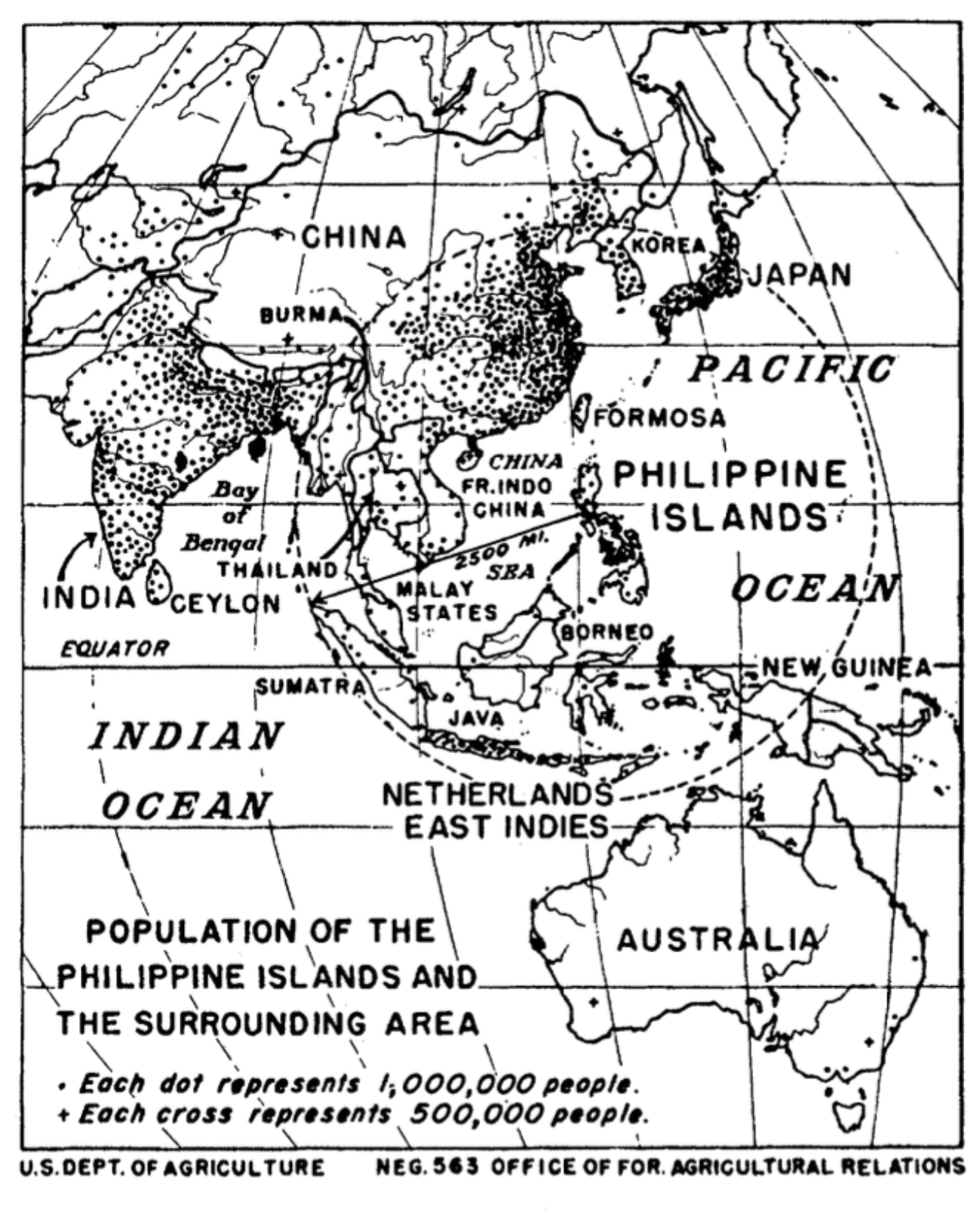
Figure 9.
From Moore 1948: 126.
The Coconut Palace is now the Vice-Presidential residence and is no longer open to visitors. Yet it still serves extractive ends now organised around a green economy. A quick web search reveals the building has been repurposed into the lexicon of sustainable luxury. According to one venture-capital funded builder, the Tahanang’s ‘coconut materials, natural textures and elements add a unique charm to the palace, proving that environmentally friendly design can be stylish and sustainable’ (BillionBricks 2024).6 Imelda Marcos’s aspirations for the Palace persevere and the coconut palm continues to work on behalf a state that acts as a labour and resource broker (Rodriguez 2015).
But from what perspective should we measure the Palace as a monument to sustainability? In terms of monetary cost, architectural historian Gerard Lico calls the Palace’s 37-million-peso price-tag ‘a high price to pay for advocating the coconut as a building material’ (Lico 2003: 118). Building funds for the Palace came from the Philippine Coconut Authority created by Ferdinand Marcos to promote planting, modernise the industry and attract more World Bank investment, and a Coconut Levy placed on the small farmers powering the industry. According to the Philippine Coconut Authority, the area planted to coconuts expanded to 2.283 million hectares by 1975, bringing at least one third of the Philippine population into the coconut trade in some way. But the dominance of the trade was hardly unifying, despite the story told by the Coconut Palace. On Mindanao, Iranun Muslim entrepreneurs redirected copra away from Manila toward traders in North Borneo and Malaysia, setting the stage for armed conflict between the national government and southern separatists (Cerepak 2016). The Coconut Palace did not represent a unifying Filipino home or even a departure in the country’s export agriculture. It instead asserted that profits from the international trade in coconuts and copra would flow through the national government in Manila, allowing the Marcoses and their cronies to grow rich from the cream skimmed off the top.
If sustainability is a measure of a balanced care relationship between people and palms, the coconut export industry encouraged by the Palace is deeply unsustainable. Today, nearly 3.5 million smallholder coconut producers labour on farms less than twenty hectares in size. Farmers sell their copra and husks to middlemen traders who in turn sell to the large processing companies holding contracts with multinationals such as Cargill, P&G and Unilever. It is these multinationals that ultimately determine copra prices. Through these links, the palm and its fruit are rendered into glycerin for cosmetics, soap, medicine and explosives, its oil and desiccated meat into food, and its kernels into activated charcoal to filter water and whiten teeth. Without national support for farmer cooperatives, smallholders are indebted to middling traders, leading one advocacy company to refer to the coconut trade as ‘copra slavery’. The outsized impact of the coconut industry, the inequality within its labour arrangements and the susceptibility of old growth trees to bud rot and disease suggest, then, that the political economies and ecologies of the coconut are as unsustainable as the CCP’s reclaimed land in Manila Bay.
Far from a statement of national independence, the Tahanang Pilipino speaks to the repackaging of resource colonialism as development in the mid- to late-twentieth century. The Palace speaks to the Marcos’s vision of centralised power but is, in practice, a testament to the fragmentary nature of the coconut palm trade and its multiple possibilities. The inequality and violence within this trade should be a warning against repurposing the Palace, and the coconut itself, into a model for sustainability. This, to be sure, is not to foreclose the possibility of palm sustainability nor a return to its uses for building materials. Rather, attention to the coconut cropscape – the assemblages and stories that make crops rooted and moveable – asks that we look for and listen to those crop stories that are not so readily told.
Alzate, M.A. 1926. Convict Labor in the Philippine Islands: Presented at the Ninth International Prison Congress Held in London, August 1925. Manila: Bureau of Printing.
Barney, K. 2009. ‘Laos and the making of a “relational” resource frontier’. The Geographical Journal 175 (2): 146–59.
Barrett, O.W. 1911. ‘Coconut conditions in Laguna’. Philippine Agricultural Review 4 (3): 151–53.
Bennett, J. (ed.) 2018. ‘Pacific coconut: Comestible, Comfort and Commodity’. Special Issue. Journal of Pacific History 53 (4).
BillionBricks. n.d. ‘Spotlight: Coconut palace’: https://billionbricks.org/blog/spotlight-coconut-palace/ (accessed 16 Oct. 2024).
Bray F., B. Hahn, J.B. Lourdusamy and T. Saraiva. 2023. Moving Crops and the Scales of History. New Haven: Yale University Press.
Brescius, M. von. 2025. ‘The “mobile plantation” of Charduar: Local connections, imperial portfolios, and the global pathways of Assam rubber’. In N. Miller and U. Linder (eds), Plantation Knowledge: Agricultural Knowledge, Exploitation, and Change Since 1500. Albany: State University of New York Press. pp. 145–80.
Cerepak, P.J. 2020. ‘Establishing the intimate link: 20th century tropical agriculture and the establishment of the coconut zone’. Journal of Maritime Studies and National Integration 4 (1): 1–11.
Cerepak, P.J. 2016. ‘Coconuts: catalyst of conflict’. Edge Effects, 5 April: https://edgeeffects.net/coconuts-conflict/
Copeland, E.B. 1914. The Coco-nut. London: Macmillan and Co.
De Leon, A. 2023. Bundok: A Hinterland History of the Philippines. Chapel Hill: University of North Carolina Press.
Driver F. and L. Martins. 2005. Tropical Visions in an Age of Empire. Chicago: University of Chicago Press.
Droessler, H. 2022. Coconut Colonialism: Workers and the Globalization of Samoa. Cambridge, MA: Harvard University Press.
Hanley, T.P. 1902. ‘Notes on agriculture in Ceylon and on the Botanical Gardens at Peradeniya’. In Report of the Philippine Commission, pp. 630–33. Manila: Bureau of Public Printing.
‘Heavy rainfall causes trouble in Palawan’. 1910. Cablenews-American (Manila), 21 December.
Iwahig Creation Act. 1904. Acts of Commission No. 1723. Reprinted in Cablenews-American, 4 October.
‘Iwahig colony is one of greatest penal reforms’. 1911. Cablenews-American (Manila), 27 August.
Kramer, P.A. 2006. Blood of Government: Race, Empire, the United States and the Philippines. Chapel Hill: University of North Carolina Press.
Laurance, R. 2019. Coconut: How the Shy Fruit Shaped the World. Stroud, UK: The History Press, Limited.
Lico, G. 2003. Edifice Complex: Power, Myth, and Marcos State Architecture. Quezon City: Ateneo de Manila Press.
Lyon, W. 1903. The Cocoanut: With Reference to its Products and Cultivation in the Philippines. Manila: Bureau of Printing.
Martinez, D. 2022. ‘From rice research to coconut capital’. In Aggregate Architectural History Collaborative (ed.) Architecture in Development: Systems and the Emergence of the Global South. London: Routledge.
McKinley, W. 1900. ‘State of the Union’. 3 December. http://www.let.rug.nl/usa/presidents/william-mckinley/state-of-the-union-1900.php
Miller, K.R. 2024. ‘Agents of the settler state: Incarcerated Filipino workers, conjugal migration, and Indigenous dispossession at the Iwahig Penal Colony’. American Quarterly 76 (1): 25–53.
Mojares, R.B. 1985. ‘Worcester in Cebu: Filipino response to American business, 1915–1924’. Philippine Quarterly of Culture & Society 13 (1): 1–13.
Moore, O.K. 1948. ‘The coconut palm: Mankind’s greatest provider in the tropics’. Economic Botany 2 (2): 119–44.
Reeves Evison, T. 2024. ‘On prospecting: visual culture between extraction and speculation’. Environmental Humanities 16 (3): 603–23.
Rice, M. 2013. Dean Worcester’s Fantasy Islands: Photography, Film, and the Colonial Philippines. Ann Arbor: University of Michigan Press.
Rodriguez R.M. 2010. Migrants for Export: How the Philippine State Brokers Labor to the World. Minneapolis: University of Minnesota Press.
Snodgrass, K. 1928. Copra and Coconut Oil. Palo Alto: Stanford University Press.
Tiglao, R. 1983. ‘The political economy of the Philippine coconut industry’. In R.S. David (ed.) Political Economy of Philippine Commodities. Quezon City: University of the Philippines Press. pp. 181–272.
Tsing, A.L. 2003. ‘Natural resources and capitalist frontiers’. Economic and Political Weekly 38 (48): 5100–106.
United States Senate, Subcommittee of the Committee on Finance. 1942. S. 2079: A Bill to Authorize the Condemnation of Materials which are Intended for Use in Process or Renovated Butter and which are Unfit for Human Consumption, and for Other Purposes. 77th Cong., 2nd sess. Washington, DC: Government Printing Office.
Ventura, T. 2025. ‘Copra and conquest’. In N. Miller and U. Linder (eds), Plantation Knowledge: Agricultural Knowledge, Exploitation, and Change Since 1500. Albany: State University of New York Press. pp. 245–72.
Ventura, T. 2022. ‘Consider the coconut: Scientific agriculture and the racialization of risk in the American Colonial Philippines’. Journal of Transnational American Studies 13 (1): 45–67.
White, J.R. 1928. Bullets and Bolos: Fifteen Years in the Philippine Islands. N.p.: Constabulary Books.
Wilson. 1903. ‘Wilson to Lamson-Scribner, October 17, 1903’. Box 1: Letter books, 1888–1903, Vol. 3. F. Lamson-Scribner Papers, Manuscript Division, Library of Congress.
Theresa Ventura is an Associate Professor of History at Concordia University, Montreal. Her writing on agriculture, environment, and empire can be found in Agricultural History, Philippine Studies, and, most recently, an Isis focus section on volcanoes.
Email: theresa.ventura@concordia.ca
1 Martinez offers an excellent reading of architecture, neocolonial agriculture, development debt and martial law.
2 On resource frontiers as spaces of expropriation and displacement see Tsing 2003; on how rural people and local ecologies contribute to and constrain resource frontiers see Barney 2009. I’ve written in greater detail on scientific agriculture as a form of labour management in Ventura 2025.
3 On coconuts as global commodities, see Bennett (ed.) 2018, Droessler 2022, Cerepak 2020; Laurance 2019 is a labour of love, full of anecdotes but short on analysis.
4 I’ve written elsewhere about these prisons and do not want to risk repetition. See Ventura 2022. On the gendered division of labour, see Miller 2024.
5 On Worcester’s ethnological photography, see Kramer 2006, De Leon 2023, Rice 2013.
6 BillionBricks is a venture-capital funded private developer with an emphasis on sustainable building materials.