Javier Carrera
A Perspective on the Historical Role and Future of Bactris Gasipaes as a Food Crop*
* AI-based tools were used during the preparation of this manuscript to support language editing, text clarification, and structural organisation and translation from Spanish. These tools were also used to assist in summarising information and improving readability. No AI tools were used to generate original data or conduct analysis. All interpretations, arguments and conclusions are the sole responsibility of the author.
PLANT PERSPECTIVES 3/2 - 2026: 218–237
doi: 10.3197/whppp.63876246815928
Open Access CC BY 4.0 © The Author
Peach palm (Bactris gasipaes) is a domesticated perennial of the tropical Americas historically cultivated within Indigenous agroforestry systems. Interdisciplinary evidence indicates that it functioned as a staple in pre-Columbian Amazonia, embedded in diversified, human-managed forests. Despite its nutritional and agronomic potential, modern development efforts have not integrated it into contemporary food economies, largely due to a mismatch with prevailing models based on annual monocultures. Current production focuses on palm heart, while fruit use remains localised. This article argues that peach palm is better understood as a staple suited to agroforestry systems and may play a role in emerging regenerative and climate-resilient food strategies, provided that genetic diversity and traditional knowledge are maintained.
Bactris gasipaes, agroforestry systems, Amazonian domestication, Indigenous food systems, perennial staples
In 2000, I worked as a local technician in the design and implementation of demonstration agroforestry plots in Orellana province, Ecuador, under the guidance of Pedro Saviniano Miranda, co-author of the handbook Agricultura em Andares (Multi-layered Agriculture) (Miranda and Rodrigues 1999). This system promoted the combined cultivation of annual crops, shrubs and useful trees. A key aspect of the methodology was that species selection was carried out by local farmers. I observed that participants – particularly those belonging to the Amazonian Kichwa people – consistently selected peach palm (Bactris gasipaes) as a central component of the system. This was my first encounter with the species and marked the beginning of a 25-year inquiry into its importance as a food security and food sovereignty crop for the peoples of tropical America.
This type of experience, involving the implementation of agroecological agroforestry practices, is widespread in Latin America, and its outcomes are generally positive. In this case, the plots established led to a significant increase in the quantity, quality and diversity of food available to participating families, including a noticeable increase in fauna available for hunting and trapping. According to participants, peach palm was an important reason for this outcome, as its fruit production exceeds household consumption and attracts wildlife that feeds on it. However, in the absence of dedicated studies, this kind of evidence remains largely anecdotal. A similar situation applies to many agroecological initiatives – particularly small-scale or locally driven ones – which, despite their reported success, remain underrepresented in formal scientific analysis.
As founder and coordinator of the Red de Guardianes de Semillas (Seed Guardians Network) in Ecuador, an organisation dedicated to promoting the use of traditional, non-proprietary plant species, I continued to encounter peach palm in the years that followed. Through exchanges with smallholder farmers and Indigenous communities in the Amazon, I developed an understanding of the role of this palm in local food systems and its potential for broader application. In 2018, I led a campaign on ancestral seeds that promoted the use of peach palm alongside nine other traditional crops. As part of this initiative, professional cooks engaged in the development of new culinary applications based on these ingredients (Carrera 2020).
In this article, I describe peach palm, its historical role in food systems, its future prospects and potential avenues for research, from the perspective of a field practitioner working with farmers and Indigenous food systems in Ecuador.
The peach palm (Bactris gasipaes), a domesticated species of the Arecaceae family, is native to the tropical forests of the Americas, ranging from Honduras to Bolivia. In natural forest conditions, it can reach heights of up to thirty metres, although in monoculture systems it rarely exceeds twenty. It grows from sea level to approximately 1,200 metres above sea level, with optimal performance below 800 metres. Fruit production begins at annual rainfall levels of around 1,000 millimetres, but the species thrives in environments receiving between 2,000 and 5,000 mm. It performs best under warm tropical conditions, with optimal fruiting typically occurring at mean temperatures around 24–28 degrees Celsius, although it can produce at slightly lower temperatures with reduced yields.
The fruits are round to ovoid, measuring approximately 2.5 to 6 centimetres in length, with coloration ranging from yellow to orange and red; some landraces present a dark purple color, almost black. The mesocarp is firm, fibrous, and starchy, surrounding a hard endocarp that encloses a seed up to two centimetres long. The trunk is relatively slender and, in most varieties, densely covered with spines strong enough to pierce rubber footwear. Its wood is very dense and hard, with a high density (often >0.9 g/cm³ and sometimes exceeding 1.0), and has long been valued in tropical America for its durability and strength. It has traditionally been used for construction, tool-making, and the manufacture of hunting weapons, as well as for other utilitarian and craft purposes.
Peach palm exhibits considerable ecological plasticity. It tolerates poor and acidic soils, although it performs best in deep, well-drained substrates. It does not tolerate waterlogged or heavily compacted clay soils. The species shows high genetic variability, resulting from frequent hybridisation among cultivated and wild populations. It is predominantly outcrossing, with monoecious and protandrous inflorescences. Pollination is primarily carried out by beetles of the Nitidulidae and Curculionidae families. The temporal separation between male and female flower phases promotes cross-pollination between individuals. This reproductive strategy, combined with high genetic segregation, contributes to the extensive diversity observed within the species.
This diversity has made precise classification challenging. Nevertheless, two major groups are commonly distinguished: the Oriental group, associated with the Amazon and Orinoco basins, and the Occidental group, which includes populations from the Pacific regions of Ecuador and Colombia, as well as Central America (Mora-Urpí et al. 1997).
The domestication of peach palm (Bactris gasipaes) is thought to have originated from one or more wild populations classified as Bactris gasipaes var. chichagui, giving rise to a proto-domesticated form known as Chichagui type 3. Available evidence suggests that this process took place in the southwestern Amazon. As the species spread through the western Amazon into Central America, secondary domestication events likely occurred. These involved the hybridisation of Chichagui type 3 with local wild populations, generating new, locally adapted domesticated varieties. The regions with the highest genetic diversity of cultivated peach palm are found in the Ecuadorian Amazon and northern Peru, indicating the intensity of human management and selection in these areas. Secondary centres of diversity include the Cauca and Llanos regions in Colombia (Galluzzi et al. 2015).
Recent research suggests that the domestication and dispersal of peach palm followed at least two distinct trajectories, associated with different fruit types and cultural uses (Clement et al. 2017). The western dispersal, extending through the Ucayali River into northwestern Amazonia and Central America, was characterised by the early selection of starchy fruits. These fruits are well suited for fermentation, and evidence indicates that they became central to food systems, particularly in the preparation of fermented beverages used in seasonal harvest festivals. Archaeological and historical data suggest that peach palm was widely cultivated in home gardens and shifting cultivation systems in these regions, often in large quantities, indicating its significant role in subsistence and cultural practices.
In contrast, the eastern dispersal, toward central and eastern Amazonia, retained fruit types with higher oil content and was not selected toward larger, starch-rich forms. These oily fruits are less suitable for fermentation, and there is limited historical or ethnographic evidence of their use in similar large-scale or ceremonial contexts. Available archaeological and historical data suggest that this eastern expansion may have occurred later and was less prominent in early accounts.
Overall, this differentiation in fruit types and uses indicates that the cultural importance of peach palm varied regionally, with starchy varieties in western Amazonia, northwestern South America and Central America playing a particularly prominent role in food systems and social practices. The broader significance of peach palm has only been recognised in recent decades. Earlier interpretations of Amazonian land use assumed that slash-and-burn agriculture was the only viable cultivation system. In this system, forest vegetation is cut and burned during the dry season, releasing mineral nutrients stored in biomass as soluble compounds in ash. While this provides a short-term increase in soil fertility, the effect is transient: heavy rainfall rapidly leaches nutrients, and within one or two years, soils become depleted and low in organic matter. Fields must then be abandoned for extended fallow periods, often up to fifteen years. Over time, repeated cycles can reduce ecosystem resilience. This method has been widely documented in agronomic and ecological literature for the region. Based on this model, researchers concluded that the Amazon could not sustain large populations, estimating limits of around fifty individuals per settlement. Observations of contemporary semi-nomadic Indigenous groups seemed to support this view. Archaeologists such as Betty J. Meggers argued that the Amazon was a ‘green desert’, incapable of supporting complex societies (Meggers 1971).
This interpretation contrasts with earlier historical accounts. In 1541, the expedition led by Francisco de Orellana reported densely populated regions along the Amazon River. His chronicler, Gaspar de Carvajal, described large settlements and intensive food production systems. Since the 1990s, archaeological research has substantially revised this perspective. Evidence of extensive settlements – including villages, towns, and urban scale sites – has been documented across the basin (Heckenberger et al. 2008, Prümers et al. 2022, Arroyo-Kalin and Riris 2021, Balée 2013). It is now widely accepted that the Amazon supported large populations, numbering between five and ten million, prior to the demographic collapse caused by European-introduced diseases.
A central question emerging from this evidence is: how did these populations sustain themselves? Slash-and-burn agriculture alone cannot account for the proposed scale, and earlier critiques of its limitations remain valid. Alternative explanations have emerged from multiple lines of evidence. One is the study of terra preta, anthropogenic soils with high fertility found throughout the Amazon and extensively documented in soil science literature (Heckenberger et al. 2008). Another comes from the composition of the forest itself: many areas contain high proportions of domesticated or semi-domesticated perennial species.
There is growing agreement that pre-Columbian Amazonian societies practised sophisticated forms of agroforestry. Over long periods, they modified forest composition by favouring useful species, creating anthropogenic ecosystems that function ecologically as forests while providing sustained food production. Domesticated and useful species are hyperdominant in modern forests, indicating past human selection (Maezumi et al. 2018, Levis et al. 2020, Balée 1993, Clement et al. 2015, Clement and Mora-Urpí 1987, Sierra 2015).
Such systems could support large populations while maintaining ecological stability. These forest-gardens recycle nutrients efficiently, preserve canopy cover and minimise soil erosion. However, the extent and intensity of these transformations varied across the basin, and the degree to which Amazonian forests can be considered broadly anthropogenic remains an active area of research. Peach palm appears to be a key species within these systems (Levis et al. 2017, Clement et al. 2017). It is widely distributed across the Amazon basin, as well as in regions such as the Pacific Chocó and Central America, often occurring in high densities. As a domesticated perennial, its presence is a strong indicator of long-term human management and the development of forest-garden systems.
From an ecological perspective, peach palm also plays a significant role in sustaining faunal populations. In traditional forest-garden systems, fruit production often exceeds human harvesting capacity. The surplus feeds wildlife, increasing animal populations that can in turn be hunted. In this way, peach palm contributes both directly to human diets and indirectly by supporting sources of animal protein. While consistent with ecological theory (trophic interactions), this interpretation is supported mainly by observational and ethnographic evidence rather than controlled studies (Balée 1993, Levis et al. 2020). Knowledge of how to manage such systems is rapidly declining as land use shifts toward monocultures, cattle ranching, and extractive activities. However, fragments of this knowledge persist. During a permaculture workshop in Napo province, Ecuador, an elderly Kichwa farmer described the following practice :
First you walk in a forest patch with a shigra (woven bag) full of maize, beans and squash seeds, and scatter them. Then you cut the low vegetation so it covers and protects the seeds. Once the understorey is cleared, the trees become visible. You select which trees to cut, leaving the most useful and maintaining sufficient canopy cover. In the gaps, you plant desired species – especially chonta (peach palm), because it is the most useful. By the time the maize is harvested, the shade has returned. Then you move to another plot and repeat the process’ (personal communication).
To the author’s knowledge, practices like these remain largely undocumented in peer-reviewed literature, indicating an important gap for future research.
Additional observations point in a similar direction. Indigenous permaculture expert Rogelio Simbaña reported comparable systems during work with the Shiwiar community of Juyuintza in the Ecuadorian Amazon, in 2020 (Simbaña 2020, personal communication). He described managed forests with minimal undergrowth, deep layers of fertile anthropogenic soil, and multiple distinct peach palm varieties distributed across several hectares.
Today, peach palm remains part of the diet in countries such as Colombia, Ecuador, Peru, Brazil, Panama, Venezuela, Nicaragua and Costa Rica, although its importance varies regionally. In Ecuador, consumption is largely restricted to areas where it is cultivated and remains limited in national markets. The species has also been introduced to tropical regions outside the Americas, particularly in Asia and the Pacific. It is cultivated in countries such as the Philippines, and to a lesser extent in India and Hawaii. However, production focuses primarily on palm heart rather than fruit, and it has not become a staple food (Lim 2012).
Detailed agronomic and genetic characteristics of peach palm have been extensively documented (Mora-Urpí et al. 1997). Peach palm can be propagated either by seed or vegetatively through basal shoots. Seed germination occurs in nurseries or seedbeds and may take between forty days and six months, depending on genotype and environmental conditions. Sexual reproduction maintains genetic diversity, which contributes to population resilience and provides a basis for selection in breeding programmes. Plants grown from seed typically begin fruit production after approximately four years under optimal conditions, although six years is more common. Vegetative propagation is carried out using shoots emerging from the clump. This method allows for earlier fruiting – typically around three years – and ensures that the genetic characteristics of the mother plant are preserved, as the resulting individuals are clones.
Ecologically, peach palm is a forest species that requires partial shade during early development. It performs well when associated with other plant species that function as nurse plants. It is typically integrated into highly diverse agroforestry systems, where it is associated with a wide range of perennial and annual species – including fruit trees such as Inga, avocado and guava; staple crops such as cassava and maize; and other useful palms – forming multi-strata production systems characteristic of traditional Amazonian forest management. As it matures and reaches the canopy, it requires increased light availability and eventually full sun for optimal fruit production.
Fruit production can continue for several decades, typically around thirty to forty years under conventionally managed conditions, although individual palms may remain productive for longer periods – up to sixty to seventy years – particularly in low-intensity or diverse agroforestry systems. Under favourable conditions, two harvests per year are possible, with yields reported between ninety and 130 kilograms of fruit per plant. Harvesting is typically carried out using poles or ladders, with care taken to prevent fruit from falling, as impact damage reduces quality.
In contrast, palm heart production is continuous. Following the cutting of a stem, new shoots emerge within approximately three months, allowing for repeated harvest cycles. At present, commercial cultivation is largely oriented toward palm heart extraction, often under monoculture systems. These systems typically use planting densities ranging from 3,000 to 20,000 plants per hectare for palm heart production, and 400 to 500 plants per hectare for fruit production. However, monocultures are associated with increased vulnerability to pests and diseases. Significant pest outbreaks have been reported, including severe impacts on plantations in Colombia (Vásquez Ordóñez 2021). Similar patterns are observed in other crops, where low species diversity in large-scale monocultures increases susceptibility to widespread damage (Wetzel et al. 2016, Balogh et al. 2021).
One of the main pests affecting peach palm is the palm weevil, Rhynchophorus palmarum. This beetle lays eggs inside the plant tissue; the larvae then bore into the trunk, feeding on internal tissues and weakening structural integrity. In addition, the species is affected by various fungal pathogens that can impact different parts of the plant. While these issues are typically limited in diversified agroforestry systems, they tend to be more severe in monocultures, particularly those relying on agrochemical inputs; this pattern is supported by agroecological literature, though specific studies on peach palm remain limited.
|
Dimension |
Traditional / Pre Columbian Systems |
Modern / Conventional Systems |
|---|---|---|
|
Production model |
Diversified agroforestry systems |
Monoculture plantations |
|
Biological diversity |
High (multiple species and varieties) |
Low (genetic and species uniformity) |
|
Primary outputs |
Fruits, ecosystem services, multiple products |
Palm heart (single commodity focus) |
|
Food function |
Staple food (carbohydrates and fats) |
Marginal or non-staple product |
|
Ecological dynamics |
Nutrient cycling, canopy continuity, resilience |
Soil depletion, higher pest vulnerability |
|
Management scale |
Smallholder and community-based |
Commercial, large-scale production |
|
Knowledge system |
Traditional ecological knowledge |
Technical/agronomic standardisation |
|
Relation to markets |
Local consumption and exchange |
Integration into national/global markets |
Table 1.
Contrasting food system models: peach palm in historical and modern contexts. This schematic comparison summarises the contrasting roles of Bactris gasipaes across historical agroforestry systems and modern production models centred around palm heart.
These observations suggest that conventional monoculture systems may not be well-suited to the ecological characteristics of the peach palm. Alternative approaches based on diversified agroforestry systems and intercropping are increasingly considered more appropriate, as they align with the species’ ecological requirements. Experimental and field-based experiences provide supporting evidence, although much of it remains anecdotal.
Plant breeding represents another key component of future strategies. However, the high genetic variability and heterogeneity of peach palm populations present challenges for conventional breeding approaches, which typically prioritise uniformity, stability and distinctiveness. These traits, while desirable in industrial agriculture, may reduce resilience to pests and diseases and limit adaptability.
An alternative approach is participatory plant breeding based on evolutionary populations. In this system, populations are continuously replanted using seeds from previous harvests, allowing natural selection to operate alongside farmer selection. Over time, this process generates locally adapted and genetically diverse populations. Research indicates that such systems can improve yield stability, adaptation and resistance to biotic stress (Ceccarelli and Grando 2020). Overall, while empirical and anecdotal evidence consistently points toward the advantages of diversified, agroecological systems for peach palm cultivation, there remains a need for more rigorous scientific research to validate and optimise these approaches.
The primary product of peach palm is its fruit. It must be cooked prior to consumption in order to inactivate naturally occurring anti-nutritional compounds. The most common preparation method in Ecuador is boiling the fruits whole, typically with salt, for up to two hours. After cooking, the outer skin is removed before consumption. The fruit is often eaten as a side dish and may be salted to taste. Alternative preparation methods include roasting or baking, similar to the processing of chestnuts.
Processing the fruit into flour is another important culinary strategy. The pulp can be dried and milled to produce a starchy flour, which may also be roasted to obtain a product similar to farina.1 This expands its culinary applications, allowing incorporation into a variety of food products, including mixtures with cereal flours and formulations for animal feed.
A widespread traditional preparation consists of fermenting the cooked and mashed mesocarp for one to two days, followed by dilution with water to produce chicha, a thick beverage that functions both as food and drink. This is one of the most common uses in Amazonian regions. Ethnographic observations indicate that it is consumed frequently throughout the day and constitutes an important source of hydration and nutrition (Clement et al. 2017)
Extended fermentation of the pulp (one week or more) produces an alcoholic beverage used in social and ceremonial contexts. The fermented mass can also be incorporated into other preparations, such as breads and cakes. In some regions, preservation techniques include the production of silage by compacting the fermented mass in pits lined with leaves (e.g., banana leaves) for periods of up to one month. A comprehensive account of traditional uses is found in Patiño (1963).
Nutritionally, the fruit contains approximately three per cent protein, 42 per cent carbohydrates (mainly starch) and seven per cent lipids. It is also a source of carotenoids, vitamins A and B2, and minerals such as phosphorus and iron. However, composition varies significantly among cultivars and landraces (Dias Soares et al. 2022). Overall, it is considered a nutritionally dense food within tropical American diets.
The lipid content is noticeable both in the texture of the fruit and in the cooking water. Oil can be extracted through traditional methods by cooking and crushing the fruits, followed by cooling, which allows the oil to separate and rise to the surface. This oil is used as a flavoring and colouring agent in local cuisines. The seed is also edible, although its use is less common and less documented than that of the pulp; after prolonged cooking – often together with the fruit – to soften tissues and reduce anti-nutritional compounds, the hard endocarp is cracked open using tools to extract the kernel, which has a firm, oily texture and may be consumed directly or occasionally roasted, although this process is labour-intensive.
Another major product is the palm heart (palmito), obtained from the apical meristem. It is commonly consumed cooked or pickled and used in salads and other dishes. While widely appreciated gastronomically, palm heart production involves the cutting of stems, which has implications for plant management. Nutritionally, it provides dietary fibre and minerals such as magnesium and iron.
Additional uses are documented in ethnobotanical sources. According to Lim (2012), the sap extracted from the trunk may be consumed fresh or fermented; young inflorescences can be roasted and eaten; and male flowers are sometimes used as a condiment. In some cases, immature inflorescences are harvested, chopped, and cooked. Facciola (1998) mentions that in Costa Rica the fruit is slowly smoked to keep it fresh and improve the flavour, that seeds are the source of an edible oil and that the young flowers may be chopped and added to omelettes. This author also mentions Coquillo, a palm wine prepared from the sap.
The larvae of the palm weevil (Rhynchophorus palmarum), which commonly infest peach palm, are traditionally consumed in several Amazonian countries, including Ecuador, Peru, Colombia and Venezuela, as well as in the Guyanas, Panamá and Costa Rica. In Ecuador, they are commonly known as chontacuros and are eaten raw, roasted or fried. These larvae are rich in fats and proteins and constitute an important nutritional resource in local diets. (Jaramillo-Vivanco et al. 2023). Harvesting practices may include opening infested trunks to collect larvae. In some cases, families intentionally fell selected palms to promote oviposition by the beetles, thereby ensuring larval production after several weeks. These practices are based on traditional ecological knowledge and are documented primarily through ethnographic observation. Beyond food uses, peach palm wood is highly valued for its density and durability. It has been widely used in the Amazon for the construction of houses, tools and hunting implements, and is suitable for fine woodworking. Archaeological and ethnographic evidence indicates its long-term importance as a structural and material resource.
|
Component |
Use |
Context |
Evidence type |
|---|---|---|---|
|
Fruit |
Boiled; fermented (chicha); flour production |
Amazonian food systems |
Ethnographic and nutritional studies |
|
Palm heart |
Fresh; pickled; processed products |
Commercial agriculture |
Agronomic and market data |
|
Seed |
Cooked kernel consumption (limited use) |
Localised traditional use |
Ethnographic (limited) |
|
Larvae (R. palmarum) |
Protein and fat source (raw, roasted, fried) |
Amazonian regions |
Ethnobiological studies |
|
Wood |
Construction; tools; weapons; crafts |
Amazonian and tropical regions |
Archaeological and ethnographic |
|
Oil |
Extracted from cooked pulp; culinary use |
Traditional food systems |
Ethnographic |
Table 2.
Main uses of peach palm across traditional and commercial systems, indicating context and type of supporting evidence.
Recent reviews highlight the nutritional and functional potential of peach palm as a future food resource (González-Jaramillo et al. 2022). The fruit combines complex carbohydrates (starch) with a moderate lipid fraction, providing a dual energy source that is uncommon among staple crops. It also contains dietary fibre, carotenoids (provitamin A), B-complex vitamins and essential minerals such as iron and phosphorus, with composition varying among landraces. Beyond basic nutrition, studies point to the presence of bioactive compounds with antioxidant properties, suggesting possible roles in functional foods and nutraceutical applications. Processing options – such as flour production, fermentation and oil extraction – expand its versatility for both local consumption and value-added products.
Modelling studies suggest that projected climate change scenarios may expand the areas suitable for peach palm cultivation. Galluzzi et al. (2015) indicate that shifts in temperature and precipitation could increase the extent of climatically favourable zones for the species. Combined with its relatively low input requirements and the nutritional properties of its fruit, this positions peach palm as a potentially important crop within tropical food systems.
It is important, however, to preserve genetic diversity and traditional cultural uses in their regions of origin. This is essential for maintaining the evolutionary processes that generate and sustain crop diversity, which depend on continuous interaction between human selection and local environmental conditions. Traditional management systems – particularly those practised by Indigenous and smallholder communities – act as dynamic reservoirs of genetic variation, allowing crops to adapt to changing biotic and abiotic stresses. The erosion of these systems, whether through genetic homogenisation, land-use change or loss of cultural knowledge, can reduce the resilience of the species and limit future breeding options. In addition, many uses and processing techniques are closely tied to specific cultural contexts and may not be easily transferred or replicated elsewhere, making their preservation critical not only for biodiversity conservation but also for the continuity of associated knowledge systems. The same study identifies priority regions for the in-situ conservation of peach palm genetic diversity, including the Ecuadorian Amazon; the Tarapoto and Pacaya-Samiria regions in Peru; Vichada in Colombia; the Solimões region in Brazil; and eastern Panama. Conservation strategies emphasise the importance of maintaining traditional agroecosystems, particularly Indigenous-managed systems, where processes of selection and diversification continue to operate. Key groups identified in this context include the Amazonic Kichwa, Huaorani and Achuar in Ecuador; Cubeo, Curripaco, and Yuriti in Colombia; Chayahuita, Quechua, Urarina, Cocama-Cocamilla and Shipibo-Conibo in Peru; Ticuna and Mirana in Brazil; and Kuna and Emberá in Panama (Galluzzi et al. 2015).
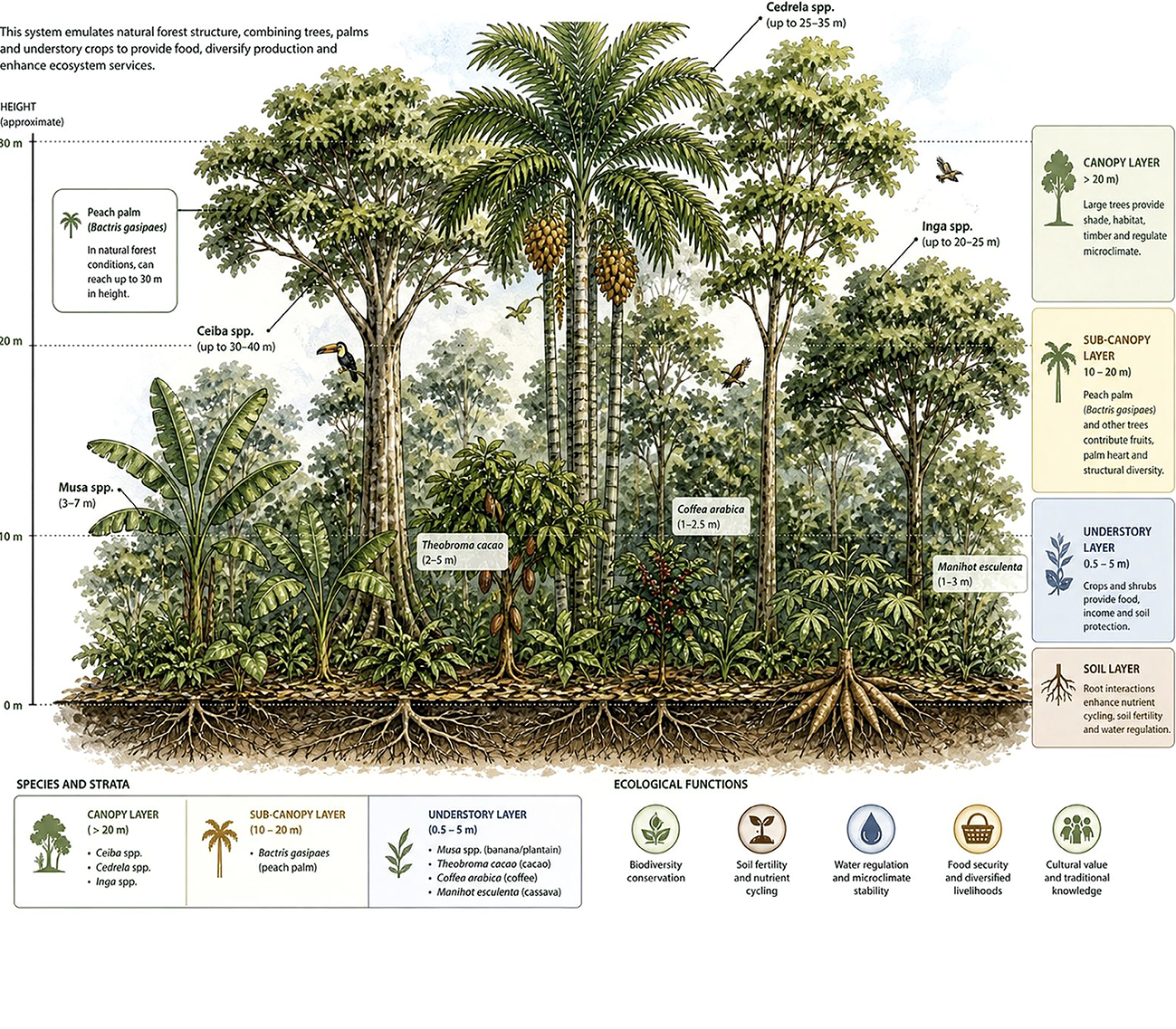
Figure 1.
Multi-strata agroforestry system incorporating Bactris gasipaes (peach palm)
(generated with AI)
Note: Heights are simplified for visualisation purposes. They are indicative and reflect agroforestry systems approximating natural forest structure; actual values vary depending on species, management and environmental conditions.
Peach palm is ecologically compatible with diversified agroforestry systems. Its growth requirements – shade tolerance in early stages and integration into multi-strata canopies – align with the structure of complex agroecosystems. This has led to its inclusion in agroecological and permaculture-based models that aim to replicate forest functions while maintaining food production. Evidence supporting these systems comes from a combination of agroecological research and field-based experiences, although controlled comparative studies specific to peach palm remain limited.
Given increasing interest in regenerative agriculture and climate-resilient food systems, peach palm may play an important role as a perennial component in diversified tropical production systems. However, its future relevance will depend on multiple factors, including the conservation of genetic diversity, the continuity of traditional knowledge systems and the development of cultivation models that balance productivity with ecological resilience.
Clement et al. (2004) carry out a very interesting analysis of the limitations in the spread of peach palm in modern markets, despite the efforts made by researchers and agencies. They signal that, although peach palm was a major staple in pre-Columbian agroforestry systems, modern research and development efforts have failed to transform it into a widely adopted crop. This failure is attributed by the authors not to biological limitations, but to a mismatch between the crop’s characteristics and market expectations, as well as to strategies that emphasised production over processing, market development and consumer demand. As a result, peach palm remains primarily a smallholder crop embedded in diversified agroforestry systems, with limited integration into modern food economies.
One key element of their analysis concerns the nature of the peach palm fruit: it is starchy and oily rather than sweet, and therefore does not fit easily within conventional fruit markets. As they note, it functions more as a ‘tree potato’, competing with staple crops such as cassava and maize. This characterisation helps clarify its historical role: peach palm appears to have been domesticated as a staple, providing carbohydrates and fats within agroforestry systems. The current dominance of crops such as cassava, maize and rice is closely linked to agricultural models based on annual monocultures, which have been widely adopted in the tropics despite well-documented ecological impacts. In contrast, perennial and mixed annual–perennial systems are increasingly recognised as more compatible with tropical soils and ecosystems. Within such systems, peach palm has the potential to become a major contributor to the provision of starch and oil. Realising this potential will require further research on production and processing, market development, practical implementation and broader dissemination of knowledge about agroforestry-based food systems.
In addition, future work may explore the development of locally grounded value chains that build on existing practices and knowledge systems. This includes the integration of peach palm into local and regional gastronomy through the diversification of culinary uses and the involvement of chefs and food networks, as well as the development of small-scale processing techniques (e.g., flours, fermented products, oils) that can extend shelf life and increase product versatility. Such approaches may support community-based enterprises and strengthen local economies, particularly when they are designed to operate within agroecological production systems rather than replacing them.
At the same time, these processes raise important questions regarding governance and equity. The commercialisation of products derived from Bactris gasipaes must consider the legal and ethical implications of intellectual property regimes, especially in relation to ancestral knowledge and genetic resources. Issues such as access and benefit-sharing, recognition of Indigenous and local communities as knowledge holders, and the risks of appropriation or biopiracy are central to the development of equitable value chains. Addressing these dimensions will be essential to ensure that any expansion of peach palm-based economies contributes not only to economic opportunities but also to the conservation of biodiversity and the continuity of cultural practices.
Arroyo-Kalin, M. and P. Riris. 2021. ‘Did pre-Columbian populations of the Amazonian biome reach carrying capacity during the Late Holocene?’ Philosophical Transactions of the Royal Society B: Biological Sciences 376 (1816): 20190715.
Balée, W. 1993. ‘Indigenous transformation of Amazonian forests: An example from Maranhão, Brazil’. L’Homme 33 (126): 231–254.
Balée, W.L. 2013. Cultural Forests of the Amazon: A Historical Ecology of People and Their Landscapes. Tuscaloosa: University of Alabama Press.
Balogh, A. 2021. ‘The rise and fall of monoculture farming’. Horizon: The EU Research & Innovation Magazine. https://projects.research-and-innovation.ec.europa.eu/en/horizon-magazine/rise-and-fall-monoculture-farming
Carrera, J. 2020. Guía de cocina (y cultivo) de semillas ancestrales. Ecuador: Red de Guardianes de Semillas.
Ceccarelli, S. and S. Grando. 2020. ‘Evolutionary plant breeding as a response to the complexity of climate change’. iScience 23 (12).
Clement, C.R. and J. Mora-Urpí. 1987. ‘Pejibaye Palm (Bactris gasipaes, Arecaceae): Multi-use potential for the lowland humid tropics’. Economic Botany 41 (2).
Clement, C.R., W.M. Denevan, M.J. Heckenberger, A.B. Junqueira, E.G. Neves, W.G. Teixeira and W.I. Woods. 2015. ‘The domestication of Amazonia before European conquest’. Proceedings of the Royal Society B: Biological Sciences 282 (1812): 20150813.
Clement, C.R., M.D. Cristo-Araújo, G. Coppens d’Eeckenbrugge, V.M.D. Reis, R. Lehnebach and D. Picanço-Rodrigues. 2017. ‘Origin and dispersal of domesticated peach palm’. Frontiers in Ecology and Evolution 5: 148.
Clement, C.R., J.C. Weber, J. Van Leeuwen, C.A. Domian, D.M. Cole, L.A.A. Lopez and H. Argüello. 2004. ‘Why extensive research and development did not promote use of peach palm fruit in Latin America’. In P.K.R. Nair, M.R. Rao and L.E. Buck (eds), New Vistas in Agroforestry, pp. 195–206. Dordrecht: Springer.
Dias Soares, S., O. Vasconcelos Dos Santos, F. Das Chagas Alves Do Nascimento and R. da Silva Pena. 2022. ‘A review of the nutritional properties of different varieties and byproducts of peach palm (Bactris gasipaes) and their potential as functional foods’. International Journal of Food Properties 25 (1).
Facciola, S. 1998. Cornucopia II: A Source Book of Edible Plants. Vista, California: Kampong Publications.
Galluzzi, G., D. Dufour, E. Thomas, M. van Zonneveld, A.F. Escobar Salamanca, A. Giraldo Toro et al. 2015. ‘An integrated hypothesis on the domestication of Bactris gasipaes’. PLoS ONE 10 (12): e0144644.
González-Jaramillo, N., N. Bailon-Moscoso, R. Duarte-Casar and J.C. Romero-Benavides. 2022. ‘Peach palm (Bactris gasipaes Kunth.): Ancestral tropical staple with future potential’. Plants 11 (22).
Heckenberger, M.J., J.C. Russell, J.R. Toney and M.J. Schmidt. 2008. ‘Pre-Columbian urbanism, anthropogenic landscapes, and the future of the Amazon’. Proceedings of the National Academy of Sciences 105 (42): 16125–30.
Jaramillo-Vivanco, T., R.M. Cámara, M. Cámara, E. Tejera, H. Balslev and J.M. Álvarez-Suarez. 2023. ‘Ethnobiology of edible palm weevil larvae Rhynchophorus palmarum L. (Curculionidae, Coleoptera), a common food source in Amazonian Ecuador’. Journal of Insects as Food and Feed 10 (3): 427–41.
Levis, C., F.R.C. Costa, F. Bongers, M. Peña-Claros, C.R. Clement, A.B. Junqueira et al. 2017. ‘Persistent effects of pre-Columbian plant domestication on Amazonian forest composition’. Science 355 (6328): 925–31.
Levis, C., M. Peña-Claros, C.R. Clement, F.R.C. Costa, R.P. Alves, M.J. Ferreira et al. 2020. ‘Pre-Columbian soil fertilization and current management maintain food resource availability in old-growth Amazonian forests’. Plant and Soil 450 (1–2): 29–48.
Lim, T.K. 2012. Edible Medicinal and Non-Medicinal Plants. Vol. 1: Fruits. Dordrecht: Springer.
Maezumi, S.Y., D. Alves, M. Robinson, J.G. De Souza, C. Levis, R.L. Barnett et al. 2018. ‘The legacy of 4,500 years of polyculture agroforestry in the eastern Amazon’. Nature Plants 4 (8): 540–47.
Meggers, B.J. 1971. Amazonia: Man and Culture in an Illusory Paradise. New York: Aldine-Atherton.
Miranda, P.S. and W. Rodrigues. 1999. Sistema agroflorestal agricultura em andares. Pará: Universidade Federal do Pará.
Mora-Urpí, J., J.C. Weber and C.R. Clement. 1997. Peach Palm (Bactris gasipaes Kunth.). Rome: IPGRI.
Patiño, V.M. 1963. Plantas cultivadas y animales domésticos en América equinoccial 1: Frutales. Imprenta Departamental.
Prümers, H., C.J. Betancourt, J. Iriarte, M. Robinson and M. Schaich. 2022. ‘Lidar reveals pre-Hispanic low-density urbanism in the Bolivian Amazon’. Nature 606 (7913): 325–28.
Sierra, R. 2015. ‘Food production systems in the Amazon’. In Encyclopaedia of the History of Science, Technology, and Medicine in Non-Western Cultures. Dordrecht: Springer.
Simbaña, R. 2020. ‘Visita a la comunidad de Juyuintza’. Personal communication.
Vásquez Ordóñez, A. 2021. Agroecological causes of the mass death of peach palm (Bactris gasipaes, Arecaceae) in Colombia. Thesis, Universidad del Valle.
Wetzel, W.C., H.M. Kharouba, M. Robinson, M. Holyoak and R. Karban. 2016. ‘Variability in plant nutrients reduces insect herbivore performance’. Nature 539.
Javier Carrera is a permaculturalist, author, educator and activist. Expert in regenerative systems, with emphasis on food systems. Founder and Social Coordinator of the Seed Guardians Network. Editor of Allpa Magazine. Editor in chief, Madre Semilla Educational Platform, Radio Semilla podcast and Tarpuna video series. Research Director of the first Inventory of Food Heritage of Ecuador. Executive Director, Grupo Allpa Foundation.
Email: rumiruna@yahoo.com
1 Farina (also spelled farinha, fariña or farina depending on region and language) is a coarse flour traditionally made in Amazonia and Brazil by grating or crushing a starchy crop, fermenting it sometimes, drying it and roasting it in a pan or griddle.