Anna S. Antonova and L. Sasha Gora
This article focuses on the cultural lives of the saline plant salicornia and its entanglement with cuisines, nature conservation and market dynamics across European coastlines. A succulent native to salt marshes, beaches and other brackish ecosystems, salicornia has a long history of being foraged; throughout the 2010s and early 2020s, it has evolved into a gourmet ingredient, resulting in its commercial cultivation. Yet the plant’s growth, harvesting and commercial availability are all threaded through with complex interrelations between coastal communities, their environments and their envisioned futures. Using case studies from culinary nature conservation and climate justice activism in Venice, Italy, and Burgas, Bulgaria, we show how salicornia comes to embody the strategies communities employ to affirm and uphold their stakes in their coastal wetland landscapes. In this way, our own rendition of salicornia offers a fusion of blue humanities, food cultural history and both critical plant and conservation studies.
KEYWORDS
Salicornia, activism, blue humanities, critical plant studies, food cultural history, critical conservation studies
 O
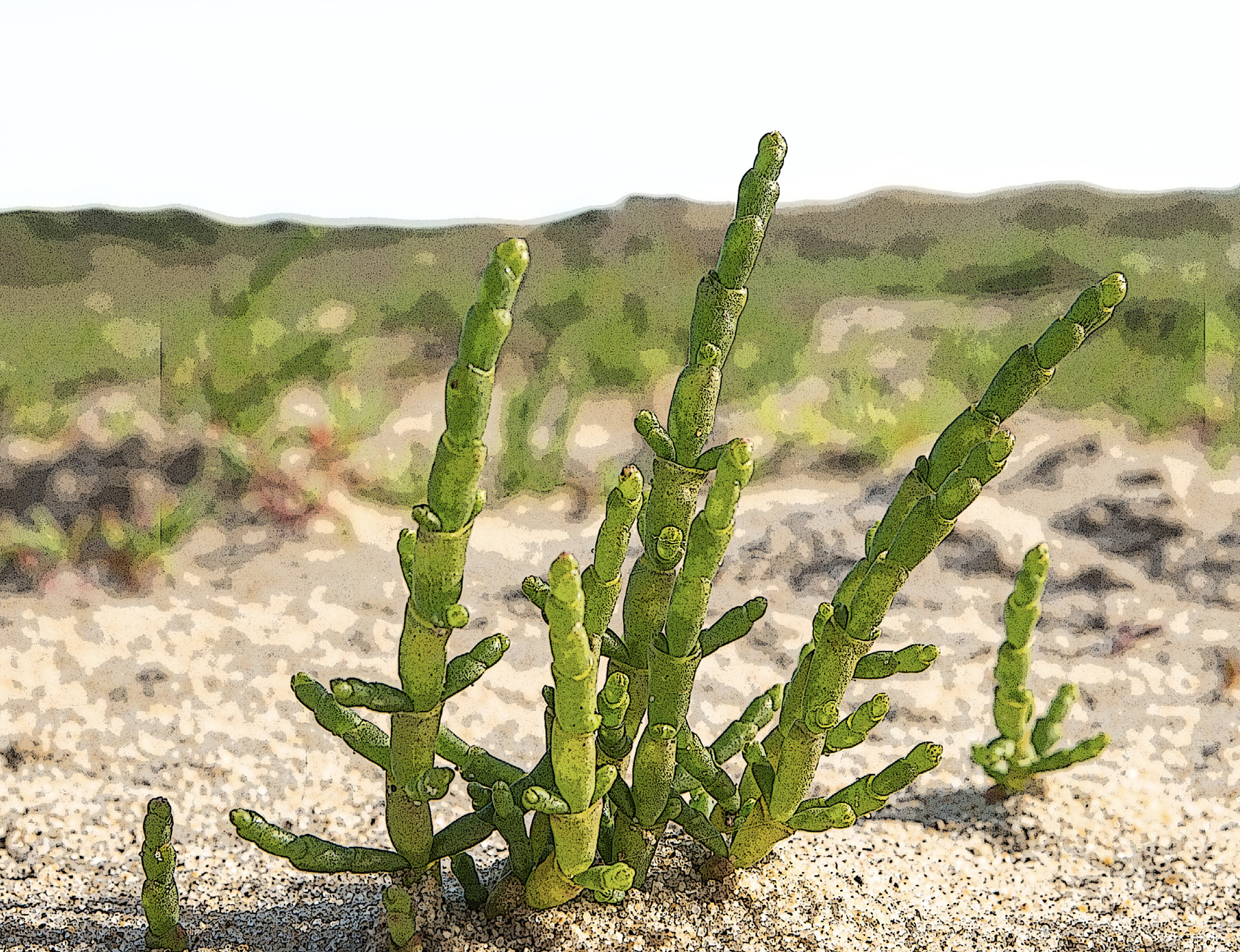
ver the 2010s and early 2020s, a new star ingredient has risen in popularity: the brackish-loving plant salicornia (Figure 1). Cooked or raw, whole or powdered,1 salicornia inspires many recipes, initiatives and even eateries. From BBC Good Food’s recommendation of casting it as a garnish for long drinks and the seafood-revolutionising Andalusían chef Ángel León’s dreamy Instagram stories of salicornia fields to restaurants and bars named after it in Mallorca and Cádiz in Spain, Koper in Slovenia, and Aveiro in Portugal, the salicornia-craze seems to be everywhere – in Europe, at least.2 What makes salicornia so popular?
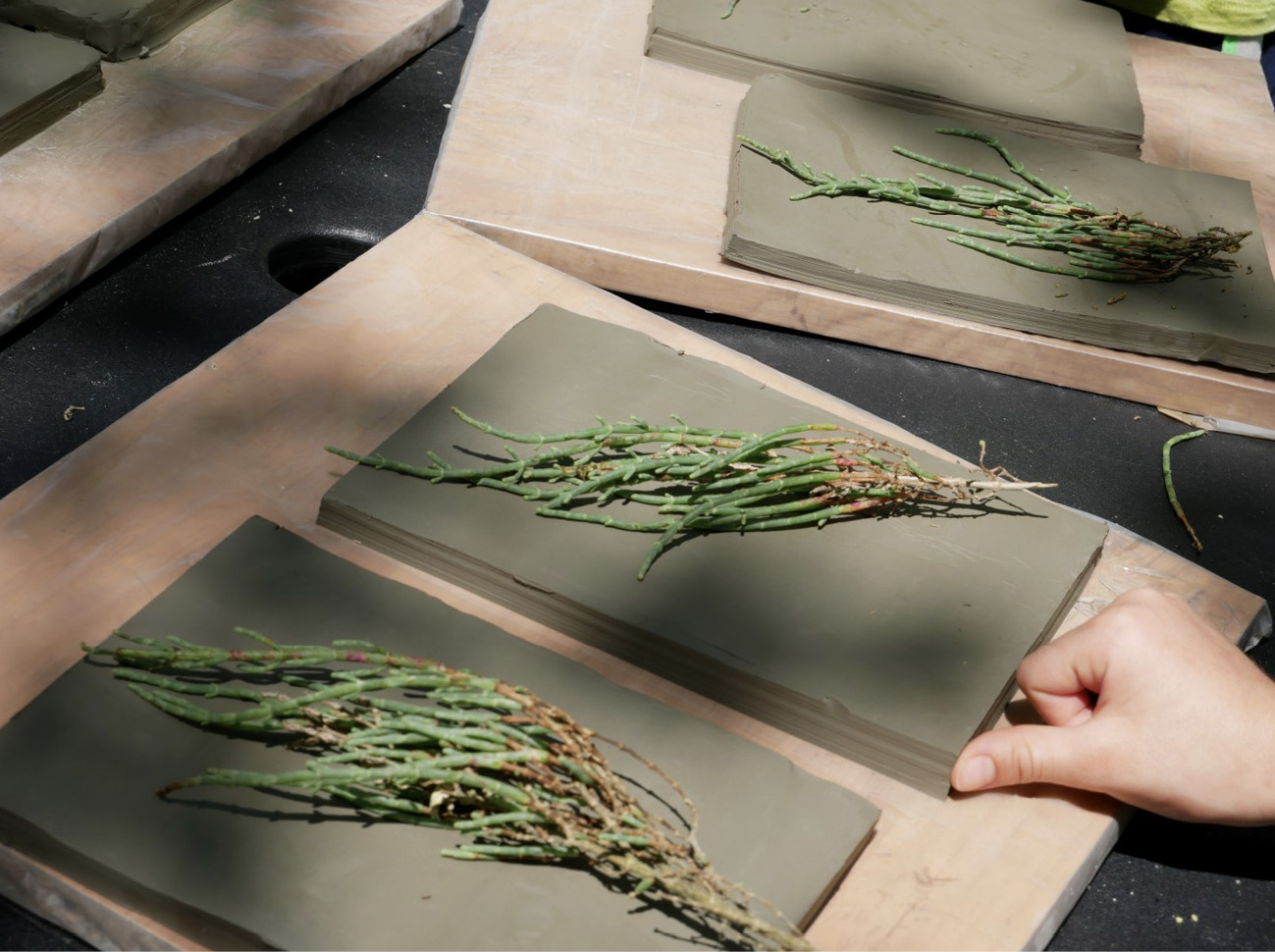
Figure 1.
Salicornia at the Primavera Estate, Linda Zennaro. Photo: Barena Bianca.
A succulent, halophytic plant native to salt marshes, lagoons and other brackish ecosystems, salicornia has a long history of being foraged, which is reflected in its many names: from glasswort and samphire to salty fingers and pickleweed. Its naturally salty flavour is complemented, as recent research shows, by high nutritional value and bioactive health properties.3 Its capacity to store water and its resistance to salt have qualified it as a candidate for low-irrigation cultivation and a model for sustainability.4 Perhaps this is why salicornia has evolved into a gourmet ingredient. Reflecting on and investigating its increasing popularity, in this paper we focus on the cultural lives of this saline plant and its agency in shaping how cuisines, nature conservation and climate justice activism entangle across European coastlines. We do so with the aim of arguing that, much more than just a culinary trend, current interests in salicornia mirror human-plants collaborations in rallying for more just, and more inclusive, futures.
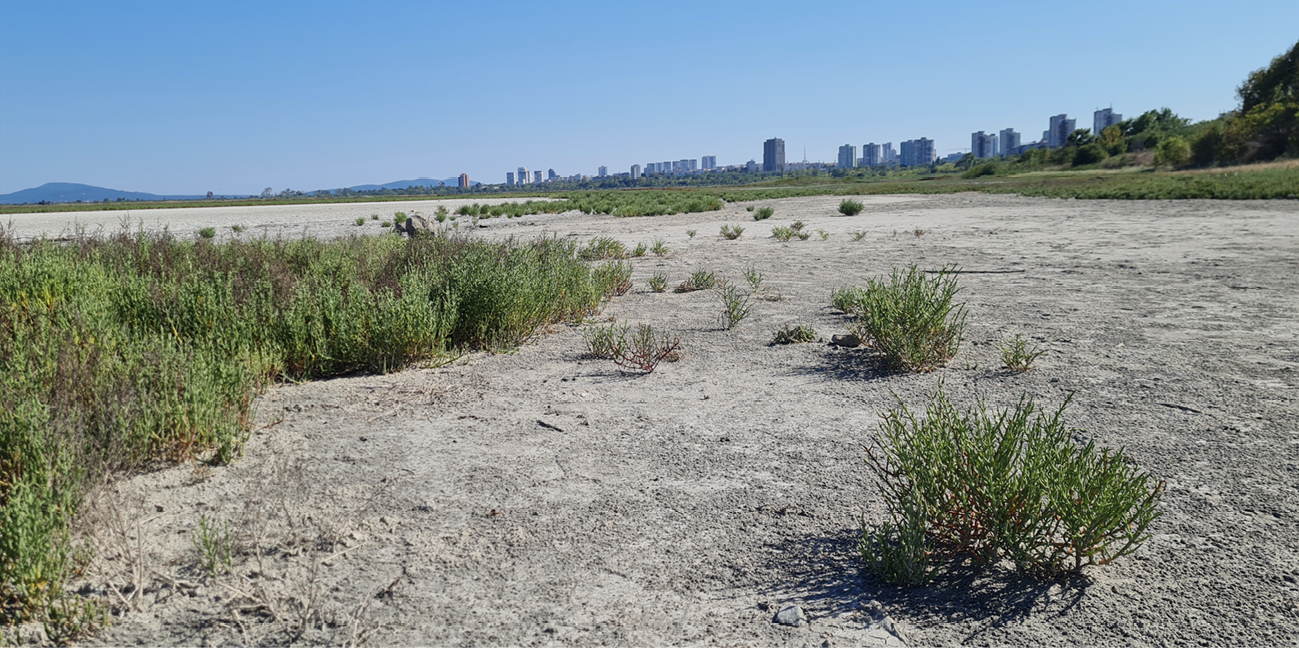
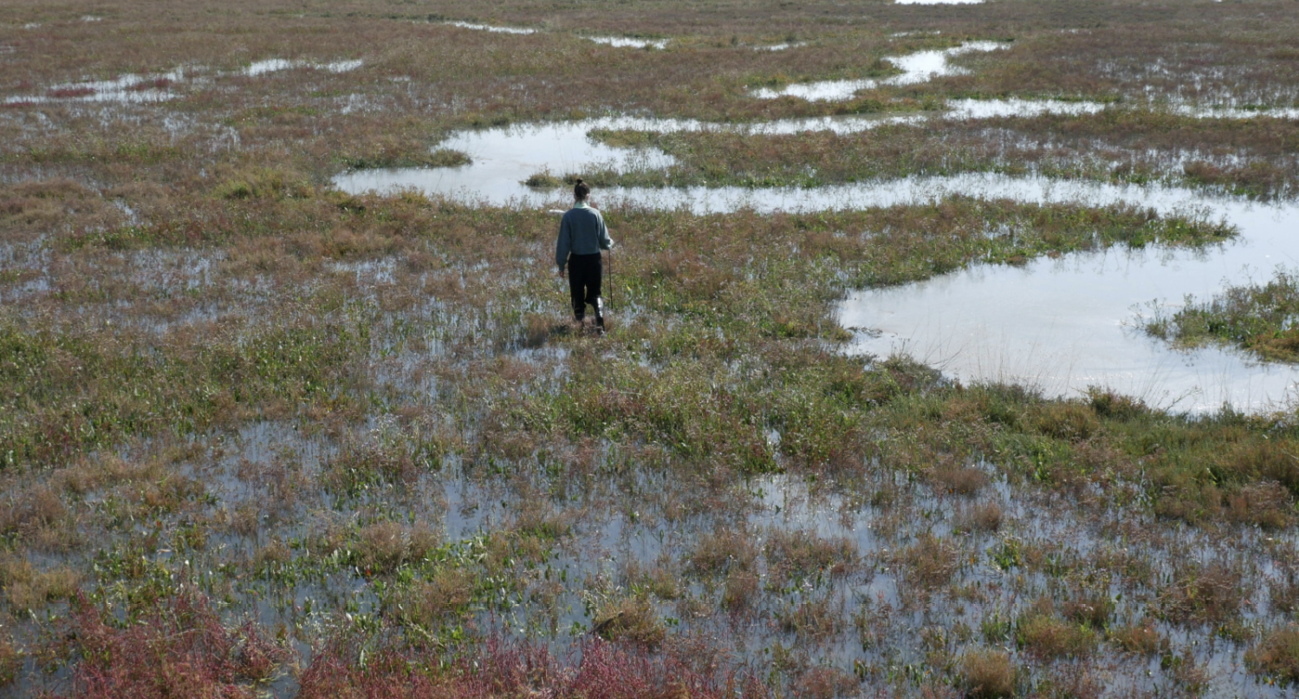
Figure 2.
Salicornia in the Venice Lagoon, top, and in the Atanasovsko Lake, bottom. Source: Barena Bianca (top) and Anna Antonova (bottom)
For a growing number of ecologists and environmental nongovernmental organisations (NGOs), the culinary properties of salicornia (along with its other halophyte siblings) represent an underutilised opportunity to protect coastal wetlands and communicate their importance to society.5 One cannot talk about climate change without talking about water: too much in some places and too little in others. But when floods spill and splash, wetlands can catch them. For this and a slew of other reasons, coastal wetlands are among the world’s most valuable ecosystems: they serve as carbon sinks, buffers for erosion and homes to vital biodiversity.6 Salicornia’s resilience reflects these virtues. Capable of existing either with lots of water or entirely without, the halophyte both inhabits and underpins the brackish ecosystem’s key ecological functions (Figure 2). This seems to add to its attraction as an edible plant. Therefore, salicornia’s status as an ingredient in contemporary European cuisines connects to more complex contexts and interrelations between coastal communities, their environments and their envisioned futures.
Using case studies from Venice, Italy, and Burgas, Bulgaria, two cities that intimately co-exist with the coastal wetlands that surround them, we think through the social lives, symbolic agency and materiality of salicornia, thereby spotlighting the many entanglements of humans and aquatic nonhumans. After all, from a scholarly perspective, coastlines are not only vital landscapes for climate change but also provocations for boundary-spanning thought. As imagined spaces, they are neither oceanic nor are they necessarily blue. Instead, their salinity and colour constantly ebb and flow, making them murky spaces of the in-between, often alternating between states of wetness and dryness, levels of salinity and sandy-fluid dynamics. In focusing on the halophyte plant salicornia native to these spaces, we join in coastal communities’ efforts to consider possible iterations of salty, watery and transitory worlds. As befits a plant that inhabits the murky zone of transition between land and sea, salicornia aids us in two simultaneous exercises in scholarly fusion: not only the blue humanities and critical plant studies, but also food cultural history and critical conservation studies.
An abundance of maritime themes has entered social scientists’ and humanities scholars’ diets over the last two decades. Appetites for critical ocean studies,7 the blue humanities,8 ever-more-wet ontologies9 and the marine social sciences10 have been thoroughly w(h)etted.11 In the midst of the UN Ocean Decade, rising awareness of the oceans and seas’ crucial role for life on this planet has also motivated heightened attention to coastal communities, their practices and imaginaries. What about their flora appetites?
Even as the focus on the more-than-human deepens across these fields, all too frequently the lives of plants remain underrepresented. Fish, marine mammals and other critters regularly feature in maritime thought along with the materiality of both shorelines and water.12 But sea plants – with the notable exception of seaweed or grass – have largely remained at the back of the metaphorical kitchen shelf.13 Conversely, the plant humanities and critical plant studies, which advocate for centring perspectives from vegetal worlds, have thus far remained largely land-locked.14 These omissions narrow the perspectives possible on coastal and marine life. And perhaps more importantly, they also fail to represent the lived experiences of coastal communities and especially women and Indigenous peoples, who have historically engaged on equal terms with their landscapes’ flora and fauna through foraging and cultivation.15
Our focus on salicornia comes from the experiences of coastal communities, respectively in the contemporary coastlines of Venice and Burgas, where this halophyte plays an increasingly active role in shaping evolving seascape imaginaries and conservation efforts. Analytically, we frame these efforts not only as a new flavour in the cuisine of blue humanities and food cultural history approaches, but also as being strongly resonant with recent calls to embed conservation more firmly in existing social and cultural practices. In particular, scholarly discussions around convivial conservation and conservation humanities both agree on the need to pay more attention to stories of more-than-human co-existence with local human communities.16 Conservation humanities scholars, for instance, demonstrate that conservation is ‘fundamentally an issue of cultural values and meaning’.17 Proponents of Bram Büscher and Robert Fletcher’s convivial conservation paradigm go even further, calling for conservation to be reframed as meaningful co-existence based in social, environmental and multispecies justice.18 Local community practices, rather than overarching global capitalist dynamics, come to the foreground for convivial conservationists.19 Yet, like much of the wider critical conservation studies, discussions in both the conservation humanities and convivial conservation remain largely land-bound. 20 Moreover, in calling for multispecies justice, these approaches still largely prioritise the ‘charismatic megafauna’ and engage with plants only to a very limited extent. As we will highlight, plants like salicornia, however, can prove to be equally charismatic in advancing nature conservation goals.
For this inquiry, we adopt an inductive approach that follows the speculative strength of grounded theory to pull on different types of empirical work. Much like the plant that inspires us, our methods are foraged. We pull examples from art and gastronomy, policy, conservation and biodiversity management, and do so by employing the interdisciplinary environmental humanities methods of multispecies ethnography, close reading and participatory research. The ingredients – or varying types of data – we gather have been recombined and fused in our comparative narrative analysis. We begin in the brackish waters of the Venetian Lagoon, which ripple into the Adriatic Sea, and then journey to Burgas on the westernmost point of the Black Sea and its salty lakes and wetlands, before concluding by considering European coastlines at large.
Salicornia and Other Venetian Survival Stories
Venice, famously, is sinking. Less famously, however, the lagoon that hosts this famous floating city is, as the anthropologist Rita Vianello describes, not ‘a natural environment’.21 Instead, she considers Venice and its lagoon as an example of what island studies scholar Philip Hayward calls an ‘aquapelagic assemblage’,22 making it clear that were it not for human labour, the sea would have long ago gulped up and swallowed Venice’s brackish waters. In this assemblage water is not only what defines the city, but also what threatens it. Salt is often to blame – seeping into its soil and soiling its bricks.23 But the Venetian salt marshes – barene – are essential to the survival of this amphibious city, and it is here where salicornia grows. It is telling that Venice’s status as a UNESCO World Heritage site refers not just to the city itself, but ‘Venice and its Lagoon’.24
The artists Fabio Cavallari and Pietro Consolandi formed Barena Bianca in the summer of 2018 ‘as a shirtwearing activist group in the Venetian Lagoon’.25 Adopting the intertidal barena as its emblem, it has since taken on the identity of ‘a lagoon artivism collective’ that aims to illuminate ecological and sociological issues in Venice and elsewhere.26 The collective pops up in public spaces, facilitating workshops, collaborating on actions and performing installations and happenings. Artistic interventions sometimes merge tastings with lectures. In these actions salicornia often pops up too. The question, then, is why? Why are chefs and activists in Venice working with salicornia? Why salicornia and not another plant? And how does salicornia mediate human-lagoon relationships?
Barena Bianca regularly collaborates with We Are Here Venice, a Third Sector Organisation founded in 2015. Operating as a research collective and an activist platform, it is dedicated to the conservation of Venice as a living city. Its founder, Jane Da Mosto, calls Venice a ‘mirror on the world: a source of inspiration and a microcosm of many of the most important global challenges’.27 In other words, the city is a canary in a coal mine. But more than just a laboratory, a place to stage experiments, it is also a home, one where locals raise their voices against the noise of mass tourism to remind the world that ‘we are here’.
For World’s Ocean Day in 2022, the two collectives hosted a workshop for Venetian children, which recycled about-to-be-abandoned T-shirts by turning them into ‘living symbols of the Lagoon’. The children composed images of barene plants and flowers on clay tablets and then stamped them onto shirts (Figure 3). This counters what the collective calls ‘the downward spiral of the Venetian ecosystem, in which both the resident population and the amount of the Barene declined by about 70% during the last century. Each of us can be a Barena.’28 The collective thus casts salicornia as material proof that the city is its lagoon and that Venice needs the lagoon, its saltmarshes and the flora they host to survive.
The barene blend binaries that separate salt water from fresh, nature from culture, above ground from below. The tide choreographs the saltmarshes, a constant inhale and exhale of water swallowing land, and then tracing its steps back, sharing its gains with the air. Salicornia shapes the lagoon’s marshland ecosystem, mediating between the islands and the mainland in its intertidal zones. Resilient to rising sea levels and to saltwater, salicornia is a collector, a scavenger, gathering debris from sand and shells and rocks to turn these particles into soil, a stage it sets to share with other brackish species.
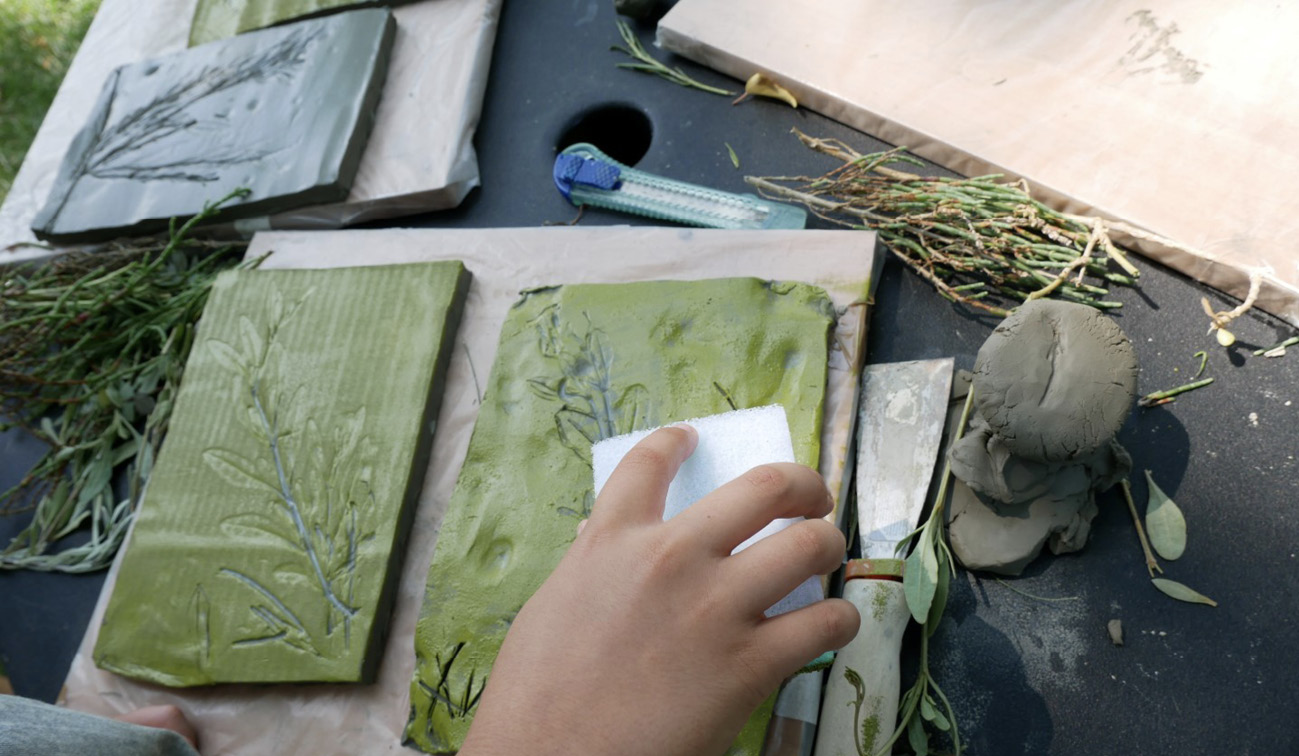
Figure 3.
Children stamping salicornia into clay slabs. Photo: Barena Bianca.
And yet the saying ‘water, water, everywhere, not a drop to drink’ applies. Many people consider salicornia a weed. Even more importantly, the salt marshes are protected areas and so foraging is a crime. A minor and insignificant crime, sure, but nonetheless a crime. Instead, Rialto Market hawks salicornia farmed elsewhere for 20 euros per kilo.
For Barena Bianca, snacking is a medium with which to swallow and metabolise distinctions between nature-culture, abandoning them for voices that include ecosystems. More-than-human choirs. In summer 2024 Barena Bianca curated the third edition of Ocean Space’s Convivial Tables. Launched in 2022 by TBA21-Academy, this research programme is ‘dedicated to the ties between food and ecology and the ways these affect bodies of water’. Barena Bianca has titled this edition’s brace of workshops and field trips, conversations and cooking ‘A Diet for Resistance’ and envisions this not as restricted to a specific geographic area, but instead as a mobile method that is ‘aware of how food is able to give voice … to one’s choices on environmental, social, and economic issues’.29 As part of the programme’s culinary installation fishing without fish, guests were invited to cast their rods through a tablescape of edibles including, of course, salicornia (Figure 4). Resistance is a red thread in Venice. Whether cultural, political or environmental resistance, the term connects various movements and actors across the city and the lagoon.
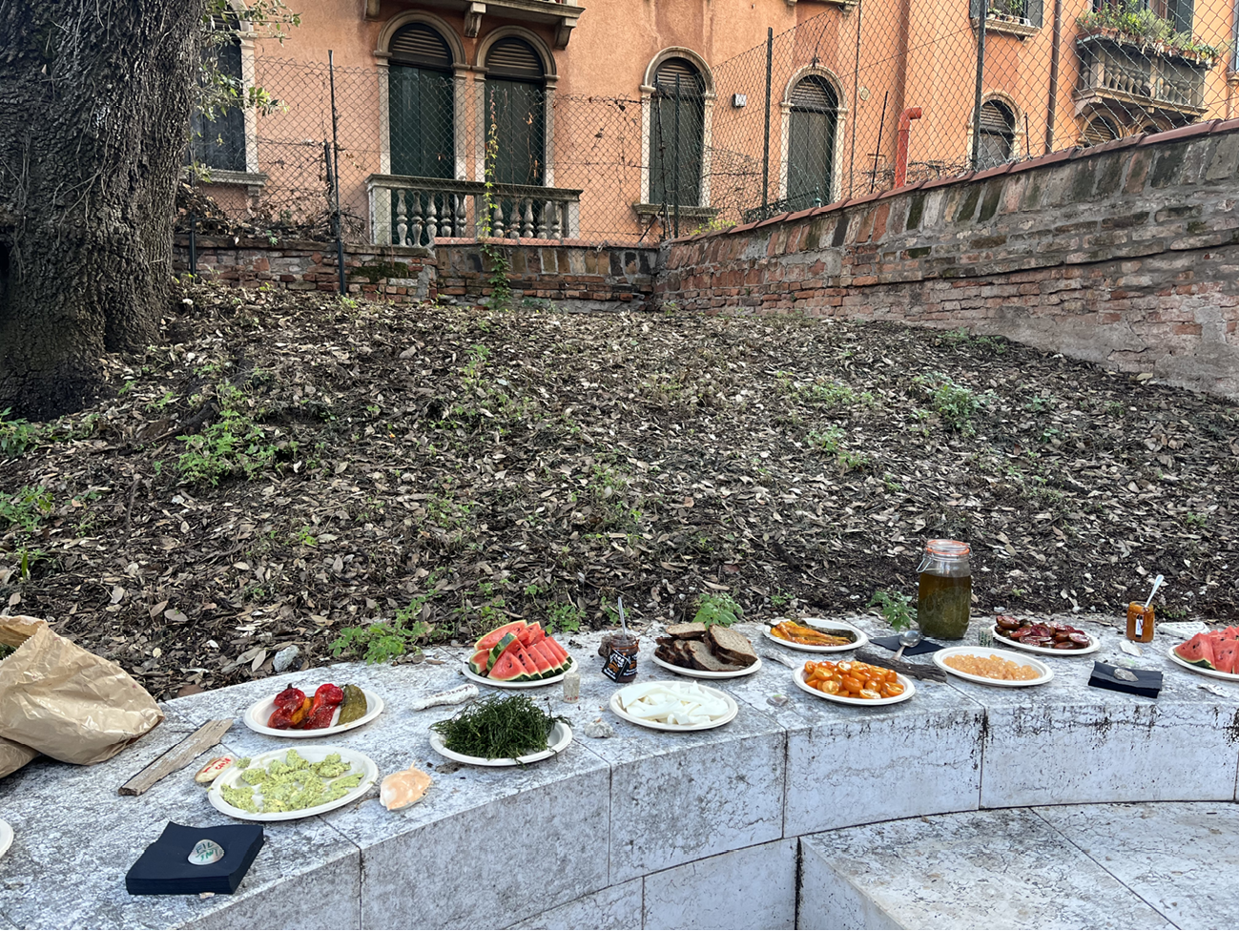
Figure 4.
An array of picnic dishes featuring salicornia. Photo: L. Sasha Gora.
Barena Bianca is not the only project promoting salicornia as a poster child of the ecological intimacy Venice shares with the lagoon and how city, plant and salt marshes all depend on each other. Since 2021, the environmental scientist Filippo Grassi, design researcher Ludovica Guarnieri and chef and artist Lorenzo Barbasetti di Prun have been collaborating under the guise of The Tidal Garden – a research agency that investigates ‘the edible potential of halophytes’, such as salicornia, ‘as a tool for cultural adaptation to climate change’.30 It is a plant’s ability to tolerate salt that qualifies it as such a tool. Instead of hanging onto the culinary traditions of a climate that no longer is, in the Venetian Lagoon halophytes represent an increasingly saltier, warmer and wetter present.
Tools appear not just as a metaphor in a 2023 publication. The Austrian designer Sigrid Schmeisser, who leads the Netherlands-based design and research studio Peak15, named her Raccogliere Magazine after the Italian word to gather or to collect. This collection of bilingual texts ‘explores Venice through the perspective of Salicornia’, which it calls a ‘plant-architect’ and proposes ‘tools for intertidal coexistence’.31 In addition to salicornia, it also gathers voices, including da Mosto’s of We Are Here Venice and di Prun’s of the Tidal Garden. Stemming out of Schmeisser’s participatory research in the lagoon, Raccogliere casts salicornia as a micro canary in its own right, detailing how it has become an indicator for transformations in the local ecosystem, marking rising levels of salinisation, which negatively impacts agriculture. To promote its use, Studio Noff, composed of Daniel Garber and Amalia Magril, designed a series of tools – jars for pickling and fermenting, a rack for drying and a saltshaker. Gin dei Sospiri, a distillery on the island of Sant’Erasmo, known as Venice’s vegetable garden, which is affected by such changes, is now turning salicornia into gin.32
Because it is a city that floats, despite the threat of sinking, and because of its art and architecture, Venice attracts so many tourists that the city itself has become another word for tourism and, increasingly, overtourism. Reflecting on the country’s economic entanglement with tourism and this history, an Italian studies scholar calls the ‘tourist imaginary’ of the country ‘destination Italy’.33 And in ‘destination Italy’ Venice occupies a starring role, and selling tourist experiences of what we call ‘destination Venice’ has become the city’s primary economic trade, and an extractive industry.34 Around half of the nearly fifty million tourists that holiday in Italy each year stop in Venice.35 They take selfies in front of canals, ride gondolas and drink spritz. In June 2025, the third richest man in the world hired Venice as the location for his second wedding. Because of the tourist behaviour that the city attracts, Robert C. Davis and Garry R. Marvin consider Venice ‘the first postmodern city’ because the only product it sells is ‘itself and its multiple images’.36
Too many tourists and too few locals lead to what Salvatore Settis terms ‘a Venice without Venetians’, in his provocatively titled book If Venice Dies.37 Salicornia, however, does not feature in tourist imaginations of Venice. Because of regulations coupled with cost, few restaurants serve it. Salicornia may be everywhere in the lagoon, but the same is not true of menus, and this paradox further adds to its appeal. Residents seek to challenge ‘destination Venice’, the airbrushed version of tourist-generated images that reduce the lagoon’s unique ecosystem to a theme park, by celebrating salicornia, its stories and its survival. For the communities of the Venetian Lagoon, human and more, salicornia is a means of hanging on, of not letting go of the city and letting it slip and sink, and of resisting tourism as monoculture, of ‘destination Venice’.
Symbiotic Imaginaries: Salicornia and Salty Conservation in Lake Atanasovsko
Salt – and the by-now infamous Sunny Beach megaresort38 – used to define the southern Bulgarian coastline along the Black Sea. In the early twentieth century, local communities subsisted on cultivating the coastal wetlands around Burgas, especially the Pomoriisko and Atanasovsko, as salt flats.39 Salt-making was the most profitable industry in the region, an industrial heritage it shares with Venice, and one that had a substantial impact on the environment. A series of dykes, channels and canals shaped the space to control the water regime and salinity, coincidentally improving the ecological conditions for a variety of species and providing disease control due to the inability of mosquitoes to survive high levels of salinity. Conservation experts today, seeking to preserve the last functional salt flats along the coastline, hence speak of salt-making and its context as a symbiosis: a productive conviviality between human and nonhuman communities in the saline environment.40 In recent years, this symbiosis has come to be embodied by a new symbol: salicornia.
As in Venice, salt and salicornia stand in for an imaginary alternative to the modern development of the Bulgarian coastline, which over the last thirty years has been dominated by tourism and for-investment property development.41 Along with changing political regimes, shifting economic and societal values incentivised the rise of these industries at the expense of salt production, spelling the latter’s substantial long-term decline.42 This new economic reality became reflected in the material landscape of the coast. Dykes, canals and other salt-making infrastructure fell into disuse, while former salt flats (especially around Lake Pomoriisko) were filled in to make way for new development.43 New road infrastructure, tourist towns and flats-for-sale springing up along the coastline make for a decidedly less symbiotic mode of human-nonhuman coexistence, contributing to issues with pollution, waste, runoff and other forms of ecosystem pressure.44
Local conservation experts found themselves cast in the role of key actors in the fight to preserve the last remaining salt flats. Cultivated wetlands like Lake Atanasovsko or Pomoriisko, veined through by dykes and divided into smaller bodies of water, provide a series of ecosystem services, among which excellent feeding and nesting habitats for highly charismatic birds like pelicans and flamingos. Advocating for these lakes’ role for local biodiversity, NGOs like the Bulgarian Biodiversity Foundation (BBF), the Bulgarian Society for the Preservation of Birds and Green Balkans have collaborated with the regional industrial salt producer, the Black Sea Salinas company, on a number of projects to maintain remaining salt-making infrastructure. In Lake Atanasovsko, especially, BBF began engaging in creative and public-facing work to promote this conservation work, emphasising the importance of the environment in general and of salt specifically. Wide-reaching, these efforts spanned travelling educational exhibitions, events like an annual salt festival, films and music clips about the symbiotic relation between people and salt45 – and, of course, culinary experimentation.
Salicornia entered these last efforts as an inspiration from BBF’s collaborative work with the Salina Greens project in Portugal, a fellow NGO that had already marketed the plant as both a fresh product and as ‘vegetable salt’ (sal vegetal) in its efforts to promote local wetland ecosystem services (Figure 5).46 BBF, who had their own Lagoon of Life project in Lake Atanasovsko and had already been experimenting with sea salt chocolate, fleur de sal and other food products to both popularise and fund conservation efforts, saw the opportunity to introduce new – literal and metaphoric – flavours in their culinary conservation work.47 In a sense, salicornia shaped its own debut into Bulgarian conservation imaginaries, helping to connect professional environmental NGO experts from organisations across Europe and enable them to exchange new creative practices.
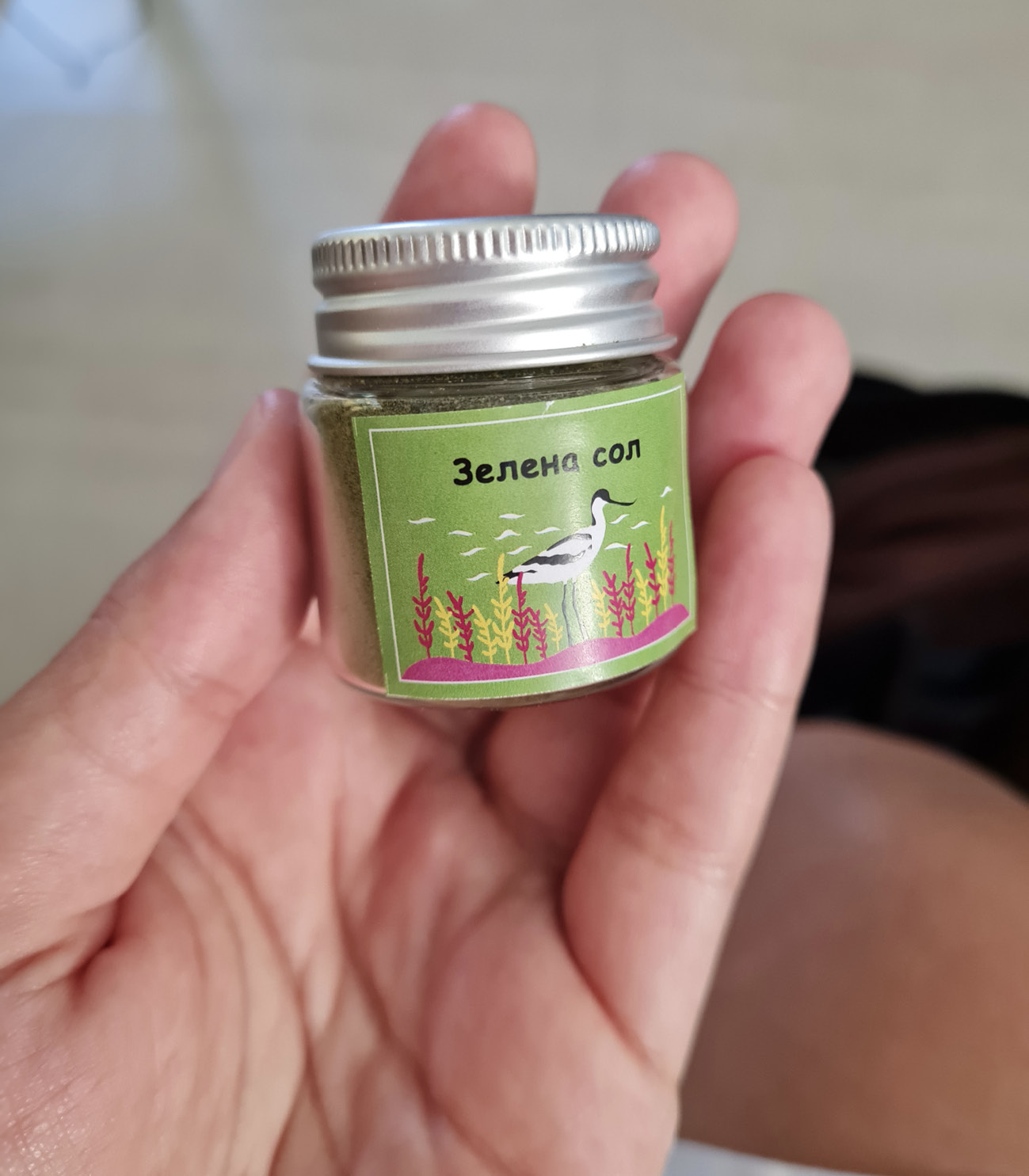
Figure 5.
Green salt sold by the Bulgarian Biodiversity Foundation. Photo: Anna Antonova.
Locally too, salicornia has been helping to link conservation efforts with new communities through the medium of food. As a way of raising awareness for the lake’s benefit, BBF formed a collaboration with a local caterer to serve a variety of recipes featuring the halophyte at stakeholder events. Salicornia-based salads, zucchini marinated in mint garnished with salicornia, rice and mussels with salicornia and chocolate-covered salicornia thus made appearances at the social gatherings of workshops, interest group gatherings and the biannual meetings of the BBF-led Lake Atanasovsko public advisory council.48 Unlike sea salt from the lagoon, salicornia has the advantage of being vividly perceptible to the senses in each dish where it makes an appearance. Its unique shape, vibrant colour, crisp texture and of course salty taste command attention and present a topic of conversation in a way that salt, given its ubiquity in contemporary life, does not.
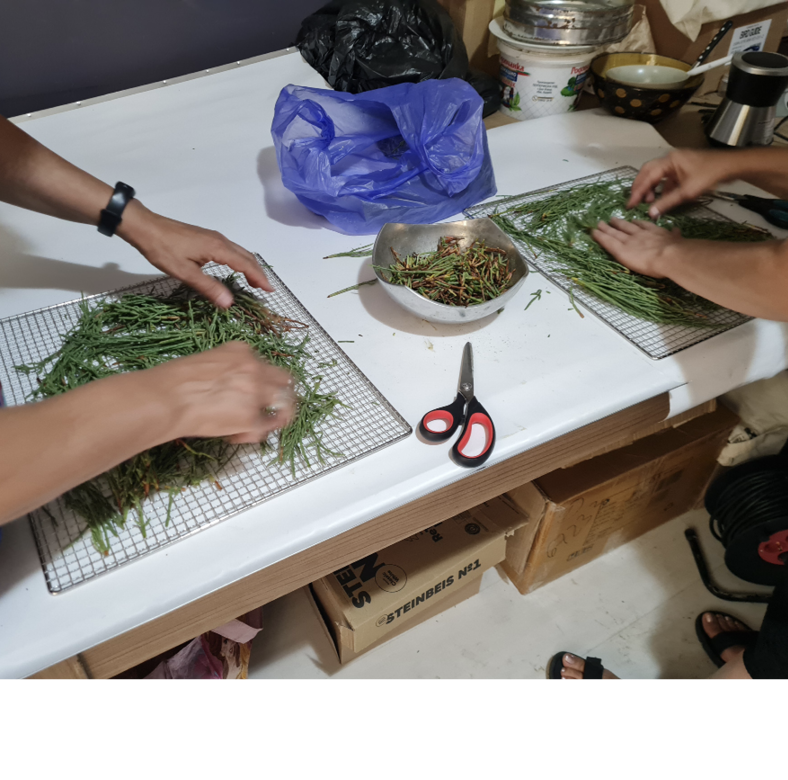
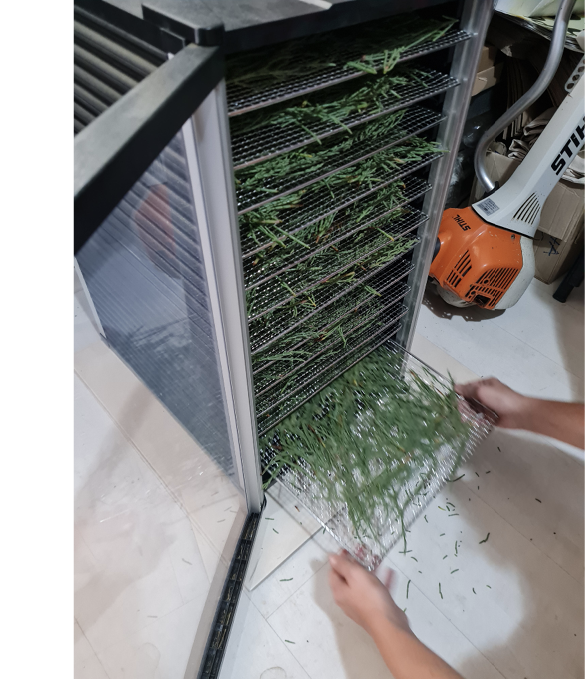
Figure 6.
BBF experts preparing salicornia for desiccation (left) and putting it inside the machine (right). Photos: Anna Antonova.
Also unlike sea salt, which after all is an industrial product from the lagoon, salicornia captures the imagination as being boutique – limited edition. Growing within Lake Atanasovsko’s Natura 2000 protected area, the halophyte can be foraged only seasonally, subject to formal licensing from the Ministry of the Environment that provisions both seasonal limitations and limited quantities so as to preserve the wetland’s fragile ecosystem. BBF, having obtained such a foraging licence, gather their allotted quantities by hand during the late summer. To stretch these into a viable product available year-round as a way of supporting their conservation activities, they focus above all on producing ‘green salt’ after the example of their Portuguese colleagues. In a dedicated machine located in their Burgas office, BBF dry the plants over the course of several hours, often overnight (Figure 6).
They then grind the desiccated salicornia to produce green salt themselves. As conservation experts, BBF have had to develop the skills necessary for this food processing procedure: they tried working with professional services but found them far more used to working with tea plants. Thus, food processing service providers would frequently dry out the salicornia too much, resulting in a yellow powder without the distinctive green colour or flavour profile of the green salt. BBF’s decision to take over the entrepreneurial production of its own green salt costs the team many additional hours of labour, as does the gathering of the plant in the first place. So far, the financial return from sales of the green salt has not been high; it forms part of BBF’s wider selection of conservation-aligned products, meant to promote the NGO’s goals and only partly to help fund conservation activities (including other spices, chocolates featuring salt from the Atanasovsko lake, alongside ‘standard’ souvenirs like t-shirts, mugs, stickers, and so on). Unlike many of the other products, the salicornia salt cannot be produced in large, readily available quantities. Thus, the efforts to create it are a recognition of the symbolic, rather than material, part that salicornia can play.
Indeed, both green salt and fresh salicornia can potentially serve as potent spices for the metaphoric platter that is Bulgarian conservation. Salicornia sparks interest not only because of its limited availability and entrepreneurial production methods, but also because it can be seen as being eco-cool. In addition to its high nutritional properties,49 the halophyte can boast of exemplifying or even embodying the environmental qualities and virtues of the landscapes it inhabits. Like the coastal wetlands themselves, salicornia has its own traits of resilience in the face of climate change, both persisting and germinating in the harsh, highly saline soil conditions that are likely to affect more cultivated agricultural land in the future.50 These properties alone qualify the plant for a place in the contemporary sustainable food consciousness, appealing to a new generation of environmentalists. And finally, since it often grows in protected areas –including in Lake Atanasovsko – salicornia can be easily tied conceptually with environmental conservation, coming to stand in for its complex cultural and ecological entanglements.51
At the same time, the plant’s limited availability and relatively low profile mean that this message cannot reach everyone. Salicornia’s appearance in individual conservation-specific events does not translate easily to a widely available culinary experience. For many of the coastline’s visitors and citizens, the halophyte’s existence hence remains niche, which is also true in Venice. Moreover, raising its profile too far might be inadvisable. Higher appetites could lead to illegal foraging and thus ecosystem damage, at the very least from more people accessing an otherwise restricted protected landscape, to the very lagoon whose conservation salicornia is meant to promote. Thus, along with representing an alternative-symbiotic-imaginary for the Bulgarian coastline, the plant also opens up a series of contradictions and questions. What is the future of this type of culinary conservation? And whose imaginaries does salicornia alternatively represent or inspire?
Conclusion: The Future is Salty
The blue humanities compel us to turn our attention to the varied human experiences of coastlines at a time when calls for blue growth seem to be everywhere.52 Critical plant studies call on us to take into account the agency and intellectual lives of plants,53 and critical approaches to conservation argue for the foregrounding of human-nonhuman relations.54 Salicornia’s star appearances – not only in our two case studies but also across Europe – exemplify all these tendencies to a large degree. The stories we have recounted here – examples of how local communities ‘story’ salicornia – show how this halophyte exerts its own influence, creating communities of salt between culinary creatives, professional conservation experts, climate activists, artists and of course sustainability-conscious publics.
As our case studies in Venice and Burgas demonstrate, at least some of salicornia’s appeal seems to pertain to a symbolic environmental imaginary tied to the material culinary practice: a sense of wanting to ‘eat the landscape’. Resonant with sociologist and food systems scholar Michael Carolan’s argument that alternative food practices can engender new perspectives on ‘social change, value creation, and a politics of the convivial’, salicornia here embodies a type of intimacy cultivated with place through food.55 And, through the symbolism of the plant’s resilience to different climatic and saline conditions, also a form of tasting a desired future: more sustainable, more conscious, garnished with a touch of hipster pride in being ahead of the curve. This echoes anthropologist Susanne Højlund’s belief in the power of taste. ‘Sustainable food futures’, she argues, ‘begin with taste experiences in social contexts.’56
Food as synecdoche for landscape pasts and futures is of course nothing new. As Carolan’s writing attests, food studies scholars have long argued for the relevance of ‘feeling’ the environment through the senses cuisine unlocks.57 These insights, of course, extend far beyond salicornia. In the context of salmon, for instance, farmed fish have been contested as emerging from a practice that divorces the deeply intertwined ecological, social and cultural practices associated with eating wild salmon – particularly in Indigenous contexts.58 In this sense, salicornia, salmon, salt and other symbolic foods matter not because of their culinary qualities per se, but because of where they grow and thrive and what they symbolise. They are material – tangible and tasteable – entry points into a wider social and environmental consciousness.
As we have illustrated in both Venice and Burgas, salicornia’s newfound symbolism may help climate and conservation activism by advertising the virtues of protected coastal wetlands – but it also creates new conundrums for biodiversity protection. Most local salicornia can only be foraged seasonally. Yet appetites for its pungent salty flavour and future-enabling potential continue year-round. As a result, the salicornia utilised in out-of-season culinary ventures comes not from the protected areas it is meant to promote but is instead imported from countries where it is cultivated for sale, like Israel or Turkey. End consumers of its salty futures are not always informed of this fact: salicornia farmed abroad does not carry the same meaning as salicornia that grows in endangered and local landscapes.
These reflections open up a wider question about symbolic and speculative futures – namely, what is their role and how can they be put to work? Across the various scholarly contexts in which our case studies operate – blue humanities, critical plant studies, critical conservation approaches and food cultural history – symbolism and speculative work are frequently employed as a pathway to alternative ontologies and worldviews. Salicornia affirms the potential of alternative imaginaries at least insofar as it enables deeper reflections on the connections between humans and aquatic nonhumans – not only for scholars but also for local communities. However, the plant’s stories in Burgas and Venice also expose some of the tensions inherent to these speculations. Given its boutique availability, the halophyte serves in conservation and climate activists’ narratives predominantly in symbolic ways; its actual material impact when it comes to delivering alternative material futures can only be limited. Nevertheless, as both Venice and Burgas demonstrate, the plant’s imaginative and speculative footprint is outsized. By inspiring artists, chefs, conservation ecologists, climate activists and community organisers, salicornia offers not one but many alternative speculative fabulations. Much like ripples in the water of a coastal lagoon, or like the aftertaste of a meal, their lingering effects remain to be seen.
Both authors would like to acknowledge Małgorzata Zofia Kowalska, Kirsi Sonck-Rautio and Emily O’Gorman for the World Congress of Environmental History 2024 panel they organised, which provided the opportunity to think through the geographies and many lives of salicornia. We would also like to thank them for tolerating us turning the seminar room into a salty buffet.
Anna Antonova would like to thank Radostina Tzenova, Gloriya Marinova, Diyana Kostovska, Diana Pavlova, and Spas Uzunov from the Bulgarian Biodiversity Foundation for teaching her about salicornia. She is also grateful to the funding support of the European Union under the Horizon Europe Program, Grant No101059957 (EmpowerUs) and the Volkswagen Foundation via her Change! Grant ‘Convivial Waterfronts’ (Project Nº 0200455).
L. Sasha Gora’s thanks go to Fabio Cavallari and Pietro Consolandi of Barena Bianca for sharing their snacks, ideas and photographs, and to the Elite Network of Bavaria for generously funding her research group.
Acosta, R., J.A. Adedeji, M. Barua, M. Gandy, L.S. Gora and K.M. Schlichting. 2023. ‘Thinking with urban natures’. Global Environment 16 (2): 177–21.
https://doi.org/10.3197/ge.2023.160202
Alaimo, S. 2019. ‘Introduction: Science studies and the blue humanities’. Configurations 27 (4): 429–32.
https://doi.org/10.1353/con.2019.0028
Antonova, A.S. 2025. ‘Regimes of value: Economic transformations, ecological livelihoods, and salt cooperatives on the Bulgarian Black Sea coast’. Environment and Planning A: Economy and Space 57 (2–3): 287–306.
https://doi.org/10.1177/0308518X241295521
Antonova, A.S. 2023. ‘Toxic flows and societal exposures: The maritime toxic timescape, environmental degradation, and social and political change on the Bulgarian Black Sea coast from the 1950s onward’. In S. Müller and M.B.O. Nielsen (eds), Toxic Timescapes: Examining Toxicity Across Time and Space. Athens, OH: Ohio University Press. pp. 130–53.
Antonova, A.S. and A. Rieser. 2019. ‘Curating collapse: Performing maritime cultural heritage in Iceland’s museums and tours’. Maritime Studies 18 (1): 103–14.
https://doi.org/10.1007/s40152-018-0128-2
Antonova, A.S. and A. van Dam. 2022. ‘Environment and integration on the Edge of Europe’. Political Geography 93: 102554.
https://doi.org/10.1016/j.polgeo.2021.102554
Antonova, A.S., W. Flannery, S. Gómez, M. Gustavsson, M. Hadjimichael, B. Murtagh, K. Ounanian, S. Solnør, V.M.D. Steiro and K. Svels. 2025. ‘Centering coastal communities’ diverse economic practices in the blue economy’. Geoforum 166 (November): 104410.
https://doi.org/10.1016/j.geoforum.2025.104410
Baldacci, C. 2023. ‘An archipelago of ecological care: Venice, its lagoon and contemporary art’. Lagoonscapes 3 (2): 321–34.
http://doi.org/10.30687/LGSP/2785-2709/2023/02/011.
Barena Bianca. ‘Barena Primavera-Estate’. https://www.barenabianca.earth/en/barena-primavera-estate/
Barena Bianca. ‘Bio & CV’. https://www.barenabianca.earth/en/bio-cv-portfolio-e/
BBC. 2017. ‘Bulgaria’s Sunny Beach offers “best value in Europe”’. BBC Business News (14 April).
https://www.bbc.com/news/business-39593993
Bear, C. 2017. ‘Assembling ocean life: More-than-human entanglements in the blue economy’. Dialogues in Human Geography 7 (1): 27–31.
https://doi.org/10.1177/2043820617691635
Bennett, N.J. 2019. ‘Marine social science for the peopled seas’. Coastal Management 47 (2): 244–52.
https://doi.org/10.1080/08920753.2019.1564958
Bertocchi, D. and F. Visentin. 2019. ‘“The overwhelmed city”: Physical and social over-capacities of global tourism in Venice’. Sustainability 11: 6937.
https://doi.org/10.3390/su11246937
Bulgarian Biodiversity Foundation. N.d. ‘Green salt: The salt without salt’. Lagoon of Life Project. https://lagoon.biodiversity.bg/products-from-the-lake-3-49
Bulgarian Biodiversity Foundation. N.d. ‘Public Council’. Lagoon of Life Project. https://lagoon.biodiversity.bg/public-council-3-67
Büscher, B. and R. Fletcher. 2020. The Conservation Revolution: Radical Ideas for Saving Nature Beyond the Anthropocene. London; New York: Verso.
Büscher, B. and R. Fletcher. 2019. ‘Towards convivial conservation’. Conservation and Society 19 (3): 1–14.
https://doi.org/10.4103/cs.cs_19_75
Cañada, J.A. 2024. ‘Ambivalence in environmental care: Marine care ethics and more-than-human relations in the conservation of seagrass Posidonia oceanica’. Journal of Agricultural and Environmental Ethics 37 (5), special issue on ‘Sea Farming and Feminist Blue Humanities’, ed. J. Peterson and C. Åsberg.
https://doi.org/10.1007/s10806-024-09924-2
Cárdenaz Pérez, S., A. Piernik, J.J. Chanova Pérez, M.N. Grigore and M.J. Perea-Flores. 2021. ‘An overview of the emerging trends of the Salicornia L. genus as a sustainable crop’. Environmental and Experimental Botany 191 (November): 104606.
https://doi.org/10.1016/j.envexpbot.2021.104606
Carolan, M. 2016. ‘Adventurous food futures: Knowing about alternatives is not enough, we need to feel them’. Agriculture and Human Values 33 (1): 141–52.
https://doi.org/10.1007/s10460-015-9629-4
Carolan, M. 2015. ‘Affecting sustainable landscapes and care ecologies: Getting a real feel for alternative food communities’. Sustainability Science 10 (1): 317–29.
https://doi.org/10.1007/s11625-014-0280-6
Cristiano, S. and F. Gonella. 2020. ‘“Kill Venice”: A systems thinking conceptualisation of urban life, economy, and resilience in tourist cities’. Humanities & Social Sciences Communications 7: 143.
https://doi.org/10.1057/s41599-020-00640-6
Da Mosto, J. We Are Here Venice. https://www.weareherevenice.org/
Davis, R.C. and G.R. Marvin. 2024. Venice, the Tourist Maze: A Cultural Critique of the World’s Most Touristed City. Berkeley and Los Angeles: University of California Press.
DeLoughrey, E. 2019. ‘Toward a critical ocean studies for the Anthropocene’. English Language Notes 57 (1): 21–36.
https://doi.org/10.1215/00138282-7309655
Denis, G.G. 2023. ‘Salicornia’. In Follow the Plants by the Food Art Research Network (3 December). https://www.foodartresearch.network/project/follow-the-plants/salicornia-ylang-ylang/.
Desmazery, B. N.d. ‘How to cook samphire’. BBC Good Food. https://www.bbcgoodfood.com/howto/guide/how-cook-samphire.
Dlabaja, C. 2021. ‘Caring for the island city. Venetians reclaiming the city in times of overtourism: Contested representations, narratives and infrastructures’. Shima: The International Journal of Research into Island Cultures 15 (1): 166–85.
https://doi.org/10.21463/shima.117
Gibson, P. and B. Brits (eds). 2018. Covert Plants: Vegetal Consciousness and Agency in an Anthropocentric World. 1st edition. Brainstorm Books. Santa Barbara, CA: Punctum Books.
Gora, L.S. 2026. ‘A cuisine without locals’. Tomato Tomato 3 (31 July). https://tomatotomato.xyz/magazine/a-cuisine-without-locals-l-sasha-gora
Gora. L.S. 2025. Culinary Claims. Toronto and Buffalo: University of Toronto Press.
Gora, L.S. 2025. ‘Snacking the edge off’. WE ARE OCEAN: Barena Bianca. Frankfurt: ARTPORT_making waves.
Gora, L.S. 2025. ‘Streams and floods, ripples and flows’. In C. Ladevèze, D. Martino, E. Rothenberger and C.F. Kiss (eds), Water Cultures, pp. 191–205. Fribourg: University of Fribourg.
Gora, L.S. 2025. ‘Time and microbes, tides and bodies: On fermentation as artistic practice and culinary cruising’. Food, Culture & Society 28 (2): 346–63.
Hayward, P. 2012. ‘Aquapelagos and aquapelagic assemblages: Towards an integrated study of island societies and marine environments’. Shima: The International Journal of Research into Island Cultures 6 (1): 1–10.
Hendlin, Y.H., J. Weggelaar, N. Derossi and S. Mugnai. 2024. Being Algae: Transformations in Water, Plants. Leiden: Brill.
https://doi.org/10.1163/9789004683310
Heise, U.K. 2024. ‘Conservation humanities and multispecies justice’. Humanities 13 (2): 43.
https://doi.org/10.3390/h13020043
Holmes, G., J. Carruthers‐Jones, G. Huggan, E.R. De Smalen, K. Ritson and P. Šimková. 2022. ‘Mainstreaming the humanities in conservation’. Conservation Biology 36 (3): e13824.
https://doi.org/10.1111/cobi.13824
Hom, S.M. 2015. The Beautiful Country: Tourism & The Impossible State of Destination Italy. Toronto: University of Toronto Press.
Højlund, S. 2020. ‘Figurations of taste: Sensing sustainable alternatives together’. International Journal of Food Design 5 (1&2): 133–38.
https://doi.org/10.1386/ijfd_00016_3
Gin dei Sospiri. N.d. ‘The first Venetian Gin with glasswort and aromatic plants from Sant’Erasmo’. https://www.sospiribotanicheveneziane.com/?lang=en
Guaraldo, E. 2021. ‘Resisting the tourist gaze. Art activism against cruise ship extractivism in the Venice Lagoon’. Lagoonscapes: The Venice Journal of Environmental Humanities 1 (1): 101–24.
https://dx.doi.org/10.30687/LGSP//2021/01/008
Jue, M. 2024. ‘Recipes for the future of seaweed aquaculture’. Journal of Agricultural and Environmental Ethics 37 (9), special issue on ‘Sea Farming and Feminist Blue Humanities’, ed. J. Peterson and C. Åsberg.
https://doi.org/10.1007/s10806-024-09927-z
Kirksey, S.E. and S. Helmreich. 2010. ‘The emergence of multispecies ethnography’. Cultural Anthropology 25 (4): 545–76.
https://doi.org/10.1111/j.1548-1360.2010.01069.x
Kohn, E. 2013. How Forests Think: Toward an Anthropology Beyond the Human. Berkeley and Los Angeles, CA: University of California Press.
Kostovska, D. and M. Vaz Pinto. 2024. ‘Biosaline agriculture: A new approach for climate change adaptation and preserving saltscapes. Examples from Bulgaria and Portugal’. Poster Presentation at the 5th European Conference on Biodiversity and Climate Change, 26–28 October 2024, Bonn, Germany.
Loconsole, D., G. Cristiano and B. De Lucia. 2019. ‘Glassworts: from wild salt marsh species to sustainable edible crops’. Agriculture 9 (1): 14.
https://doi.org/10.3390/agriculture9010014
McKinley, E., D. Burdon and R.J. Shellock. 2023. ‘The evolution of ocean literacy: A new framework for the United Nations Ocean Decade and beyond’. Marine Pollution Bulletin 186 (January): 114467. https://doi.org/10.1016/j.marpolbul.2022.114467
Mentz, S. 2023. An Introduction to the Blue Humanities. 1st ed. New York: Routledge. https://doi.org/10.4324/9781003166665
Mitsch, W.J., B. Bernal and M.E. Hernandez. 2015. ‘Ecosystem services of wetlands’. International Journal of Biodiversity Science, Ecosystem Services & Management 11 (1): 1–4.
https://doi.org/10.1080/21513732.2015.1006250
Neimanis, A. 2017. Bodies of Water: Posthuman Feminist Phenomenology. London: Bloomsbury.
https://doi.org/10.5040/9781474275415
Nessa, N., R. Gatta, R. Ambo-Rappe, J. Jompa and A.F. Yahya. 2020. ‘The role of women in the utilization of Enhalus Acoroides: Livelihoods, food security, impacts and implications for coastal area management’. IOP Conference Series: Earth and Environmental Science 564 (1): 012073.
https://doi.org/10.1088/1755-1315/564/1/012073
Ocean Space. 2024. ‘Tavole Conviviali. Una dieta di resistenza’. Ocean Space Instagram (13 June).
https://www.instagram.com/p/C8KSc4Oo_px/?hl=de
Otto, L. 2024. ‘Working seagrasses: Emerging coastal ethics in the Mexican Caribbean’. Maritime Studies 23 (1): 12. https://doi.org/10.1007/s40152-024-00354-4
Patel, S. 2016. ‘Salicornia: Evaluating the halophytic extremophile as a food and a pharmaceutical candidate’. 3 Biotech 6 (1): 104.
Peters, K., J. Anderson, A. Davies and P. Steinberg. 2022. The Routledge Handbook of Ocean Space. 1st ed. London: Routledge.
https://doi.org/10.4324/9781315111643
Peters, K. and P.E. Steinberg. 2019. ‘The ocean in excess: Towards a more-than-wet ontology’. Dialogues in Human Geography 9 (13): 293–307.
https://doi.org/10.1177/2043820619872886
Probyn, E. 2016. Eating the Ocean. Durham, NC; London: Duke University Press. https://doi.org/10.15713/ins.mmj.3
Ritson, K. 2019. The Shifting Sands of the North Sea Lowlands: Literary and Historical Imaginaries. Routledge Environmental Humanities Series. London and New York: Routledge.
Robert, M. 2024. ‘Salty creatures’. Bulgarian Biodiversity Foundation.
https://youtu.be/kTAFL0HtHLI?si=rNWN_oxherg0Sw_f
Ryan, J.R. 2016. ‘Planting the eco-humanities? Climate change, poetic narratives, and botanical lives’. Rupkatha Journal on Interdisciplinary Studies in Humanities 8 (3): 61–70.
https://doi.org/10.21659/rupkatha.v8n3.08
Salina Greens Project. N.d. ‘Who we are’.
https://salinagreens.pt/
Schmeisser, S. 2023. Raccogliere 1.
https://raccogliere-magazine.com/
Schmeisser, S. 2024. ‘Raccogliere: Tools for intertidal existence’. MOLD (18 June). https://thisismold.com/object/raccogliere
Schreiber, D. 2003. ‘Salmon farming and salmon people: Identity and environment in the Leggatt Inquiry’. American Indian Culture and Research Journal 27 (4): 79–103. https://escholarship.org/uc/item/175934gk
Settis, S. 2015. If Venice Dies. Trans. by André Naffis-Sabely. New York: New Vessel Press.
Skumov, M. 2022. Солодобивът в Анхиало/Поморие От 1878 До 1951 Година. [Salt Production in Anhialo/Pomorie] Sofia, Bulgaria: Издателство на БАН ‘Проф. Марин Дринов’ [Bulgarian Academy of Sciences ‘Prof. Marin Drinov’ Publishing House].
Slavov, M. and R. Palupi. 2019. ‘Over-tourism: The untold story of the rise of Sunny Beach, Bulgaria’. International Journal of Applied Sciences in Tourism and Events 3 (2): 142–57.
https://doi.org/10.31940/ijaste.v3i2.1547
Smith, C. and J. Da Mosto. 2020. Whose City Is It Anyway? Venice: We Are Here Venice.
Spalding, A.K. and E. McKinley. 2025. ‘The state of marine social science: Yesterday, today, and into the future’. Annual Review of Marine Science 17 (1): 143–65.
https://doi.org/10.1146/annurev-marine-121422-015345
Steinberg, P. and K. Peters. 2015. ‘Wet ontologies, fluid spaces: Giving depth to volume through oceanic thinking’. Environment and Planning D: Society and Space 33 (2): 247–64.
https://doi.org/10.1068/d14148p
Syperek, P. and S. Wade. 2024. ‘Oceanic curating’. Environmental Humanities 16 (3): 680–91.
https://doi.org/10.1215/22011919-11327316
Taiguri, L.C.S. 2024. ‘Food forecast: Salt surviving salinity’. MOLD (5 January).
https://thisismold.com/series/food-forecast/food-forecast-salt
Tarocco, F. 2024. ‘How do Venetian artists contend with mass-tourism?’ Frieze, The Venice Issue (5 April). https://www.frieze.com/article/venice-biennale-tourists-everywhere-242
The Tidal Garden. N.d. Eating habits for cultural adaptation to climate change.
https://thetidalgarden.earth/
Todd, Z. 2014. ‘Fish pluralities: Human-animal relations and sites of engagement in Paulatuuq, Arctic Canada’. Études/Inuit/Studies 38 (1–2): 217–38.
https://doi.org/10.7202/1028861ar
Turner, N.J. and K.L. Turner. 2008. ‘“Where our women used to get the food”: Cumulative effects and loss of ethnobotanical knowledge and practice; case study from coastal British Columbia. Botany 86 (2): 103–115.
https://doi.org/10.1139/b07-020
UNESCO World Heritage Convention. N.d. ‘Venice and its lagoon’. The List. https://whc.unesco.org/en/list/394/
Ventura, Y. and S. Moshe. 2013. ‘Halophyte crop cultivation: The case for Salicornia and Sarcocornia’. Environmental and Experimental Botany 92: 144–53.
https://doi.org/10.1016/j.envexpbot.2012.07.010
Vianello, R. 2021. ‘The MOSE machine: An anthropological approach to the building of a flood safeguard project in the Venetian Lagoon’. Shima: The International Journal of Research into Island Cultures 15 (1): 94–120.
https://dx.doi.org/10.21463/shima.104
West, P. 2026. ‘Revolutionary rhetorics and situated sovereignties: A critical response to The Conservation Revolution’. Environmental Conservation 53: 62–66.
https://doi.org/10.1017/S037689292610037X
Zocchi, D.M., G. Mattalia, J. Santos Nascimento, R.M. Grant, J.E. Martin, R. Sexton, C. Romano and A. Pieroni. 2024. ‘Gathering and cooking seaweeds in contemporary Ireland: Beyond plant foraging and trendy gastronomies’. Sustainability 16 (8): 3337.
https://doi.org/10.3390/su16083337
Anna S. Antonova currently leads the Convivial Waterfronts research group at the Technical University of Munich School of Social Sciences and Technology. Previously, she was director of environmental humanities development at the Rachel Carson Center for Environment and Society at LMU Munich and academic lead for the EmpowerUs Burgas Transition Coastal Laboratory.
Email: anna.antonova@tum.de
https://orcid.org/0000-0001-6091-6182
L. Sasha Gora is a writer and cultural historian with a focus on food studies, the environmental humanities, and contemporary art. She earned her Ph.D. from LMU Munich and the Rachel Carson Center for Environment and Society, for which she received the Bavarian American Academy Dissertation Award. In 2023 she joined the University of Augsburg, where she leads the Off the Menu: Appetites, Culture, and Environment research group.
sasha.gora@uni-a.de
https://orcid.org/0000-0002-0192-3574
1 Powdered salicornia goes by the name of ‘green salt’.
2 Desmazery, ‘How to cook samphire’. In Cádiz: https://www.restaurantesalicornia.com/; in Mallorca: https://salicorniarestaurant.com/en/; in Koper: https://guide.michelin.com/en/coastal-karst/koper/restaurant/salicornia; and in Aveiro: https://www.instagram.com/barsalicornia.
3 Patel, ‘Salicornia’.
4 Cárdenaz-Pérez et al., ‘An overview of the emerging trends’; Ventura and Moshe, ‘Halophyte crop cultivation’.
5 Kostovska and Vaz Pinto, ‘Biosaline agriculture’.
6 Mitsch, Bernal and Hernandez, ‘Ecosystem services of wetlands’.
7 DeLoughrey, ‘Toward a critical ocean studies’; Syperek and Wade, ‘Oceanic curating’.
8 Alaimo, ‘Introduction’; Gora, ‘Streams and floods’; Mentz, An Introduction to the Blue Humanities.
9 Peters, Anderson, Davies and Steinberg, The Routledge Handbook of Ocean Space; Steinberg and Peters, ‘Wet ontologies, fluid spaces’.
10 Bennett, ‘Marine social science’; McKinley, Burdon and Shellock, ‘The evolution of ocean literacy’; Spalding and McKinley, ‘The state of marine social science’.
11 As interdisciplinary scholars who together span several humanities and social science fields, we have at different times engaged with all these terms. For this article, given the transitional nature of the lagoons on which we focus, we predominantly refer to the ‘blue humanities’ rather than terms that foreground the ‘oceanic’ or ‘marine.’
12 Todd, ‘Fish pluralities’; Neimanis, Bodies of Water; Probyn, Eating the Ocean; Peters and Steinberg, ‘The ocean in excess’.
13 Jue, ‘Recipes for the future of seaweed aquaculture’; Zocchi et al., ‘Gathering and cooking seaweeds in contemporary Ireland’; Cañada, ‘Ambivalence in environmental care’; Hendlin et al., ‘Being algae’; Otto, ‘Working seagrasses’.
14 Gibson and Brits (eds), Covert Plants; Kirksey and Helmreich, ‘The emergence of multispecies ethnology’; Kohn, How Forests Think; Ryan, ‘Planting the eco-humanities?’
15 Nessa et al., ‘The role of women’; Turner and Turner, ‘Where our women used to get food’.
16 Büscher and Fletcher, ‘Towards convivial conservation’; Büscher and Fletcher, The Conservation Revolution; Heise, ‘Conservation humanities and multispecies justice’; Holmes et al., ‘Mainstreaming the humanities’.
17 Heise, ‘Conservation humanities and multispecies justice’, 3.
18 Massarella et al., ‘Exploring convivial conservation’; Büscher and Fletcher, The Conservation Revolution.
19 Massarella et al., ‘Exploring convivial conservation’; Büscher and Fletcher, ‘Toward convivial conservation’.
20 West, ‘Revolutionary rhetorics’.
21 Vianello, ‘The MOSE Machine’, 100.
22 Ibid.; Hayward, ‘Aquapelagos and aquapelagic assemblages’; see also Acosta et al., ‘Thinking with urban natures’.
23 Gora, ‘Time and microbes’.
24 UNESCO World Heritage Convention, ‘Venice and its lagoon’.
25 Barena Bianca, ‘Bio & CV’; see also Gora, ‘Snacking the edge off’.
26 Ocean Space, ‘Tavole conviviali’. For a brief summary of the context of Venice and how tourists are now everywhere, see Tarocco, ‘How do Venetian artists contend with mass-tourism?’ and Baldacci, ‘An archipelago of ecological care’.
27 Da Mosto, We Are Here Venice. For an example of some of the research that We Are Here Venice does, see Smith and Da Mosto, Whose City Is It Anyway?
28 ‘Barena Primavera-Estate’, Barena Bianca.
29 Ocean Space, ‘Tavole conviviali’.
30 The Tidal Garden.
31 Schmeisser, Raccogliere; Schmeisser, ‘Raccogliere: Tools for intertidal existence’. Although she is also not based in Venice, another example of a creative project rooted in the city is Grace Gloria Denis’ ‘Salicornia’.
32 See Gin dei Sospiri. For a similar project in Athens that is in dialogue with Venice, see Lily Consuelo Saporta Tagiuri, ‘Food forecast’.
33 Hom, The Beautiful Country, p. 7; see also Gora, ‘A cuisine without locals’.
34 For tourism as extraction, see Guaraldo, ‘Resisting the tourist gaze’.
35 Hom, The Beautiful Country, p. 1.
36 Davis and Marvin, Venice, the Tourist Maze, p. 3.
37 Settis, If Venice Dies.
38 BBC, ‘Bulgaria’s Sunny Beach’; Slavov and Palupi, ‘Over-tourism’.
39 Antonova, ‘Regimes of value’; Skumov, Солодобивът в Анхиало/Поморие [Salt Production in Anhialo/Pomorie].
40 Antonova, ‘Regimes of value’.
41 Ibid.; Antonova and van Dam, ‘Environment and integration’.
42 There is currently only one active salt producer on the Bulgarian Black Sea coast, the Black Sea Salinas company, whereas the industry previously provided the livelihoods of hundreds through salt producing cooperatives. For more on this, see Antonova, ‘Regimes of value’.
43 Antonova, ‘Regimes of value’.
44 Antonova, ‘Toxic flows’.
45 Antonova et al., ‘Centering coastal communities’ diverse economic practice’; Robert, ‘Salty creatures’.
46 Salina Green Project.
47 Bulgarian Biodiversity Foundation, ‘Green salt’.
48 Bulgarian Biodiversity Foundation, ‘Public council’.
49 Patel, ‘Salicornia’.
50 Loconsole, Cristiano and De Lucia, ‘Glassworts’.
51 Heise, ‘Conservation humanities and multispecies justice’.
52 Bear, ‘Assembling ocean life’.
53 Ryan, ‘Planting the eco-humanities’.
54 Büscher and Fletcher, ‘Towards convivial conservation’.
55 Carolan, ‘Adventurous food futures’, 142.
56 Højlund, ‘Figurations of taste’, 134.
57 Carolan, ‘Adventurous food futures’; Carolan, ‘Affective sustainable landscapes’.
58 Schreiber, ‘Salmon farming and salmon people’; see also Gora, Culinary Claims.