Hal King
The phenomenon of plant empathy has started to gain traction in contemporary literature within environmental philosophy and ethics. Phenomenology is often invoked to broach this subject matter, most notably, the respective works of Edmund Husserl and Max Scheler. Whilst these discussions have been fruitful, I suggest that Edith Stein’s account of plant empathy, given in her inaugural work On the Problem of Empathy (1916), has been sorely overlooked and offers a considered and nuanced approach to this discussion. Construing plants as Leib (living body), Stein captures the ways in which they are perceptually gleaned as living, animate beings. Seeing what she calls ‘spontaneous movement’ as the perceptual gateway into a kind of empathy with plants, I evaluate the pertinence of her notion of intuitive empathy for refining our conception of empathy through the terms of movement and organic development. As a relatively overlooked interlocutor on plant empathy, I suggest that Edith Stein not only enriches our understanding of plant empathy itself, but intimates how we possess an intuitive understanding of radically different living beings like plants.
KEYWORDS
Edith Stein, plant empathy, eco-phenomenology, spontaneous movement, intuitive empathy
 Introduction
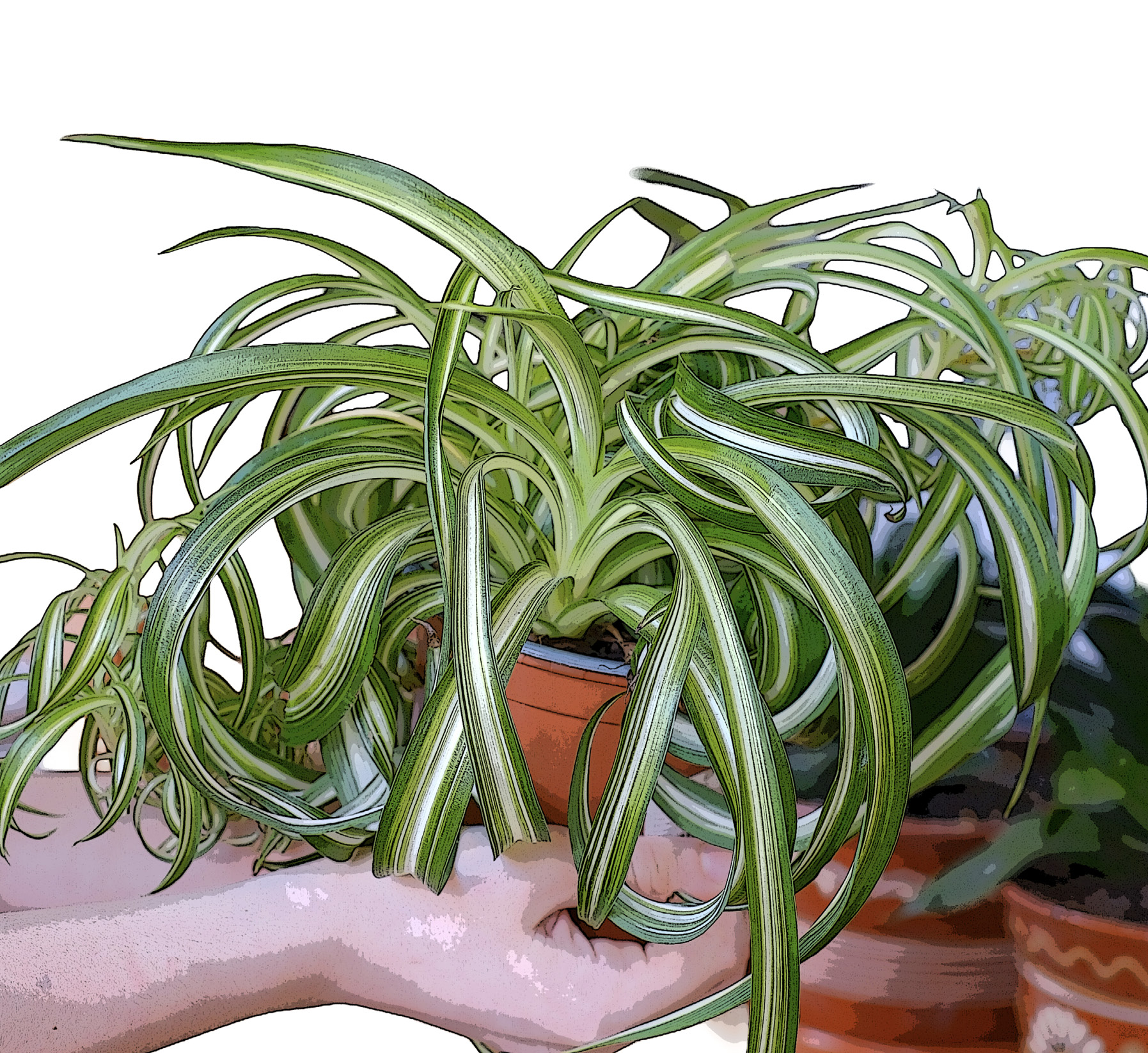
A relatively ubiquitous houseplant, the spider plant (Chlorophytum comosum) lives out a rather modest and understated existence, often thriving with little need for attentive solicitude. In my mother’s home there is a prolific specimen, one that she says is ‘pregnant’ with litters of offspring waiting to be plucked and grow independently from the mother plant. Every so often she offers me a cutting to propagate, as the ‘plant babies’ or spiderettes encroach on her living space with protruding shoots. Placing one in a glass ramekin filled with water that it will thirstily sequester, I perceive the subtle emergence of roots over the course of a week from beneath the now independent-plant, careful not to leave it bathing for too long in opaque water, at the mercy of root rot. There is something endearing about the image of the plant leaving its nest, much like the proverbial fledgling. But is the empathy we might feel towards a young bird or even with our own human-kin really mirrored in our experience of tending to a plant? This rests largely on one’s definition of empathy, which is a much-contested topic within both philosophy and the natural sciences. As a study of experience, we shall turn to phenomenology to broach the limits and scope of empathy.
The field of phenomenology and study of empathy was developed in the early twentieth century almost contemporaneously, most notably by Husserl, Stein and Scheler, who all respectively expanded on the latter concept, originally developed by psychologist Theodor Lipps.1 Exploring empathy to understand intersubjective experience, Stein expanded upon some of Husserl’s work. While much of the above literature is dedicated to analyses of human-to-human relations, the foregoing phenomenologists also touched upon the ways that empathy manifests between humans and other living beings, namely non-human animals and, less so, plants. Though experience is normatively contingent on consciousness or perception, reserved for humans and other animals, plants still demonstrate fundamental features of animacy and aliveness which elicit our awareness of their distinct vitality, as living others. More recently, the field of eco-phenomenology has been pertinent for characterising ‘species-specific expressions’ of non-human beings including plants.2 This can be seen in recent work by Michael Marder and Edward Casey, who have developed a detailed phenomenology of plants oriented around ‘place’.3 Whether it is entirely incongruous to speak of plants in the context of empathy though, remains unclear, but burgeoning literature on this subject, particularly within the purview of environmental philosophy, suggests that there is potential here for nuanced debate.4
In this paper, we shall be dedicating our analysis to the human-plant relation, discussing and evaluating the recourse of Stein’s version of plant empathy. There are five sections to this paper. The first will analyse the differential ways that Stein describes empathy manifesting with humans, animals and plants. The second section will involve fleshing out the distinctions between what Stein calls ‘perceptual empathy’ and ‘intuitive empathy’, demonstrating why this distinction is especially helpful when conceiving of plant empathy. We shall then critically engage with some of the literature on ‘bio-empathy’, demonstrating the salience of Stein’s conception of plant animacy in the third section of the paper. The penultimate section will involve placing Stein into contemporary debates around plant empathy, and the final section entails putting Stein’s ideas into practice, by looking specifically at our situated interactions with plants.
Empathy with humans, animals and plants
Originally introduced as a term to describe the nature of aesthetic experience, Lipps developed the concept of Einfühlung, translated as empathy. As Douglas Chismar contextualises, ‘In aesthetic Einfühlung, one imaginatively attributes to an object feelings, attitudes or activities aroused in oneself by the object’s depicted position and surroundings.’5 Just as an art object provokes this imaginative attribution of feeling, Lipps saw a similar kind of phenomenon occurring in our recognition of feelings and attitudes expressed by other humans. While Chismar suggests that Lipps’ conception of empathy involves eliciting an ‘involuntary neurophysical response’, Stein clarifies that empathy for Lipps leads to arousing ‘the impulse to imitate’ the other’s gestures.6 Empathy for Lipps therefore involves being affected, in turn leading to an act of imitation, as we project those qualities that we attribute to the object or indeed person. Early on in Stein’s seminal monograph on the subject she offers a definition of empathy as ‘the perceiving of foreign subjects and their experience’.7 Stein’s contention with Lipps is that the other’s experience is perceived in such a way that does not require one to imitate or imagine their experience; moreover, one does not even need to possess the same kind of body as another to empathise with them, nor have experienced what they have. This is why she contends, using the example of perceiving another person’s hands, ‘empathy is also quite successful with men’s and children’s hands which are very different from mine’. Moreover, Stein adds ‘We also understand expressions that we cannot imitate, for example, the expressive movements of animals’.8 Distinguishing between Körper (the body as object) and Leib (living body), she focuses on how the latter enriches the former to the point where empathy, à la Lipps, cannot simply be equated with our experience of art objects. For Stein, empathy is a perceptual, intuitive phenomenon, neither contingent on imitation nor imagination.
In the case of sentient animals, Stein illustrates how we might empathise with their experience of pain, writing ‘Should I perhaps consider a dog’s paw in comparison with my hand, I do not have a mere physical body, either, but a sensitive limb of a living body’ and suggests that ‘I may sense-in pain when the animal is injured.’9 As she contends, empathy does not amount to a ‘knowledge of’ this experience but pertains to how the sense of the phenomenon is given, even without our imagination, or indeed by making a logical inference of the other’s experience. This is why Stein is critical of theories of empathy that rely on inference of analogy, as they in her words, do ‘not yield perception but a more or less probable knowledge of the foreign experience’, and therefore simply furnish philosophical arguments for the problem of other minds, rather than distilling the ways that empathy manifests qua phenomena.10
Just like the sense we grasp of a fellow human’s experience, Stein demonstrates how we also possess a sense of the sentient experience of a non-human animal, without the necessity for physiological evidence. Leib, however, as Stein outlines, also encompasses plants, as living bodies.11 Whilst Husserl was interested in the phenomenon of the living body as it concerns empathy, namely in terms of animacy, he did, as Peter Gaitsch and Sebastjan Vörös attest, demarcate his analysis principally to ‘animal life’.12 As Husserl attempted to distil the ways that distinctions between animate organisms and material objects must be intuitively articulated before being explicated by the natural sciences, he ultimately contended that phenomenological inquiry ‘does not go so far that a definite interpretation of the plant as an animate organism has become possible’.13
‘Analogy’ for Husserl ‘is not enough’; as he implores, we need ‘experience of concrete sensitivities related to concrete organs, whereby the analogy of the plant organs with brute-animal ones, to which well-known sensitivities belong according to experience, must be broad enough to ground the probability of the interpretation’.14 Stein, on the other hand, does at least avow plants as part of her phenomenological definition of empathy, albeit in a qualified manner, and, as we shall illustrate, sees this as inextricable from our perception of ‘spontaneous movement’ and organic development.
Stein contends that there are ‘types of various grades of generality to which correspond various possible grades of empathy’, distinctions that are inherently corporeal in nature.15 As she delineates, ‘The type “human physical body” does not define the limits of the range of my empathic objects, more exactly, of what can be given to me as a living body. However, it certainly marks off a range within which a very definite degree of empathic fulfillment is possible.’16 While the pain we perceive in animals is something conspicuous enough to empathise with, as we saw with Stein’s example of the dog above, any such putative pain – or sensation for that matter – felt by plants, is equivocal and therefore, perhaps tenuous to classify as empathy. This is why Stein qualifies that we would be unjustified if we believe ‘we are inflicting pain on a tree by cutting it down with an ax’.17 However, she also concedes that she would not be justified ‘in interpreting what is present in a new way and distinguishing the phenomena of life in plants from our own’.18 Whilst Stein is not arguing that plants are sensitive in the same way as humans and other sentient animals, she doesn’t take this to mean that the animacy and life of plants is entirely recalcitrant to the phenomenological inquiry requisite for making sense of plant empathy. As we shall demonstrate, Stein’s consideration of the possible role of analogy offers something different from Husserl’s comparatively conservative account.
Although her comments on plants in On the Problem of Empathy are relatively sparse, I wish for this paper to elicit a richer consideration of Stein’s phenomenology for thinking plant empathy, as, even with these limited references, I believe that her perspective lends much fecundity to contemporary discussions. Despite this, she has still been fairly overlooked as an interlocutor in such debates, as attested by a recent literature review about plant empathy.19 Whilst I shall predominately make use of the aforementioned monograph, Stein’s later work Finite and Eternal Being, a more metaphysical and theological foray into the notion of ‘plant soul’, will also prove helpful. The intention of the paper is not only to take Stein’s rarely invoked passages on plant empathy into greater account, but also to demonstrate their recourse for conceiving of the ways that we are connected to plant life, despite its radical alterity. Through her notions of perceptual and intuitive empathy, we can start to build a clearer picture of how plant empathy manifests.
The roles of perception and intuition
The physiological basis of empathy could, as has recently been suggested by contemporary neuroscience, be attributed to the brain – namely to ‘mirror neurons’, which were originally discovered in macaque monkeys.20 Captured through brain scanning technologies, these neurons were shown to fire off when a monkey witnessed another primate perform a particular action that they then came to mimic. Gallese contends that mirror neurons ‘likely underpin a direct form of action understanding’, serving to substantiate the claim that such neural mechanisms could plausibly be at the bedrock of the phenomena of ‘intersubjectivity’.21 As Gallese sees it, Stein’s notion of empathy qua perception prefigures recent neuroscientific findings, as empathy with others appears not to be causally related to an inference or cognitive representation, but an experience that is inextricable from the body. It is important, however, to emphasise that Stein’s phenomenological approach to empathy distanced itself from the foundations of scientific knowledge. As she contends, à la Husserl, ‘for a science which proposes ultimately to clarify all scientific knowledge must not, in turn, be based on a science already extant, but must be grounded in itself.’22 For the purview of phenomenology, Stein reminds us of the salience of circumscribing what science can encapsulate, which is helpful for unearthing how plant empathy is at all possible. When approaching the case of plant empathy, we, as well as Stein, are not speculating about the capacities of plants to enact empathic behaviours, although this could itself be an intriguing and potentially fruitful avenue to take. Conversely, we are gleaning how plants are plausibly open as targets of empathy.
Following a phenomenological method, we are not expected to corroborate this phenomenon neurophysiologically – that is, assessing whether mirror neurons fire off when we nominally empathise with plants. This means taking seriously the implications of intuition which guide our means of investigation, summarised perspicaciously by Gaitsch and Vörös, who write, ‘to be able to investigate it scientifically, we must already have a certain preconception of plant life based on our everyday experience’.23 As they elaborate, ‘experience of the fundamental “aliveness” of plants must be there a priori for the whole scientific endeavor to take off at all’.24 However, while they invoke and interpolate the gaps in Husserl’s thought to schematise a phenomenology of plant empathy, it is our impression that Stein provides a more fleshed-out account of the role of intuition specifically in the case of plants.
As Stein argues, it isn’t ‘a mere metaphor to compare our development with that of a plant; it is a genuine analogy in the previously defined sense of grasping that something belongs to the same type’.25 If empathy is thought of as the ‘givenness of the other living body’,26 this more qualified definition that Stein alludes to could be congruous for conceiving of how empathy manifests with plants in particular. As Stein contends ‘we not only see such vigor and sluggishness in people and animals, but also in plants. Empathic fulfillment is also possible here.’27 But as she qualifies again, ‘Of course, what I grasp in this case is a considerable modification of my own life … Neither do I have any right to ascribe an “awake” “I” to the plant, nor a reflective consciousness of its feelings of life.’
Therefore, Stein’s definition of empathy as ‘the perceiving of foreign subjects and their experience’ is perhaps infelicitous for characterising the phenomenon of plant empathy. This is why Marder is critical of Stein and others’ conception of empathy, as he suggests that this definition contradicts the sui generis of vegetal ontology, which negates the ‘feeling into’ constitutive of empathy, as he argues that plants lack the ‘psychic interiority’ and depth that this ‘feeling may probe’.28 This privative interiority in plants, however, is avowed by Stein, who still thinks that empathic fulfilment is possible, as she maintains that we can witness a plant’s ‘feelings of life’. The important thing is that the feeling in this case doesn’t coincide with the feeling allegedly felt by the plant. But this is also analogous in the case of humans, whose experience we feel through empathy, but not as that original experience, which we can never quite capture in toto. Accordingly, Marder does acknowledge ‘in Edith Stein’s phenomenological account of empathy, the unity of the empathizer and the empathized with is neither presupposed nor actually accomplished’.29 This is a salient feature of Stein’s version of empathy, as ‘coincidence’ is not for Stein achieved in either empathy with plants or fellow humans. As she puts it, ‘The subject of the empathized experience, however, is not the subject empathizing, but another … These two subjects are separate and not joined together.’30 Giving the example of empathising with someone’s joy, Stein clarifies that ‘while I am living in the other’s joy, I do not feel primordial joy’. Empathy for Stein ‘is a kind of act of perceiving’ and, like perceiving objects in general, Stein phenomenologically describes how the ‘givenness of the one side implies tendencies to advance to new givennesses’ – that is, through intuition.31 While Stein contends that ‘the foreign living body is “seen” as a living body’ in this perception, she argues that ‘The co-seeing of foreign fields of sensation also implies tendencies, but their primordial fulfillment is in principle excluded here.’32 Consequently, Stein concedes, ‘I can neither bring them to primordial givenness to myself in progressive outer perception nor in the transition to bodily perception’ and declares that ‘Empathic representation is the only fulfillment possible here.’33 This is why empathy not only involves a perception of the other’s living experience, but an intuitive representation of the foreign other’s sensations, which we can never truly feel, thus building upon what perception introduces, but irreducible to imagination. As Stein writes, ‘I can also bring these fields of sensation to givenness by making them intuitive for me, not in the character of perception, but only representationally.’34 ‘Intuitive empathy’, according to Jim Jardine, is given ‘the most succinct and evocative phenomenological treatment’ by Stein no-less.35 Beginning as implicitly perceptual, Stein illustrates how empathy subsequently manifests into a more explicit ‘intuitive envisaging’, as Jardine calls it, of the other’s complex experiences, which remain somewhat concealed.36 This doesn’t mean that we are forced simply to imagine the other’s experience or imitate it ourselves, but it provokes us to expand upon what is latent within this perception, to envisage their experience as something that is commensurate to ours but wholly theirs. As Jardine puts it, ‘For Stein, just as empathy is not a process of genuinely living through the other’s state of mind, it is also no activity of imagining oneself engaged in the other’s context.’37
We have this ‘perceptual recognition of (this body as expressing) an embodied subject who is like me’, but also, as Jardine importantly adds, ‘beyond me’.38 While Husserl didn’t necessarily elucidate a perceptual gateway, forming an empathic bridge to plants, Stein demonstrates that empathy with plants can manifest as a perception of their aliveness. But what is it that we perceive in plants that can lead us to cultivate this intuitive empathy requisite for a richer understanding? Moreover, what is especially unique in our perception of living beings such as animals and plants, say, compared to rocks and other non-living entities? We will tackle these questions in the following sections, invoking some of the literature on ‘bio-empathy’ which is perhaps less mindful of what is unique about plant empathy itself.
Plant animacy: The limitations of bio-empathy
Proffering the term ‘E-Co-Affectivity’ Marjole Oele characterises the ways that organic beings like plants occupy an interface, whereby they are neither perceived as an ‘agent nor simply the patient, but an internally immersed, decentralized, yet coherent and continuous part of a process’, a ‘middle voice’ as she phrases it.39 This perspective of a plant’s ‘dynamic happening’ or ‘affective continuous unfolding process’ encompasses ‘nutrition, growth and withering, and disease and suffering’.40
Interestingly, though for Stein ‘A plant is not the center of orientation of the spatial world’, ‘nor voluntarily mobile’, she stipulates that a plant is ‘capable of alive movement in contrast with the inorganic’.41 Here Stein emphasises not only the phenomenal differences between animate and inanimate beings, but the ways that plants themselves emerge and unfold within their environment. As she continues, ‘Even if plants do not possess the voluntary movements of animals, they still essentially possess the phenomenon of growth so that they are comprised of not merely mechanical movement. In addition, they evidence heliotropism and other alive movements.’42 Thinking of this in terms of the ‘middle voice’, the processes of alive movement in lieu of ‘pondering who is doing what to whom’, we see Stein also taking seriously the ways that plants manifest empathically through movement qua process, rather than as individuals, in the same way as a human or animal.43 Their capacity to affect us through the particularity of their movement therefore intimates how plants might come to manifest as suitable targets for empathy in the first place.
While Husserl implores that ‘We have, therefore, to distinguish between mechanical movement, movement of the material-thing: animate organism, as material doing; and spontaneous movement’, these distinctions are not fleshed-out when it comes to spontaneous movement indicative of plants, certainly compared to ‘free willing’ movement of humans and animals.44 Incidentally, the translators of this text concede that ‘Husserl encountered a problem which he did not solve in this text in regard to the relation of the plant sciences to those of animate organisms’.45 Even if Husserl concedes that plants are not necessarily excluded from having sensitivities or being perceived as alive, it’s not clear from his analysis how phenomenology can provide insight into how we perceptually, not to mention intuitively, recognise their aliveness that we in turn empathise with. For Stein, there isn’t necessarily a problem in perceiving the animacy of plants, made manifest by processes like growth and heliotropism, which she characterises as ‘living spontaneous movement’.
We are, as Parviainen suggests in their reading of Stein, ‘able to empathize with the phenomena of life in plants, in particular their kinaesthesia and living movements: their turning toward light, movements under the wind or withering without water’.46 A sunflower, for example, famously demonstrates heliotropic tendencies of vegetal life, bending in the direction of the sun. When planting and tending to a sunflower, we can witness, across the course of a day, its bud following the sun travelling from east to west. As such, there is a kind of openness between us and plants, despite their alterity. What is helpful is how Stein attunes to how we can perceive these vegetal expressions without the necessity of invoking biological material as an authority, nor with the interface of time-lapse photography, the tools utilised by the botanical sciences.47 Contra Husserl, Stein manages to ground what is botanically explainable with what is intuitively realisable. As she puts it in her later work Finite and Eternal Being, ‘The plant grows by degrees, and this gradual process of growth can – at least in its major phases – be observed.’48
Distinguishing again between mechanical and alive movement, Stein contends that ‘We would never interpret the spontaneous movement of a physical body as alive’, such as the sudden falling of rocks; rather, for Stein this ‘associated movement’ would be understood through a kind of ‘quasi-empathy’.49 What is intriguing for us here is Stein’s focus on the phenomenality of movement, which she suggests is salient for understanding the ways that empathy manifests. As she writes, ‘rigid immobility conflicts with the phenomenon of the sensitive living body and the living organism in general’. Movement is therefore implicit to the ways that we empathise with living beings, including plants. This is why Stein claims that ‘We cannot imagine a completely immobile living being’; here, she does not fall for attributing a plant’s sessility with the privation of movement, for, as she argues, ‘That which is bound to one place completely motionless is “turned to stone”.’
Even with these differences in mind, anthropologists Michel Schnegg and Thiemo Breyer distil the notion of a ‘Multispecies World’ from Stein’s conception of empathy. Assessing how the Damora people of Namibia seemingly have a perception of the winds that involves a recognition of ‘expressive behaviour’ and ‘emotions’, including sensing anger in a strong wind, the anthropologists suggest that this intimates a level of empathy demonstrative of Stein’s conception.50 As they contend, ‘The advantage of Edith Stein’s approach to empathy is that it does not impose a human-like mind to other beings.’51 While Schnegg and Breyer concede that this perception of the wind would not enter into ‘other stages of empathy’, due to its radical divergence from living bodies, their interpolation of Steinian empathy does contradict the caveat that she herself originally espoused, that ‘In nature the most general type, the “living organism,” marked off the range of empathic possibilities.’52 Feeling meteorological phenomena in this way would therefore seem to have more in common with the quasi-empathy Stein attributes to spontaneous mechanical movement, than it does ‘the givenness of the other living body’.53
Concepts like bio-empathy, for example, help articulate what is so peculiar about our affection for living beings. For J. Baird Callicott, a ‘bio-empathetic moral metaphysic’ is auspicious for articulating how ‘value is affective’, and how living beings themselves elicit this affection.54 This is why he invokes biologist E.O. Wilson’s speculation that ‘the perception of another being as a family and/or community member triggers in us certain instinctive emotional responses’, indicative of Wilson’s concept of ‘biophilia’ in particular.55 The trouble with this notion of bio-empathy is that it risks encapsulating a general affection for life and the conditions that nourish it, used by Callicott to furnish a holistic environmental ethic, rather than a descriptive tool that can help us to flesh out how empathy manifests between differential living beings like plants.
For John Ryan and Qi Li, however, aesthetic practices can be instrumental for bio-empathy; the authors invoke the ancient Chinese aesthetic of ‘yijing’ to demonstrate this. Embodied in both Chinese poetry and painting alike, they suggest that these works express ‘the intermeshing of feeling and scene’, whereby the artist is affected both by living creatures and ‘inanimate elements’ like rocks, soil and water.56 This form of bio-empathy that Ryan and Li discuss is therefore reflective of a broader sense of interconnectedness with our environment, sharing vital features such as affection and feeling, but not quite as Stein construes empathy and its peculiar magnetism towards the living body. This is why I think Stein’s notion of ‘quasi-empathy’ is salient, because it demonstrates how the perceptual and intuitive nature of empathy can inform any such cleavage between life and non-life, notwithstanding its ontological truth.57 While we shall address the inherent contiguity between plants and other non-living elements in the final section, we shall first discuss the recourse of Stein’s contribution to contemporary debates, with a focus on process and plant ontology.
Plant empathy as process: Placing Stein in contemporary debates
We find at some points in Stein’s monograph flashes of perspective that lend themselves to some kind of tangible understanding of plant empathy. However, the risk of Stein’s definition of empathy is one of contradiction, especially when we run her definition of empathy as ‘the perceiving of foreign subjects and their experience’ together with her broader notion of ‘the givenness of the living body’, the latter being ostensibly felicitous in the case of plants, in lieu of the former. One criticism of Stein’s notion of plant empathy is its ‘heavily qualified’ nature.58 Whilst qualified, I am suggesting that Stein’s interpretation of plant empathy can be supplemented by this notion of intuitive envisaging we invoked earlier on. However, while we previously saw Stein claiming that an immobile living thing was inconceivable, therefore evincing a gateway into how we empathise with plants through the givenness of their alive movement, she then goes on to say that a ‘a body without an “I” is utterly impossible’ and that we could ‘speak of an “animated” but “I”-less living body. But I do not believe such an interpretation possible’59 What does this say about the givenness of a plant body? As we have seen, a plant’s body is noticeably given in a very different way to a fellow human or animal. The phenomena or ‘feelings’ of life are expressed by a plant’s living body, but they are not, as Stein caveats, given as the expressions of a conscious, sentient individual. But empathy with plants then appears to not be possible, if for Stein an ‘animated but I-less living body’ is totally nebulous.
This question hinges on the divergent ontologies of animals and plants. For Matthew Hall, in response to Marder’s original paper on plant empathy, Marder is erroneous to deny some kind of inner state to plants, prima facie denying the manifestation of the phenomenon of ‘feeling-into’ qua Einfühlung. With reference to Scheler’s notion of empathy, later reconfigured to ‘sympathy’, Hall argues that empathy with plants is possible because plant ontology is not so equivocal as Marder intimates.60 Invoking Scheler’s notion that ‘living beings are not only objects for external observers, but also have a being in and for themselves, or an inner life of their own’, Hall contends that we can see ‘the plant body as simply a manifestation of life—a life itself infused with mind’.61 This comparative level of transparency in Hall’s Scheler-inspired version of plant empathy can be contrasted with the relative opaqueness of vegetal ontology we find in Marder’s work. However, by seemingly dispelling the mystery of a plant’s inner life, Hall simply engenders a smoke and mirrors effect which leaves the philosophical problem of gleaning the kind of empathy unique to plants relatively undeveloped. This is why Stein asks, ‘What do “own” and “foreign” mean in the context in which Scheler uses them? If we take his discussion of a neutral stream of experience seriously, we cannot conceive of how a differentiation in this stream can occur.’62 As she continues, Scheler cannot ‘exhibit such an “I-less” experience, as ‘Every case he brings up presupposes our own as well as the foreign “I”’. ‘Only if we leave the phenomenological sphere do these terms make good sense.’ In the case of plants and other living beings, Scheler’s notions of Einfühlung (Empathy) and Einsfühlung (Oneness) furnish a kind of ontology of nature, which Stein critiques. While Scheler rejects what he calls ‘metaphysical biologism’, he does contend that there is an ‘agency which governs the development of form and the vital reactions’, encompassed in all living organisms and that which he characterises as ‘a single, self-same reality’.63 Therefore, even if Scheler insists that his notion of sympathy is grounded in experience, it still implies that the unity of self and other is metaphysically implicit, extrapolating an intuition he has about others onto nature more broadly. Stein sees this as contradictory, as empathy always appears to involve coming up against some kind of translucent alterity that it can’t unequivocally reveal.
For Hayden Kee, who has most recently added to these discussions, Hall falters at the point of making what he calls a ‘sentiomorphic projection’, which doesn’t sufficiently attend to the differences between the ‘sensory phenomenal consciousness’ of humans and even animals, and the vitality of plants.64 While Kee intimates the intuition that a plant ‘solicits me to feel into it’, he concludes that it is ultimately thwarted, when one perceives a ‘tendril-like finger’ reaching out, only to turn ‘numb’ and into ‘stone’. In lieu of repudiating the very concept of plant empathy Kee suggests that a phenomenological conception must take seriously the role of sentience which can guide us towards plants, not by merely reaching out to the plants themselves, but recoiling into ourselves through interoception. This means attuning to the inner processes that constitute our embodied lives, such as tapping into autonomic bodily processes. For Kee, ‘Sentience is intertwined with and dependent upon the organic body’, encompassing the foundations of both animal and vegetal life.65 Though I do think that interoception can play a salient role in developing plant empathy, I’m not convinced that our choices simply narrow down between either sentiomorphism or interoception, for this overlooks the unique phenomenality of our perception of plants and the processes that make them manifest, not to mention what we can intuitively envisage when it comes to our physiological semblance with plants, as remote as it may seem.
While our internal organs are admittedly less commensurable to a plant’s physiology, our organic development is at least phenomenally comparable, as Stein suggests when she writes that it ‘isn’t a mere metaphor to compare our development with that of a plant’.66 As we previously referenced, Stein suggests that ‘the absence of’ phenomenal consciousness ‘does not justify us in interpreting what is present in a new way and distinguishing the phenomena of life in plants from our own’. The implication is that the phenomenon of empathy with humans and other animals is not exhaustive of empathy itself, because approaching a living body, whether human or animal, doesn’t strictly mean empathising with what is conscious or sentient about this other’s experience, their capacity to feel pain, for example. Of course, I don’t deny that Stein spent a great deal of her thesis speaking about empathy in terms of the ‘foreign consciousness’, incongruous as it seemingly is for describing plants. While she is tentative about making a final judgment on the matter, the corollary of the foregoing point that empathy pertains not only to conscious and sentient life due to empathy being elicited by plants themselves, is conceded by Stein – ‘this would make phenomena of life conceivable as non-psychic and plants conceivable as soulless living organisms’.67 Although this point remains admittedly ambivalent in Stein’s early work, she later developed a notion of ‘plant soul’, writing that a plant’s ‘manner of growth, of ripening and withering’ are ‘diversified “manifestation[s]” of the one nature or essence’.68 As she concedes, ‘In a limited sense even the plant may be said to have a soul and a body.’69 This aspect of the plant soul is actually elicited by the phenomenality of plants themselves, as, for Stein, the ‘abundance of forms which springs from’ a plant’s ‘creative power’ is not necessarily reflective of the interior lives of plants, but is an external manifestation of a plant’s immanent life, its capacity to reproduce and propagate interminably, an expression of the eternal soul that also encompasses vegetal life.70 This is why she argues that plants ‘endure, not indeed as self-identical individuals but rather in something that is like themselves’.71 While we are not delving into this later work of Stein’s, partially due to complex concomitant theological and metaphysical implications, these later developments of plant soul do help us to corroborate Stein’s own views on the nuanced continuity between ourselves and plants, and the subtle intimation of plant empathy provoked by our perception of their unique manifestation.
Marder actually picks up on some of these implications, sympathising at least partially with Stein; as he contends, ‘The limits of empathy here bleed into the edges of phenomenology, extended to existences other than human and charged with the task of outlining the non-anthropocentric orientations to and ways of being in the world’.72 What remains undoubtedly knotty, though, is how plants are ontologically conceived. As Marder writes ‘The plant, too, is “a center of orientation” to the world, but its “body,” which is a loose conglomerate and a non-totalizable multiplicity of vegetal bodies, does not belong to an “I” and does not follow the course of subjective individuation.’ However, returning to Oele’s notion of the ‘middle voice’ invoked in the previous section, Stein’s focus on process and movement involves moving away from this preoccupation with ontology to understand plant empathy. Instead of simply needing to identify some kind of vegetal homunculus, or, in more serious terms, an individual who enacts their own movements or indeed is passive to what is moving them, Stein’s perspective of empathy urges attentiveness to the ways that plants appear, that is the phenomenality of plant movement, an affective and dynamic process. This is partly why propagation felt like such a pertinent instantiation for the purposes of this paper, as it demonstrates both literally and symbolically the fulcrum of plant empathy, the question of whether we are dealing with an individual or multiplicity that we can even feel into.
Invoking Goethe’s work on the metamorphosis of plants, Wahida Khandker refers to the ‘way in which stem cuttings can be taken from plants, replanted, and then grown as new individuals, thus revealing how’, in Goethe’s terms, ‘independent life is attributed to them’ and how they come to possess ‘the power to move independently and to assume a definite direction’.73. The crux for Khandker is that Goethe’s perspective helps to ‘overcome a purely physical or physiological description in favour of some sort of impetus, or a true tendency in process terms’, made clearer by processes like propagation and transplanting.74 Attuning to how this process manifests in situ, the spider plant, for example, can initially be perceived as amorphous in its multiplicity, excessively spilling out from a pot with its tentacular bunches. Making a cutting exposes the fragility of the plant, despite the cutting itself appearing to begin a journey of its own, slowly developing roots from its nodes as it burrows in water. Therefore, while the plant is initially an amalgam of sorts, the process of propagation discloses the phenomenon of plant empathy qua process, as we perceive the vulnerable exposure of the plant unfolding gradually through our interactions with the plant(s). This is why the following and final section will involve bringing Stein’s ideas to the surface, applying them to instantiations of plant empathy in situ, helping us to refine the analogues between ourselves and plants, engendered by practices that put us into direct contact with plant life.
Making sense of Stein’s plant empathy in situ: The elements of water, soil and sunlight
Even if Marder is largely critical of the concept of plant empathy, he concedes that ‘At the extreme, to empathize with plants is to recognize in ourselves certain features of vegetal life, rather than to project the metaphysical image of human existence onto other life-worlds.’75 But to do so, I argue that one must move outwards following Stein, towards the plants themselves, to interpolate the famous phenomenological injunction, so we can return inwards with a more refined perception.
To put this into practice, turn your head, if you can, towards a nearby plant. Notice how it appears. Is it wilting? Is it blossoming, shedding its leaves or withering? Feel the soil beneath it; is it dry, moist, waterlogged? Perhaps a houseplant is immersed in exceptionally dry soil and requires ample watering. Here there is at least an opening onto the vulnerable condition of the plant. As Ralph Acampora puts it, ‘Plants manifest simple internal states and semi-agential behaviour in the way that they express themselves in postures (which can be seen with the naked eye)’, which distinguishes them, perceptually, from stone, regardless of the putative ‘numbness’ of the plant’s sensitivities.76 It’s not that stone cannot be ‘affected’ in some ways by other elements like water. This can be evidenced by abrasion and hydraulic action, a waterfall for example that wears away stone over time. But a salient difference would be how this change is expressed. With plants, sluggishness, i.e. withering, may indicate too much or too little exposure to the elements, and vigour, i.e. growth, may signify satisfaction; whereas stone, certainly when thought outside of its relations to other beings, does not express any kind of ‘preference’ shall we say, about its own conditions, the ‘something that is like themselves’ which Stein attributes to plants as living beings.
Acampora declares that ‘we reach out, psychosomatically, and find a fellow life form in the plant’.77 While a plant can elicit this reaching out, we may of course be faced with what confounded Kee’s invitation to empathise with plants. However, one alternative I propose is to reflect deeply on how we interact with and ordinarily engage with plants themselves, to unveil certain contexts in which plant empathy might well be brought to the fore. It is interesting then that Stein uses the example of gardening to illustrate the empathic relation. Comparing a ‘doctor’s relationship to his patients with the ‘gardener’s relationship to his plants, whose thriving he oversees’, Stein writes that the gardener ‘sees [plants] full of fresh strength or ailing, recovering or dying. He elucidates their condition for himself empathically. In terms of cause, he looks for the cause of the condition and finds ways to influence it.’78 This point concedes that, while the practice of taking care of both patients and plants requires bespoke knowledge, they both presuppose an empathic recognition of the conditions of the living other.
Perceiving a plant’s physical state is one thing, but as Stein suggests, the gardener must elucidate the condition of plants empathically, and this would involve building intuitively on what is perceptually available. Influencing these conditions involves an engagement with the elements that support plant life, including the quantity of water, humidity, exposure to sunlight and nutritious profile of the soil. As one of those examples of a middle voice or interface, Oele contends that soil ‘emphasizes relationality and mediation among various forms of life as well as relationships to the inorganic, without prioritizing any’.79 Soil is a requisite medium for plants to soak up the elements that make them fecund and is itself an organic process, composed of living and once-living entities. It is not a mere plenum, a homogeneous backdrop to plant life, but is a vital milieu that ‘not only confronts us with its profound and complex past’, as Oele says, ‘but also with rich emergent possibilities yet to come’.80
How we cultivate this attunement, though, will depend on the circumstances of our interactions with plants. As Isis Brook writes, ‘One of the main sites of interaction between people and plants is the garden.’81 The garden of course encompasses many types of green spaces, both private and public. Without explicitly invoking plant empathy, Brook comes close to describing something reminiscent to what we are interpreting through Stein, and her phenomenological characterisation of gardening is pertinent for us here. This is because it helps to illustrate how plant empathy manifests in situ. Like the careful process of propagation which involves making a cut, gently handling the newly emerged roots and repotting the plant into fresh soil, Brook describes the act of planting seedlings in a garden, imploring that ‘Here we need a delicacy of touch as we tuck the intricate roots of these tiny plants into a fine soil.’82 This sensuous and embodied engagement with the soil reawakens our awareness of a plant’s inherent vulnerability and entanglement with the elements it requires to live and indeed emerge in the first place. For Brook it appears to provoke something at least close to empathy, a ‘mirroring’ quality as she describes it, tacitly empathic as she makes reference to ‘mirror neurons’.83 In the context of gardening especially, she contends, ‘there do seem to be occasions where engaging with plants, whether through their beauty or vulnerability, opens us up to a recognition of something in ourselves’.84 Though cautious of construing this affectivity in purely anthropomorphic terms, Brook suggests that perceiving processes like plant growth ‘we connect to the plant as if there is some fellow feeling’, potentially even getting ‘a taste of what that would feel like’.85 With this perception of a plant’s conditions, we are provoked to intuitively envisage this adumbration of empathy, returning to our own experience to unravel it.
We could say that the perception of a wilted plant in dry soil for example engenders the intuitive envisaging of a plant’s ‘thirstiness’, which we corporeally glean through our interaction with the interface of the soil. Here, what is nominally ‘thirstiness’ is irreducible to sentience, is of our experience, but overflows it. This tendency to project the phenomenon discursively confounds but distils this intuitive sense we have of the plant’s expression, which for lack of a better word, appears thirsty. Upon watering the plant, there is a ‘sense’ of hydration, regardless of the plant’s inability to discursively communicate this, just as an elephant’s hydration from an oasis would not be communicated linguistically. While we have a clearer picture of the internal experience of hydration going on inside the elephant, proportional to our animal physiology, the sense of the phenomena is not totally incommensurable to the ways plants absorb liquids to stay alive.
Similarly, the salient dynamic between light and shade, requisite for all living things, is especially distilled in our perception of plants, who may well benefit from a sunny spot to photosynthesise, only to become scorched by the intensity of the sun. Perhaps, in this case, we move the plant away from the window to provide it with relief. This is analogous to the ways we interact with the sun, when we experience the sudden respite granted by a shady spot under a canopy on a sweltering day. Again, what I am discursively communicating here only faintly intimates the nondiscursive sense implicit. We must concede, however, that this does still not permit me to correlate nondiscursive sense to what is onto-epistemologically true of plants on their own terms, in line with Stein’s emphasis on the relative limits of our own situatedness.86.
There is also something exceptional and indeed peculiar about the manifestation of plant life, which exceeds even our own organic development. Stein intimates this herself when comparing plant soul with the animal soul, writing ‘The life of plants is continuous actualization of potentialities.’87 We could think of this in terms of the cumulative capacity for regenerative growth, a plant’s being relatively incommensurable to the limits of regenerative growth in humans and many animals; think of the emergence of shoots from a coppiced tree or the titular phenomenon of propagation, whereby the plant asexually reproduces itself into a clonal, but novel plant. This is why Kee’s suggestion that this plant-like layer of the organic body, shared by humans and plants alike, is ‘dim’, overlooks the richness of plant phenomenality for broaching plant empathy. The regenerative growth of a plant, whilst analogous to our own healing skin, which Oele also construes as a middle voice, is a rather extraordinary manifestation of regeneration unique to plants.
Like Marder, Monica Gagliano has argued that grasping the alterity of plants involves attuning to the ‘plantness within ourselves’, which she says is in some sense ‘unthinkable’.88 But while Gagliano sees this attunement as an intimate understanding of plants, she is vehemently against calling this empathy, which she says ‘bears upon the empathizer projecting and depositing himself into the other in order to rediscover himself’.89 While this reticence towards identifying our relations with plants as empathy might well be justified, at least with certain variants thereof, Gagliano’s intimation that empathy involves no phenomenon of ‘surprise’ as it is seemingly ‘intentionally predetermined’ seems to contradict at least Stein’s account of empathy. Because, for Stein, empathy cannot merely be predetermined, for it is constituted by an openness that does not merely reflect to us what we already possess, but resembles what we share, a ‘diversified “manifestation”’ of what life itself encompasses. With plants, we share growth, development and decay, but never quite as it is for them. This is why Stein sees spontaneity as requisite for empathy and writes ‘every alive movement seems to be a spontaneous’ one.90 But Gagliano’s comments on the plant’s tacit relationship with water, where she argues that the plant ‘needs neither questions nor concepts of water to know water’, highlights what is problematic about articulating the phenomenon of plant empathy discursively at all.91 If Stein sees an intimation of ‘feeling’ in plants, it is not as a glance into the spuriously sentient inner lives of plants themselves, but a form of life that elicits a partial ‘feeling into’ (qua Einfühlung) which mirrors and indeed exceeds our own growth and organic development. Plant empathy does of course hinge upon a degree of awareness and appreciation of plants already constituted, which will depend largely on the individual or milieu in question, whose knowledge and affection of plants may or may not be sedimented by discursive and non-discursive practices. But this is why Stein’s approach is helpful, for she intimates how an understanding of plant empathy can be phenomenologically descriptive, dependent on our own situated interactions with the plants we encounter. This also means conceding that interactions with plants will depend on accessibility to gardens and other outdoor spaces, as well as the species that are more commonly encountered, not to the mention more maligned species of ‘weeds’ and ruderal plants, which might elicit empathy in very different ways. These topics are sadly beyond the scope of this paper. More time in this paper has been spent on looking at house plants, but Steinian plant empathy could certainly have recourse to help conceive of our empathic relations with other types of plants, including wild species and trees.
Without avowing some kind of grandiose ontological project in the vein of Scheler, or circumscribing the remit of phenomenology à la Husserl, Stein’s work illustrates how our conception of empathy can be challenged, and indeed kept in check, by phenomenological reflections on our experience of living beings, differentially encountered, whilst all the while intimating how our perception of plants activates something dormant in our perception. It is interesting to note Stein’s avowal that ‘the concept of purpose’ used so commonly in her time to describe ‘the individual or organism’ ‘does not come into consideration ... in ... empathic grasping’.92 Irreducible to a biological or even vitalistic principle, Stein portrays empathy with the more-than-human as an open-ended encounter. This also offers further reason to be cautious of naturalising Stein’s notion of embodied empathy, say in the neuroscientific language of mirror neurons, that seemingly forecloses empathic fulfilment with plants. There is a powerful implication to draw from this, in that plants can be embodied limits to scientific demarcations and reductive ontologies, prompting us to put intuition and feeling to the test. I shall leave you with a quote from Virginia Woolf, who evinces the sense of ‘feeling’ implicit to Stein’s plant empathy, a vegetal tension at the very heart of discursivity:
What do I mean by ‘reality’? It would seem to be something very erratic, very undependable – now to be found in a dusty road, now in a scrap of newspaper on the street, now a daffodil in the sun [italics my own] It overwhelms one walking home beneath the stars and makes the silent world more real than the world of speech - and then there it is again in the uproar of Piccadilly 93.
Conclusion: The problems and promises of Stein’s plant empathy
Undoubtedly, there are limitations to Stein’s notion of plant empathy. These limits not only pertain to the type of language frequently invoked to describe empathy by Stein and others, but also the sparse comments Stein made on plants in her own work. In this paper we have tried to bring her comments on plants and empathy to the surface, especially those made in her dissertation, turned inaugural monograph, and tease out their rich and insightful implications as thoroughly as possible. Her frequent usage of terms like ‘foreign consciousness’ inevitably troubles our attempts to put forth a consolidated representation of Steinian plant empathy. But equally, I argue that they don’t preclude our attempt to draw out what is promising.
Without seeing empathy with others as transparent or ontologically true, Stein’s notion of intuitive empathy helps us to reserve a salient place for envisaging and imagination, which may rely on creative uses of language – which of course are at risk of betraying the non-discursive sense of vegetal expression, but are requisite notwithstanding. Whilst we have made more use of Stein’s first work, her later works, such as Finite and Eternal Being, are also fruitful and are worth investigating further when it comes to considering Stein’s contribution to eco-phenomenology, perhaps even in conjunction with her more theological conception of plant soul. Bringing Stein into contemporary discussions on plant empathy though, I have hoped to engender more awareness of her nascent contributions to environmental and botanical philosophies more broadly.
We have not, however, had room to explore issues pertaining to ethics and epistemology. Providing descriptive phenomenological accounts of empathy, Stein was careful not to equate empathy with ethical behaviour. However, this is not to say that reflections on plant empathy cannot help inform ethical practice, beyond the litmus test of ‘pain’ in ethics debates. While epistemic conceptions of plants are sedimented into our perceptions thereof, the likes of which may determine the auspiciousness of practices such as gardening, Stein’s descriptions suggest that they are not necessarily requisite for tapping into our intuitive capacity to understand and recover our connectedness to plants, albeit without committing to the same metaphysical architecture that confounds Scheler’s account.
The purpose of the example of propagation in the introduction was to challenge the ontological presuppositions we often adopt when it comes to conceiving plants, their putative lack of selfhood precluding them from empathic consideration. If we see empathy as simply hinging on ontologically vital peculiarities then we risk missing how empathy manifests notwithstanding our knowledge of the living other’s experience, which for Stein, resembles but never coincides with our own.
Hal King is an independent scholar, whose work focuses on eco-phenomenology and environmental aesthetics. He is particularly interested in the role that plants and other ‘marginal’ living species play in our conception of and relationship with the natural world. His work involves reflecting and recovering features of our experience in the shape of intuitions that help to glean our connectedness with and latent affection for living beings.
Email: halrexking@gmail.com
https://orcid.org/0009-0009-9308-8200
1 See E. Stein, On the Problem of Empathy, trans. W. Stein (The Hague: Springer, 1964); M. Scheler, The Nature of Sympathy (New York: Transaction, 2008); E. Husserl, Ideas Pertaining to a Pure Phenomenology and to a Phenomenological Philosophy, Book 3: Phenomenology and the Foundations of the Science, trans. T. Klein and W. Pohl (The Hague: Nijhoff, 1980).
2 R. Booth, Becoming a Place of Unrest: Environmental Crisis and Ecophenomenological Praxis, Series in Continental Thought, no. 55. (Athens, OH: Ohio University Press, 2021), p. 244, n. 244.
3 E. Casey and M. Marder, Plants in Place: A Phenomenology of the Vegetal (New York: Columbia University Press, 2023).
4 To provide some exegesis, Marder originally set the tone of these contemporary discussions, ultimately casting suspicion on plant empathy: M. Marder, ‘The life of plants and the limits of empathy’, Dialogue 51 (2) (2012): 259–73. Hall subsequently responded more optimistically to the phenomenon of plant empathy: M. Hall, ‘Empathy for plants’, Environmental Ethics 44 (2) (2022): 121–36. Even more recently, Kee took a rather nuanced, but careful approach, adopting some of Merleau-Ponty’s ideas, with his paper H. Kee, ‘Roots of sentience: An alternative phenomenological approach to empathy with plants’, Environmental Philosophy 21 (2) (2024): 155–79.
5 D. Chismar, ‘Empathy and sympathy: The important difference’, The Journal of Value Inquiry 22 (4) (1988): 257–66, at259.
6 Stein, On the Problem, p. 22.
7 Ibid., p. 5.
8 Ibid., p. 22.
9 Ibid., p.55.
10 Ibid., p. 26.
11 Ibid., p. 64
12 P. Gaitsch and S. Vörös, ‘Husserl’s somatology reconsidered: Leib as a methodological guide for the explication of (plant) life’, Horizons of Embodiment, aka Phainomena 25 (98–99) (November 2016): 203–226 at, p. 205.
13 Husserl. Ideas, p. 8. To be fair to Husserl, however, he also declares that he wants to be as ‘accommodating as possible’ to ‘physiological botany and biology in general’, and concludes that he will ‘leave open the question whether interpretive experience cannot play – or whether in fact it is not playing – its fruitful role after all’ in the case of plants.
14 Ibid.
15 Stein, The Problem, p. 55.
16 Ibid.
17 Ibid., p. 64.
18 Ibid.
19 See H. Kee, ‘Empathy with plants’ in M. Henwise, C. Falke et al. (eds), The Routledge Handbook of Eco-Phenomenology (New York: Routledge, 2025), pp. 227–237. Kee’s entry for Steinian plant empathy is comparatively slimmer than entries for other interlocutors such as Husserl and Scheler. Phenomenologist Conrad-Martius is also invoked, a thinker whom Stein references in her later monograph Finite and Eternal Being to develop her concept of ‘plant soul’. A discussion of Conrad-Martius’s intriguing work on plants is unfortunately beyond the scope of the current paper.
20 See V. Gallese, ‘Mirror neurons, embodied simulation, and the neural basis of social identification’, Psychoanalytic Dialogues 19 (5) (2009): 519–36.
21 Ibid., 521.
22 Stein, The Problem, p. 4.
23 Gaitsch and Vörös, ‘Husserl’s somatology’, 204.
24 Ibid.
25 Stein, The Problem, p. 65.
26 Ibid., p. 38.
27 Ibid., p. 64.
28 Marder,‘The life of plants and the limits of empathy’, 264.
29 Ibid.
30 Stein, The Problem, p.11
31 Ibid., p. 53.
32 Ibid.
33 Ibid.
34 Ibid., p. 54.
35 J. Jardine, ‘Empathy, as a theme in phenomenology’, in N. de Warren and T. Toadvine (eds), Encyclopedia of Phenomenology (Cham: Springer, 2023), p. 6.
36 J. Jardine, ‘Envisioning others without pretence: Husserl and Stein on the Irreducibility, complexity, and value of empathy’, in Keith Ansell-Pearson and David James (eds), The Empathetic Emotions in the History of Philosophy (Oxford: Oxford University Press, 2025), pp. 233–52, at p. 241.
37 Ibid., p. 243.
38 Ibid., p. 247.
39 M. Oele, E-Co-Affectivity: Exploring Pathos at Life’s Material Interface (New York: SUNY Press, 2020), p. 20.
40 Ibid.
41 Stein, The Problem, p. 64.
42 Ibid., p. 63, n. 2.
43 Oele, E-Co-Affectivity, p. 20.
44 Husserl, Ideas, p. 107.
45 Ibid., p. viii.
46 Parviainen, ‘Kinaesthetic empathy’, Dialogue and Universalism 13 (11–12) (2003): 151–62, at p. 156.
47 I have written on this subject elsewhere in the context of plant aesthetics, but I did not refer to Stein’s work. See Hal King, ‘Plant emergence: The aesthetics of plant movement and the phenomenology of vegetal growth’, Environmental Values 34 (4–5) (2025): 372–96.
48 E. Stein, Finite and Eternal Being: An Attempt at an Ascent to The Meaning of Being, trans. K.F. Reinhardt (Washington, DC: ICS Publications, 2002), p. 215.
49 Stein, The Problem, p. 62.
50 M. Schnegg and T. Breyer, ‘Empathy beyond the human. The social construction of a multispecies world’, Ethnos 89 (5) (2022): 848–869, at p. 860.
51 Ibid., p. 864.
52 Stein, The Problem, p. 104.
53 This is not to say that intuitions aren’t culturally contingent, nor is it necessarily a critique of animism. I merely wish to point out the differences in Stein’s account of empathy.
54 J. Baird, Callicott, In Defense of The Land Ethic: Essays in Environmental Philosophy (Albany, NY: State University Of New York Press, 1989), p. 147.
55 Ibid., p. 50.
56 Q. Li and J. Ryan, ‘Nature, engagement, empathy: Yijing as a Chinese ecological aesthetics’, Environmental Values 26 (3) (2017): 343–64, at p. 354.
57 Especially problematic are strains of speculative realism, such as object-oriented ontology, which ontologically flatten all entities and thus risk glossing over differences between living and non-living beings, pertinent to understanding the phenomenon of empathy, but this is not the place to develop this critique.
58 Kee, ‘Roots of sentience’, pp. 161–62, n.10.
59 Stein, The Problem, p. 44.
60 M. Hall, ‘Empathy for plants’, p. 123. Particularly where Hall writes ‘Key to the latter is Marder’s erroneous position [italics my own] that plants do not possess individuated selfhood’.
61 Ibid., p. 129.
62 Stein, The Problem, pp. 27–28
63 M. Scheler, The Nature of Sympathy, pp. 74–76.
64 Kee, ‘Roots of sentience’, 2.
65 Ibid., 11
66 Stein, The Problem, p. 65.
67 Ibid., p. 64, n. 2.
68 Stein, Finite and Eternal Being, p. 156.
69 Ibid., p. 246.
70 Ibid., p. 266.
71 Ibid., p. 181.
72 Marder, ‘The life of plants and the limits of empathy’, 264–65.
73 Wahida Khandker, Process Metaphysics and Mutative Life (Switzerland: Springer Nature, 2020), p. 91.
74 Ibid.
75 Marder, ‘The life of plants and the limits of empathy’, 265.
76 R. Acampora, ‘Towards a philosophic appraisal of plants: Their metaphysical and moral significance’, Plant Perspectives (ahead of print, 16 July 2025), 13, https://doi.org/10.3197/whppp.63876246815899.
77 Ibid., 20.
78 Stein, The Problem, p. 65.
79 Oele, E-Co-Affectivity, p. 8.
80 Ibid., p. 154
81 I. Brook, ‘Gardening and the power of engagement with nature for mental well-being’, in M. Poltrum et al. (eds), The Oxford Handbook of Mental Health and Contemporary Western Aesthetics (Oxford: Oxford University Press, 2025), p. 217.
82 Ibid., p. 224.
83 Ibid., p. 223.
84 Ibid.
85 Ibid.
86 The salience of conceding the limits of our positionality when conceiving of the more-than-human in an eco-phenomenological context are emphasised in Booth’s Becoming a Place of Unrest.
87 Stein, Finite and Eternal Being, p. 257.
88 M, Gagliano. Thus Spoke the Plant: A Remarkable Journey of Groundbreaking Scientific Discoveries and Personal Encounters with Plants (Berkeley: North Atlantic Books, 2018), p. 15.
89 Ibid., p. 17.
90 Stein, The Problem, p. 62.
91 Gagliano, Thus Spoke the Plant, p. 16.
92 Ibid., p. 53, n.1.
93 Virginia Woolf, A Room of One’s Own (London: Triad Grafton, 1987 [1929]), p. 104.