Sanja Puljar D'Alessio
Trees can become political actors within communal life. This article introduces the concept of the ‘arboreal political body’ to explain how certain trees acquire political significance through interactions with communities, spatial contexts and narratives. Drawing on the historical tradition of liberty trees and contemporary examples from the European Tree of the Year contest, the article identifies five analytical dimensions through which trees operate as political entities: living materiality, spatial agency, communal embeddedness, narrative identity and symbolic condensation. These dimensions cluster into three interrelated registers of arboreal political existence: the living material body, the narrative body and the symbolic body. The framework is developed through an ethnographic case study of the Rab holm oak in Croatia. The analysis shows how trees function as nodes where ecological life, collective memory and political meanings converge, revealing vegetal life as an active participant in the organisation of political and communal worlds.
Keywords
Arboreal political body, liberty trees, European Tree of the Year, plant politics, human–arboreal relations.
 I. Bringing ETOY into dialogue with liberty trees
Certain trees become more than elements of landscape or heritage: they emerge as sites where political memory, communal identity and ecological relations converge. This text approaches trees selected for the European Tree of the Year (ETOY) contest as human–arboreal constellations, interpreted within the broader framework of more-than-human sociality (Kirksey and Helmreich 2010; Haraway 2008, 2016; Tsing 2013, 2015). In following this path, the discussion brings into dialogue the ETOY contest and the historical tradition of the French liberty tree (arbre de la liberté), while using the stories of ETOY national entries and especially the Freedom Tree from the island of Rab (Croatia) as a situated point of access for thinking across these repertoires. These two phenomena emerge from radically different political worlds – the late eighteenth-century revolution period and twenty-first-century environmental heritage policy – yet both mobilise trees as carriers of communal meaning and as embodiments of political and ecological values. By tracing these overlapping arboreal practices, the text shows how trees act as participants in anchoring communities and imaginaries across distant historical periods. From this comparative insight emerges the article’s central concept: the arboreal political body, a term that describes trees whose living presence mediates social relations, spatial practices and collective imaginaries within shared environments. This approach situates trees within arboreal–human constellations, viewing their meanings as arising from practices, narratives and affections rooted in local worlds. It contributes to ongoing debates on the more-than-human foundations of political life by showing how vegetal beings participate in the organisation of space, memory and collective belonging.
Although the ETOY contest has attracted public attention since its establishment in 2011, academic engagement remains limited. Existing studies situate it mainly within broader discussions of monumental trees and heritage conservation. For example, Sladonja et al. (2023) emphasise its role in valorising culturally significant trees, while Budău et al. (2025) highlight its contribution to transnational visibility and civic participation. Yet no study has offered a sustained cultural or anthropological analysis of the contest itself or its role in foregrounding the relational significance of trees in public life and thereby countering plant blindness (Wandersee and Schussler 2001). This article approaches it as a space where the relational, narrative and symbolic dimensions of community trees become visible, providing the groundwork for the concept of the arboreal political body.
The contest, held annually since 2011, is organised by the Environmental Partnership Association (EPA)1 with the support of the European Landowners’ Organization (ELO).2 The ELO maintains institutional connections with the European Commission through expert groups, stakeholder forums, policy consultations and co-financing from EU programmes such as Horizon, while its Brussels headquarters serves as a liaison channel for rural interests in EU policymaking (Treeographer 2019). Through its Brussels headquarters, it also acts as a liaison body channelling rural interests into EU policymaking. These links demonstrate that the contest is aligned with and supported by official European policy frameworks, a point that becomes crucial later on, when examining how the French liberty tree tradition was likewise shaped and sustained through formal political directives.
The competition does not seek the most beautiful, oldest or rarest tree, but the one with the most meaningful story: a tree embedded in the life of the people who live around it (Tree of the Year. n.d. a), testifying to natural and cultural heritage and to the ecosystem services it provides. Each participating country conducts a national selection and the winner enters the European vote for the continent’s favourite tree. The contest’s grounding in official EU policy frameworks gives contemporary community trees a civic and institutional visibility that, although differently articulated, recalls the historical moment when liberty trees materialised political ideals in eighteenth-century Europe. The tradition of the liberty tree did not originate in France but in pre-revolutionary North America. The first liberty tree was the great elm of Boston (Ulmus americana), under which citizens gathered in 1765 to protest the Stamp Act; from that moment, the tree became a living emblem of a people claiming their political rights (Detch 2018: 12–23, Mancuso 2020: 23–25).
By the late 1780s and early 1790s, as the French Revolution unfolded, revolutionary committees and municipal authorities adopted and transformed this American precedent. Between 1790 and 1794, liberty trees were planted across towns and city squares in a ritualised fashion, accompanied by music and civic proclamations (Mancuso 2020: 25–27). These plantings formed part of an explicit pedagogical and political programme. Revolutionary authorities conceived the liberty tree as a living metaphor of the Republic, a body that would grow together with the people. Its purpose was to materialise republican ideals in the landscape, and to establish places where the people gathered, swore oaths and learned to act as political subjects. Liberty trees were thus designed as centres of community, spatial anchors around which a new political order could be enacted and embodied.
As Erik Fechner argues, the arbre de la liberté possesses a dual ontology: it is at once a concrete, vulnerable tree and a symbolic construct that carries the political aspirations of the Revolution (Fechner 1987). Its political force arises from this tension: the tree never functions solely as an organism or an abstract emblem, but through the interplay between its vegetal presence and its symbolic mobilisation. This relational configuration, in which meaning emerges between material form and collective imagination, anticipates the broader analytical concerns of this text and provides a foundation for understanding how trees come to function as political actors in human-arboreal worlds. What makes this tradition significant is the degree of institutional codification. Revolutionary authorities issued guidelines specifying that a liberty tree had to be long-lived, winter-hardy, wind-resistant, locally available and capable of producing shade, which are qualities that rendered it suitable both as a gathering place and as a material metaphor for republican endurance (Mancuso 2020: 26–27). The poplar (Populus spp.) became the most common liberty tree, its name echoing the very idea of ‘the people’ (le peuple). Yet, as Stefano Mancuso notes, its biological fragility undermined the symbolism: poplars grow quickly but are prone to breakage and decay, so the revolutionary ideal collided with the biological reality of the chosen species (Mancuso 2020: 27–29). Many liberty trees perished not only because of unsuitable conditions and biological vulnerability but also because of deliberate destruction by counter-revolutionaries. Their felling was, as Mancuso writes, ‘a political gesture aimed at erasing the living sign of the Republic’ (Mancuso 2020: 28). By 1792, more than 60,000 liberty trees had been planted across France, forming a dense network of public spaces for oath-taking ceremonies, commemorations and civic life during the Directory. Precisely because they served as visible sites of republican pedagogy and communal identity, they became frequent targets of political opposition: trees were cut down, sawn in half or uprooted (Woell 2017: 226–27). These cycles of planting, destruction and replanting reveal the extent to which their political force depended on their double life as both living organism and political sign. The liberty tree thus exemplifies a broader European tradition in which the political efficacy of a tree emerges from the interplay between its biological life and its political uses.
From revolutionary trees to contemporary heritage
The historical trajectory of the liberty tree reveals how trees become charged with political meaning, functioning as communal landmarks and symbolic condensations of collective aspirations. It offers a productive lens for understanding the dynamics at play in the ETOY contest. Firstly, although contemporary community trees are not planted to inaugurate a new political order, they participate in a similar political logic: their significance derives from their capacity to mediate civic values. In contemporary Europe, ecological awareness is increasingly regarded as a form of civic and political consciousness. The ETOY contest explicitly emphasises this connection by presenting tree care as a shared public responsibility and encouraging participation as a demonstration of environmental commitment (Tree of the Year n.d. b). Secondly, both liberty trees and ETOY winners operate through a similar relational logic: they function as living anchors of social life. What ultimately matters is the tree’s capacity to host rituals, shape local attachments and sustain a sense of belonging. In this non-revolutionary guise, the contemporary celebration of community trees echoes older forms of more-than-human public life.
Two axes of continuity: relational logic and political naming
The continuity between arbre de la liberté and ETOY becomes visible along two interconnected axes. On the one hand, it appears explicitly at the level of naming, through the recurrent invocation of liberty and freedom in the designation of contemporary community trees. In the case of the Rab holm oak (Quercus ilex),3 the designation Tree of Freedom is not a retrospective or symbolic label introduced through the ETOY campaign. Archival documentation shows that the holm oak was officially registered in 1964 as ‘Stablo slobode’ (Tree of Freedom), following a decision by the Institute for Nature Protection, which recognised the tree as a memorial natural monument. The name explicitly commemorates the public assembly held in 1921 to celebrate the liberation of Rab and its return from Italian occupation (Španjol 1992: 82). The contemporary ETOY nomination thus reactivates, rather than invents, an already existing political and memorial name, anchoring the tree within a longer genealogy of freedom trees in Europe. The Rab case is not isolated. Several recent ETOY entries invoke the lexicon of political symbolism, naming trees as Liberty or Freedom and linking them to democratic struggles. The Conxo Oak (Quercus sp.) (Spain), explicitly presented as a Tree of Liberty and linked to the Democratic Banquet of 1856, is described in official materials as a living witness to Enlightenment ideals and to the principles of liberty, equality and fraternity (Tree of the Year 2022). The Lime Tree of Liberty (Tilia platyphyllos) from Velké Opatovice (Czech Republic), planted in 1918 to mark the founding of Czechoslovakia, circulates as a symbol of independence and democratic renewal (Treeographer 2019). In Belgium, the Arbre de la Liberté, a horse chestnut tree (Aesculus hippocastanum) in Warêt-la-Chaussée, was planted in 1796 under orders from the Directoire to commemorate the execution of Louis XVI. It continues to be featured in national heritage competitions as a rare surviving relic of the revolutionary era (CG Concept 2019). These cases show that ETOY tacitly curates a European mnemonic landscape of liberty trees, in which eighteenth-century revolutionary symbols, nineteenth-century democratic struggles and twentieth-century moments of national emancipation are woven into a shared transnational narrative. Within this expanded repertoire, even trees whose histories originate outside the French revolutionary tradition enter the European arena as contemporary articulations of freedom, community and political belonging. ETOY participates in the ongoing reconfiguration of arboreal political imaginaries, enabling older political symbolisms and contemporary ecological consciousness to coexist in the living bodies of Europe’s community trees.
On the other hand, continuity operates through a shared relational logic that binds material vulnerability and biological presence to symbolic and civic meaning. Turning to the winners of the ETOY contest from 2015 to 2025 offers a way to trace how their stories submitted to the competition articulate different modalities of human–tree relations, how the contest frames significant trees and how the public, voting individually through their personal email accounts, collectively shapes the meaning of arboreal heritage. Across the ten-year sample, two different logics of significance can be discerned, although they are not equally distributed among the winners. Relational and communal dimensions appear only in a subset of winners.4 For example, the 2021 winner, Millennial Carrasca of Lecina, a holm oak, illustrates this relational logic. According to its official ETOY story, the oak has long functioned as a centre of village life, gathering residents beneath its canopy and appearing in local legends about witches dancing under its branches. Each year, it produces around 600 kilograms of acorns that feed village sheep, embedding the tree in agro-ecological relations (Tree of the Year 2021). Through these intertwined social and ecological relations, the Lecina oak symbolises communal identity. These cases show how ETOY foregrounds the social and narrative dimensions of community trees, laying the groundwork for the concept of the arboreal political body.
At the same time, the contest also produces a second mode of arboreal significance. Alongside trees whose importance derives primarily from their embeddedness in everyday communal life, there are winners whose appeal rests largely on their impressive physical presence, visual dominance, or biological exceptionalism. For instance, the 2020 winner, The Guardian of the Flooded Village, a Norway spruce (Picea abies) (Czech Republic), is introduced as ‘an impressive testimony to its high resistance to the elements and the passage of time’ (Tree of the Year 2020). Similarly, the 2016 winner, The Oldest Tree of Bátaszék, a pedunculate oak (Quercus robur) (Hungary), is presented as ‘one of the largest and oldest oaks in Hungary, standing proudly at the entrance of the town’ (Tree of the Year 2016). In these cases, the public vote gravitates toward trees valued for their grandeur rather than for their relational depth. Despite the organisers’ emphasis on the tree’s story and its connection to local people, public behaviour continues to reflect a mixed value system: part relational, part oriented toward physical prominence. This tendency mirrors the eighteenth-century criteria for liberty trees, where height, girth, species resilience and durability were explicitly valorised.
These patterns indicate that, in ETOY narratives, trees become meaningful through a dual articulation. They are presented both as extraordinary specimens and as nodal points within dense human–plant constellations. Their significance emerges at the intersection of their physical exceptionality, ritual practices, intergenerational memories, social and ecological relations, everyday forms of care and the shared temporalities that bind communities to place.
II: Towards an arboreal political body: five dimensions of trees’ engagement
Reading trees as political bodies
Despite emerging from different historical and political contexts, liberty trees and contemporary ETOY entries share a relational logic through which trees acquire political significance. Building on this insight, I identify five dimensions of the arboreal political body. Together, they provide a heuristic framework for analysing how the political force of trees emerges through relations between vegetal life, human practices and shared environments.
First, the living materiality of liberty trees is essential. Their strength lies in their vulnerability and the passage of time. As living organisms, they can grow, break, decay or be cut down. These processes intensify their political significance because they unfold as part of an ongoing negotiation with a heterogeneous environment that is never purely ‘natural’, but always entangled with social practices, political interventions and material transformations. Liberty trees were exposed not only to weather and seasonal cycles, but also to care, neglect and deliberate destruction. Likewise, many ETOY trees are celebrated for their material endurance, environmental responsiveness and particularly their persistence across decades of infrastructural transformation, including intensive agriculture, industrialisation and repeated reconfigurations of the surrounding landscape. The Pear Tree in the Middle of a Field, a wild pear (Pyrus pyraster) (Czech Republic) approximately 110 years old, has survived collectivisation in former Czechoslovakia, the consolidation of fields, the construction of land reclamation works and unprofessional interventions in the surrounding landscape, while its unusual shape reflects the strong winds and its lonely location in the middle of an open field. This resilience has made the tree a local emblem of persistence in the face of repeated socio-material change (Tree of the Year 2024). In such contemporary cases, infrastructural change makes especially visible what was already present in the liberty tree tradition: the tree’s political life unfolds through its capacity to adapt and endure within shifting socio-material regimes. In both cases, the tree’s political life emerges from biological rhythms of growth, injury and regeneration within changing human and non-human worlds.
Second, both traditions show that trees exercise spatial agency.5 Liberty trees functioned as anchors of revolutionary public life, turning squares and crossroads into civic stages for oaths and assemblies. Similarly, ETOY trees often serve as central features of modern communal life, acting as venues for reading circles, masses, feasts, children’s games and everyday social interactions. In each of these instances, the physical presence of the tree helps to organise the space, guide movement and create areas for visibility, encounter, or shelter. Trees actively shape the space. The spatial agency of the Rab holm oak is explicitly documented in earlier expert assessments. In his detailed report on nature protection in the island of Rab, Željko Španjol (1992: 82) describes the tree as a living organism that continuously negotiates its position in the town square through interactions with climate, soil, infrastructure and everyday human use. Planted in the exposed centre of the rather small square, the holm oak is directly affected by strong local winds, bura and jugo, which regularly break smaller branches and expose the tree to sea-salt spray, underscoring its vulnerability in an open, coastal urban setting. At ground level, Španjol notes that the concentration of children’s play around the tree leads to soil compaction, reduced permeability and the retention of rainwater, demonstrating how everyday social practices materially transform the soil’s water–air regime. At the same time, the tree’s root system actively reshaped the square itself: already by the mid-twentieth century, roots had lifted and fractured the concrete surface, prompting later infrastructural interventions. The raising and repaving of the square involved replacing the previously sealed concrete surface with stone paving that allows greater permeability and water–air exchange, creating more favourable soil conditions for the tree’s roots rather than eliminating the tree. Through these intertwined processes (wind exposure, soil conditions, children’s play, root growth and infrastructural interventions), the holm oak does not merely occupy the square but materially conditions its form, revealing how the square as a lived environment emerges through ongoing negotiation between vegetal life, human practice and built infrastructure.
Third, these trees are inseparable from the communities within which they are embedded. Their political force arises through relational and communal embeddedness. Liberty trees offered a performative setting in which people learned to see themselves as a political collective, while ETOY trees often function as community anchors around which belonging and intergenerational continuity accumulate. Without a surrounding community, neither a liberty tree nor a community tree becomes politically meaningful; they are relational bodies whose significance is co-produced through shared practices, material encounters, attachments and forms of care that link human and arboreal lives.
Fourth, in both repertoires, trees develop layered narrative identities. Liberty trees accrued stories of planting, oath-taking, destruction and replanting; many ETOY trees likewise carry stories of witch dances, wartime survival, democratic gatherings, agricultural endurance or everyday rituals. These narrative strata shape the tree’s identity and mediate its political presence. The tree becomes a narrative entity as its meaning derives from storytelling, marked by the accumulation and transmission of memories and everyday events that intertwine human and plant lives.
Finally, both liberty trees and contemporary community trees function as symbolic condensations of political, ethical and affective values. Liberty trees crystallised republican ideals of freedom, equality and civic renewal; ETOY trees often condense values such as resistance, resilience, identity or communal solidarity. As literary scholar and cultural botanist Nikola Visković observes, trees have long provided humans with ‘inspiration, strength and the happiness of symbolism and art’, revealing the depth of their cultural resonance in human worlds (Visković 1997: 410). Crucially, however, this symbolic charge is inseparable from the tree’s living body. As Fechner (1987) and Pacini (2007) note for the revolutionary period, the symbolic power of a liberty tree derived from the fact that it could be damaged, defended, healed or cut down. In the same way, the symbolic force of ETOY trees is grounded in their material vulnerability and their narratively charged longevity. The symbolic domain is never abstract; it is enacted through a living organism whose exposed body bears the marks of time, conflict, weather and care.
These five dimensions, living materiality, spatial agency, communal embeddedness, narrative identity and symbolic condensation, illuminate how arboreal political bodies take shape through relational entanglements. Rather than functioning like monuments or architectural structures, trees grow, age, shed, regenerate and respond, and in doing so introduce temporalities and agencies that cannot be fully choreographed or controlled by human intention.6 Their political force arises from situated relationality, from the ways in which their living bodies shape space, orientation, memory and belonging. Unlike metaphoric invocations of the body politic as a unified social organism, arboreal political bodies act through their biological lives: through shade, scale, longevity, branching and the seasonal rhythms that structure everyday sociality. Crucially, their agency is not autonomous but relational: it arises from the shared practices, affections and conflicts through which trees and people co-produce place, belonging and political meaning. Approaching community trees in this way avoids anthropomorphism while recognising their capacity to shape space, mediate attachments and anchor collective imaginaries. The contours of the arboreal political body emerge most distinctly when traced through a concrete ethnographic example. Returning to the case of the Rab holm oak in greater ethnographic detail, I use it as a situated lens through which material, spatial, relational and symbolic dynamics become analytically legible. The Rab holm oak offers an illuminating case because it combines a historical naming as a Tree of Freedom, a contemporary role within the ETOY framework and an active place in everyday communal life.
A situated ethnography of a community tree
The Rab holm oak stands at the centre of the Square of Freedom on the island of Rab (Figure 1). As Croatia’s national Tree of the Year 2024 and a candidate for the European competition, it is presented to the wider public under the English name Tree of Freedom. This title refers to both the square on which the tree grows and the historical moment of its planting in 1921, when the Italian army left the island. At the same time, this naming resonates with the older European lexicon of liberty trees, even if the campaigners’ reference is local rather than explicitly Jacobin. Rab holm oak condenses multiple threads that run through this text: it is a community tree, a political tree and a living witness of everyday life, whose meanings become legible through the stories that islanders tell about it and the practices that gather around its shade. I encountered the holm oak through repeated ethnographic visits to Rab over the two years (2024–2025). During this period, I returned to the square on several occasions, engaging in conversations primarily with residents who live in the immediate vicinity of the square, as well as with members of the local association Društvo prijatelja Raba (Friends of Rab Association), who initiated and coordinated the nomination of the tree for the Croatian Tree of the Year contest. Alongside these conversations, I conducted participant observation on the square, observing children playing, residents resting in the shade and tourists taking photographs. Following ethnographic approaches to public space that attend to patterns of movement, spatial orientation, and everyday practices (Low, Simpson and Scheld 2019), I also observed how people navigated the square and positioned themselves in relation to the tree. Across these encounters, a consistent spatial pattern emerged: people move around the holm oak, orient themselves in relation to it and make use of its shade and presence. Along with providing physical protection from the sun, it also creates an atmosphere that renders the square inhabitable, inviting and socially meaningful. It is the only tree in the stone-covered square, positioned in its centre. The tree functions as the square’s gravitational centre. People do not simply use the square and incidentally encounter the tree; rather, they use the square in a certain manner because the tree is there and orients movements, shaping the rhythms of the square’s everyday life. As one neighbour who lives near the square put it, people ‘identify with this space’, and the tree is at the heart of that identification: ‘Everyone comes here to take photos; if it’s carnival, if it’s the first day of school, if a baby is born they come with the pram, they come to be photographed with the tree. Even if we don’t consciously think about it, we go there because that’s where you go to take a photo’. The holm oak anchors a dense repertoire of everyday uses: people swim at the small beach below and return to rest in its shade; children play cards, hide-and-seek, improvised tennis and badminton on the square; adults sit on the low wall erected around the tree, sing, drink and celebrate birthdays or anniversaries. In local memory, Pjaceta (the square) has long functioned as a kind of open-air living room and day-care. As two mothers, whose children were playing under the holm oak during one of my visits, explained, everyday supervision is diffuse and collective. There is always ‘a nona (granny) in the corner keeping an eye on the children’, and a neighbour on the square, barba Bepo, a locally respected older man who watches over the children, scolds them in the evenings and offers water when needed.
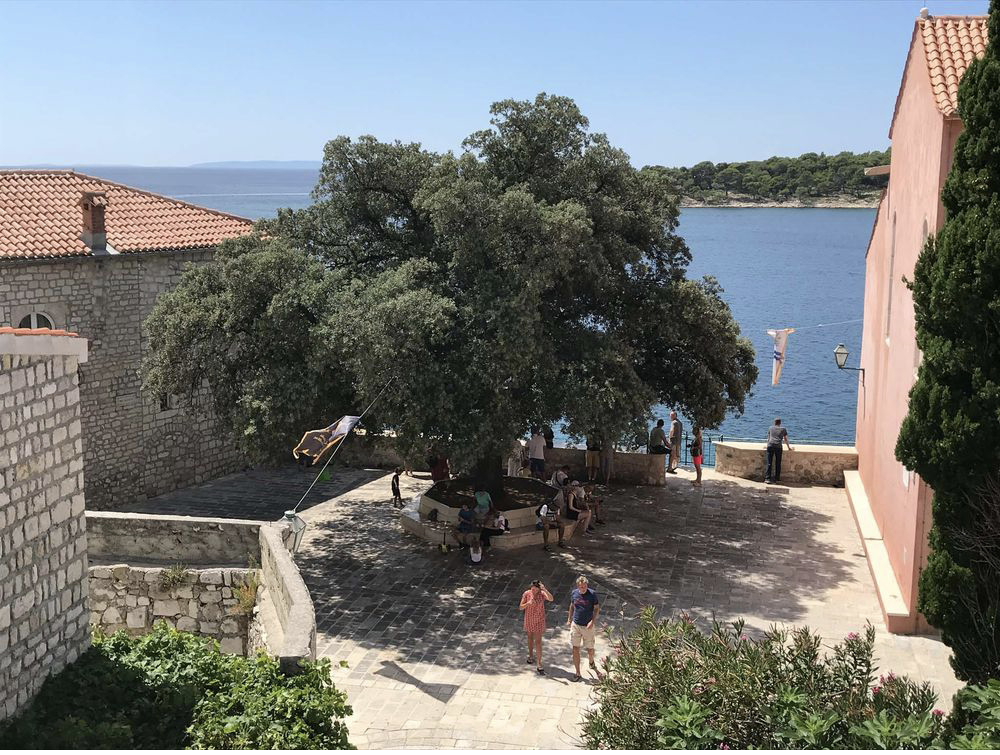
Figure 1.
The Tree of Freedom, Rab, Croatia.
Source: photo courtesy of David Kabalin.
This dense tree’s embeddedness in human everyday life (and vice versa) invites a rethinking of what counts as political force beyond human intention, formal institutions, or explicit political action. Michael Marder addresses this problem in his rethinking of political life. In ‘Resist like a plant!’ (2012), Marder argues that political thought has long been constrained by zoocentric metaphors centred on volition, mobility and intentional mobilisation, thereby reducing politics to forms of locomotion characteristic of animals. Against this tradition, he proposes vegetal modes of being, growth, endurance, exposure and metamorphosis as a different grammar for understanding political life. These modes articulate a form of political existence grounded in temporal persistence, vulnerability and ongoing negotiation with a heterogeneous environment. For Marder, this shift culminates in the notion of phyton politikon, through which human political existence is rethought via vegetal ways of being (2012: 2–4, 16–18). Vegetal life thus serves as a philosophical interlocutor in reconceptualising the political as something that unfolds through endurance, exposure and relational embeddedness rather than through intentional action alone.
While Marder mobilises vegetal modes of being in order to rethink human political existence, this text extends his insight in a different analytical direction. Rather than stopping at the human, I return the analytical focus to plants themselves, proposing that living trees can be understood as political beings in their own right. They are relational entities whose political force emerges in a form of non-sovereign agency through their material presence, capacity to organise space and communal embeddedness within shared worlds. The Rab holm oak concretely enacts the vegetal dynamics that underpin Marder’s redefinition of political life. With its wide canopy, the holm oak anchors the square, shelters its users and both constrains and enables spatial practices through the vegetal rhythms by which it has grown into the site across more than a century. Part of its political presence arises from the way its living body persistently negotiates with weather, soil and human use. The low wall encircling the holm oak was built in response to the tree’s growth and the need to stabilise the soil around its roots, preventing erosion and collapse. Yet this protective structure has been appropriated into everyday life, functioning as a circular bench where people sit, talk, watch children play and rest in the tree’s shade. These interactions reveal how the tree’s living materiality and spatial agency already shape the square as a shared social environment, foreshadowing the broader political roles that will become visible in the practices and narratives discussed below.
This perspective situates the analysis within a broader body of scholarship that reconceptualises politics as emerging through relations between humans, plants and their environments. Within this line of thought, the notion of plant politics becomes especially relevant. Lesley Head and colleagues (2014: 866) define it as ‘the collaborative and conflictual relations between people, plants and others’, thereby recognising plants as consequential participants in shaping lived environments. To take plant politics seriously is to analyse how plantness, the specific capacities and dispositions of plants – such as growth, endurance and environmental responsiveness – actively participates in the making of political landscapes and in the transformation of social and ecological identities (Fleming 2014, 2017). Within this scholarship, plants are frequently approached not as isolated organisms but as collective or distributed forms of life. Michael Marder, for instance, describes vegetal existence as ‘non-individuated’, foregrounding plants as collective modes of being (Marder 2013: 183). Similarly, Sarah Elton proposes shifting ethnographic attention from individual plants to plant communities, arguing that vegetal politics emerges through the relational dynamics of plant assemblages. In the cases examined here, however, the analytical focus is not on plant communities but on the relations that develop around a particular tree in public space. The relevant community is organised through the interactions, practices and attachments that emerge between the tree and the people who gather, dwell and act in its presence. For that reason, the analytical focus remains on the individual tree as the most visible node through which these relations become publicly articulated. What becomes analytically significant is the way such a tree concentrates and mediates relational, narrative, symbolic and infrastructural processes, allowing them to become publicly recognisable and socially consequential.
Because human control over plants is always partial, even in settings that appear to be fully human-designed (gardens, parks, urban squares), political processes emerge as the outcome of interactions among multiple agencies rather than the effect of human intention alone. Plant agency should not be understood as autonomous, something a plant possesses, for such an interpretation risks anthropomorphising vegetal life. Instead, plant agency is relational: it arises in concrete encounters, practices and shared activities through which human and vegetal beings act together. Agency, therefore, is co-produced in situ, in a public square, and the political appears as an effect of related agencies rather than as an attribute of any single actor. Without the people who rest, celebrate, argue, remember and organise their routines beneath its canopy, the holm oak would not acquire social or political force; yet, without the holm oak, these very practices and the attachments, orientations and forms of belonging they enact would not take shape. Its political agency therefore emerges through the relations that develop between the tree and the people who live with it, within co-produced practices through which human and vegetal lives mutually enable, constrain and render one another socially legible. This understanding resonates with Donna Haraway’s insistence that beings become-with others (2008: 16) and with Anna Tsing’s argument that significance arises within assemblages of interdependent life-worlds rather than within isolated organisms (2015: 22–25). Through such relational entanglements, the holm oak’s endurance and the community’s everyday practices continually shape one another. For instance, residents living near Pjaceta recall celebrating the tree’s hundredth birthday with a gathering organised by the local Friends of Rab association. Old photographs of the square were displayed on surrounding walls, and 100 small holm oak saplings donated by the forestry service were distributed to visitors. As one resident remembered: ‘The place was packed with people … old photographs of the tree and Pjaceta were projected on the wall, and people stood around chatting and pointing at them – look at this one, he is my grand grandad.’ In this way, the holm oak becomes not only an old tree but a catalyst for collective self-recognition: a living archive that draws people back to the square and invites them to read their own histories against its silhouette.
These dynamics illuminate why the Rab holm oak becomes a site of memory in the strong sense articulated within memory studies. Pierre Nora’s notion of lieux de mémoire explains that certain places become repositories of collective memory when everyday practices, symbolic investment and historical consciousness converge (Nora 1989). The holm oak operates precisely in this register: it is a material site where personal recollections, communal narratives and political histories become publicly recognisable. Its thick trunk, gnarled branches and the surrounding square provide the spatial form through which those memories are rehearsed and renewed. Christopher Tilley’s phenomenological approach to landscape further clarifies this process. Landscapes function as mnemonic fields in which movement and bodily orientation generate experiential memory (Tilley 1994). The Pjaceta operates in exactly this way: children run around the low wall surrounding the holm oak, elderly neighbours sit in habitual places and families return for photographs. Through these repeated movements, the tree becomes a material hinge linking embodied routines with shared remembrance. Tim Ingold’s notion of lines offers an additional vocabulary for understanding how remembering unfolds through movement and attention (Ingold 2007). The tree’s leaning growth, the polished stone wall around its base and the habitual paths traced by children, neighbours and festival-goers constitute such lines through which past and present continually intersect. Read together with Nora’s lieux de mémoire and Tilley’s phenomenology of landscape, these perspectives reveal the Rab holm oak as a mnemonic and political assemblage in which material endurance, spatial centrality and symbolic naming enable memories to circulate as socially consequential narratives.
This becomes particularly visible in the layered historical narratives associated with the tree. Older residents recount that it was planted to commemorate the departure of Italian troops, often adding details about who planted it. Several families maintain their own versions of the story in which a grandfather or uncle figures among the planters. A widely circulated anecdote recounts that the first sapling dried out, after which three new ones were planted, each dedicated to one of the peoples of the Kingdom of Serbs, Croats and Slovenes; only ‘the Croatian one’ is said to have survived. The joke is playful but politically sharp, using the tree as a medium through which complex histories of Yugoslav and post-Yugoslav identity are remembered and negotiated. This everyday embeddedness extends the political dynamics described above into the routines and relationships of everyday life. It resonates strongly with Anna Tsing’s account of assemblages, in which beings do not simply occupy places but actively compose them through entangled, interdependent processes of growth, attention and use (Tsing 2015). The Rab holm oak does not merely stand in the Pjaceta: it co-produces the square’s form and meaning. Its canopy choreographs movement and hosts encounters, its trunk anchors orientation and its seasonal cycles mark recurring moments through which communal memory is rehearsed. At the same time, the square shapes the tree through shifting paving materials, microclimates, municipal interventions and the frictions of everyday activities. What emerges is not a static backdrop but a heterogeneous assemblage in which vegetal and human agencies continually remake one another. This is particularly significant when viewing the holm oak as a contested element in current debates about public space, tourism and commercialisation. Recent years have seen intermittent attempts to transform the square into an extension of nearby cafés and festival infrastructure. During cultural events such as the film festival or summer concerts, temporary bars, tables and cushions are installed in ways that effectively privatise the shared space: public benches are appropriated, and the square, according to residents, becomes ‘only for users of the café’. Local activists perceive this as an erosion of the square’s character as an open communal space. In response, the 2023 open-air exhibition about the holm oak and the Pjaceta, built from family photographs collected across the island, was intentionally installed on the square itself as a dam, a way of making visible that this is a public place and not an extension of the hospitality industry.
The conflict comes into sharp relief in a recent incident connected to the Rab film festival held in summer 2025. The organiser, having been granted logistical help from municipal workers and their electric vehicle, decided to set up a large projection screen on the square. When he found that the holm oak’s branches interfered with the screen, he instructed the workers to cut them back. Although no branch thicker than three centimetres was removed, the reaction was immediate and intense: residents were outraged that ‘Croatia’s Tree of the Year, a candidate for European Tree of the Year, was being cut because it interfered with a screen’. As one interlocutor put it succinctly: ‘It is the screen that should move, not the tree.’ In that moment, the political status of the tree became unmistakable: the intervention was perceived as an unacceptable intrusion into the living body that symbolises the community. Municipal staff, who had authorised help with carrying equipment but not with pruning, were themselves ‘horrified’ and feared a ‘local revolution’. The incident reveals how the holm oak functions as a limit-point: a boundary beyond which interventions in the name of tourism or commerce become unacceptable because they touch the living body that stands for the community itself. The Rab holm oak functions as a nodal site of contested public space, where divergent visions of the square as communal living room, commercial extension, or cultural venue collide, where abstract debates about the public good become materially grounded, and where political conflict becomes visible because it is enacted upon the living body of the tree itself (Low 2000, 2017).
These stories and practices show how the Rab holm oak operates as an arboreal political body. It is a living organism with its own material vulnerabilities, a branded Tree of Freedom in a European contest and a dense social node saturated with affection, conflict and memory. It shapes the surrounding space, structures children’s games and adult feasts, anchors local narratives of freedom and everydayness, and becomes the site where competing visions of public space, like communal living room, tourist spectacle and commercial venue, are negotiated. The holm oak is not merely a witness to political and social life in Rab; it is one of the actors through which that life is continually made and contested.
III: Arboreal political bodies
The conceptual and ethnographic strands of this analysis point to a triadic structure of the arboreal political body. The five dimensions identified earlier, living materiality, spatial agency, communal embeddedness, narrative identity and symbolic condensation, do not operate as separate analytical layers. Rather, they coalesce into three interrelated bodies – the living material body, the narrative body and the symbolic body – through which trees come to function as political and relational beings. As shown through both historical cases and ethnographic analysis, arboreal political bodies first take shape as living material bodies. This body is constituted through living materiality and spatial agency: through the tree’s vitality, vulnerability and special capacity. Trees persist, grow and regenerate within changing social, ecological and infrastructural conditions, while simultaneously anchoring practices of gathering and movement. Their political force is grounded in their exposed biological existence and in the ways their living bodies materially shape and are shaped by the environments they inhabit.
Narrative bodies emerge where communal embeddedness and narrative identity intersect. Here, political significance arises through the accumulation of stories, memories and anecdotes that gather around a tree. Communal identity is produced through narrative practices, through the ways people remember and articulate human–arboreal relations. Besides the Rab holm oak, the earlier mentioned Czech pear tree embodies a layered repository of memory. It carries stories of how it survived collectivisation, how it persisted when neighbouring orchards were cleared during land reforms. It becomes a sedimented mesh of histories and affective ties distributed across a living organism. Within arboreal political bodies, political significance is therefore not confined only to high-intensity events (wars, revolutions); it is also continually produced in narrative practices of everyday life. Storytelling becomes a way for communities to imagine and reproduce themselves.
The symbolic body emerges through symbolic condensation, where political and ethical values are crystallised in a living organism. As Erik Fechner (1987) and Giulia Pacini (2007) show in relation to revolutionary trees, political symbols derive their force precisely because they are embodied in vulnerable, living beings that can grow or be destroyed. As the case of the Rab holm oak already suggests, such symbolic charge emerges from the interplay between a tree’s material vulnerability, its narrative histories and the practices of care that sustain it. In Puig de la Bellacasa’s sense (2017), this symbolic dimension is a performative relation: meaning is constantly renewed through acts of care and storytelling. A second, equally illuminating example is the Conxo Oak in Galicia. The tree is historically linked to the Banquete Democrático de Conxo of 1856, a clandestine gathering of progressive intellectuals, artisans and students who articulated democratic ideals in the face of political repression. Here is the tree’s symbolic body activated in an openly political register: it becomes a living emblem of egalitarianism and civic freedom. Yet its political significance is inseparable from its material vulnerability (an ageing oak with a complex root system) and from its narrative body (stories about its role as a sheltering canopy for dissent, its inscription in Galician democratic memory and its contemporary mobilisation as a community symbol). The Conxo Oak demonstrates that symbolic potency circulates through living matter, through the seasons of a tree that grows and requires care.
In sum, the arboreal political body unfolds as a triadic formation. As a living material body, a tree persists, grows and bears the marks of history through its exposed biological existence, acting at the same time as a spatial agent that mediates environments and social encounters. As a narrative body, it anchors stories of survival and transformation. As a symbolic body, it condenses political and affective values into a single living organism. These three dimensions do not exist separately but mutually constitute a tree’s political force. What distinguishes arboreal political bodies from human or institutional ones is that their political force remains inseparable from their living vegetal existence. They are political because their growth and vulnerability become sites of negotiation between competing visions of space and community. They redistribute agency across species lines: the tree shapes the square as much as the square shapes the tree; its biological needs constrain human plans; its slow temporalities embed political gestures in lifespans that exceed individual memories. Arboreal political bodies unsettle anthropocentric models of political life by revealing that political relations are always already more-than-human arrangements of care and conflict.
***
The analyses presented here propose the notion of the arboreal political body as a way of understanding how trees participate in the making of political and communal worlds. Rather than approaching trees as passive symbols or natural backdrops to political life, the concept highlights how their living presence, narratives and symbolic investments allow them to acquire political significance within communal and ecological contexts. To clarify how such arboreal political force takes shape, five analytical dimensions were identified: living materiality, spatial agency, narrative identity and symbolic condensation. These dimensions form three broader registers of arboreal political existence: the living material body, the narrative body and the symbolic body. In this triadic formation, trees appear as biological organisms negotiating their environments, as narrative entities around which communities accumulate memories, and as symbolic condensations of political values. The Rab holm oak, together with other community trees discussed here, shows how older traditions of liberty trees and contemporary practices of environmental heritage converge in living arboreal bodies. Attending to trees as arboreal political bodies invites reconsidering political life as co-produced through living matter, shared practices and histories of human–arboreal relations.
ALL-READY Project. European Landowners’ Organization (ELO). https://www.all-ready-project.eu/about/elo.html (accessed 6 January 2026).
Budău, R., C.S.C. Timofte, L.V. Mirisan, M. Bei, L. Dincă, G. Murariu and K.A. Răcz. 2025. ‘Living landmarks: A review of monumental trees and their role in ecosystems’. Plants 14 (13): 2075.
CG Concept. 2019. L’Arbre de l’Année 2019: L’Arbre de la Liberté de Warêt-la-Chaussée. https://www.cgconcept.fr/larbre-de-lannee-2019-larbre-de-la-liberte-de-waret-la-chaussee (accessed 10 December 2025).
Detch, A.R. 2018. Liberty’s Forest: Liberty Trees and Liberty Poles During the Age of Revolution. Ph.D. thesis, University of Colorado.
Elton, S. 2021. ‘Growing methods: Developing a methodology for identifying plant agency and vegetal politics in the city’. Environmental Humanities 13 (1): 93–112.
Environmental Partnership Association. Brno: Nadace Partnerství. https://www.nadacepartnerstvi.cz/projekty/environmental-partnership-association (accessed 5 January 2026).
European Landowners’ Organization (ELO). Brussels: ELO. https://europeanlandowners.org/ (accessed 5 January 2026).
Fechner, E. 1987. ‘L’arbre de la liberté: Objet, symbole, signe linguistique’. Mots 15: 23–42.
Fleming, J. 2014. ‘Political ecology and the geography of science: Lesosady, Lysenkoism, and Soviet science in Kyrgyzstan’s walnut–fruit forest’. Annals of the Association of American Geographers 104 (6): 1183–98.
Haraway, D.J. 2008. When Species Meet. Minneapolis: University of Minnesota Press.
Haraway, D. J. 2016. Staying with the Trouble: Making Kin in the Chthulucene. Durham: Duke University Press.
Head, L., J. Atchison, C. Phillips and K. Buckingham. 2014. ‘Vegetal politics: Belonging, practices and places’. Social & Cultural Geography 15 (8): 861–70.
Ingold, T. 2007. Lines: A Brief History. London: Routledge.
Jones, O. and P. Cloke. 2002. Tree Cultures: The Place of Trees and Trees in Their Place. Oxford: Berg.
Kirksey, S.E. and S. Helmreich. 2010. ‘The emergence of multispecies ethnography’. Cultural Anthropology 25 (4): 545–76.
Low, S.M. 2000. On the Plaza: The Politics of Public Space and Culture. Austin: University of Texas Press.
Low, S.M. 2017. Spatializing Culture: The Ethnography of Space and Place. New York: Routledge.
Low, S., T. Simpson and S. Scheld. 2019. Toolkit for the Ethnographic Study of Space (TESS). New York: Public Space Research Group, Center for Human Environments.
Mancuso, S. 2020. La pianta del mondo. Bari: Laterza.
Marder, M. 2012. ‘Resist like a plant! On the vegetable life of political movements’. Peace Studies Journal 5 (1): 24–32.
Marder, M. 2013. Plant-Thinking: A Philosophy of Vegetal Life. New York: Columbia University Press.
Nitzke, S. and G. Braunbeck. 2021. ‘Arboreal imaginaries: An introduction to the shared cultures of trees and humans’. Green Letters 25 (4): 367–81.
Nora, P. 1989. ‘Between memory and history: Les lieux de mémoire’. Representations 26: 7–24.
Pacini, G. 2007. ‘A culture of trees: The politics of pruning and felling in late eighteenth-century France’. Eighteenth-Century Studies 41 (1): 1-15.
Puig de la Bellacasa, M. 2017. Matters of Care: Speculative Ethics in More Than Human Worlds. Minneapolis: University of Minnesota Press.
Sladonja, B., D. Damijanić, M. Uzelac and D. Poljuha. 2023. ‘Catalogue of super-trees in Istria (Croatia) created as a result of the citizen science action’. Frontiers in Environmental Science 11: 1154101.
Španjol, Ž. 1992. ‘Zaštita prirode u općini Rab’. Glasnik za šumske pokuse: Annales pro experimentis foresticis 28: 49–132.
Tilley, C. 1994. A Phenomenology of Landscape: Places, Paths and Monuments. Oxford: Berg.
Tree of the Year. 2016. The Oldest tree of Bátaszék. Brussels: Environmental Partnership Association and European Landowners’ Organisation. https://www.treeoftheyear.org/previous-years/2016 (accessed 11 November 2025).
Tree of the Year. 2020. The Guardian of the flooded village. Brussels: Environmental Partnership Association and European Landowners’ Organisation. https://www.treeoftheyear.org/previous-years/2020 (accessed 12 November 2025).
Tree of the Year. 2021. The Millennial Carrasca of Lecina. Brussels: Environmental Partnership Association and European Landowners’ Organisation. https://www.treeoftheyear.org/previous-years/2021/The-Millennial-Carrasca-of-Lecina
Tree of the Year. 2022. Oak of Conxo’s banquet forest. Brussels: Environmental Partnership Association and European Landowners’ Organisation. https://www.treeoftheyear.org/previous-years/2022/Oak-of-Conxo-s-Banquet-Forest (accessed 10 December 2025).
Tree of the Year. 2024. Pear Tree in the Middle of a Field. Brussels: Environmental Partnership Association and European Landowners’ Organisation. https://www.treeoftheyear.org/previous-years/2024/pear-tree-in-the-middle-of-a-field (accessed 10 October 2025).
Tree of the Year. n.d. a About the Contest. Brussels: Environmental Partnership Association and European Landowners’ Organisation. https://www.treeoftheyear.org (accessed 9 October 2025).
Tree of the Year. n.d. b Support the Trees. Brussels: Environmental Partnership Association and European Landowners’ Organisation. https://www.treeoftheyear.org (accessed 9 October 2025).
Treeographer. 2019. European Tree of the Year 2019. https://thetreeographer.com/2019/02/01/european-tree-of-the-year-2019 (accessed 6 January 2026).
Tsing, A. 2013. ‘More-than-human sociality: A call for critical description’. In K. Hastrup (ed.) Anthropology and Nature, pp. 27–42. London: Routledge.
Tsing, A.L. 2015. The Mushroom at the End of the World: On the Possibility of Life in Capitalist Ruins. Princeton: Princeton University Press.
Visković, N. 1997. ‘Stablo i čovjek’. Socijalna ekologija 6 (4): 401–22.
Wandersee, J. and E. Schussler. 2001. ‘Toward a theory of plant blindness’. Plant Science Bulletin 47: 2–9.
Woell, E.J. 2017. ‘Localizing the liberty tree: Republican ritual in the wake of civil war, 1794–1800’. Proceedings of the Western Society for French History 45: 225–38.
Sanja Puljar D’Alessio teaches cultural anthropology at the Faculty of Humanities and Social Sciences, University of Rijeka, Croatia. Her work explores visual anthropology, cultural botany, multispecies ethnography and anthropological studies of plant–human relationships. She is particularly interested in more-than-human sociality, vegetal worlds, care and environmental change. She has published several articles on these topics and edited the special issue of the Southeastern Europe journal, More-Than-Human Sociality in an Anthropogenic Earth: Balkan Perspectives. Her book Living with Plants: Insights from a Multispecies Ethnography of Rijeka and Its Surroundings (Croatian Ethnological Society, 2026) continues this line of research.
Email: spuljar@ffri.uniri.hr
1 The Environmental Partnership Association is an international consortium of six foundations supporting community-based environmental initiatives and local development (Environmental Partnership Association).
2 The European Landowners’ Organisation (ELO) is a Brussels-based federation of national associations representing landowners, farmers and rural stakeholders across Europe (ALL-READY Project. European Landowners’ Organization).
3 The holm oak from the Adriatic island of Rab entered the ETOY competition in 2025 as Croatia’s national representative, following its selection as the Croatian Tree of the Year in 2024.
4 The Heart of the Dalkowskie Hills (beech, Fagus sylvatica) (Poland, 2025), The Oak Fabrykant (Quercus robur) (Poland, 2023), The Millennial Holm Oak of Lecina (Quercus ilex) (Spain, 2021).
5 Jones and Cloke (2002) similarly argue that trees should be understood as active participants in the making of place. Rather than merely occupying space, trees help organise spatial relations around themselves, shaping movement, visibility, attachment and everyday practices through their material presence.
6 This argument resonates with recent work on ‘arboreal imaginaries’, which foregrounds trees as living participants in shared human–arboreal worlds rather than as static symbols or landscape features. Their growth, longevity, vulnerability and material presence shape cultural meanings and temporal relations in ways that exceed human planning and control (Nitzke and Braunbeck 2021).