 The recognition of plants as intelligent beings is as much in vogue now as it was at the turn of the twentieth century, when the first experimental results showing volitional and sentient behaviour in plants were publicised through books and magazines. The shock of these results and their potential implications, that plants could have agency and even desires, took a strong hold of people’s imaginations. Soon, the realisation that plants are capable of movement, perception and communication instigated a profusion not only of further scientific work, but also of literary and, later, cinematic productions. These observations also served to rupture the once hermetic boundaries between science and fiction. Indeed, on more than one occasion, works of plant fiction were published as fact, generating astonished and somewhat frightened responses.1 But what if the merging of fact and fiction first suggested in the 1890s could instead provide us with a way of seeing and engaging with plants on their own vegetal terms?
That is precisely the provocation of the exhibition Science/Fiction: A Non-History of Plants and the eponymous book co-edited by Mona Schubert, Victoria Aresheva and Clothilde Morette. Comprising historic and contemporary works, including photographs, videos and other lens-based media, both exhibition and book are divided into six sections termed ‘chapters’. Rather than following a linear chronology, the exhibition employs the structure of science fiction novels as a theoretical lens, beginning with ‘a stable, recognizable world’ which later ‘gradually unveils uncertain, unexpected realities’.2 In the exhibition space, this strategy is experienced through a semi-enclosed layout with minimal wayfinding at the start of each chapter. In this way, the visitor is free to engage with the last four chapters, centred around scientific, political and speculative fiction, in a non-linear order, thus enhancing the idea of time fluidity characteristic of many science fiction narratives.
In the first chapter, plant agency is explored through shapes, movements and colours. We are made to look closer, as with the work of German photographer and sculptor, Karl Blossfeldt, which reveals a myriad of artistic details in plant form (Figure 1). Preferring common species, often gathered along railway tracks around Berlin, Blossfeldt photographed plants at different stages of their life cycle, including wilting and drying.3 This meticulous visual documentation, which finds echoes in scientific practice, also attains visibility in The Miracle Garden, a project by Dutch artist and horticulturalist, Elspeth Diederix. Established as an actual garden inside a public park, the space allows Diederix to cultivate a variety of flowering plants, which she carefully documents through sketches, annotations and photographs. The resulting images, achieved by manipulating light and shadow, carry a sense of mystery, as if the intense colours of each flower were just at that moment being revealed.
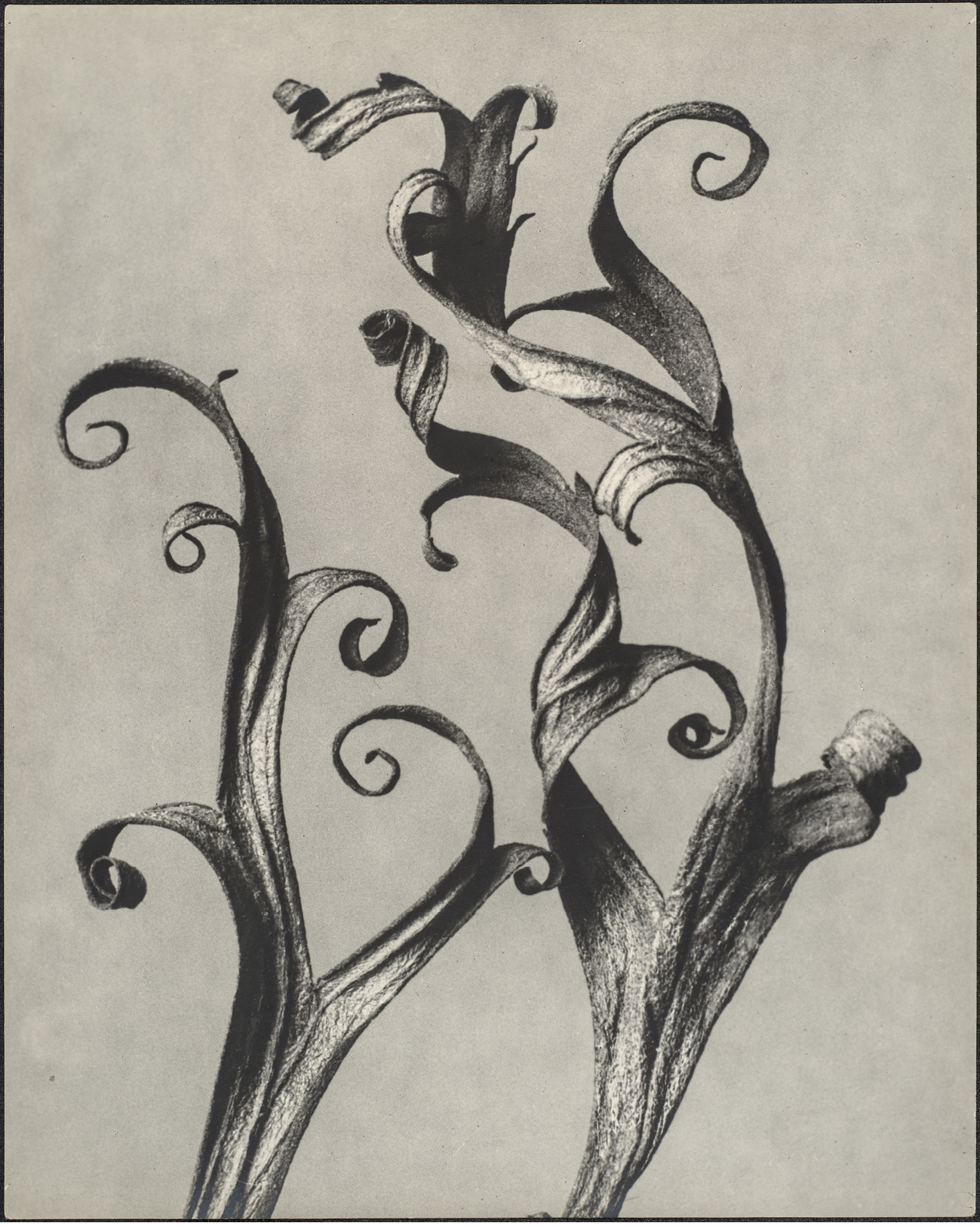
Figure 1.
Karl Blossfeldt, Delphinium (Larkspur), 1920–1929, Gelatin silver print, 29.8 x 24 cm. © Courtesy of Galerie Berinson, Berlin.
A similar sense of wonder animates chapter two, as evoked by the installation Over the Air and Underground, by Australian multidisciplinary artist Angelica Mesiti (Figure 2). In a room with bright-pink walls, six screens show plants under ultraviolet light and speakers play humming sounds; the visual and aural cues emanating from the space attract us like pollinating insects. Only after closer inspection do we notice that the sounds are not those of insects but made to represent the frequency emitted by tree roots for communication. As for the plants, they are in various stages of decomposition, and the eye-catching colours come from the fungi performing the decomposition. The final effect is both eerie and placid, exploring multiple forms of symbiotic interaction. As philosopher Michael Marder remarks in his essay for the companion book, ‘plants invent and reinvent themselves, molding their environments and inviting others to share the ecosystems they enliven’.4 Similarly, a strange animacy is present in the work of French research-based artist Anaïs Tondeur. Comprising a series of rayographs, Tondeur’s project Chernobyl Herbarium reveals the continued presence of radioactive particles in the body of plants growing naturally in the area established as an exclusion zone after the eco-social catastrophe of 1986. Today, while only a few hundred people dare reside within the exclusion zone, plants, fungi and animals have taken over the entire landscape, thriving even in radiation hotspots.
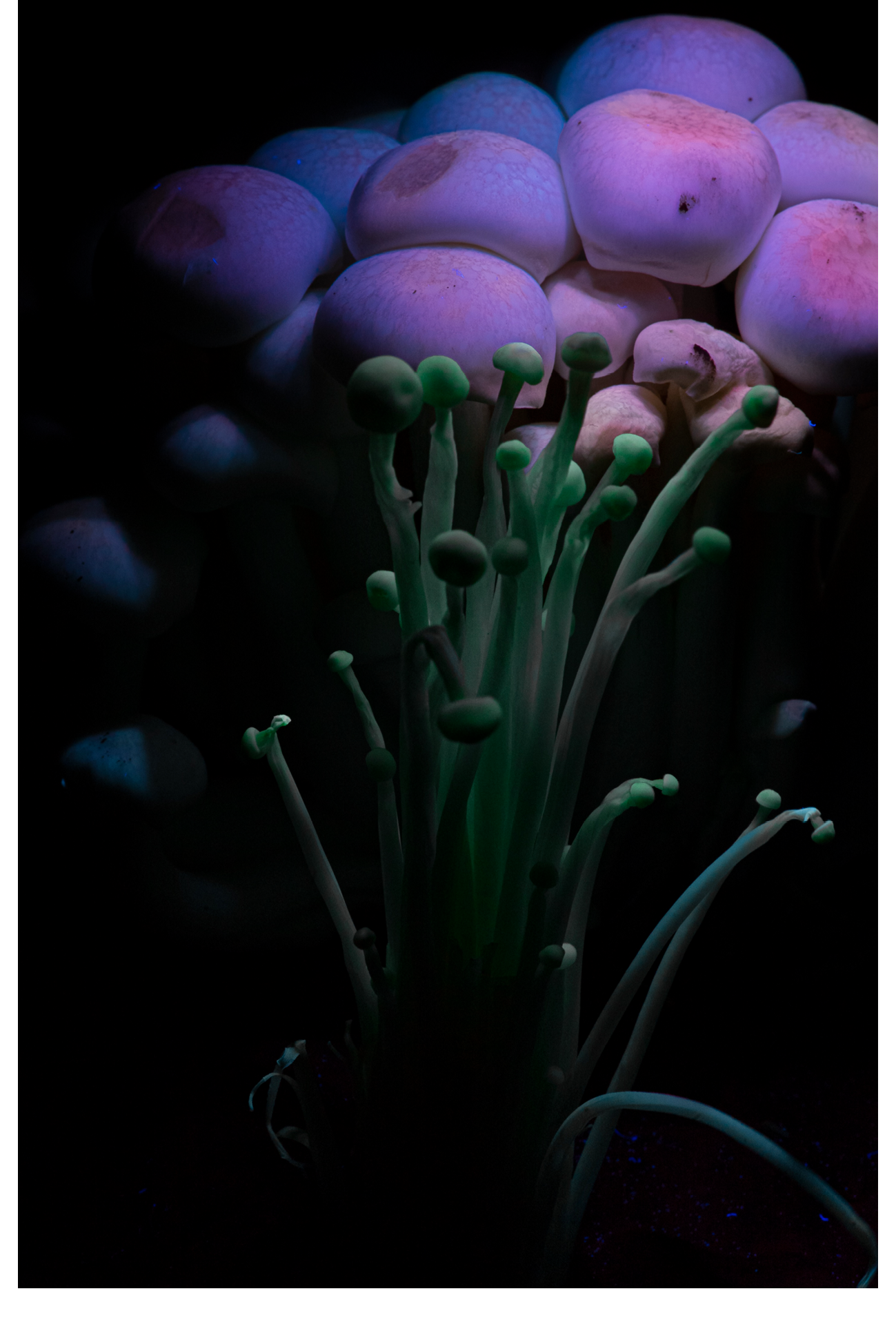
Figure 2.
Angelica Mesiti, Over the Air and Underground (Über der Luft und unter der Erde), 2020, Video with 5 channels, 10 audio mono channels, 9 minutes, in Auftrag der Busan Biennale, 2020. © Angelica Mesiti / ADAGP, Paris, 2025. © Pierre Jouvion Courtesy Galerie Allen.
From the presence of radiation particles made visible in the work of Tondeur, we are brought to think of a common literary and cinematic trope: unchecked biological experimentation producing mutated and monstrous plants. At this point, in both exhibition and book, the narrative begins to shift, exposing the nature-culture divide for its artificiality. In this way, chapter three introduces multimedia works portraying a rich imaginary flora that questions the binary between organic and synthetic. This inquiry is epitomised by the Spanish photographer and critic Joan Fontcuberta’s Herbarium series, in which life-like species are created by combining industrial waste with plant and animal detritus. Likewise, multimedia artist Eleonore False creates photomontages combining botanical and medical imagery with inert matter. The result is a series of ‘frankenplants’ in which vegetable, inert, and human matter mingle in fantastical ways (Figures 3 and 4). These works call us to ‘stay with the trouble’ and make kin with both real and imaginary life forms inhabiting our damaged planet.5
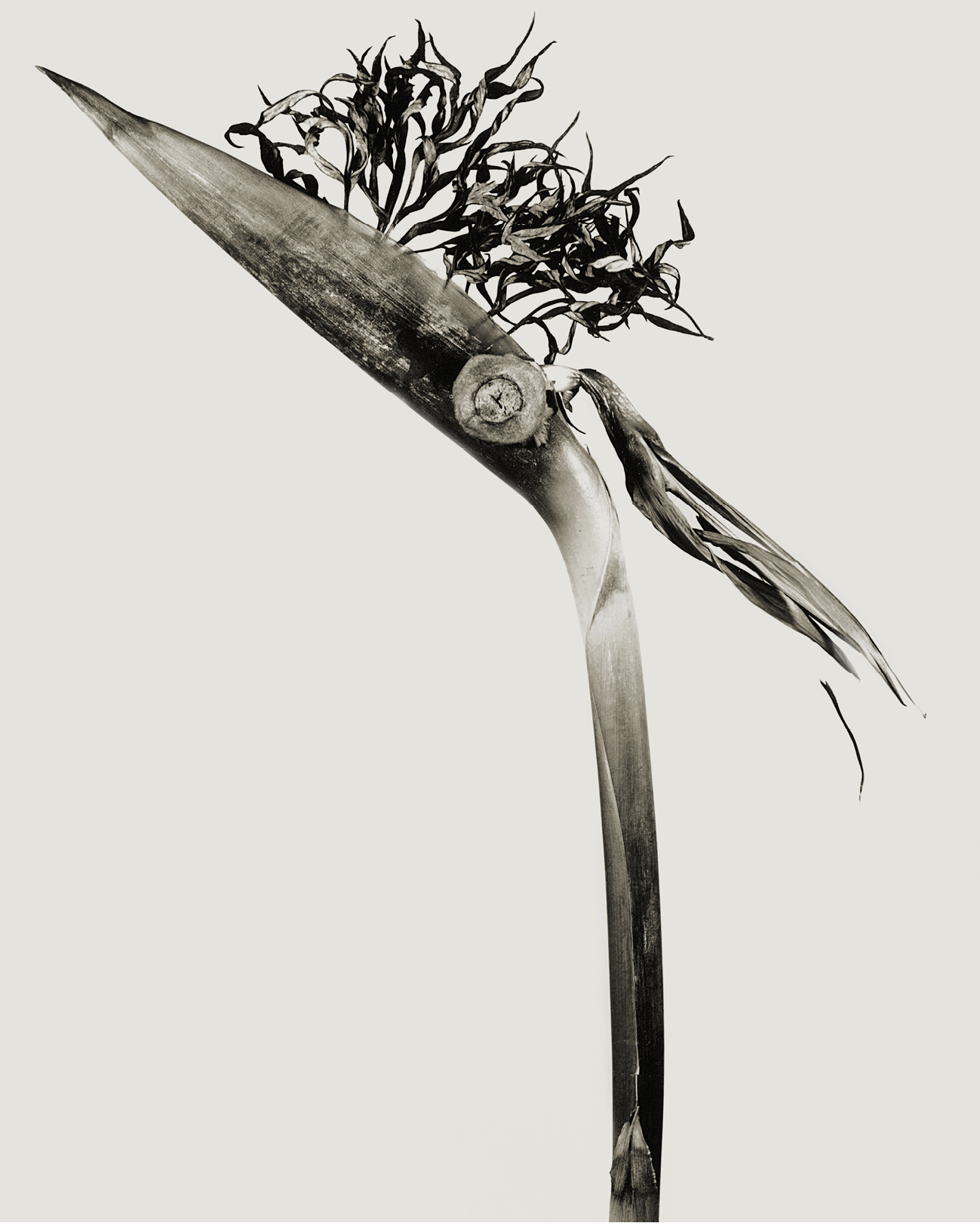
Figure 3.
Joan Fontcuberta, Giliandria escoliforcia, from the series ‘Herbarium’, 1984, Gelatin silver print, 39,6 x 30 cm. © Joan Fontcuberta / ADAGP, Paris, 2025. Collection MEP, Paris.
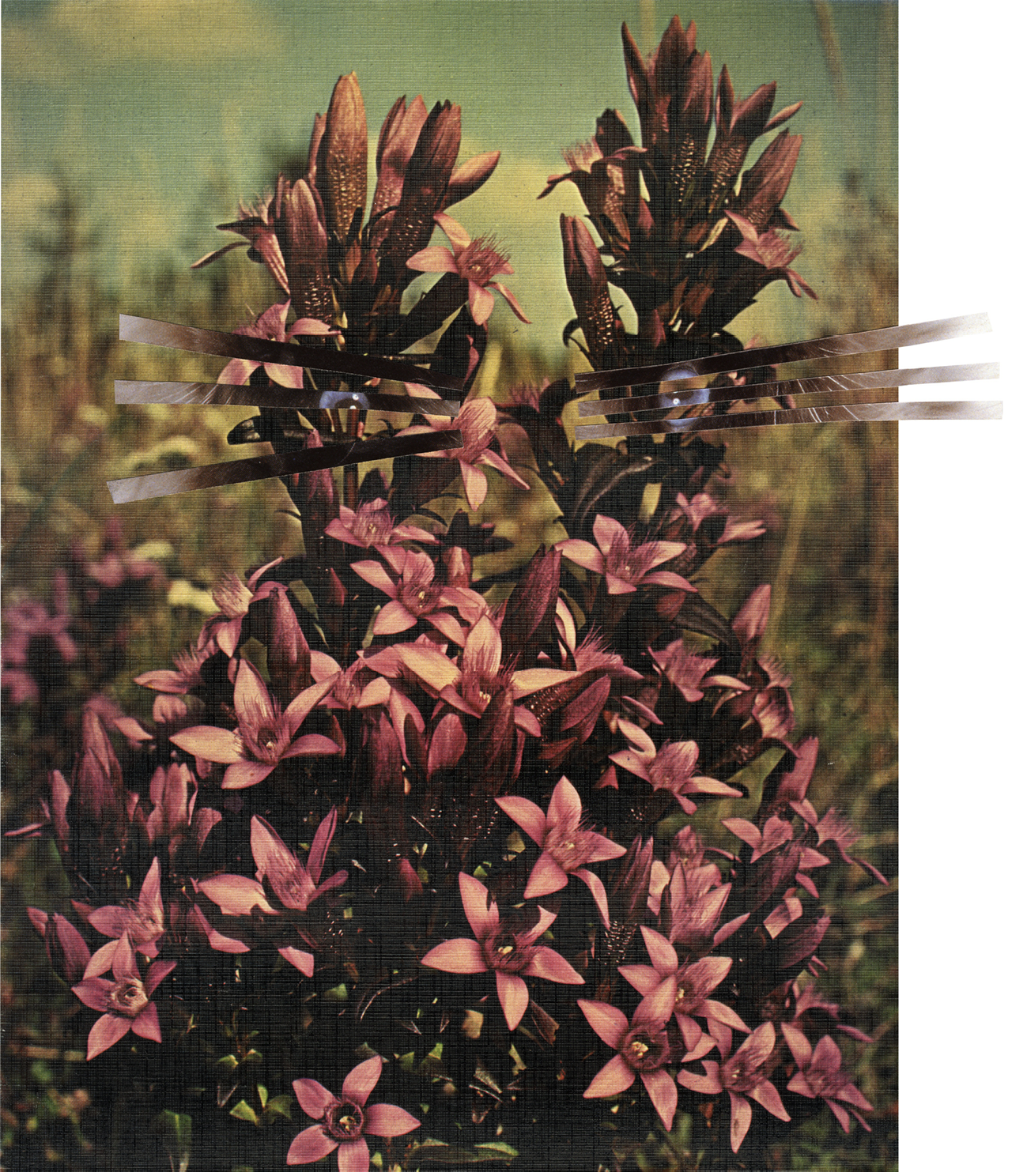
Figure 4.
Eleonore False, Chat, 2023, collage, 29 x 22 cm. © Eleonore False / ADAGP, Paris, 2025.
Further troubling the nature-culture divide, chapter four pays homage to the popular 1951 science fiction novel The Day of the Triffids, by British author John Wyndham. In its original version, as well as in its first television adaptation, the story can be read as a cautionary tale in which human survival is threatened by our own actions. Transporting this warning to present time, the essay by author and art curator Giovanni Aloi for the companion book discusses the profusion of images generated through artificial intelligence showing plants with impossible colours and patterns. This algorithmic iteration of plant fiction published (and sold) online as blooming fact, represents, as argued by Aloi, ‘the fruit of our technological ambition now sow(ing) the seeds of our utter alienation from the natural world’.6 To heed these warnings, chapter five urges us to acknowledge that our histories are irrevocably intertwined with that of more-than-human actors. This idea comes across in the video Quinquina Diaspora, by French artist Samir Laghouati-Rashwan. In the video, two cinchona plants converse about their histories of migration and economic exploitation in the context of European colonisation in South America. The work also evokes histories of mutual care, showing the respect and attention humans can devote to cinchona plants, which in turn provide powerful antimalarial compounds. Similar themes are manifest in the project Home, by Iranian photographer Gohar Dashti. In Dashti’s photographs, however, it is the plants who stay and overtake domestic spaces abandoned by people who are forced out by sociopolitical conflicts (Figure 5). The carefully staged photographs present a duality between the harsh reality of abandoned houses and the vital force of abundant vegetation.
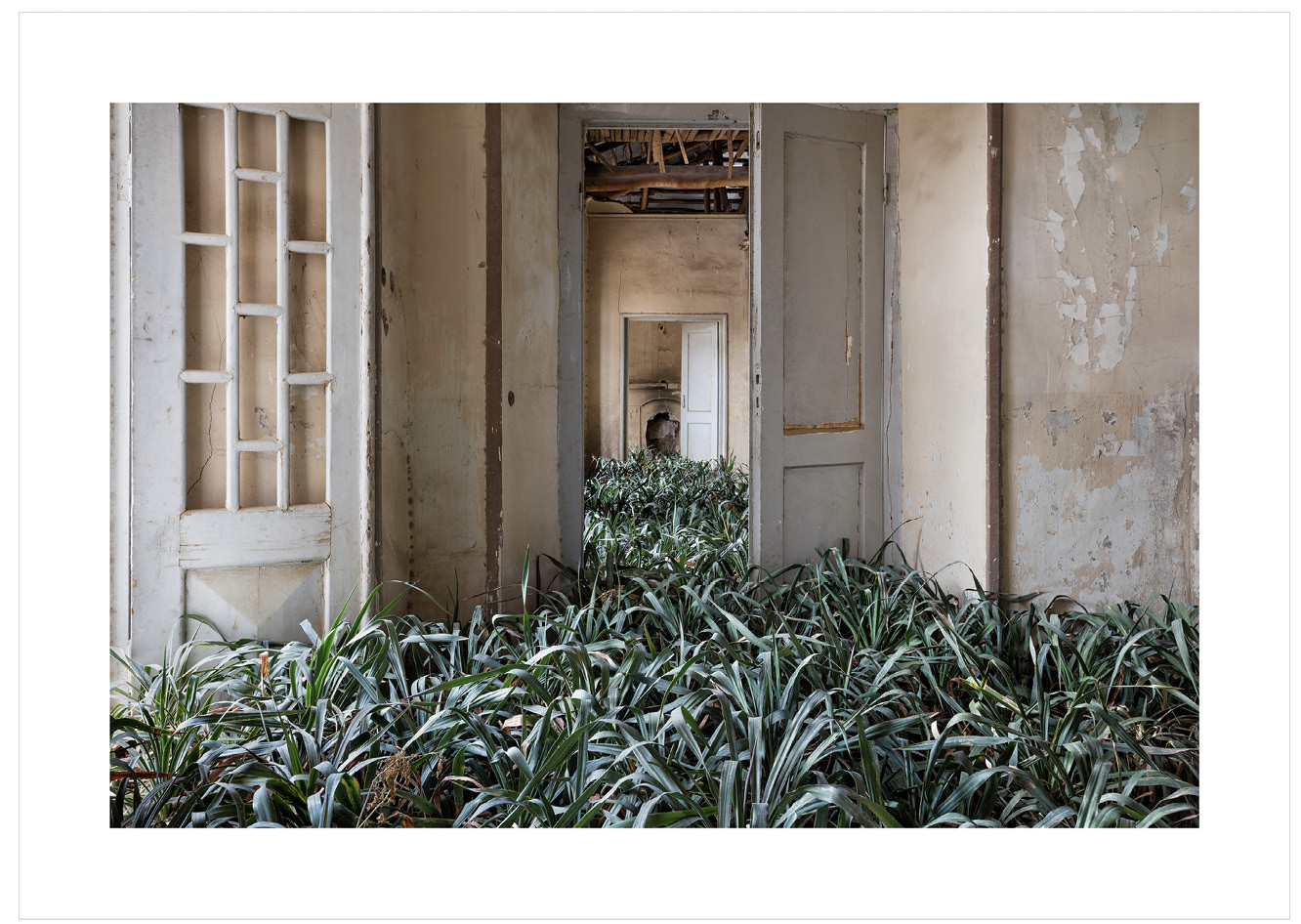
Figure 5.
Gohar Dashti, Untitled #2, from the series ‘Home’, 2017, Inkjet printed, 80 x 120 cm.© Gohar Dashti.
Having then acknowledged our intertwined histories and mixed present, chapter six invites us to dream about plants and people sharing a more intimate past and a more balanced future. This possibility is incapsulated by the video installation The Book of Flowers, by Polish visual artist Agnieszka Polska. This work hypothesises an ancestral connection between humans and plants in which the reproduction of both was physically and morally interdependent. In time, the narrative tells us, this connection is deeply altered by technological progress and eventually disintegrated. We are then left with a sense of haunting familiarity about our non-analogous future – an unsettling feeling typical of critical moments in science fiction tales.
Altogether, the exhibition advances the notion of merging science and fiction as a new way of re-enchanting the world, allowing us to see and engage with plants in all their meristematic possibilities. It provides a circuitous roadmap to recognising the limitations of our human condition while opening space for other ways of knowing and interacting with the world. As remarked by curators Victoria Aresheva and Clothilde Morette in their introductory essay for the exhibition book, ‘we must now find other stories – bold and open-minded stories – so that we can choose a better future and build it’.7
Luiza Teixeira-Costa is Postdoctoral Researcher at the Meertens Institute, Netherlands and Research Associate at Meise Botanic Garden, Belgium. Her research focuses on multiple interactions established among plants and between plants and people, with particular interest on parasitic plants, botanical art, natural history collections, monster studies and history of urban landscaping.
Email: luiza.teixeiracosta@meertens.knaw.nl
1 Two alleged accounts of human-eating plants were published anonymously in different USA periodicals (‘The Man-Eating Tree’, The New York World, 26 April 1874; ‘A Blood-Sucking Plant’, The Philadelphia Times, 9 December 1889). Both stories carry a strong xenophobic undertone that exoticises the locations where the plants were supposedly found – Madagascar and Nicaragua, respectively.
2 Excerpt from the introductory text written by curators Mona Schubert, Victoria Aresheva and Clothilde Morette for the exhibition at Foto Arsenal Wien.
3 H.C. Adam, Karl Blossfeldt: The Complete Published Work (Cologne: Taschen, 2024).
4 M. Marder, ‘The labyrinths of non-history: Of plants and not only’, in V. Aresheva and C. Morette (eds), Science/Fiction – A Non-History of Plants (Leipzig: Spector Books, 2025), pp. 85–92.
5 D. Haraway, Staying with the Trouble (Durham: Duke University Press, 2016).
6 G. Aloi, ‘Le Fleur du Mal Algorithmique’, in Aresheva and Morette (eds), Science/Fiction, pp. 141–48.
7 V. Aresheva and C. Morette, ‘What shouldn’t have happened’, in Aresheva and Morette (eds), Science/Fiction, pp. 11–17.