Shelley Kolstad
Between ‘The Outlier’ and ‘The Dead’: Ethnographic and Phenomenological Encounters with a Mangrove Community
In this paper I share encounters with a mangrove community facilitated by practical engagement with concepts drawn from natural philosophy and anthropology. Ways of encountering mangroves which compel the process of ‘becoming with mangroves’ are elucidated as well as a reflection on personal impacts of being with mangroves. By employing Johann Wolfgang von Goethe’s ‘observation as phenomenology’ and plant ethnography I was able to record through narrative and photography a place-based ontology which shapes ways of being. I found that understanding what it means to be mangrove is grounded in place-based experience. Further, the emergence of the self is synonymous with the process of experiencing mangroves and mangrove places.
Keywords
mangroves, ethnography, Goethe, phenomenology
The rich scholarship offered by Critical Plant Studies on plant ‘agency, ethics, cognition and language’1 opens up the possibility of considering mangroves as subjects rather than objects.2 To appreciate mangroves as subjects, an understanding of the lifeworlds of mangroves is essential. My focus in this paper is to articulate my efforts to achieve an understanding of mangrove lifeworlds by engaging in the ‘delicate empiricism’3 of Goethean ‘observation as a form of phenomenology’4 and plant ethnography.
This paper consists of three sections. In the first section, Research Orientation, I outline the rationale for the approach taken to engage with mangroves, which demands a theoretical and practical awareness of inter-species ways of communicating, knowing and meaning-making. My approach includes participant observation and sensory immersion employing ethnography and Goethean ‘observation as a form of phenomenology’.5 I explain why it is important to identify prior considerations or knowledge about mangroves and I give an overview of the impact and my personal experiences of being with mangroves. The second section, Notes on Mangrove Lifeworlds, consists of six vignettes. Through these, I aim to let particular mangrove individuals and mangrove places which I visited in the Daintree coastal region of Queensland, Australia, communicate through a synthesis of my field-journal, reflection diary, narrative and photography. In Final Thoughts I reflect on what I have learned from being with mangroves, which includes the importance of embodied, place-based experience.
Is it possible to have a conversation with a mangrove plant? How can I seek responses from mangroves? As a way through or around species barriers, Ellie Anderson advises that encounters with a phenomenon (such as a mangrove plant) are experienced through senses.6 Notably a general version of my senses of smell, vision, hearing, touch and taste are shared by mangroves.7 Expanding on the meaning of encounter, Gilles Deleuze suggests ‘[a]n encounter is perhaps the same thing as a becoming … each encounters the other, a single becoming which is not common to the two … but which is between the two…’8 Employing Goethe’s insight that a phenomenon is not separated from but ‘caught up and entangled’ in my self,9 I propose that ‘becoming with’ usefully describes how I, a non-mangrove being, can share insights into the lifeworld of mangroves.
Encounter epistemology resonates with my reading of ethnography and the phenomenological utility of Goethean observation. Ethnography will be employed to observe and record mangroves, animals and other phenomena including but not limited to the ocean, earth, temperature and wind; contemplating and noting interactions, connections and patterns. Through these detailed observations and descriptions of the lifeworlds of mangroves, phenomenology facilitates a reflection and interpretation on the way life appears to and is lived by mangroves, which corresponds to the ‘meaningfulness of the world for a [mangrove] subject’.10 Ethnography is a temporal account of ‘life as it is actually lived and experienced’, where the practice of participant observation is about ‘participating attentively’ and not ‘observation with objectification’.11 Tim Ingold writes that ethnography is foremost ‘educational … a way of learning … [that] … can be transformative’.12 Providing depth to the wide lens of ethnography, Goethean observation assists in encounters that venture behind the superficial mangrove form and their ‘exterior relations’ to sense the gathering within the concealed ‘inner side’.13 According to Craig Holdrege, the faculty of imagination, for example, can be called upon to ‘experience more vividly what I have observed’ with the goal of making ‘thinking fluid (process-oriented)’ to ‘grasp the flow of life’.14 A key aspect of Goethe’s way of seeing, named as Anschauung, is described by Christoph J. Hueck as the internal perception or mental images of the active processes taking place within a plant.15 Hueck emphasises the utility of Goethe’s way of seeing as a means of both orienting and ethically grounding humans toward nature.16 I turn to briefly consider advice on how to, through Goethean observation, orient myself toward and understand mangroves.
Isis Brook notes that there are four stages of Goethean observation in knowing a phenomenon,17 with the antecedent process of choosing the phenomenon a matter of trusting your senses, be it a feeling of curiosity, revulsion or challenge.18 I had chosen mangroves prior to researching ways of knowing and, interestingly, my choice was partly due to the feeling of discomfort I had regarding the environment in which they thrived being often muddy and teeming with insects. At the same time, I was attracted by their curious shapes and the ability to see more of the plant than usual given that much of their root systems are above ground.
The first step, ‘exact sense perception’, founds the entire exercise in Goethean observation.19 I understand this step as a literal application of the title – that is, to animate all of the senses to precisely regard the plant, aided by techniques which themselves engage our bodies in ways of knowing. These techniques include drawing in situ or from memory, descriptive narratives which reject orthodox nomenclature and privileging the plant as the primary source of information.20 The second stage, ‘exact sensorial imagination’, is characterised by engaging our imagination to ‘perceive the phenomenon as a dynamic entity’,21 facilitated by, for instance, noting particular growth stages of the same species and then directing our mental processes to animate those processes for a particular plant. Both these steps arguably address the problem of static proximity which contributes to the idea that plants are regarded as merely scenery or a backdrop.22 This stage is marked by a requirement to think fluidly before moving to the third stage ‘seeing-in-beholding’.23 This stage is distinguished by retreating from an overt orientation of the senses and imagination toward the plant but remaining receptive to the experience of a plant initiated or inspired gesture.24 This may be experienced through emotions that feel given rather than internally arising,25 such as the joy or surprise of being given a gift. The fourth and final stage, ‘being one with the object’, is intuitive and more abstract than the previous stages and involves a combination of ‘the being of the phenomenon with the human ability to think and act’.26 The experience of this stage appears to be similar to a moment of profound insight and would not be achieved without the experiences of the preceding stages.
To faithfully engage with the process of becoming, both ethnography and Goethean observation as phenomenology necessitate a bracketing of prior knowledge and perspectives. Cultivating a humble openness to experiences that organically arise as opposed to proceeding from a specific hypothesis27 and instantiating the ‘practices of knowing and meaning-making that happen in the field’28 is important to ethnography. That each vignette in Notes on Mangrove Lifeworlds differs in length and style is reflective of being faithful to this practice of remaining open to what is offered by the mangroves during fieldwork. Similarly, Goethean observation requires bracketing of prior knowledge to inhibit bias or the intrusion of preconceptions preventing new ways of seeing and relating.29 More particularly, it is not that prior knowledge is excluded but rather that any usual expectations or perspectives are suspended to permit philosophy as ‘critical elucidation’.30 Much available material on mangroves focuses on their capacities as halophytes and a focus on functional characteristics to explain their form including salt tolerance abilities may, as Holdrege emphasises, ‘fall short because they are an attempt to get a grip on a complex biological phenomenon from only one narrow and limited perspective’.31
While accepting this guidance, prior to my fieldwork I gathered research on mangroves from scientific sources mindful that it is argued that phenomenology requires scientific developments both historic and recent to be grounded by individual embodied experiences.32 I also gathered geographic, literary, historical, cultural and aesthetic perspectives on mangroves. This education and range of perspectives enabled me to be intelligently open to what I was encountering in my fieldwork. To that end, in the Notes on Mangrove Lifeworlds sections of this paper, containing a synthesis of ethnographic and Goethean observation fieldwork, I make it explicit where my bracketed knowledge about mangroves acts as a filter or lens.
Part of bracketing prior knowledge and perspectives further includes recognising the impacts on, reactions to and personal feelings about a phenomenon.33 Doing fieldwork in the mangrove community invites physical challenges ranging from the irritating, (being chased by a biting march fly) to the mildly astonishing (something latching onto a toe in a tide-pool) to the ‘look but don’t touch’ (intricate wasp nest hiding in plain sight in the mangrove tree) to the deceptively relaxed advice to ‘be crocwise’34 and look out for snappies. The mangrove community I was visiting was inhabited by saltwater crocodiles.
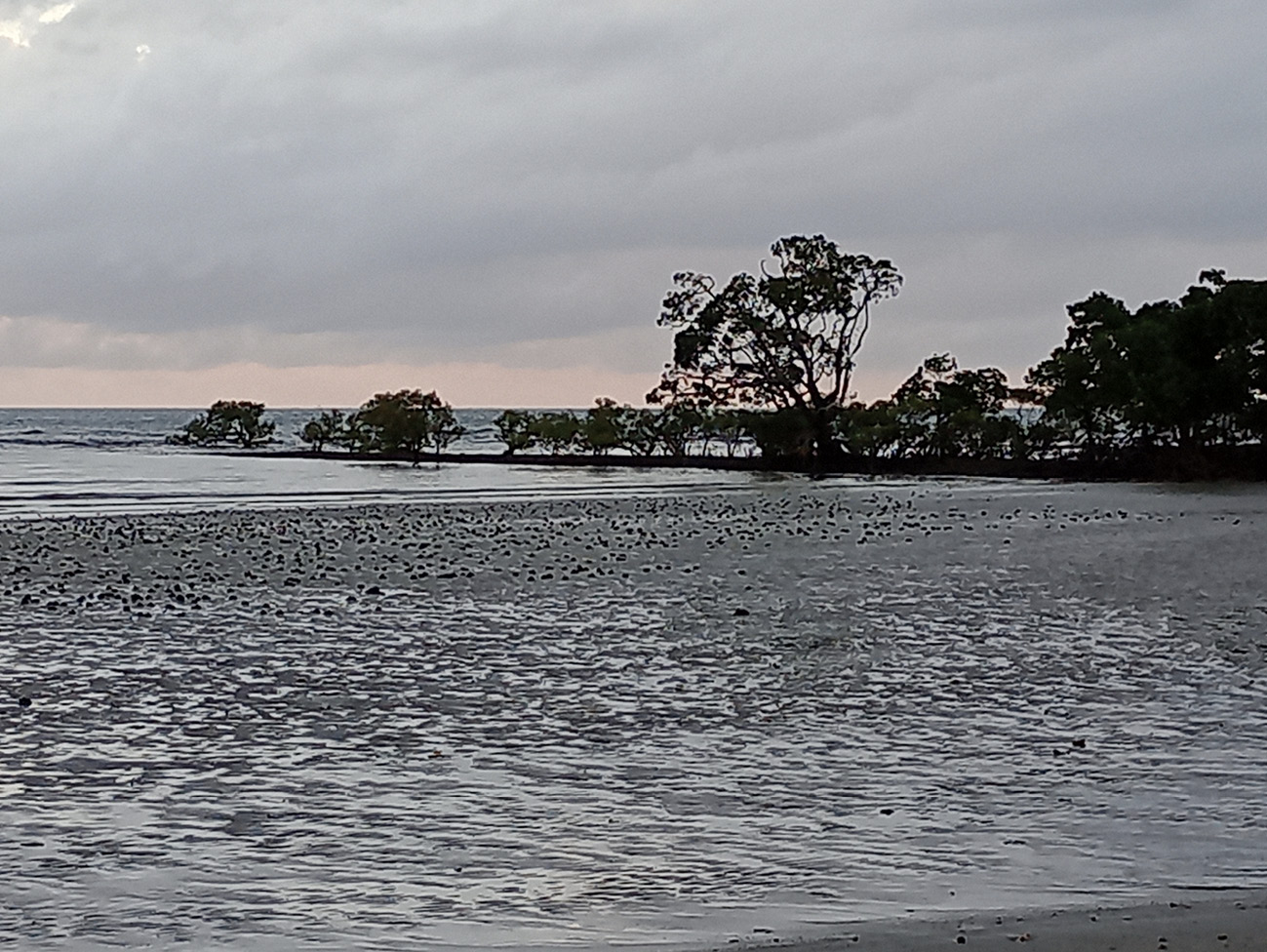
Figure 1.
Mangrove community – sunrise between tides. Author, Daintree, 25 August 2025
Australia’s saltwater crocodile, Crocodylus porosus, is an ambush hunter possessive of an ‘extraordinarily high bite-force’35 of some 3,700 pounds per square inch.36 While a crocodile can propel its entire body out of the water,37 such vigorous behaviour is underwritten by long periods of sedentism including hours of lying on the bottom of a water course integrated with ‘silent and surreptitious’38 movements. My behaviour and ipso facto ethnographic and phenomenological research was consequently governed by crocodiles even during their confirmed absence from a particular place. The locations where crocodiles might lurk, including proximity calculations and terrain obstacles gathered through my vision or hearing, became over time an extension of my proprioception as to my spatial orientation and readiness for flight.
The other key constraint of similar influence was the tide. During high tide I could not access the mangrove community due to the corresponding extension of crocodile territory and the difficulty of detecting them in these temporal habitats. There were certainly other valid reasons to avoid the mangroves at this time, including, as I observed, rough seas obscuring sharp fringing coral reef, stingrays and a lone shark implying the presence of other sharks. The crocodile, which I never saw, except those featured on crocodile warning signs, operated as an availability heuristic, however, explaining a recurring hesitation and caution about venturing amongst the mangroves even while the tide was out.
While mindful of the requirement of openness, my journey into encounters with mangroves in the beginning was marked by a sense of uncertainty, with no familiarity or structure to lean into. Over time I was guided by a sense of return and continuation of where I had left off, of participating in social and environmental milieus, conforming to the rhythm set by the tidal landscape and sensitively orienting both my notes and my body to place. While habits arose in my patterns of behaviour as a result of constraints, on the other hand, invitations were extended in the form of sensations of care and recognition. Each time I took up my hat, my shoulder-bag containing my field journal and pencils and my phone to start my fieldwork, I anticipated ‘nomos in its primary sense of rhythm and melody, as well as nostos meaning here the poetry of homecoming, of recognising the wildly unfamiliar’.39
Temporal aspects of course marked difference, but each time there was an anticipated repetition in the rhythmic roaring of the ocean beyond the surf-break with the trickling sounds of the tide in the foreground, or the black crabs scuttling into their burrows on first encounter, or the sight of a ship on the horizon, or the tide’s retreat or return. Together these anticipated events acted like an embodied perpetual canon, a nomos, enveloping my self, my actions such as always holding onto my hat when it was windy or turning away from the sun, within the composition. Nostos arose with the sense I had of returning to a plant I had previously drawn or photographed, especially a young mangrove which in the time between encounters had been engulfed by the tide; or the deliberate care I took to avoid walking on the thin pencil roots of a particular grey mangrove I called ‘the Outlier’, or spending the time to untangle fishing lines and ropes from familiar mangrove bodies. This sense is named amity. This sense of return and familiarity between friends, of saying ‘see you later’ providing the basis of an unwritten but shared expectation forming a bond: a first law. 40
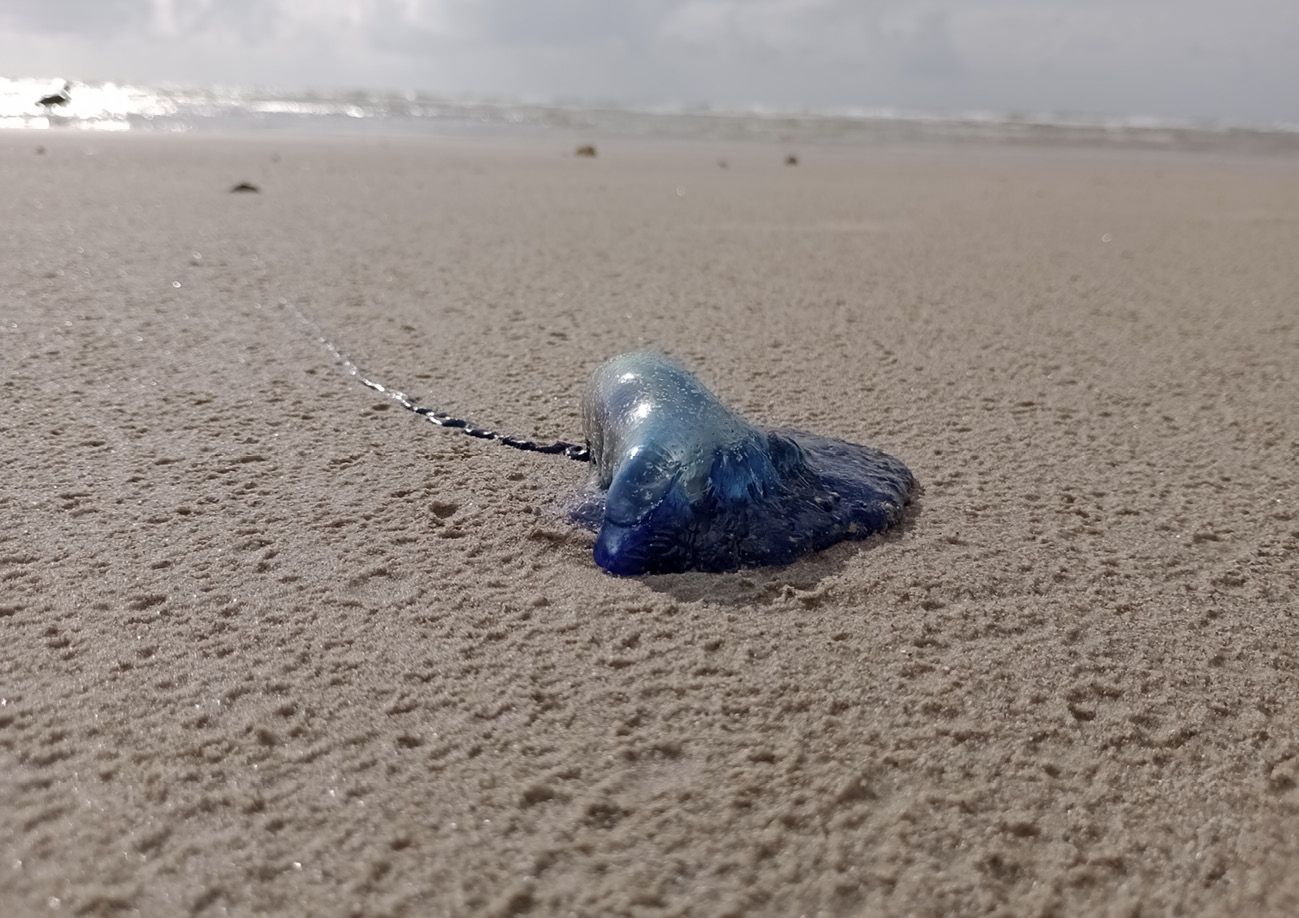
Figure 2.
Stranded Portuguese man o’ war. Author, Daintree, 15 October 2025.
Beyond invitations, ethnographic attentiveness and awareness ensured I was open to the full possibilities of a place founded human ontological experience. Joy emerged, catalysed by the sight of a majestic sea eagle clutching a fish in its claws flying low over the tidepools on the shoreline. Sorrow arose in the wake of the realisation that the many stranded Portuguese men o’ war (see Figure 2) I saw one morning were likely to die. Surprise erupted, catalysed by the sight of a nocturnal bat flying low over the ocean and then dipping down into its surface for a mysterious purpose. And laughter quickly replaced fright when I realised the large shape appearing on the bank of the creek ahead of me one day was a goanna and not a crocodile. But these emotions, habits and experiences are primarily about my relations with the mangroves from my embodied and grounded egocentric perspective. I turn now to consider mangroves and mangrove communities as ‘distinct subjects’ which fully experience a meaningful life from their own standpoint.41
In my fieldnotes I record the location where I encountered the mangroves featured in this article as -16.09, 145.46 via Google maps. This was to bracket out my own colonial human territorialisation practice of relying on nominated human names for places. The location was adjacent what appeared to be fringing coral reef which emerged at low tide, interspersed with tide pools to the north and a permanent creek to the south. This creek flowed down from mountains that towered over terrestrial rainforest that lived behind or westward of the mangroves, while the ocean marked the fluid eastern edges of the mangrove community.
This paper relates to time I spent in the field during extended visits to the Daintree in Queensland, Australia over the period late August until mid-October 2025. I recorded observations in obedience to the local maritime tidal clock which governed my access to the mangroves such that, while I might be able to visit the mangroves at sunrise on one day, on another day I needed to wait until noon. The weather through the period ranged from the cool dry season to the warm wet season of the tropics with predominantly clear sunny days.
My encounters were overwhelmingly experienced through my visual senses, supplemented by botanical science research essential to imagine, for instance, the plant’s roots beneath the ground (or covered by the tide) out of sight.42 Knowledge of mangrove form by type from earlier research guided this imagination, although I emphasise that I have not had anyone independently verify the species identified. To adhere to the requirements of this journal, I have included the scientific and common name of the plant underneath the name or names I reflexively associated with a particular plant or plant community.
The Outlier
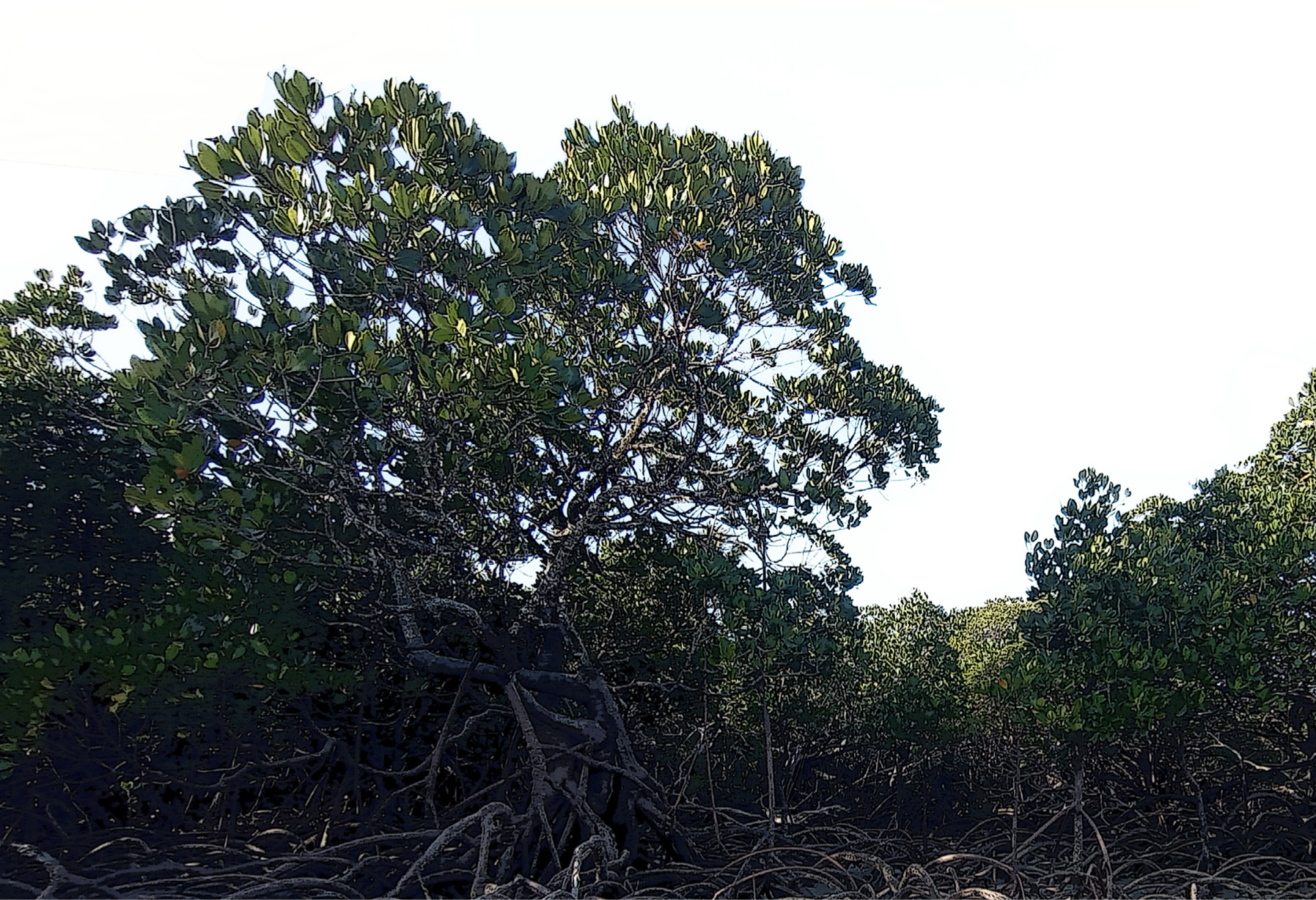
My earlier research had informed me that grey mangroves are referred to as ‘pioneer species’ and the most likely to dominate the ‘seaward side of the community’.44 Described in modern times as ‘tough’,45 while Theophastrus thought they looked ‘like stones so far as they project above the sea’,46 such descriptions did not fully prepare me for my encounters with the Outlier. In this regard I agree with the advice from Holdrege that ‘[t]he realisation that the phenomena we confront are always richer than the abstractions we use to explain them is central to a Goethean approach’.47 On my first encounter, the Outlier was submerged by the ocean (see Figure 1) and being the furthest I could see from my location at the high tide mark, compelled a sense of turbulence, remoteness and inaccessibility. Later, I would encounter the Outlier at low tide, reflected in cool tidepools against a still and sultry afternoon sky (see Figure 3).
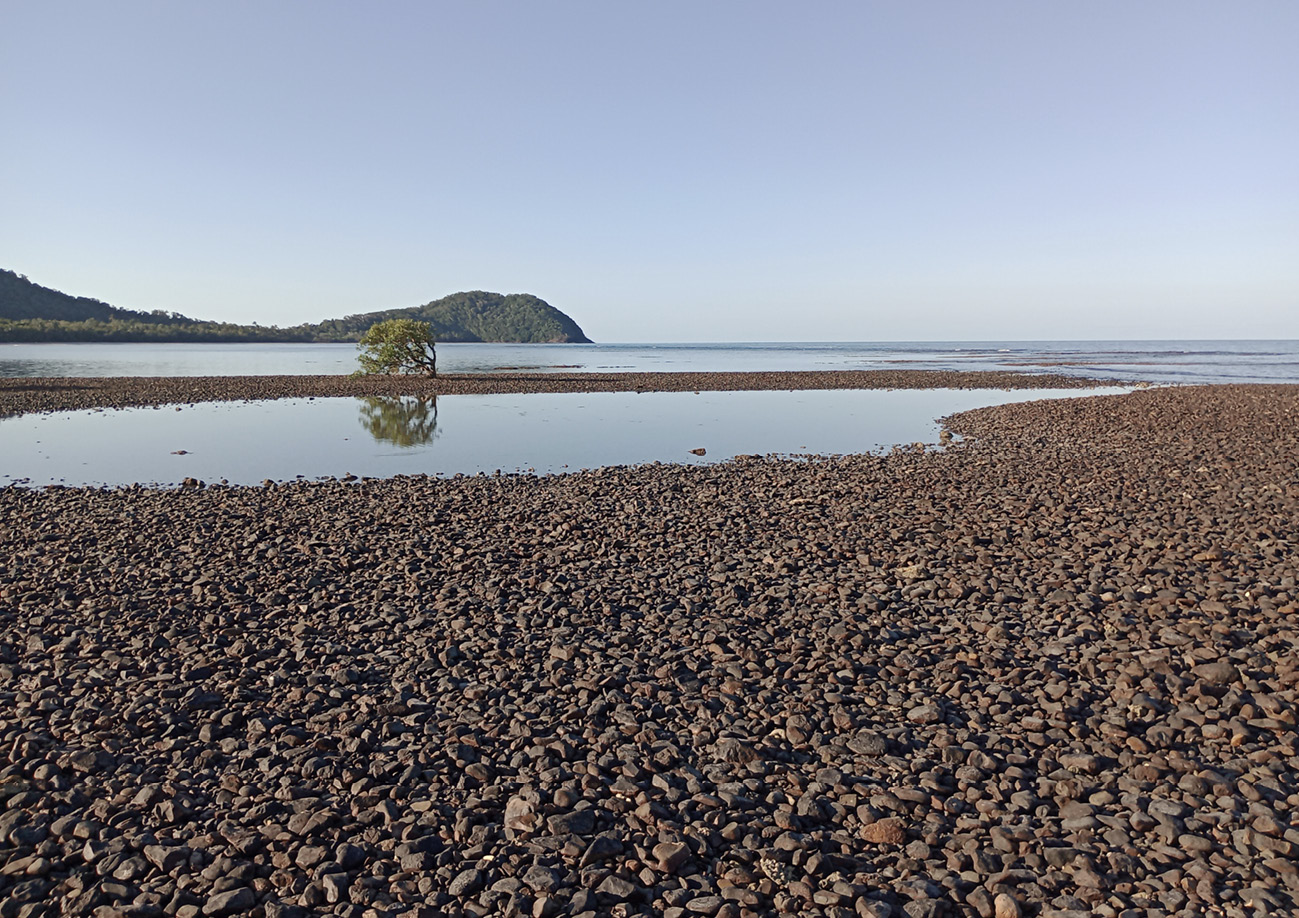
Figure 3.
Tide-pool reflections of the Outlier. Author, Daintree, 27 August 2025.
It was while I encountered the Outlier that I practised the first step of Goethean observation which is exact sense perception, ‘characterized by a detailed observation of all the “bare facts” of the phenomenon that are available to our ordinary senses’.48 Sketching the Outlier helped to concentrate my attention49 and notice details and patterns previously undetected.50 I found the process of rendering the complex living body of the mangrove incredibly difficult even with the aid of impromptu shortcuts including focusing only on the main trunk and disregarding the countless twigs and leaves. I was constantly distracted from the task, for example, by ‘the white flash of a small fish in the tide pool’ next to me or how a white branch ‘looks so distinct against the glossy vibrant green of the mangrove leaves and the mostly dull grey/brown rocks’.51 I could hear birds ‘behind me back on the beach in the forest’, the ‘whump’ of a noisy wave and the rocks smelled something like tar.52
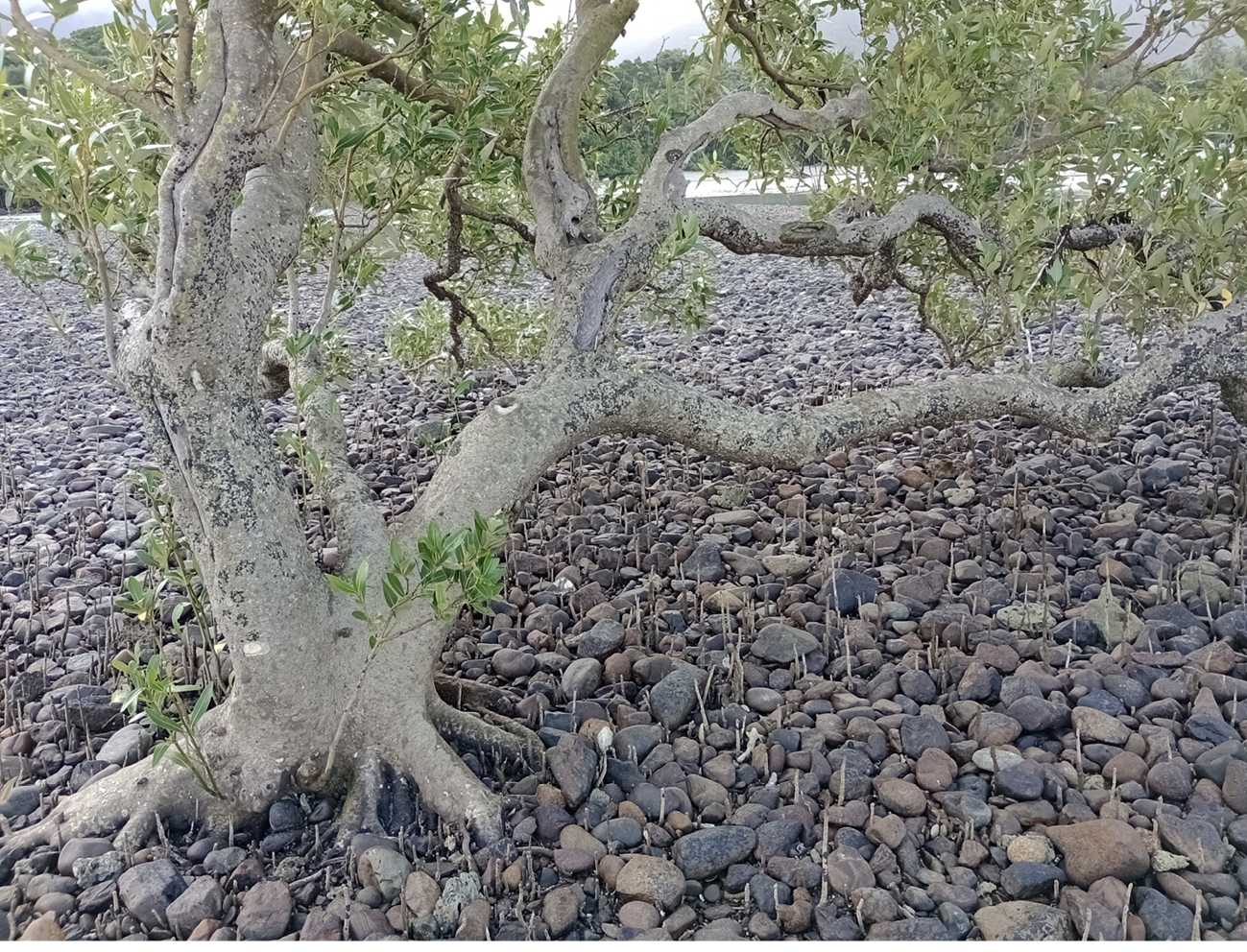
Figure 4.
The Outlier’s aquatic hull. Author, Daintree, 8 October 2025.
Calling on the next phase of Goethean observation which is ‘exact sensorial imagination’,53 even now as I draft this article I can imagine the Outlier engulfed in a tidal tempest. Resolute against the pounding waves, hard core, asserting aquatic territory and terra forming. The Outlier is ocean-going, its hull, like the ocean-going vessels witnessed during fieldwork, scraped and battered from separating the water molecules of countless salt laden waves. As the wind rushes through its masts and its sail leaves, it sways back and forth. This constant motion enlivens its thick cable lateral roots, driving them down and then horizontally in earth’s rocky mantle, bracing the Outlier while it continuously constructs its body of wood in delicate precision, finding best orientation in consultation and processual conversation with the elements. Together the ocean tide, the wind, the sun, the mountains delivering soil through the waters of the creek, conquest of salt and soil hypoxia all becoming together in the form of the Outlier. Access to the place created and occupied by the mangrove is expressed through its form.54 Its trunk a home for barnacles and snails, its leaves for insects and its pencil roots a thicket for tiny fish. It marks the contours of the mangrove community, inviting others in to its register, gathering communities of soil, molluscs, fish, birds and a human ethnographer heeding to its claim as the boundary of her study.
The young mangrove
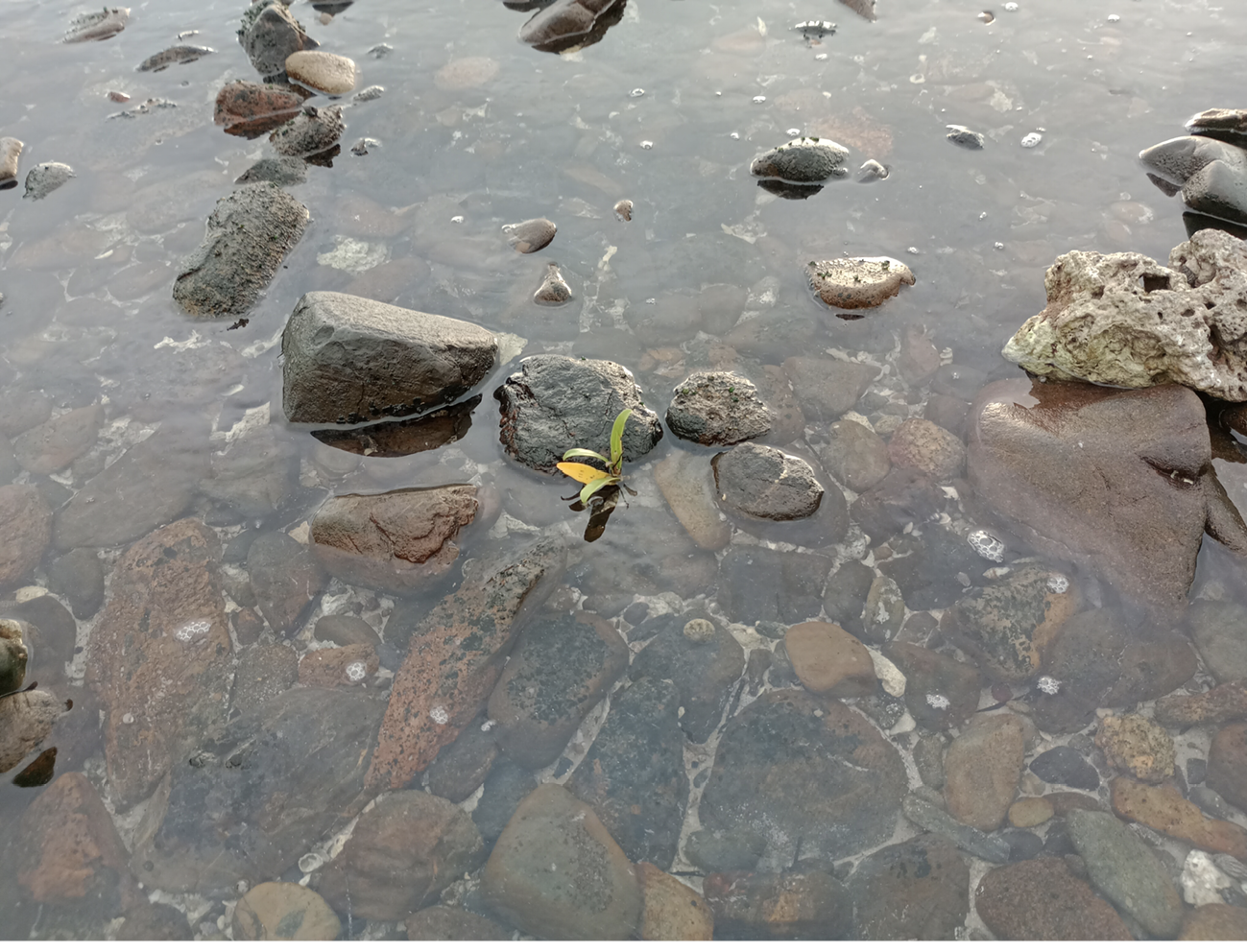
Figure 5.
Young mangrove and stones in tide. Author, Daintree, 9 October 2025.
Stephen Lezak observes that environmental ethnography at times ‘requires setting aside … the tacit assumption that ecological activity is the nearly exclusive provenance of DNA-bearing life forms.’55 While mindful of John Hartigan’s revelation of the likelihood of plants being ‘far more exquisite ciphers of “place” than the mammals examined by ethologists and ethnographers’,56 as an ethnographer committed to flat ontology57 I recorded the presence and interactions of inter alia water, sand, stones, sun, wind, mountains, plastic and non-plastic human waste with mangroves. In particular, over a period of time I recorded interactions with the young mangrove in Figure 5.
This young mangrove was situated close to the low tide mark and was comfortably established between a cluster of rocks that I spent time drawing and reflecting upon later in my diary in relation to the concept of assemblages. Here I employed Ingold’s elucidation of Gilles Deleuze and Felix Guatarri’s meaning of assemblage as an agencement, a gathering, both internal and external, as portrayed through the experience of Lars Spuyborek liking what he saw in a field consisting of stones and a plant: ‘I am with the stones and plant immediately, fitting in with them’.58 Unlike a fisherman I observed walking past the mangroves, I was poised together with the young mangrove, the stones, the wind and the tide. For a moment I was in correspondence with the tide as it washed over my skin, the stones as they made me unsteady on my feet and the young mangrove which I imagined (part of Goethean phenomenology) growing through the unfurling of small leaves to the lateral growth of strong cable roots and the soon to be shedding of its tiny yellow sacrificial leaf. I became a part of the gathering where it was woven into and exists now in the material composition of my life.59
While my participation in the assemblage was brief, the material assemblage of stones, wind, tide, young mangrove and sun was continuous. As an agencement, the stones are in correspondence with one another in their eventual settling into the ground, the young mangrove is in correspondence with the ground between the stones and as it grows the correspondence involves the stones shielding the mangrove from the wind and the tide as it engulfs all of them each turn of the tide. To return to Ingold, ‘the emergent heft of the [stones] has its source in the effortful heave of [the wave]’.60 As the stones are dislodged or slightly moved, the mangrove answers to the new positioning of the stone by growing through the assistance of the sun into a new shape. In this way it is possible to see without any reference to a species ontology each phenomenon is in correspondence with the other. This processual conversation started by the wind and tide is answered by the stones and adopted by the young plant in conversation with the sun, day after week after month after year, shape norming from young mangrove form to the form of the Outlier.
Look like termite mound peg roots mangrove
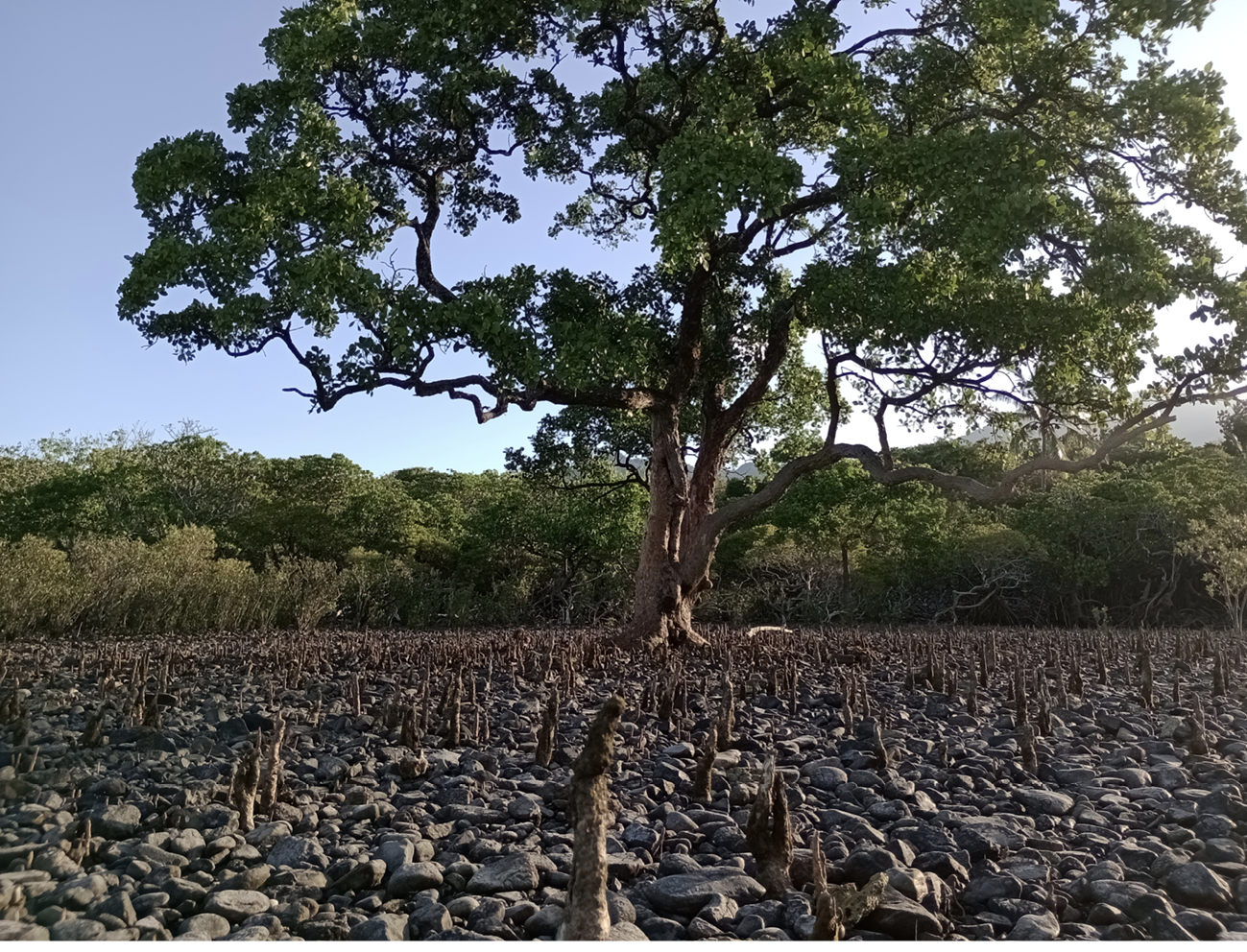
Figure 6.
Termite mound looking mangrove roots. Author, Daintree, 27 August 2025.
Following the advice of Lezak once again, I strove to undertake my fieldwork with the ‘humility of gathering only that which is offered, when it was offered’.61 One day in my field-journal I noted, ‘12 midday. Sunburn on my legs!’62 in answer to which I had gratefully accepted the shade of one of the largest and (to me) most beautiful mangroves (Figure 6), centrally located in the community. The prehistoric looking peg roots radiating out from the tree, occupying place and marking territory, reminded me of the slender tops of termite mounds that can be found in Cape York. Mindful that historically, for humans, large trees indexed cultural spaces where justice decisions were made, maintaining social cohesion,63 so too did this tree offer respite. Creating shade might be seen as a way to invite relations, providing for resting animals which in turn bring nutrients or assist in the dispersal of seeds.
The red mangroves
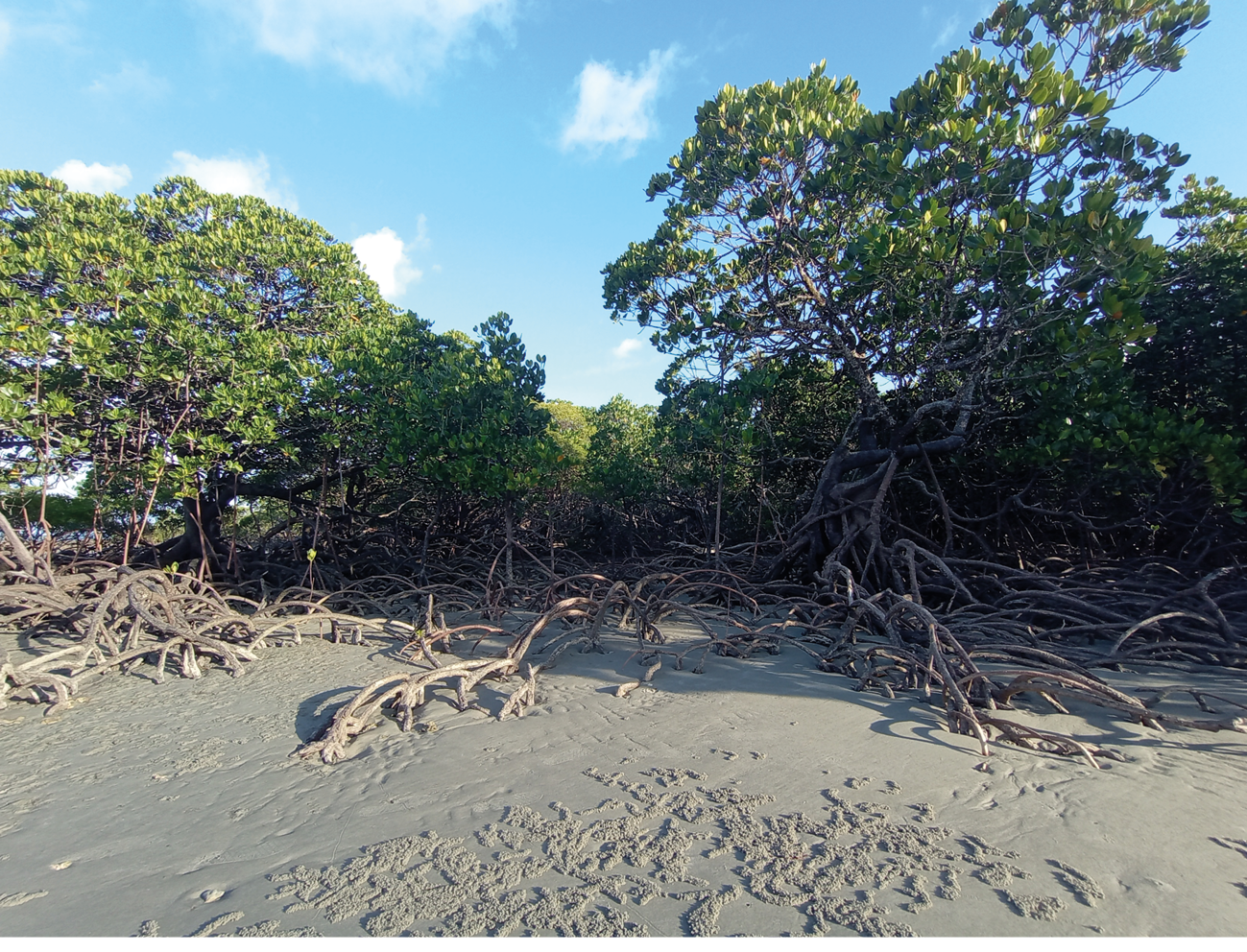
Figure 7.
Red mangroves. Author, Daintree, 26 August 2025.
While I referred to all the mangrove trees in my ethnographic fieldwork footprint as a community, it is the red mangroves that provide the most vivid visual instantiation of social relations (Figure 7). These mangroves occupied place from approximately mid to high tide mark and those nearest the edge of their territory intermingled leaves with a huge terrestrial tree whose leaves I sketched alongside that of a red mangrove to fully appreciate their unique differences. Here, amongst their interlacing prop roots and swaying aerial roots, were semi-permanent tide pools home to tiny fish, mudskippers and molluscs and the kingfishers that dived upon them from branches above.
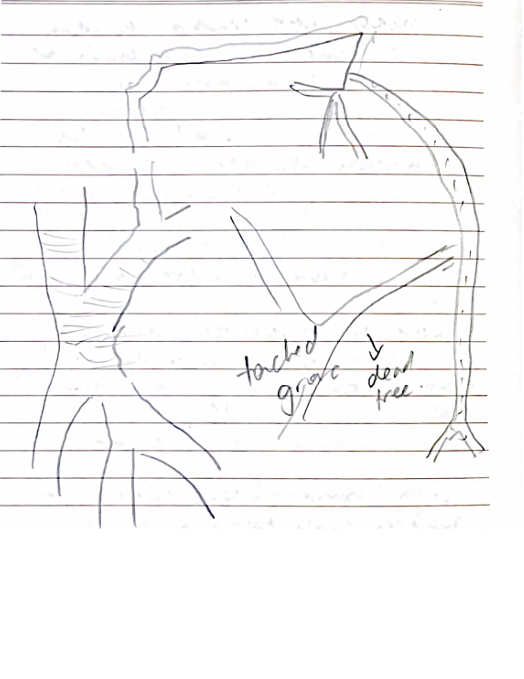
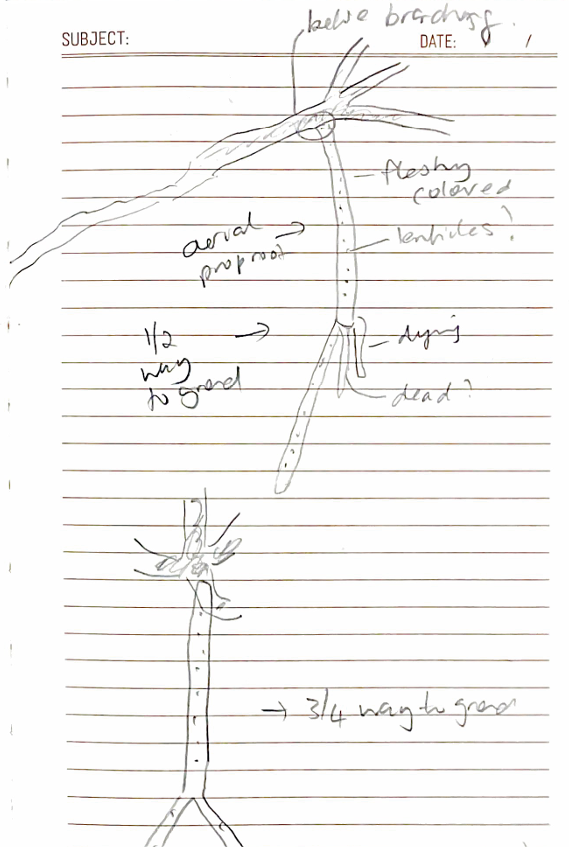
Figurres 8a and 8b.
Field drawings of aerial prop roots of a red mangrove. Author, Daintree, 13 October 2025.
One day at low tide I stood in the rain within the tangled forest of prop roots that originate from the main trunk and help stabilise the tree. I could hear kingfishers I had seen and heard previously chattering above me and with some amusement ‘I watch a mudskipper coming over to inspect me. I was contemplating how to approach the second stage of Goethe observation being Exact Sensorium Imagination.’64 One way of doing this is by drawing various stages of development of a plant, such as from bud to flower or small to large leaf. I chose to draw various lengths of aerial roots, which are those that descend from branches, representing stages of development of a single red mangrove (see Figure 8). On completing these drawings, I could visualise the tree growing, see its movement, responding to subtle shifts in the surface of the ground moved by the tide, the weight of the tree leaning into or against currents, growing its woody body, branch by branch and root by root, reaching both for the sunlight and the earth to balance itself in the flux.
Wrapped around and capable of strangling a prop root which along with countless others provided the contours of habitat for fish on both low and high tide, I saw plastic fishing line. Its presence a sign of a global connection beginning with mangroves and fish, moving to humans and water vessels, wind and tide, fishing lines, nets, spears and buoys, individual human catch licences, regional fishing laws and failed efforts to form global treaties on plastic waste, the neglect only visible to an egocentric gaze. The Anthropocence acting as global force here among the red mangroves.
Three red fins
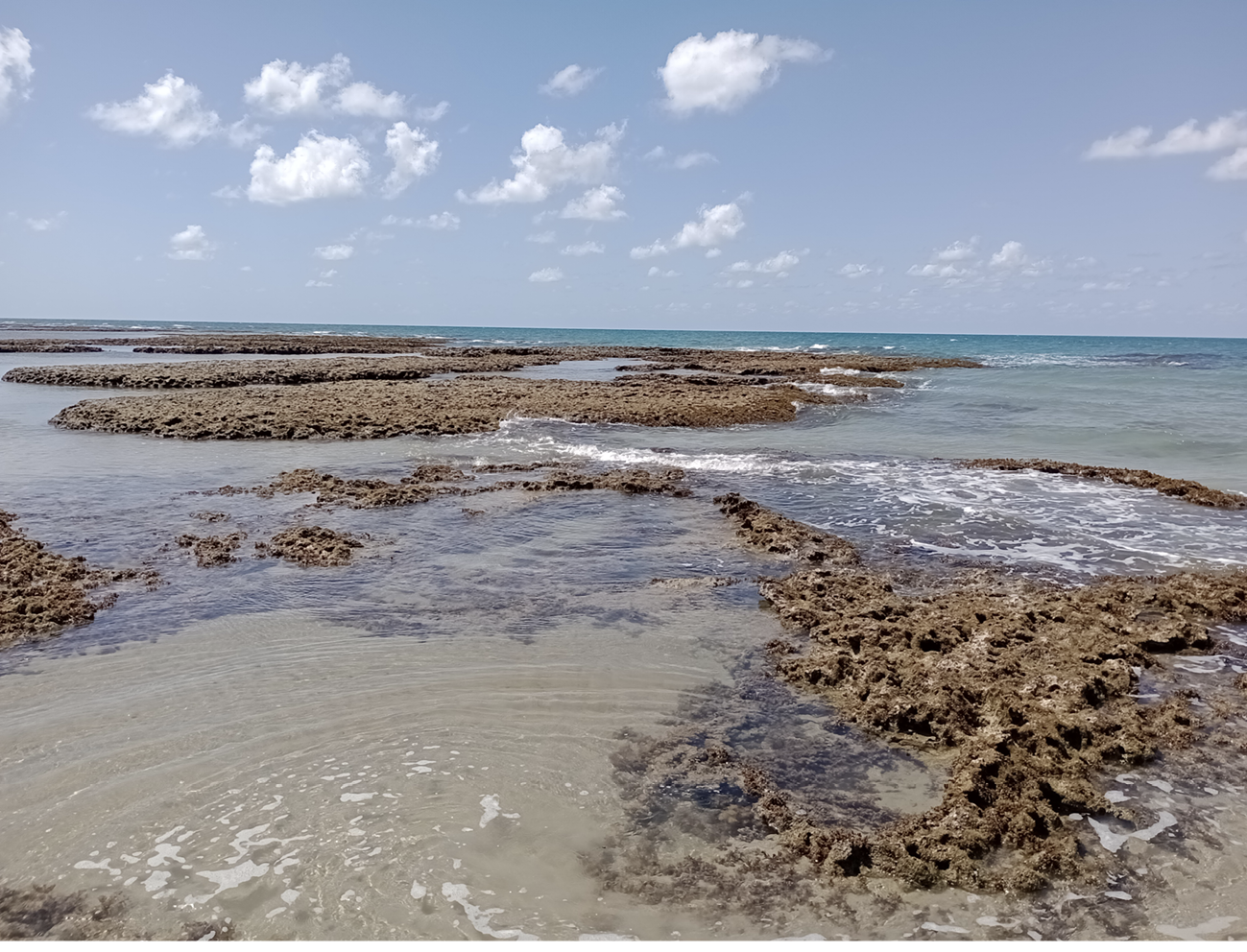
Figure 9.
Fringing coral reef, tide pools and the Pacific Ocean. Author, Daintree, 2 September 2025.
On the final day of fieldwork I had been searching for the young mangrove in part because the last time I visited it was looking unhealthy and I was worried it might be deteriorating. I felt joy when I located it and saw it looking more vigorous, it had discarded its yellow sacrificial salt leaf. As I had straightened to standing from crouching position I looked toward the ocean and saw ‘a glimpse of triangular fins – 3 I believe. Was definitely a small shark in the shallows.’65 Subsequent research narrowed it to possibly a banded wobbegong which frequents shallow waters such as those depicted in Figure 9. I was thrilled. Dark clouds had showed up on the horizon around then, I described the sky as ‘moody grey, green grey, black, blue, sky, ocean and clouds.’66
Perhaps unconsciously aware that this was my last day and coupled with the feelings of joy now juxtaposed with physical vulnerability against a threatening sky, I experienced the third stage of Goethean observation: ‘seeing in beholding’.67 ‘To experience the being of a phenomenon requires a human gesture of “self-dissipation.”’68 Heather Sullivan reminds us that we are ‘within, always within, plant-created worlds’,69 taking in their oxygen, sustaining our bodies with their flesh.70 Mirja Lobnik, following Michael Marder, puts it this way: ‘To discover oneself in the plant world, as Marder has argued, is to become aware of our breathing … [to] adopt what Marder has called vegetal mindfulness entails a being-together with air, moisture, soil, warmth, and sunlight.’71
Walking away from the ocean, picking a deliberate path through the pencil roots of the Outlier, taking care not to crush them and
thinking of their purpose for gathering oxygen and then thinking about my own breathing, which joined together with the other hundred maybe thousand [above-ground] roots all in this small community taking in oxygen breathing deeply and then sensing the whole area, the stones underneath and over the top and through which the snails trail and crabs tunnel and water flows and wind whips, worms sift sand and insects quiver and birds fly and swoop and inspect and the incessant movement of the tide its retreat and its return bringing and taking life. All produced a deep existential feeling inspired by connections.72
The dead
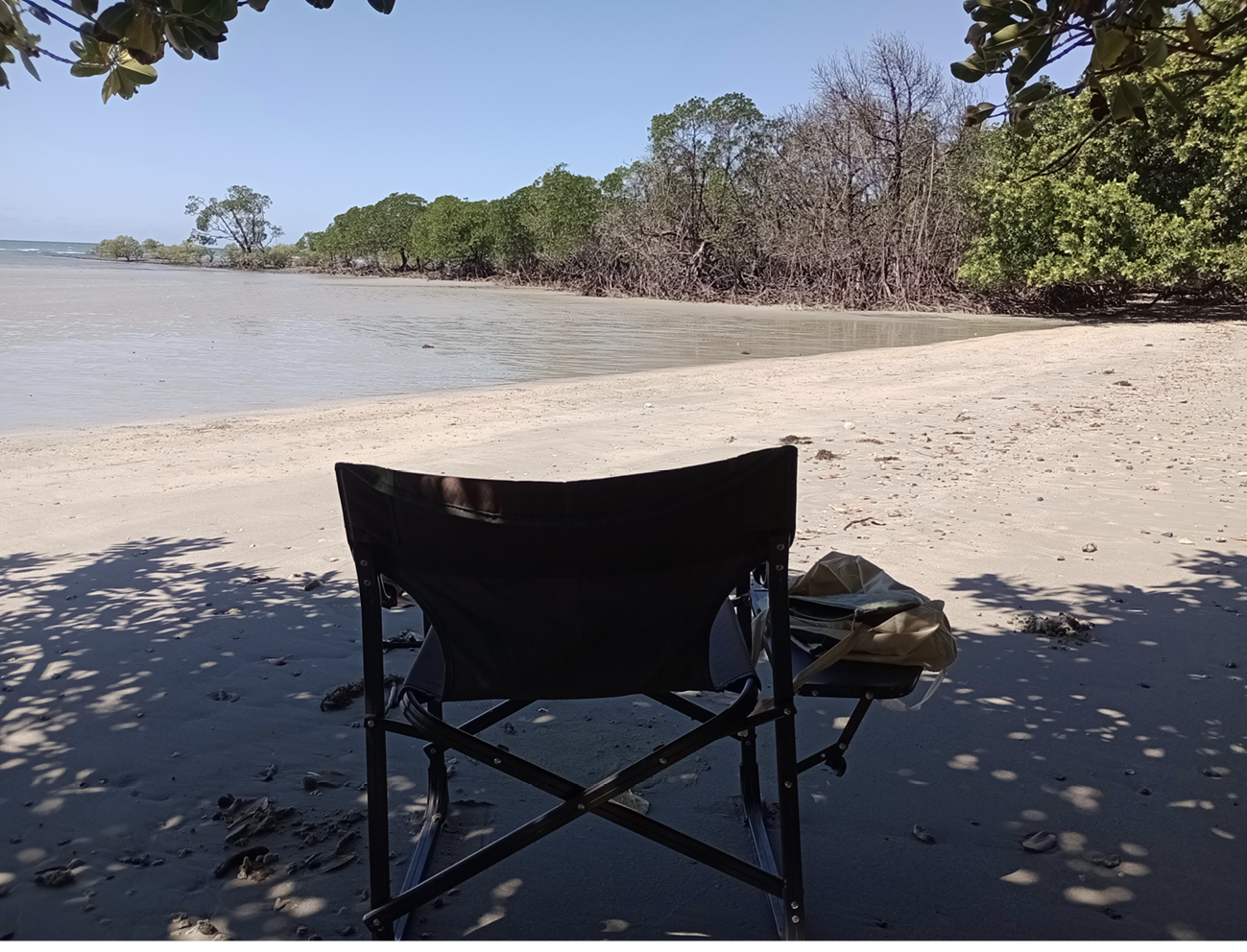
Figure 10.
Beneath a terrestrial tree across from the Dead. Author, Daintree, 24 August 2025.
Occupying the place closest to the high tide mark (see Figure 10) is a group of standing dead red mangroves. When a tree dies it can remain standing in death for a long time, continuing as home to others from cone snails to crabs and birds. It was difficult to determine which tree was dead, sometimes I would note it as such then glimpse a single green leaf bearing twig. The question ‘why did you die’ occupied my thoughts each time I saw these mangroves, the answer beyond reach as I lack the skill and knowledge of a botanist or plant scientist.73 But just as death does not reduce a human life to the immediate present, so too with the mangrove community’s dead. I saw and drew young mangroves pushing up between their grey black hulks, their future protection anticipated. One morning I spent an hour watching kingfishers sitting high in the dead branches, the absence of leaves I thought improving their vision as they surveyed the sand flats below and swooped back and forth with prey. This ritual repeated on other mornings I noted as such by the sound of their chatter. Inert aerial prop roots now fixed in time but signifying past efforts to attain the sandy ground. These tall dead mangroves representing past, present and future, an integral part of the community still.
I sought encounters with mangroves by way of ethnography and Goethean observation as phenomenology. These encounters I described in my field-journal and reflection diary and recorded in photography. In this article I shared my ethnographic and phenomenological experiences with mangroves, finding a unique place-based ontology arising from mangrove forms occupying and creating place, establishing local and global connections.
I can tell you how I can still now visualise the intricately connected concentric circles left by raindrops on the smooth surface of the creek and how the drops of rain shone like silver; or relate a memory of how the ocean pooling around young mangrove felt cool on my skin in the heat of the day; or of the tangy odour of eucalypt from a crushed leaf of Osbornia octodonta (Myrtle mangrove); or the sound of the shrill whistle of a shore bird taking flight angular and low over the tidepool; or the raw taste of salt straight from a mangrove leaf. I dreamed of crocodile, swimming midstream, for a moment bathed in sunlight, small as if from a long distance. Shapes in my dreams, fluid and gentle, making space for the other, representing the unique morphology of mangroves. This may well be the final stage of Goethean observation of being one with the mangroves, fully absorbing the meaning of what it is to be mangrove in this place.74
But what I cannot share is the physical experience of mangrove becoming with my self or how mangrove being is now inscribed in me. It may be as written in poetry, in the verse from My Country by Dorothea McKellar: ‘all of you who have not loved her, you will not understand’.75 Or to return to the senses, as William Blake deftly summarised, ‘As a man is, so he sees.’ To fully understand mangroves, you must experience mangroves. The emergence of the self coincides with the sometimes delicate other times dramatic fusion of the faculties.76 And it is through or via the constant becoming of the self, from the subject, both human and mangrove, that ways of being in place, as an individual or as part of a community, are manifest and sometimes re-manifest. Over and over.
Ethnography and phenomenology helped me to appreciate that mangroves experience life through their bodies: anticipating as I do the emergence of the sun, the return of the tide and the lift of the wind. As I retreat to the shade to hide my skin from the sun and avoid its burn, mangroves grow new leaves, positioning them in a precise way to receive its nourishment. The tide’s return is anticipated in the strengthening of lateral roots and my feet making for higher ground. The effect of wind is manifest in the bent shape of mangroves and my efforts to adopt a posture where my hat remained on my head and my notebook stayed open so I could write down my thoughts through to the end.
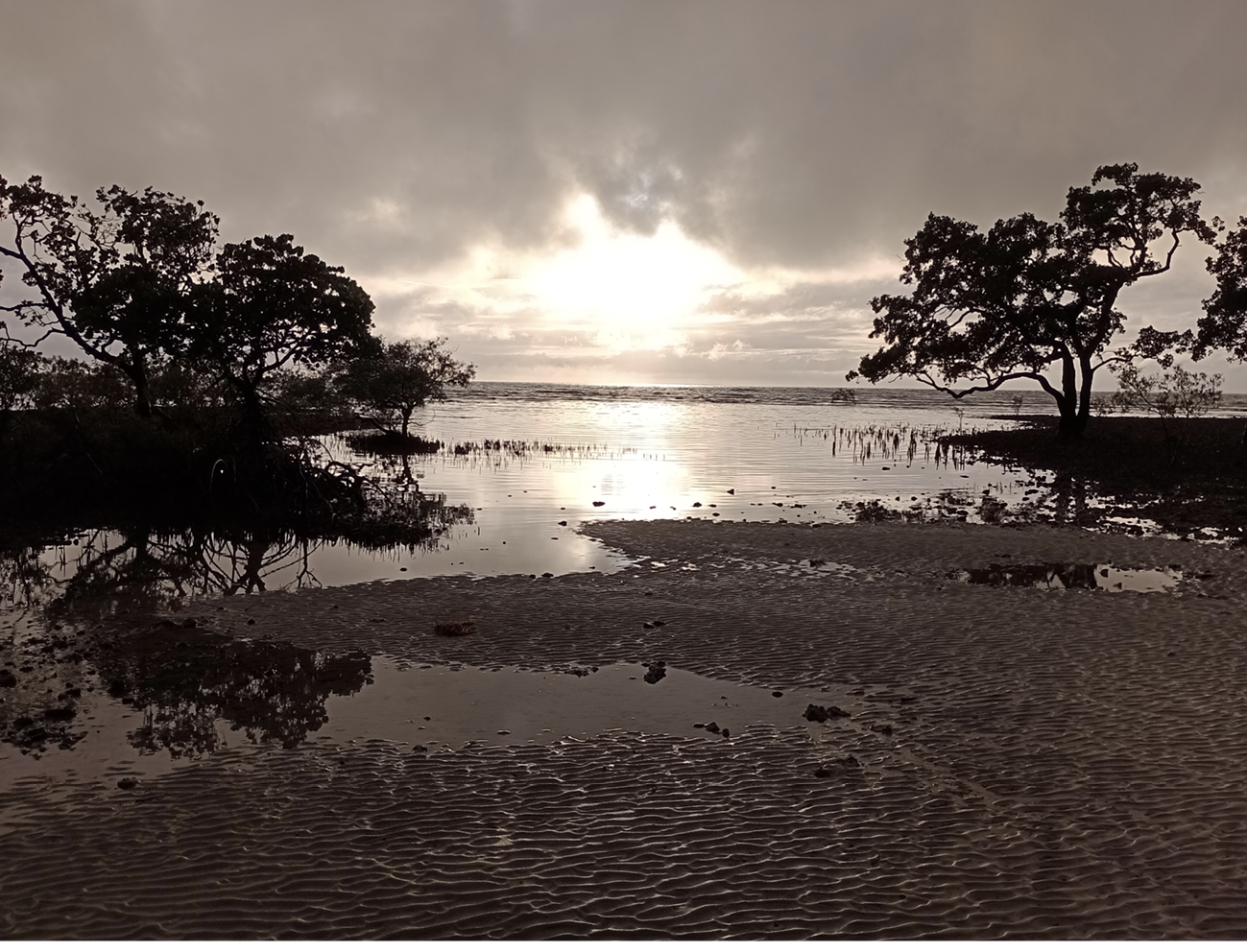
Figure 11.
Sunrise at centre of mangrove community. Author, Daintree, 9 October 2025.
Shelley Kolstad, LLB (Hons 1), BBus (Distinction), is a Ph.D. candidate and sessional academic in the School of Law at the Queensland University of Technology, Brisbane, Australia. Her research occupies a liminal zone between critical plant studies, non-human philosophy and emerging legal theories such as ecolaw to consider the normative lives of mangroves, as individuals and communities, their connections to place and the impact mangroves have beyond their physical territories.
Email: shelley.kolstad@hdr.qut.edu.au
https://orcid.org/0009-0003-9052-3621
1 A.M. Lawrence, ‘Listening to plants: Conversations between critical plant studies and vegetal geography’, Progress in human geography 46 (2) (2022): 629; for a recent review of the plant sentience debate, see M.J. Hansen, ‘A critical review of plant sentience: Moving beyond traditional approaches’, Biology & Philosophy 39 (4) (2024): 13.
2 Referring to the Western philosophical tradition as opposed to Indigenous Knowledge Traditions.
3 Johann Wolfgang von Goethe and D. Miller, Scientific Studies (New York, NY: Suhrkamp Publishers, 1995), p. 307.
4 I. Brook, ‘IEP 405: Phenomenology and environment’ (Lancaster University: 2005). https://www.lancaster.ac.uk/users/philosophy/awaymave/405/wk8.htm (accessed 21 Dec. 2025); see also I. Brook, ‘Goethean science as a way to read landscape’, Landscape Research 23 (1) (1998): 51–69; I. Brook, ‘A new science from a historical figure: Goethe as holistic scientist’, in J. Wright (ed.), Subtle Agroecologies: Farming with the Hidden Half of Nature (Boca Raton, FL: Taylor & Francis Group, 2021) pp. 71–78; I. Brook, ‘Engaging in the Goethan method: An approach for understanding the farm?’, in Wright (ed.), Subtle Agroecologies, pp. 229–37; see also B.D. Robbins, ‘The delicate empiricism of Goethe: Phenomenology as a rigorous science of nature’, Indo-Pacific Journal of Phenomenology 6 (supp. 1) (2006): 1–13.
5 Brook, ‘IEP 405: Phenomenology and environment’.
6 E. Anderson, ‘Deleuze on the image of thought’, Overthink podcast. https://www.youtube.com/watch?v=MFMDywR01zo (accessed 21 Dec. 2025).
7 See generally S. Mancuso and A. Viola, Brilliant Green: The Surprising History and Science of Plant Intelligence (Washington, DC: Island Press, 2015).
8 G. Deleuze and C. Parnet, Dialogues II (New York: Columbia University Press, 2007), pp. 6–7.
9 J.W. von Goethe and D. Miller, Scientific Studies, p. 307.
10 M. Marder, ‘Plant intentionality and the phenomenological framework of plant intelligence’, Plant Signalling and Behaviour 7 (11) (2012): 1365–66.
11 T. Ingold, ‘Anthropology contra ethnography’, HAU: Journal of Ethnographic Theory 7 (1) (2017): 21, 23.
12 Ibid., 23.
13 T. Ingold, ‘In the gathering shadows of material things’, in P. Schorch, M. Saxer and M. Elders (eds), Exploring Materiality and Connectivity in Anthropology and Beyond (London: University College London Press, 2020) pp. 21, 22.
14 C. Holdrege, ‘Doing Goethean science’, Janus Head 8 (1) (2005): 27, 35, 36.
15 C.J. Hueck, ‘Understanding organisms by intuiting life: Kant, Goethe, and Steiner’, History and Philosophy of the Life Sciences 47 (3) (2025): 36, 3; following Rudolf Steiner’s interpretation of Goethe’s method.
16 Ibid., 23.
17 Brook, ‘Engaging in the Goethan method’, p. 229; these stages are widely recognised.
18 Ibid., p. 230.
19 Ibid., pp. 231–32.
20 Ibid.
21 Ibid., p. 233.
22 J.H. Wandersee and E.E. Schussler, ‘Preventing plant blindness’ (Pt National Association of Biology Teachers) The American Biology Teacher 61 (2) (1999): 82, 85–86.
23 Brook, ‘Engaging in the Goethan method’, p. 234.
24 Ibid., p. 235.
25 Ibid.
26 Ibid., p. 236.
27 S. Lezak, ‘Environmental ethnography’, Progress in Environmental Geography 2 (4) (2023): 289, 303.
28 J. Bens and L. Vetters, ‘Ethnographic legal studies: reconnecting anthropological and sociological traditions’, The Journal of Legal Pluralism and Unofficial Law 50 (3) (2018): 239, 240.
29 See H. King, ‘Plant emergence: The aesthetics of plant movement and the phenomenology of vegetal growth’, Environmental Values 34 (4–5) (2025): 1, 6; Brook, ‘Goethean science as a way to read landscape’, 53.
30 M. Burch, J. Marsh and I. McMullin, Normativity, Meaning, and the Promise of Phenomenology (New York: Routledge, 2019), p. 53.
31 Holdrege, ‘Doing Goethean science’, 28.
32 S.A. Kauffman and A. Gare, ‘Beyond Descartes and Newton: Recovering life and humanity’, Progress in Biophysics and Molecular Biology 119 (3) (2015): 219, 223.
33 Brook, ‘Goethean science as a way to read landscape’, 53.
34 Queensland Government, Snappy Facts: Everything You Wanted to Know about Crocodiles in Queensland, Department of the Environment, Tourism, Science and Innovation, 2024: https://www.detsi.qld.gov.au/our-department/news-media/down-to-earth/snappy-facts-to-know-about-crocs-in-qld (accessed 22 Dec. 2025).
35 J. Enax et al, ‘Characterization of crocodile teeth: Correlation of composition, microstructure, and hardness’, Journal of Structural Biology 184 (2) (2013): 155, 161.
36 A.S.M. Saber and A. Hassanin, ‘Some morphological studies on the jaw joint of the Australian saltwater crocodile (Crocodylus porosus)’, Journal of Veterinary Anatomy 7 (2) (2014): 55, 56.
37 G. Grigg and C. Gans, Morphology and Physiology of the Crocodylia, Fauna of Australia Vol 2A Amphibia and Reptilia (Canberra: Australian Publishing Service,1993), p. 329.
38 Ibid.
39 P. Goodrich, ‘The poetry of black letters: Deleuze and lex amicitia’, in K. McGee and L. de Sutter, Deleuze and Law (Edinburgh: Edinburgh University Press, 2012) p. 42, citing from S. Heinzelman, Riding the Black Ram: Law, Literature, and Gender (Stanford: Stanford University Press, 2010).
40 Goodrich, ‘The poetry of black letters’, 42.
41 Marder, ‘Plant intentionality’, 1368.
42 For expert knowledge on mangroves, see, for example, N. Duke, Australia’s Mangroves: The Authoritative Guide to Australia’s Mangrove Plants (Brisbane: University of Queensland, 2006); P.B. Tomlinson, The Botany of Mangroves (Cambridge: Cambridge University Press, 2016).
43 In taking my ethnographic photos, I follow a similar practice to Epha Roe and try to avoid ‘artificially re-contextualising the trees and their environment’ and I am inspired similarly by the shared attraction to light which unites ‘philosophy, photography and plants’. See E.J. Roe, ‘Photographic phytography: Towards a photographic re-centring of the oak tree within theory, material and practice’, Plant Perspectives 2 (1) (2025): 140, 150, 158.
44 Queensland Government, Wetland Info. Department of the Environment, Tourism, Science and Innovation, 2019: https://wetlandinfo.des.qld.gov.au/wetlands/ecology/components/biota/flora/flora-structural/mangroves/ (accessed 22 Dec. 2025).
45 Ibid.
46 P. Schneider, ‘“On the Red Sea the trees are of a remarkable nature”(Pliny the Elder): The Red Sea mangroves from the Greco-Roman perspective’, in D.A. Agius et al. (eds), Human Interaction with the Environment in the Red Sea – Selected Papers of the Red Sea Project VI (Leiden: Brill, 2017) p. 16, citing Theophrastus, Enquiry into Plants pp. 4, 7, 2 (tr. Arthur Hort, The Loeb Classical Library).
47 Holdrege, ‘Doing Goethean science’, 29.
48 Brook, ‘Goethean science as a way to read landscape’, 53.
49 J. Hartigan, Care of the Species: Races of Corn and the Science of Plant Biodiversity (Minneapolis: University of Minnesota Press, 2017) p. 255.
50 Brook, ‘Goethean science as a way to read landscape’, 54.
51 Author, Field-journal, 23 Aug. 2025.
52 Ibid.
53 Brook, ‘Goethean science as a way to read landscape’, 55.
54 The thinking that the mangrove form is an expressive act is inspired by M. Gagliano, ‘Breaking the silence: Green mudras and the faculty of language in plants’, in M. Gagliano, J. Ryan and P.I. Vieira, The Language of Plants: Science, Philosophy, Literature (Minneapolis: University of Minnesota Press, 2017).
55 Lezak, ‘Environmental ethnography’, p. 289.
56 J. Hartigan, ‘Plants as ethnographic subjects’, Anthropology Today 35 (2) (2019): 1, 2, citing the work of A. Trewavas, Plant Behaviour and Intelligence (Oxford: Oxford University Press, 2015).
57 Meaning equal hierarchy of everything – see P. Gibson, ‘Plant thinking as geophilosophy’, Transformations Journal of Media, Culture & Technology 26 (2015): 1, 6.
58 Ingold, ‘In the gathering shadows of material things’, pp. 17, 27, citing Lars Spuybroek, The Sympathy of Things: Ruskin and the Ecology of Design (London: Bloomsbury Academic, 2016).
59 Ingold, ‘In the gathering shadows of material things’, pp. 17, 27.
60 Ibid pp. 17, 33.
61 Lezak, ‘Environmental ethnography’, p. 303.
62 Author, Field-journal, 1 Sept. 2025.
63 P.C. Ugalde and S.L. Kuhn, ‘Making places in the world: An ethnographic review and archaeologic perspective on hunter-gatherer relationships with trees’, Journal of Anthropological Archaeology 73 (2024): 101572, 7.
64 Author, Reflection diary, 13 Oct. 2025.
65 Author, Field-journal, 15 Oct. 2025.
66 Ibid.
67 Brook, ‘Goethean science as a way to read landscape’, 56.
68 Ibid.
69 H.I. Sullivan, ‘Plant worlds’, Plant Perspectives 1 (2) (2024): 373.
70 Ibid., 373–74.
71 M. Lobnik, ‘Multisensory entanglements in Edwidge Danticat’s Claire Of The Sea Light and Chimamanda Ngozi Adichie’s Purple Hibiscus’, in A. Kern-Stähler and E. Robertson (eds), Literature and the Senses (Oxford: Oxford University Press, 2023) p. 481.
72 Author, Reflection diary, 15 Oct. 2025.
73 Gaps in canopies in mangrove forests often consist of standing dead trees with lightning strike a common cause of small gaps: see N. Duke, ‘Gap creation and regenerative processes driving diversity and structure of mangrove ecosystems’, Wetlands Ecology and Management 9 (3) (2001): 267, 264.
74 Brook, ‘Goethean science as a way to read landscape’, 57; see also Hartigan, Care of the Species: Races of Corn and the Science of Plant Biodiversity, p. 279, where the author relates how the plants he had been interviewing became entangled in his own thinking (and possibly dreaming), noting that he had achieved success in applying Holdrege’s method developed from Goethe.
75 Synonymous with the maxim, ‘He who beholds a phenomenon will often extend his thinking beyond it; he who merely hears about the phenomenon will not be moved to’: see von Goethe and Miller, Scientific Studies, p. 307.
76 R.J. Johnson, Deleuze-Lucretius encounter (Edinburgh: Edinburgh University Press, 2016) p. 182.