Marion De Schepper
Violently Vibrant, Obscurely (Un)Alike:
Surrealist Representations
of Plants in the Avant-Garde Magazine Minotaure
ABSTRACT
This article investigates how artists depict and relate to plants in the early twentieth-century surrealist magazine Minotaure. I will illuminate the diversity and continuity of the textual and visual engagements with plants of Roger Caillois, André Masson, Max Ernst and Benjamin Péret. Some of these surrealists highlight physical and behavioural areas of overlap between humans, animals and plants, thus blurring hierarchical taxonomies. Others reflect on the obscure and radical otherness of plants, which inhibits their connection-seeking endeavour and leads them to question the place of humans in a vast, potentially indifferent and violent vegetal world. Ultimately, through their engagements with plants, these surrealists rethink traditional world views and push imaginative boundaries in ways that resonate with the twenty-first-century endeavours of plant critics. The centrality of the vegetal realm to surrealist thinking, which this article underlines, contributes, firstly, to the wider investigation of scholars into surrealism’s ecological and anti-anthropocentric attitudes, and, secondly, to the central endeavours of critical plant studies of removing plants from their neglected positions.
KEYWORDS
critical plant studies, Surrealism, plant humanities, Minotaure, human-vegetal relation
 INTRODUCTION: SURREALISM AND ENVIRONMENTALIST THOUGHT
Multiple scholars argue that the twentieth-century avant-garde movement of Surrealism is marked by ecological and anti-anthropocentric attitudes, and that it thus anticipates the fully-fleshed environmentalist and ecocritical attitudes that have become prevalent in twenty-first century Western society (Kalaidjian 2021; Noheden 2022; Rentzou 2013; Rudosky 2021). Like any avant-garde movement, the surrealist endeavour was centred on the ‘search for a new and timely art’ – a form of art making, interpreting and diffusing that radically pushed the limits of what art is or can be (Bru 2018: 10). The surrealists not only engaged in a rethinking of art – everything became subject to interrogation: the self, society, reality, their environment and so on. In short, Surrealism was ‘from its inception… a “world-making” endeavor’ (Lusty 2021: 22). Artists questioned traditional ways of understanding and organising the world. Major points of critique were Eurocentrism and the belief in human exceptionalism (Lusty 2021: 1; Kalaidjian 2021: 275). This anti-anthropocentric attitude is particularly present in the surrealists’ writings and works on animals, or, as it has also been called, the ‘surrealist bestiary’ (Kalaidjian 2021).
Surrealism, Walter Kalaidjian notes, was fascinated with the animal kingdom (2021: 272). Surrealists interrogated the boundaries between human and nonhuman animal beings, highlighted the many similarities between them, and argued that certain abilities and behaviours usually considered exclusively human are also present in animals. André Breton, for instance, one of the central figures of surrealism and the writer of three surrealist manifestos, was especially interested in species overlap or ‘signs of species hybridity that crossed the human/animal divide’ (Kalaidjian 2021: 272). Surrealist artists, such as Max Ernst and Leonora Carrington, frequently depicted hybrid figures that were partly animal and partly human (Kalaidjian 2021: 279–81). Additionally, surrealists interpreted animal behaviour and phenomena in the ‘natural’ world along the lines of human conditions and ‘cultural’ phenomena, and vice versa. A famous example is Roger Caillois’s linking of the praying mantis with humans in his article ‘The praying mantis: from biology to psychoanalysis’ [‘La mante religieuse: de la biologie à la psychanalyse’], which appeared in the surrealist magazine Minotaure (1934: 23–6). 1 The praying mantis’s sexual behaviour, by which the female habitually decapitates and eats the male during mating, is interpreted by Caillois as related to the human anxiety of castration and sexual cannibalism (Roberts 2016: 300). The surrealists’ reconsideration of boundaries between human and animal realms contributes, on the one hand, to their undermining of the belief in human superiority and exceptionalism. However, as Kalaidjian notes, their revolutionary exploration is not purely anti-anthropocentric or anti-humanistic (2021: 274). Principally, their interest in animals stemmed from an interest in humans; they questioned what constituted the human by investigating animals. Reflections on animals brought them to reflections on humans and thus, they traced and redrew the boundaries between the two (Cahill 2019: 3). They did not reject the existence of boundaries between humans and animals. Instead, their endeavour was ‘an effective epistemological and cognitive reshuffling of the two that results in a new understanding of these two categories’, but, most of all, it resulted in an ‘empirical redefinition of the human’ (Rentzou 2013: 32, 25).
Be that as it may, the surrealists’ practice of questioning given knowledge led them to connecting and criticising different Western hierarchical and oppressive frameworks and practices, such as ‘the discourses of speciesism, classism, and colonialism’ (Kalaidjian 2021: 273). Scholars have illustrated that the surrealists’ works on animals, objects, and Western and non-Western cultures have contributed to this effort (Conley 2013; Kalaidjian 2021; Rentzou 2013; Roberts 2016; Rudosky 2021). One realm of nonhuman beings, however, has remained largely out of the picture. Plants are profusely present in surrealist works. Donna Roberts touches upon the vegetal in her discussion of nature and the marvellous in surrealism, and hints at the fundamental importance of plants to the surrealist endeavour and its central concepts. Roberts mentions, for instance, that for Breton and Salvador Dalí, ‘automatism … reflected the vegetal energies of the imagination’ (2016: 290) and that ‘Goethe’s notion of an intrinsic force within vegetal life is passed into surrealism along with a complex blend of vitalist ideas’ (2016: 293). However, Roberts remarks, this vibrancy of plants also gives rise to a certain ‘fear’ in the surrealists (2016: 291). Caillois shies away from the ‘dark powers of vegetal nature’, which ‘nothing can stop, not even its own excess’ (Caillois 2008: 143, 139). Similarly, Breton and André Masson are drawn to a large rock in the midst of a jungle, which they see as an antidote to the ‘natural delirium’ of the jungle (Roberts 2016: 292). Despite these interesting findings, Roberts does not explore the human-vegetal relation in further depth. So far, surrealist representations of plants have not been extensively studied. Since plants are significant to surrealism’s world view and aesthetics, as Roberts insinuates, I will investigate vegetal beings in their works and how these vegetal representations contribute to, or potentially nuance, current knowledge of the Surrealist movement.
In their discussion of the human-nonhuman relation, scholars have frequently mentioned and analysed the European magazine Minotaure. Founded by A. Skira and E. Tériade, Minotaure was published between 1933 and 1939. In this review, the surrealists explored their new art and societal vision. Its contents were diverse: it consisted of psychoanalytical and ethnographical articles, essays, poems, photographs, paintings, drawings, sculptures, literary texts and so on, from key avant-garde and mostly surrealist artists, such as Breton, Dalí, Ernst, Marcel Duchamp, Paul Eluard, René Magritte and many more. This magazine, thus, gives a rich and condensed picture of the diversity and range of the surrealists’ endeavours of the thirties. As the name of the journal suggests, Minotaure frequently investigated and pictured human-animal relations, which is why this magazine has been at the forefront of scholars’ research on the surrealist bestiary and anti-anthropocentric vision. Animals are more profusely present in the magazine than plants, but vegetal beings are present, too. They are part of the surrealists’ world and art making programme in Minotaure. In this article, I will analyse both textual and visual material from the journal in which plants are notably featured. Due to the range of authors and artists that will be examined, I do not expect to find nor claim for the presence of one consistent attitude towards plants in Minotaure. Instead, I will investigate how the juxtaposition of these different textual and visual materials ‘speak’ to each other – one piece can enhance or challenge the other – and how centralising plants in the investigation of each piece can enable us to gain a richer and more nuanced understanding of the surrealists’ engagement with the nonhuman realm, and some of their central concepts. Furthermore, this article highlights that the plant-attentive endeavours of the surrealists bear affinity to, and to some degree anticipate the efforts of, the plant humanities.
Concretely, I will analyse one painting – André Masson’s The Metamorphosis of the Lovers [‘La Métamorphose des Amants’] (1939) 2 – and three texts – Roger Caillois’s ‘Mimicry and legendary psychasthenia’ [‘Mimétisme et psychasthénie légendaire’] (1935), Max Ernst’s ‘The mysteries of the forest’ [‘Les mystères de la forêt’] (1934), and Benjamin Péret’s ‘Nature devours progress and surpasses it’ [‘La nature dévore le progrès et le dépasse’] (1937). Additionally, I will discuss the visual material accompanying Ernst’s and Péret’s texts. My approach to these pieces is informed by the ‘vegetal dialectics’ or ‘duality’ put forth by John Charles Ryan in his development of phytocriticism (2018: 16).3 I will pay attention to how the works reflect and represent both the ‘radical otherness and profound sameness’ of plants (Ryan 2018: 17), or in Michael Marder’s words, how ‘the absolute familiarity of plants coincides with their sheer strangeness’ (Marder 2013: 4). I will analyse whether the surrealists’ representations of vegetal alterity and/or similarity emphasise or reduce the complexity of plants and what this reveals about their more general world view. Additionally, I will explore what the vegetal representations reveal about the surrealists’ conception of other central concepts in surrealism, such as the marvellous, eros, or the unconscious. In short, my analysis will start with plants and how they are represented, but this will lead to reflections on broader surrealist concerns. I have grouped the textual and visual material in pairs according to two main continuities. Firstly, I will examine how Caillois and Masson reconsider and redraw boundaries between human and vegetal beings by highlighting similarities. Secondly, I will turn to more extreme and ‘wild’ portrayals of plants in Ernst’s ‘The mysteries of the forest’ and Péret’s ‘Nature devours progress and surpasses it’, in which a distance rather than affiliation is emphasised between the human and the vegetal. In the conclusion, I will reconsider my findings on these four artistic pieces and discuss them in a more comprehensive light, by centralising the relation of the painting and texts to anthropocentrism.
ANALYSIS: PLANTS IN MINOTAURE
Rethinking boundaries: highlighting similarities between the realms
The first textual and visual pair is centred around a questioning and rethinking of the boundaries between human and vegetal realms. Both Roger Caillois’s psychoanalytical essay ‘Mimicry and legendary psychasthenia’ and André Masson’s painting The Metamorphosis of the Lovers challenge conventional distinctions between human and nonhuman beings, highlight certain similarities between them, and draw attention to instances of hybridity in which conventional boundaries are blurred. Nonetheless, their conceptions of plants are markedly different. While one largely reduces plants to inanimate background surfaces, the other emphasises the vibrancy and animacy of these beings.
Caillois published several psychoanalytically tinted articles in Minotaure, in which he compared the behaviour of insects to that of humans.4 His most famous article, as discussed in the introduction, is on the sexual behaviour of the praying mantis. In ‘Mimicry and legendary psychasthenia’ (1935), Caillois uses the phenomenon of mimetism or mimicry, by which a being anatomically mimics elements from their habitat or other beings, to interpret the human phenomenon of psychasthenia, a pathological term now no longer in use, which is akin to what would now be called obsessive-compulsive disorder.5 In the article, Caillois begins by stating that the primary philosophical problem of how humans make sense of reality is that of distinctions. We draw distinctions between ‘the real and … the imaginary, … waking and sleeping, … ignorance and … knowledge, etc.’, 6 and one of the clearest distinctions we draw is that between ‘the organism and [the] environment’ (Caillois 1935: 5).7 Phenomena by which this distinction is blurred or challenged, such as mimicry, are the phenomena Caillois finds particularly interesting.
Mimicry, Caillois states, has not been satisfactorily explained by scientists. Despite their categorisation of different types of mimicry – ‘offensive mimicry intended to surprise the prey, defensive mimicry intended either to hide from the aggressor (concealment mimicry) or to frighten it with a deceptive appearance (mimicry aimed at terrifying)’ (1935: 5) – Caillois argues that these do not explain mimicry.8 He points to studies that show that prey animals are not tricked by their disguised prey; mimetic prey insects are eaten equally as much as non-mimetic insects (1935: 7). Furthermore, some insects, by mimicking the vegetal species which they reside on and consume, risk provoking cannibalism (1935: 7). Hence, Caillois concludes, mimicry is ‘a luxury, and even … a dangerous luxury’ (1935: 7).9 The goal of mimicry, which he considers to be an instinct present in all beings, is not only to resemble something, but to assimilate to one’s environment: ‘the recourse to the magical tendency of the search for the similar, … appears to be a means, if not a mediator. The end seems to be the assimilation to the environment’ (1935: 8).10 Caillois then compares this assimilation to one’s environment, by which the self retreats and is reduced in some way, to how people suffering from psychasthenia experience reality: ‘The body then becomes disconnected from thought, the individual crosses the boundary of their skin and dwells on the other side of their senses … They feel themselves becoming space’ (1935: 8–9).11
On the one hand, Caillois blurs conventional boundaries between human, animal and vegetal beings, and draws attention to certain similarities between them. Mimetic insects are stated to insert themselves in the vegetal realm: ‘cataleptic attitudes often help the insect in its insertion in the other kingdom’ (emphasis added, Caillois 1935: 9).12 By means of their mimetic anatomy, such as their rigidity, leafiness or branch-like appearance, the bodies of insects resemble that of plants. Visually, the physicality of animals and plants blur. Sometimes this resemblance goes even further than mere superficial resemblance: ‘the eggs of stick insects resemble seeds not only in shape and colour, but also in their internal biological structure’ (1935: 9).13 The materiality of these two usually separate realms cannot be separated in this case. Caillois then points out that humans, too, can become rigid due to certain conditions, which he compares to the rigidity and upright stature of geometer-moth caterpillars: ‘the rigidity of caterpillars, standing upright, which cannot not evoke hysterical contractures’ (1935: 9).14 Hence, Caillois indicates similarities not only between humans and insects, but also between humans and plants, connecting these all to each other by means of their similar rigid physicality. Caillois interprets this mimetic behaviour as universal to all animate beings: it is a tendency, he states, ‘the universality of which becomes difficult to dispute’ (1935: 8).15 In short, ‘Mimicry and legendary psychasthenia’ fundamentally engages with cases in which the usually strict physical and behavioural distinctions between humans, animals and plants are unsettled, and highlights connections between them.
On the other hand, however, plants are mainly portrayed as inanimate rather than animate, as passive rather than active, as, indeed, milieu rather than organisme. In abandoning their animality by mimicking the outlook of plants, life is said to retreat: ‘Life withdraws to a lesser state’; ‘life appears to lose terrain’ (Caillois 1935: 9).16 In other words, the animal becomes more inanimate by becoming more vegetal. Indeed, Caillois explicitly describes the mimicry of insects as a mimetic assimilation ‘of the animate to the inanimate’ (1935: 9).17 For humans too, psychasthenia means a diminution of life and individuality: ‘This assimilation to space is necessarily accompanied by a diminished sense of personality and life’ (1935: 9).18 Hence, Caillois views plants as inanimate, or at least considerably less active and vibrant than animals or humans, and as undistinguished collectives rather than individual beings. He solely discusses examples of mimetic animals. The only example he gives of a mimetic quality in plants is their resemblance to rocks, i.e., to inanimate objects: ‘And plants are mistaken for rocks’ (1935: 9).19 There are multiple examples of mimetic plants which mimic animals, such as the bee orchid (Ophrys apifera), the flower of which resembles a bee. These reversed examples of mimicry are, however, not discussed. Instead, Caillois explicitly refutes the existence of such mimicry: ‘the phenomenon only occurs in one direction: the animal mimics the plant, leaf, flower or thorn’ (9).20 To conclude, despite his emphasis on the blurred physical and behavioural distinctions and similarities between different realms, Caillois depicts plants principally as inanimate, passive background surfaces rather than active, living organisms. While animals are depicted as complex organisms that react to their environment, plants remain largely passive in this article. Their sensitivity to their environment and complexity as organisms is not discussed. This neglective perception of plants is a clear example of what James H. Wandersee and Elizabeth E. Schussler have famously termed ‘plant blindness’; a disparity in awareness to plants which is prevalent in Western society, and of which one of the symptoms is ‘thinking that plants are merely the backdrop for animal life’ (1999: 82).21 It is precisely this conception of plants as the ‘inconspicuous backdrop of our lives’ which scholars in the plant humanities challenge (Marder 2013: 3).
In a similar vein as Caillois’s discussion of the plant-like appearance of non-vegetal beings, Masson portrays two humans who physically consist of vegetal elements in his painting The Metamorphosis of the Lovers. Masson’s depiction of plants is, however, markedly different from Caillois’s conception of plants as mere background environments.
In The Metamorphosis of the Lovers, we see two beings, lovers, as the title suggests, who are recognisably both human and vegetal. They have hands, arms, necks and heads. One has a mouth, nose and lips; the other a mouth, teeth and braided hair. These body parts have a human form, but their texture or conformation seems to be mainly vegetal. The limbs and torsos are often wrinkled, hardened and extend into flowers, leaves and other vegetal-like configurations, sometimes erotically shaped. Their mouths open up and reveal a flower in one, an apple in the other. Muscle tissue twists into the green stem of a blooming flower. It is often unclear where a body begins and ends; they are intermingled in an erotic embrace. The twisted limbs, the bodies leaning back, and the vegetal parts protruding from the bodies generate a picture both of activity and passivity, of fertility and violence. The eye-less creatures are both human and plant, both vibrant and morbid-like.22 Is their metamorphosis still ongoing? Will the vegetal matter in their bodies fully take over and consume them, until the now recognisable limbs lose their recognisable human forms? The boundlessness and hybridity of the bodies incite a questioning and reimagining of what is the human and what is the vegetal; no clear distinctions can be drawn in these hybrid bodies.
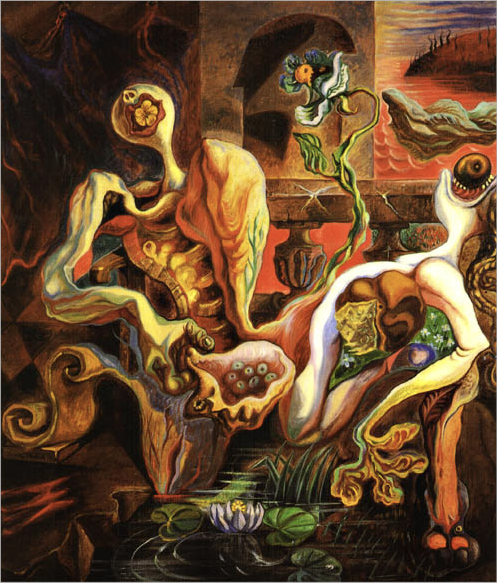
Figure 1.
The Metamorphosis of the Lovers, André Masson.
In addition, it symbolises the act of lovemaking in which separate bodies intertwine. The vegetal nature of the bodies indicates the primordial life force present in and driving all animate beings. Eros, or the life drive, is a central point of interest for the surrealists. Located in the instinctual part of the self, the life drive or pleasure principle is seen by the surrealists as something which could balance out thanatos, or death drive, a tendency towards destruction that is present in society. They believed that ‘the life drive might make for a more humane, less warring, society’ (Mahon 2021: 112), a society which was then deeply marked by the Great War, and, at the time of the painting’s publication, on the verge of plunging itself into a second World War. As has been discussed in the introduction, Roberts strikingly notes that the surrealists frequently associate the vegetal with the instinctual, the automatic, the unconscious and a primordial life force (2016: 288–293). In The Metamorphosis of the Lovers, plants are not pictured as environment or background surface, but as animate, vibrant organisms that are paragons of the essential vitality and instinctual life drive in all animate beings. The shape-shifting, blooming and growing vegetal conformations on and in these bodies amplify this depiction of vitality, fertility and activity. Even though Masson’s painting, much like Caillois’s essay, is fundamentally concerned with an investigation of similarities and connections between human and nonhuman beings, thus destabilising common taxonomies and indicating a porousness between realms, this surrealist work highlights a very different commonality. Whereas Caillois points to the inanimacy and passivity of plants as the connecting factor between phenomena across realms, Masson draws attention to the pure and primordial animacy and vitality of plants, which is present in humans, animals and plants alike. This painting suggests that humans have a vegetal energy within them, which becomes dominant in the body when engaging in the act that perpetuates animate life. This tendency toward the vegetal, i.e., to take not humans but plants as the outset in one’s reflections, and explore how common conceptions such as time, thinking and animacy are ‘rendered plant-like’ in the wake of such a shift in perspective (Marder 2013: 10), bears affinity to philosophical endeavours of seminal plant critics, such as Marder. Contrary to Caillois, Masson conceives plants as representing animacy in its purest form. The painting reveals the plant-like qualities of humans; humans become more plant-like when they tap into this primordial, vegetal energy.
However, the metamorphosis that the lovers are undergoing is, as stated above, violent as well as vibrant. The vegetal consumption that their bodies are undergoing – vegetal matter is consuming their human forms – mirrors their state of being consumed by lust and their hunger for each other. Sexual intercourse, or consummation, means a loss of a clearly delineated self, and a being overcome by and passively undergoing sensations. An apple is protruding, or fruiting, from the mouth of one figure, while a flower is revealed in the mouth of the other, but it is unclear whether the figures are eating these fruiting bodies, or if these fruiting bodies are indicative of how the vegetal matter is internally consuming their bodies. Either way, a voracity is indicated, which, when given into, results in what could be both a state of increasing and receding vitality. Are the lovers vibrantly becoming, or morbidly becoming undone? The black, bare tree trunks on a red, bare island in the background of the painting evoke a dark prospect looming on the margins, the other side of the coin of vitality – death. If a complete consumption of the human figures into plant matter means the end of their human selves, plants ultimately share that same fate: what is alive, will die. Life and death are complexly intertwined in this painting, just as vegetality and humanity are.
Masson’s painting is an example of how the surrealists responded to and challenged how vegetation and vegetables were depicted in previous Western artistic, philosophical and scientific traditions. In these dominant traditions, such as in still lives and botanical illustrations, plants were decontextualised, flattened, domesticated and generalised, although the realism of the paintings and illustrations seemingly pointed to authenticity and objective truth (Aloi 2019: 19). ‘Accurate’ depictions of a variety of species artificially brought together, such as in the composite portraits of Renaissance painter Giuseppe Arcimboldo (e.g., Portrait of Rudolf II of Habsburg as Vertumnus, 1590), illustrated the control of the artist – or the empire more generally – over plants and other subjects, conquered by Western reason and colonisation, and plants functioned merely as anthropocentric symbols (Aloi 2019: 10–25). In short, artistic and scientific engagements with plants displayed a belief in the ‘unipolarity of reason, objectifying everything in its path, and the self-proclaimed exclusiveness of the human existential comportment’ (Marder 2013: 8). On the contrary, Masson’s painting destabilises strict and ‘objective’ Cartesian and Linnean taxonomies, resists a clear-cut knowability or understandability, and reverses the Aristotelian and Christian belief in humanity’s superiority over everything. Plants conquer humans, plants are humans are plants, and all is equally caught up in a cycle of becoming and uncoming.
The vegetal unbound: vitality, violence and wild vegetal spaces
Masson’s representation of vegetal vibrancy is taken to an extreme in the next pair: Max Ernst’s The Mysteries of the Forest (1934) and Benjamin Péret’s ‘Nature devours progress and surpasses it’ (1937). Max Ernst’s text The Mysteries of the Forest (1934) has a question-and-answer format. Simple questions about the forest – ‘What is a forest?’; ‘What do forests do?’; ‘What are forests used for?’ and so on23 – are answered by an unknown speaker with illogical or, indeed, surrealistic answers. The answers to the respective questions above: ‘A wonderful insect. A drawing board’; ‘They never go to bed early. They wait for the tailor’; ‘To make matches that are given to children as toys’ (Ernst 1934: 6).24 The text is accompanied by an alphabet made in 1835 by J. Midolle, in which the letters are formed by trees, and three photographs of parts of tree trunks, taken by French photographer and journalist Henri Tracol.
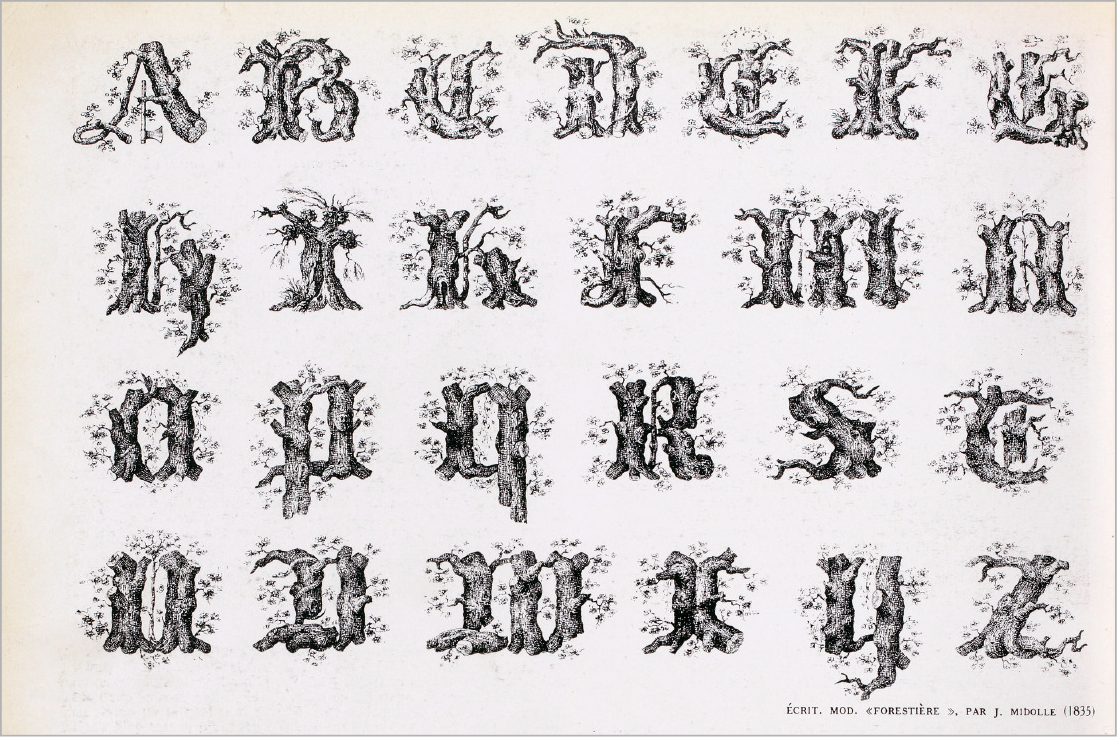
Figure 2.
Arboreal Alphabet, J. Midolle. Source: Minotaure 5: 6, Bibliothèque Nationale de France, https://gallica.bnf.fr/ark:/12148/bpt6k15259759/f12.item.
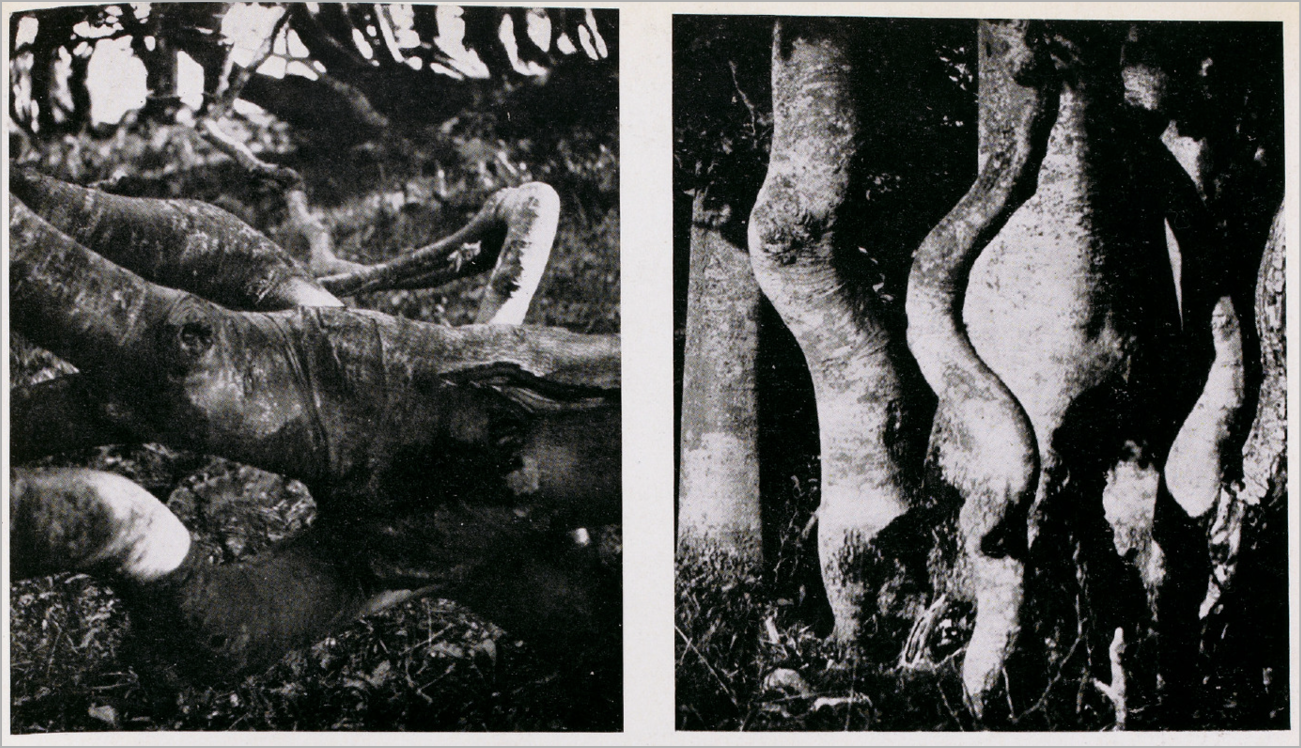
Figure 3.
Photographs of tree trunks, Henri Tracol. Source: Minotaure 5: 6, Bibliothèque Nationale de France, https://gallica.bnf.fr/ark:/12148/bpt6k15259759/f13.item.
The arboreal alphabet, in which trees are shaped into something readable to humans, stands in stark contrast to the unreadability, mysteriousness and unknowability of Ernst’s forest. Tracol’s photographs accompanying the text further contribute to Ernst’s conception of plants, by showing, as in the alphabet, parts of tree trunks that bend, twist, split and thus create arboreal shapes. However, contrary to the alphabet, these shapes are not letters – they cannot be read. The pictures highlight the bodily quality of the arboreal parts: the bark is wrinkled in areas where the tree bends, the trunks and branches resemble limbs and joints. The photographs thus picture the trees as living, growing, moving bodies that are unreadable and unmanipulated, unlike the letters of Midolle’s alphabet.25 Thus, the juxtaposition of the visual and textual material creates a dialogue between a surrealist conception of plants, in which mystery is emphasised, and an early nineteenth-century representation of plants, in which trees are rendered readable and manipulable. This visual and textual dialogue in Minotaure is thus another example of how the surrealists responded to and critiqued classical Western traditions and philosophies, as also discussed in relation to Masson.
In Ernst’s text, the forest is repeatedly associated with mystery. It is said to be a place where, in an undefined past when nightingales did not yet believe in God but in mystery, man and the nightingale could dream and imagine: ‘The man and the nightingale were in the most favourable position to imagine: in the forest, they had a perfect conductor of dreams’ (Ernst 1934: 6).26 Plants ‘feed’ on ‘mystery’, and ‘the end of the forests’ would come when, instead of being wild and intemperate – ‘hitherto a friend of dissipation’ – the forest would conform itself to the rules of civilised society (1934: 6).27 It would become conscientious, hardworking, republican, feed itself on ‘canned newspapers’, and only walk on paved roads, which will cause ‘[p]eople [to] become bored of it’ (1934: 6).28 The only forests that will remain will be, on the contrary, ‘wild and impenetrable … secular … fierce, fervent and amiable’, they are adorned only by ‘their majesty and mystery’ (1934: 6).29 In short, mysteriousness and wildness are portrayed as essential qualities of a forest. Without them, the forest expires.
As is also the case in many of the examples in the previous paragraph, Ernst continuously anthropomorphises forests: he depicts them as individuals with a certain character and emotional depth, capable of actions. On the one hand, this contributes to the surrealistic imagery which he generates: realistically, a forest is not capable of waiting for a tailor, of walking on paved roads or of being hired. However, this stimulates the reader to transgress their imaginative boundaries. The investigation, exploration and stimulation of the imagination are central endeavours of the surrealists (Lusty 2021: 10). Additionally, they frequently used the technique of automatism, by which the artist writes down, draws or paints whatever comes into their head without reflecting further upon it, letting their imagination and unconscious take the lead. Ernst explored the technique of automatism in his pictorial and visual work, developing the techniques of grattage and frottage (Ubl 2013).30 It can well be imagined that this text was also written by Ernst in an automatic manner, and that the surrealistic answers to the simple questions are results of Ernst’s unbounded imagination. Furthermore, the questions in this text are questions which adults, on a day-to-day basis, would not usually reflect on. Asking these types of questions is typical for children: they question what adults have simply accepted. The answers that adults then give, when forced to, are often evasive and unsatisfactory for the child, along the lines of the typical ‘Why? Because’. Equally, in Ernst’s text, the answers to the simple questions are unexpected and often leave the reader feeling none the wiser. A first reading of this text is bewildering, due in part to the anthropomorphic depictions of the forest, which radically stimulate the reader’s imagination, and to the surprising answers to the questions.
In addition to this, the anthropomorphism in Ernst’s text contributes to his critique of bourgeois conformism and consumerism that is prevalent in modern urban society. The behavioural change that the forest undergoes is one in which the forest conforms to societal expectations and moral code. The text satirically evokes the conformity that is expected and valued in urban, bourgeois society, and refers to typical habits of wealthy city-dwellers: they go for promenades on Sundays, read the newspaper and support the republic, as illustrated by Ernst’s remark that ‘a forest … will resolve to be frequented only by Sunday walkers. It will feed on canned newspapers … It will become … constructivist and republican’ (1934: 6).31 In this civilised, tamed state, the forest is called ‘Mme de Rambouillet’, who was a Parisian, high-class salonnière in the seventeenth century. However, this conformist attitude does not suit the forest, it radically reduces its imaginative potential and freedom; in fact, it erases its essence and integrity. As opposed to this tamed forest, the forests that do not conform to modern human society are wild and ‘extravagant, secular’ and majestic (Ernst 1934: 6).32 Hence, this text indicates how modern morality and society radically limit one’s freedom, identity and imagination.
This ‘pursuit of the imagination and unbridled freedom’ is central in the Surrealist movement (Lusty 2021: 13). The surrealists investigated what such alternative, non-conformist life styles could entail, in which there was more ‘individual and collective freedom’ on a sexual, artistic, spiritual ... level, which is reflected in their cross-border and experimental art (Lusty 2021: 2). The Mysteries of the Forest is an example of this. It centralises mystery, the imagination and freedom, and critiques conformism and the restraints of modern society. In addition, it challenges the readability and knowability of plants, by representing them as mysterious, majestic, primordial beings that can offer a space in which one can freely dream and imagine. Plants are represented not as passive background collectives or manipulable objects, but as individual, active beings that evade humans’ full appropriation and understanding. Ernst’s approach to plants resonates with plant critics’ aims to ‘avoid [the] objective description [of plants], and thereby preserve their alterity’ (Marder 2013: 9); in other words, to accept that we can never fully know plants. The forest in Ernst’s text is an independent space of vegetal beings, which would lose its essence, its vegetality or ‘forestdom’, when entering or adapting to urban civilisation. It should remain untainted, free from human manipulation.
In Benjamin Péret’s ‘Nature devours progress and surpasses it’ (1937), yet another forest is depicted. Much like Ernst’s contrast between wilderness and civilisation, this text also stages an encounter between civilised humans and wild vegetal beings. The text opens with a description of a space in which violence is predominant: the sun ‘flays’ the ghosts which have not been able to hide in time, their bones then become violins which ‘tear’ the ears of humans lost in the woods (Péret 1937: 20).33 It is a hostile space, where things transform into other things and where there are mystical creatures, such as ghosts and vampires. Following the sensorial setting of the scene, humans start to participate in the violence. They are said to have ‘pierced’ their way into the forest, and have unwound a telegraphic line.34 The forest reacts: after having pinched the line which carries only the voice of humans, plants start to stifle this human voice bearer ‘with their kisses; then silence fell again on the forest’ (20).35 In other words, they grow over and eventually shroud this trace of human society. However, humans continue with their violent attempt to enter and dominate the vegetal space: ‘The forest has retreated before the axe and dynamite’, humans have built railroads across the forest, and ‘in equatorial America the gun hunts the bird’, thus directly referring to the colonial enterprise in America (21).36 While nonhuman nature initially seems to recoil and subside for this human violence, plants eventually spring back on and over man-made material, swallowing everything in their way: ‘after having licked its prey for a long time, the forest will swallow it like an oyster’ (21).37 Plants absorb traces of ‘modern’ civilisation: ‘the slow absorption: connecting rod by connecting rod, lever by lever, the locomotive returns into the lap of the forest’, flowers ‘kill the pistol’, and ‘the snake crushes the gun like a rabbit’ (21).38 This is captured in the photograph which accompanies this text, in which a locomotive is shown overgrown with plants, vegetal beings overpower and erase human traces.
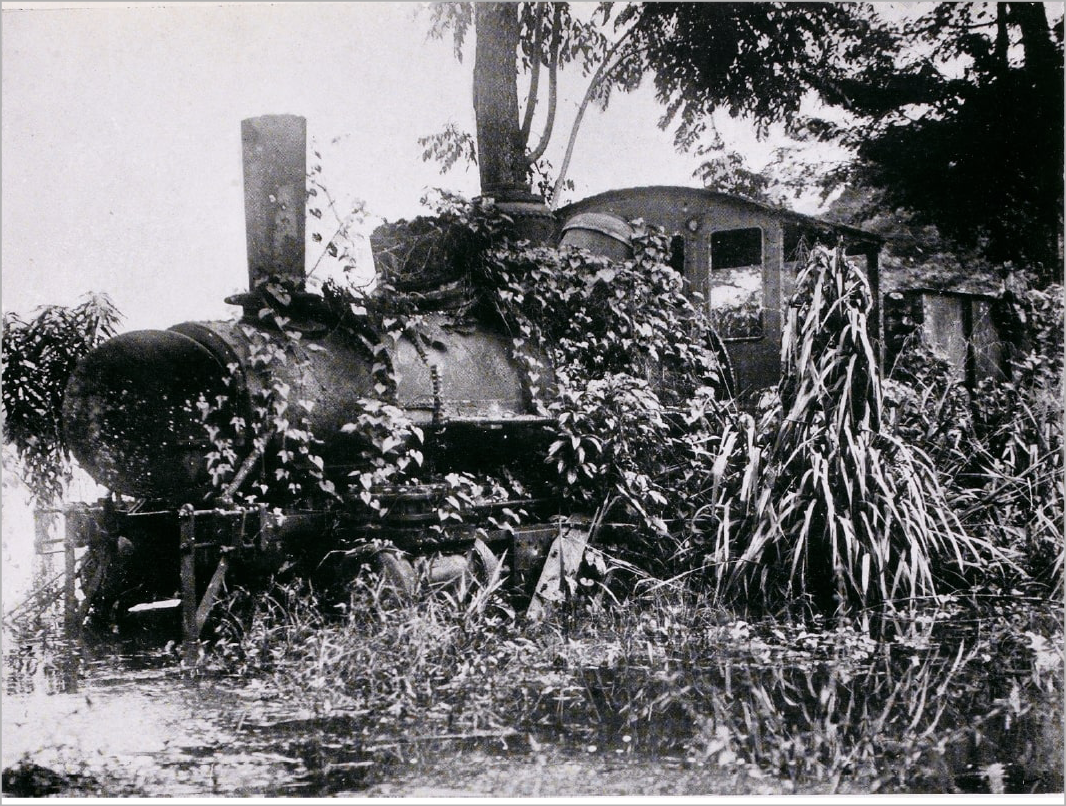
Figure 4.
Photograph accompanying Péret’s ‘Nature devours progress and surpasses it’, Minotaure 1937]. Source: Minotaure 10: 20, Bibliothèque nationale de France, https://gallica.bnf.fr/ark:/12148/bpt6k15259774/f32.item.
Péret’s text stages a scenario of vengeance in which the wild American forests, tainted by colonisation and ‘modern’ civilisation, return to their wild, primeval state. It is a ‘rallying cry for awareness of what is lost with technological progress’, which, as Kristoffer Noheden argues, resonates with Romantic anti-industrialisation sentiments and ‘bears the seed of an environmental consciousness’, which will become more pronounced in surrealist circles in the latter half of the twentieth century (2022: 53). Moreover, it indicates a fascination with non-Western, non-urban ‘wilderness’ – also present in Ernst’s text – which can be contextualised in the surrealist interest in Indigenous cultures as alternatives to Western objectifying and instrumentalising world views (Juarez Cruz 2022).39
In this text, life and death, and love and violence are paradoxically close to each other, just as in Masson’s The Metamorphosis of the Lovers. Life is both gentle and murderous: ‘Life loves and kills, passionately caresses with a murderous hand what it adores’ (Péret 1937: 21).40 Plants bursting with life and vibrancy destroy, which is expressed in erotic terms: the forest is described as a mythical female figure – ‘[an] enchantress’, ‘the siren’, ‘a seductress’ – who seduces the convoy mechanic.41 The mechanic is eventually unable to resist ‘temptation’, and is dragged into an infinite, fatal embrace (21).42 Erotic seduction ends in death and destruction; the plants, lurking at the sides of the railroad, have made the train stop in its tracks, taken hold of it, and started to absorb it. The anthropomorphic and mythical imagery amplifies and visualises the power and vibrancy of the plants, and it concretises an encounter between human and nonhuman nature, between an individual and a multitude of beings. The engagement with mythical figures is a typical feature of the Surrealist movement, which the title of the journal Minotaure also indicates. Myth was thought to have an ‘instinctual grounding’, which paired well with the surrealists’ interest in the unconscious (Roberts 2016: 300), and was considered a viable alternative to provide ‘new forms of collective social meaning’, which could be a counterweight to the post-war disillusionment and growing hostile climate (Lusty 2021: 10). In ‘Nature devours progress and surpasses it’, the mythical elements contribute to the text’s exploration of the primordial force of life, and how this force is paradoxically close to death. The mythical figure of the forest as a siren encapsulates both eroticism and violence, the female is a figure of fertility, a giver of life, and a femme fatale, capable of manipulating and destroying the male figure by means of her sexual energy, much like Caillois’s praying mantis. Nature is similarly conceived as the basic force of life, a force which is simultaneously capable of destruction and death. Nature gives and takes. There is no life without death.
Plants are represented as beings that ultimately prevail over humanity. Humans can violently attempt to control this vegetal life force, but plants are more powerful, they cannot be dominated and will outlive humans and their traces: ‘In the distance, slow-moving skyscrapers of trees will rise to signify a challenge [that is] impossible to face (Péret 1937: 21).43 Initially, the stranded train, overgrown by plants, becomes a more-than-human amalgam, which serves, like the forest, as a home for a multitude of nonhuman beings: ‘It smokes orchids, its boiler houses the frolics of crocodiles hatched the day before, while in the whistle legions of hummingbirds live that give it a chimerical life’ (21).44 The reference to the mythical figure of the chimaera amplifies the compound quality of this human-nonhuman amalgam: a chimaera consists of parts from different species. However, eventually, all human traces will be erased: this more-than-human being’s life is only ‘temporary, because soon ... the forest ... will swallow it like an oyster’ (21).45 Péret’s text thus destabilises a belief in human superiority, the objectification and reductive conception of plants, and the controllability and exploitability of nonhuman nature. The dominance, power, activity and vital energy of plants is also pictured in a number of other visual works in Minotaure, such as the previously discussed painting The Metamorphosis of the Lovers, but also in many of Ernst’s paintings, such as The conversion of fire [La conversion du feu] (1937), The angel of the hearth [L’ange du foyer] (1937), and Nature at dawn (evening song) [La nature à l’aurore (chant du soir)] (1938), which he painted using the automatic technique of grattage (Ubl 2013: 68). The chaotically and densely growing plants again capture both a sense of vitality and claustrophobic hostility: they seem to take hold of the strange hybrid figures that are trying to make their way through these vibrant vegetal spaces.
CONCLUSION: DESTABILISING HUMAN EXCEPTIONALISM IN THE (DIS)SIMILAR FACE OF PLANTS
Anthropocentrism is increasingly challenged in the texts and visual material discussed here, Caillois’s text being the mildest challenge, Masson and Ernst occupying the middle ground, and Péret being the most non-anthropocentric. Caillois’s ‘Mimicry and legendary psychasthenia’ unsettles physical and behavioural distinctions between humans, animals and plants. His investigation into animals and their resemblance to their milieu – i.e., plants – is one that reflects back on humans. In other words, humans remain relatively central in this article. Nonetheless, his emphasis on similarities across realms does challenge conventional conceptions of human exceptionalism: he indicates that humans share affinities with nonhuman beings, and partly moves away from a purely anthropocentric discussion of human and nonhuman phenomena. Nevertheless, Caillois’s text is marked by a high degree of plant blindness: plants are perceived as background surface rather than living, reacting organisms. Masson’s The Metamorphosis of the Lovers similarly draws attention to an affinity between humans and plants, in this case their shared fundamental animacy and life drive. As with Caillois, Masson explores human-vegetal relations, and his painting is a reflection not only on the vegetal, but also on the human. Human exceptionalism and superiority is, however, more forcibly challenged than in Caillois’s text. Vegetal matter seems to take over the human bodies, which are passively undergoing this metamorphosis. In contrast to Caillois, Masson portrays plants as active, animate organisms.
Ernst, then, challenges the manipulability and knowability of plants by portraying vegetal spaces as mysterious and wild. Modern, urban civilisation and bourgeois conformism are critiqued for their restrictive imposition on freedom and the imagination, whereas ‘wild’ forests and vegetal spaces untouched by modern civilisation are seen as places where the imagination can roam more freely. ‘The mysteries of the forest’ indicates that vegetal beings should not and cannot be controlled nor fully understood, and challenges the anthropocentric view of nonhuman nature as subservient to humans. There is some room for humans, in the shape of poets going to the forest to let their imagination run freely, but vegetality remains relatively obscure and detached from humans in Ernst’s work, more so than in Masson’s painting. Lastly, anthropocentrism and human superiority are the most radically undermined in Péret’s ‘Nature devours progress and surpasses it’. Vegetal beings are depicted as simultaneously vibrant and violent, sensual and destructive, full of life and capable of sowing death. Humans are completely dominated by plants, and, while human traces are initially turned into more-than-human amalgams, their presence is ultimately erased. Péret’s text stages the most non-anthropocentric world out of all four works.
Representations of plants in Minotaure are highly diverse, yet they resonate with each other and with issues at the centre of the Surrealist movement, such as the exploration of the unconscious, myth, the imagination and the marvellous. Plants are figures with which the surrealists sought affinity, yet not as much as they did with animals: plants were still considered more obscure and distinct, and therefore more difficult to relate to. Their explorations of plants, therefore, did not always enable a reflection back unto humans. Plants were both the obscure ‘other’ and archetypical figures which emblematise the essential animacy shared by all animate beings, a vegetal energy present in the self. In this way, their works resonate with different endeavours and tenets of critical plant studies. The four artists discussed here challenge traditional conceptions and organisations of the world, amongst which is the belief in human superiority and exceptionalism, but they do so in differing degrees and different ways, and without offering or imposing a single conclusive answer or view. By means of their diverse and unconventional works as recorded in Minotaure, the surrealists stimulate the reader to engage in a similar inquisitive practice: to look anew at something which initially seems obscure, connect what seems unconnected, and allow one’s imagination to challenge one’s knowledge and perception of the world.
ACKNOWLEDGEMENTS
I am deeply indebted to Inge Arteel and Sascha Bru, who introduced me to avant-garde art in their stimulating master’s course and helped me in the early stages of this essay. The fascinating realm of avant-garde art lies open to explore, and I am grateful for their guidance and encouragement while taking my first tentative steps. Special thanks go to Leanne Rae Darnbrough, whose incredibly insightful comments and suggestions were invaluable in the final stages of editing, as well as to the insights and suggestions of the anonymous reviewers from Plant Perspectives. Lastly, I want to thank papa for checking my translations. You inspire me with your infectious energy, passion for life and extraordinary geographical, historical and multilingual knowledge.
REFERENCES
Aloi, G. 2019. ‘Introduction: Why look at plants?’. In G. Aloi (ed.), Why Look at Plants? The Botanical Emerge in Contemporary Art, pp. 1–38. Leiden, The Netherlands: Brill.
Bennett, J. 2010. Vibrant Matter: A Political Ecology of Things. Durham: Duke University Press.
Bru, S. 2018. The European Avant-Gardes, 1905–1935: A Portable Guide. Edinburgh: Edinburgh University Press.
Cahill, J.L. 2019. Zoological Surrealism: The Nonhuman Cinema of Jean Painlevé. Minneapolis: University of Minnesota Press.
Caillois, R. 1934. ‘La mante religieuse: de la biologie à la psychanalyse’. Minotaure 5: 23–26.
Caillois, R. 1935. ‘Mimétisme et psychasthénie légendaire’. Minotaure 7: 4–10.
Caillois, R. 2008. Oeuvres. D. Rabourdin (ed.). Paris: Gallimard.
Conley, K. 2013. ‘Surrealism, ethnography, and the animal-human’. Symposium (Syracuse) 67 (1): 1–5.
Ernst, M. 1934. ‘Les mystères de la forêt’. Minotaure 5: 6–7.
Ernst, M. 1937. ‘La conversion du feu’. Minotaure 10: 30.
Ernst, M. 1937. ‘L’ange du foyer’. Minotaure 10: 30.
Ernst, M. 1938. ‘La nature à l’aurore (chant du soir)’. Minotaure 11: 58.
Juarez Cruz, M.P. 2022. ‘The surrealist experience of Indigenous North America: a second “discovery” of the Americas’. In K. Strom (ed.), The Routledge Companion to Surrealism, pp. 329–237. New York: Routledge.
Kalaidjian, W. 2021. ‘Chapter 15: The surrealist bestiary and animal philosophy’. In N. Lusty (ed.), Surrealism, pp. 272–290. Cambridge: Cambridge University Press.
Keetley, D. 2016. ‘Six theses on plant horror; Or, why are plants horrifying?’. In D. Keetley and A. Tenga (eds), Plant Horror: Approaches to the Monstrous Vegetal in Fiction and Film, pp. 1–30. New York: Palgrave Macmillan.
Lusty, N. 2021. ‘Introduction: Surrealism’s critical legacy’. In N. Lusty (ed.), Surrealism, pp. 1–28. Cambridge: Cambridge University Press.
Mahon, A. 2021. ‘Chapter 6: Surrealism and eros’. In N. Lusty (ed.), Surrealism, pp. 112–128. Cambridge: Cambridge University Press.
Marder, M. 2013. Plant-Thinking: A Philosophy of Vegetal Life. Columbia University Press.
Masson, A. 1939. ‘La métamorphose des amants’. Minotaure 12–13: 15.
Noheden, K. 2022. ‘Toward a total animism: Surrealism and nature’. In K. Strom (ed.), The Routledge Companion to Surrealism, pp. 53–61. New York: Routledge.
Parsley, K.M. 2020. ‘Plant awareness disparity: a case for renaming plant blindness’. Plants, People, Planet 2 (6): 598–601.
Péret, B. 1937. ‘La nature dévore le progrès et le dépasse’. Minotaure 10: 20–21.
Rentzou, E. 2013. ‘Minotaure: On ethnography and animals’, Symposium (Syracuse) 67 (1): 25–37.
Roberts, D. 2016. ‘Surrealism and natural history: Nature and the marvelous in Breton and Caillois’. In D. Hopkins (ed.), A Companion to Dada and Surrealism, pp. 287–303. Hoboken: John Wiley and Sons Incl.
Rudosky, C. 2021. ‘Chapter 8: Surrealist objects’. In N. Lusty (ed.), Surrealism, pp. 151–175. Cambridge: Cambridge University Press.
Ryan, J. C. 2018. Plants in Contemporary Poetry: Ecocriticism and the Botanical Imagination. New York: Routledge.
The American Heritage Dictionary of the English Language. 2022. s.v. ‘Psychasthenia’, 5th ed., Harper Collins Publishers. https://ahdictionary.com/word/search.html?q=
psychasthenia. (accessed 30 May 2025).
Ubl, R. 2013. Prehistoric Futures: Max Ernst and the Return of Painting between the Wars. Translated by E. Tucker. Chicago: The University of Chicago Press.
Wandersee, J.H. and E.E. Schussler. 1999. ‘Preventing Plant Blindness’. The American Biology Teacher 61 (2): 82–86.
Marion De Schepper (she/her) obtained a MA in Literature and Linguistics — English and Scandinavian Studies at Ghent University, and a MA in Literary Studies at KU Leuven et al. Her research interests lie in studying plants and environmental issues in historical and contemporary literature. She has just started her doctoral research project at Ghent University, which explores literary expressions of plants as experiencers and mediators of environmental change in contemporary Anglophone fiction.
Email: marion.deschepper@ugent.be
1 Throughout this essay, I provide translations of the cited French textual fragments, with the original French excerpt in footnotes. In the case of titles of paintings or texts, the French original is given once in square brackets next to the translated title. These translations are my own. They are not literary or professional translations, but principally meant to convey the basic meaning of the excerpts.
2 The Metamorphosis of the Lovers was painted in 1938, and appeared in Minotaure 12–13 (1939).
3 Ryan defines phytocriticism as a ‘plant-attentive practice inspired by the perspectives of vegetal neurobiology and allied areas of behavior, cognition, and sensing’, that ‘emphasizes the agencies of botanical beings in poetic texts and considers how plants are rendered, evoked, mediated, or brought to life in and through language’ (2018: 14).
4 Caveat: This article is not aimed at discussing the scientific validity or ethical dimensions of Caillois’s pathological and biological observations, classifications and arguments. Its aim is purely to highlight which vegetal-human dynamics emerge from this text, i.e. how plants are depicted, and how Caillois views the relation between plants, animals and humans.
5 The American Heritage Dictionary (2022) defines psychasthenia as follows: ‘A group of psychiatric symptoms, including phobias, obsessions, and compulsions, that were formerly thought to constitute a distinct disorder but are currently attributed to other disorders, including obsessive-compulsive disorder and anxiety disorders’.
6 ‘[le] réel et ... l’imaginaire, ... la veille et [le] sommeil, ... l’ignorance et ... la connaissance’.
7 ‘l’organisme et [le] milieu’.
8 ‘mimétisme offensif destiné à surprendre la proie, mimétisme défensif destiné soit à se dérober à la vue de l’agresseur (mimétisme de dissimulation) soit à l’épouvanter par un aspect de trompeur (mimétisme de terrification)’.
9 ‘un luxe et même ... un luxe dangereux’.
10 ‘Le recours à la tendance magique de la recherche du semblable … apparaît comme un moyen, sinon comme un intermédiaire. La fin semble bien être l’assimilation au milieu’.
11 ‘Le corps alors se désolidarise d’avec la pensée, l’individu franchit la frontière de sa peau et habite de l’autre côté de ses sens ... Lui-même se sent devenir de l’espace’.
12 ‘des attitudes cataleptiques aident souvent l’insecte dans son insertion dans l’autre règne’.
13 ‘les œufs des Phasmes ressemblent à des graines non seulement par leur forme et leur couleur, mais aussi par leur structure biologique interne’.
14 ‘la rigidité des chenilles arpenteuses dressées toutes droites qui ne peut pas ne pas évoquer la contracture hystérique’.
15 ‘dont il devient ainsi difficile de contester l’universalité’.
16 ‘La vie recule d’un degré’ ; ‘la vie paraît perdre du terrain’.
17 ‘de l’animé à l’inanimé’.
18 ‘Cette assimilation à l’espace s’accompagne obligatoirement d’une diminution du sentiment de la personnalité et de la vie’.
19 ‘Et puis les plantes se confondent avec les pierres’.
20 ‘le phénomène ne s’effectue jamais que dans un seul sens : l’animal mime le végétal, feuille, fleur ou épine’.
21 Kathryn M. Parsley proposes the term ‘plant awareness disparity’, or PAD, to attend to concerns of ableism which the original term ‘plant blindness’ raises (2020).
22 Jane Bennett’s concept of ‘vibrant matter’ was seminal for challenging the passivity and inertness usually associated with ‘matter’ and other nonhuman entities, highlighting ‘the material agency or effectivity of nonhuman or not-quite-human things’ (2010: 9). When I use the term ‘vibrant’, I use it both in its more general sense (i.e., meaning alive, dynamic or bright, as in vibrant colours), and to challenge, as Bennett does, the usual passivity, immobility and even inertness often associated with plants.
23 ‘Qu’est-ce qu’une forêt ?’ ; ‘Que font les forêts ?’ ; ‘A quoi servent les forêts ?’.
24 ‘Un insecte merveilleux. Une planche à dessin’ ; ‘Elles ne se couchent jamais de bonne heure. Elles attendent le tailleur’ ; ‘A faire des allumettes qu’on donne aux enfants comme jouets’.
25 Dawn Keetley argues that plants’ complete unknowability is one of the six reasons why humans can find plants horrifying (2016).
26 ‘L’homme et le rossignol se trouvaient dans la position la plus favorable pour imaginer : ils avaient, dans la forêt, un parfait conducteur du rêve’.
27 ‘De quoi se nourrissent les plantes ? De mystère’; ‘la fin des forêts’; ‘amie jusque-là de la dissipation’.
28 ‘journaux en conserve’; ‘On s’y ennuiera’.
29 ‘sauvages et impénétrables … séculaires ... féroces, ferventes et aimables’; ‘leur majesté et de leur mystère’.
30 Grattage is a pictorial technique by which the painter scratches through a fresh layer of paint, thus revealing underlying layers and colours. Frottage is a technique by which a piece of paper is spread over a certain textured surface (such as the bark of a tree or a wooden floor) and one gently rubs a pencil or another tool over the paper, thus capturing the underlying surface.
31 ‘une forêt ... prendra la résolution de ne plus fréquenter que les promeneurs du dimanche. Elle se nourrira de journaux en conserve ... Elle deviendra ... constructiviste et républicaine’.
32 ‘extravagantes, séculaires’.
33 ‘écorche’; ‘dechireront’.
34 ‘percé’.
35 ‘sous leur baiser; puis le silence est retombé sur la forêt’.
36 ‘La forêt a reculé devant la hache et la dynamite’; ‘en Amérique équatoriale le fusil chasse l’oiseau’.
37 ‘la forêt après avoir longuement léché sa proie l’avalera comme une huître’.
38 ‘la lente absorption : bielle par bielle, manette par manette, la locomotive rentre dans le lit de la forêt’; ‘tuent le pistolet’; ‘le serpent broie le fusil comme un lapin’.
39 The surrealist engagement with Indigenous cultures is not unproblematic. While the surrealists criticised ‘the colonizing processes … that devaluated and exoticized pre-Columbian art … [without] study[ing] and research[ing] the local context that originated these pieces’, their engagements with these practices and art forms were often characterised by the same tendencies to ‘misinterpre[t] and co-op[t] the Native art to their particular agendas’ (Juarez Cruz 2022: 329, 331).
40 ‘La vie aime et tue, caresse passionnément d’une main assassine ce qu’elle adore’.
41 ‘[une] enchanteresse’, ‘la sirène’, ‘une séductrice’.
42 ‘à la tentation’.
43 ‘Au loin de lents gratte-ciels d’arbres s’édifieront pour signifier un défi impossible à relever’.
44 ‘Elle fume des orchidées, sa chaudière abrite les ébats de crocodiles éclos de la veille, cependant que dans le sifflet vivent des légions d’oiseaux-mouches qui lui rendent une vie chimérique’.
45 ‘provisoire car bientôt ... la forêt ... l’avalera comme une huître’.