Research Article
Wheelbarrow motion theory:
Climate change and corruption as interdependent drivers of irregular
South-to-North migration – practical solutions and policy responses
Adam I. OHirsi1
Abstract
Irregular migration from the Global South to the Global North has increased alongside intensifying climate stress and persistent governance failure. Existing migration frameworks often examine environmental pressures and corruption separately, limiting their capacity to explain sustained irregular migration and the limited effectiveness of deterrence-based policies. This article proposes the Wheelbarrow Motion Theory to explain how climate stress and corruption interact to generate and sustain irregular migration. A critical narrative review was conducted using peer-reviewed literature, multilateral agency reports and policy evaluations published between 2000 and 2025, with empirical illustrations drawn from Africa, Latin America and South Asia. The review shows that climate stress erodes livelihoods and coping capacity, while corruption weakens adaptation, distorts relief delivery and restricts lawful mobility pathways. When these forces interact, displacement becomes structural and resistant to containment through border enforcement alone. Predominant policy responses centred on securitisation, deportation and migration externalisation have rerouted rather than reduced migration flows. Irregular migration is best understood as the outcome of interacting climate and governance failures rather than isolated drivers. Effective mitigation requires integrated approaches that combine climate adaptation, governance reform and expanded legal mobility options, rather than deterrence-centred strategies alone.
Keywords
climate change, corruption, irregular migration, governance failure, displacement, Wheelbarrow Motion Theory.
Introduction
Migration is the movement of persons away from their places of usual residence either across an international border or within a state (International Organization for Migration, 2019). It results from individual decisions shaped by unique circumstances, goals and the broader context in which people choose to relocate (Abel et al., 2019). Climate change has emerged as one prominent factor shaping both regular and irregular migration patterns in recent decades. The International Organization for Migration (IOM) defines climate migration as ‘the movement of a person or groups of persons who, predominantly for reasons of sudden or progressive change in the environment due to climate change, are obliged to leave their habitual place of residence, or choose to do so, either temporarily or permanently, within a State or across an international border’ (IOM, 2019). Migration is irregular when it occurs outside the legal frameworks applicable in the involved countries (Fontana, 2024; Almulhim et al., 2024).
Global South nations, notably Africa, struggle to mitigate climate consequences, deploy technological solutions and build resilient infrastructure. Without action, climatic stress causes protracted droughts, floods, excessive temperatures and landslides, driving migration (Batista et al., 2024). Climate change drives irregular migration, notably to the European Union (EU) (Fontana, 2024). The 2020 global displacement rate was 40 million, with 30 million directly affected by natural disasters (Almulhim et al., 2024). Social deterioration suppresses migration until critical thresholds are crossed, then migration occurs abruptly (Abel et al., 2019). Governance failings exacerbate these dynamics, sustaining Global South–to–North migratory patterns (Adams, 2015). Importantly, violence, economic instability and corruption influence migration decisions more than climate change, making safe and orderly mobility difficult (Younis, 2022; Almulhim et al., 2024).
The combined pressures of climate change and corruption increasingly undermine local coping systems and restrict lawful mobility options in climate-vulnerable regions. Corruption in public institutions that fail to manage resources, assist adaptation or provide relief increases migration pressure in communities affected by droughts, floods, environmental degradation and livelihood disruption (Adams and Kay, 2019). International organisations such as the UNDP, World Bank and Transparency International have sought to address these dynamics through anti-corruption frameworks, governance reform programmes and climate finance safeguards. However, these interventions have often been fragmented, insufficiently coordinated and limited in reach, leaving significant governance vacuums that sustain migration pressure. Climate stress and corruption are major push factors in the neoclassical push-pull framework (Lee, 1966), but it does not fully reflect their interaction. Living with corruption increases emigration and climate vulnerability, according to empirical studies (Maara and Maydom, 2024; Schran, 2021). Building on this gap, the Wheelbarrow Motion Theory, introduced in this study, conceptualises irregular migration as forward motion generated by the joint and reinforcing forces of climate stress and corruption. When these forces operate together, migration accelerates and becomes resistant to containment through border controls alone. Drawing on a critical synthesis of empirical and policy literature, this framework explains how environmental shocks filtered through weak governance structures produce sustained migration patterns that single-factor explanations fail to capture.
This study adopts a critical narrative review. It synthesises peer-reviewed articles, multilateral agency reports and policy analyses published between 2000 and 2025. Sources were identified through structured searches of Google Scholar, Scopus and Web of Science using keywords related to climate change, corruption, governance failure, irregular migration and displacement. Grey literature from the International Organization for Migration (IOM), the United Nations Development Programme (UNDP), the Food and Agriculture Organization of the United Nations (FAO), the World Bank (WB) and the Office of the United Nations High Commissioner for Refugees (UNHCR) was included to capture policy dynamics and empirical trends often absent from academic journals. Studies were selected based on their explicit linkage of environmental stress, governance or corruption, and migration outcomes, with single-factor analyses excluded. Thematic synthesis was used to identify cross-regional patterns, which were interpreted through the Wheelbarrow Motion Theory.
Theoretical framework
Lee’s Push-Pull theory of migration
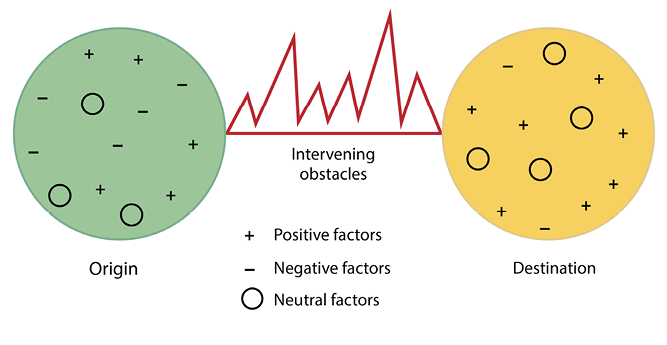
In 1966, Everett Lee created a migration theory that states that people move because of push and pull factors in their home country and the new region. According to this theory, economic hardship, conflict and harsh environment drive people away (Saraswati et al., 2025). Better jobs, security and living circumstances attract them to the new location. In migration research and policy, Lee’s thesis has helped shape government immigration and refugee policies (Faridi, 2018). This theory, thus, helps to explain how climate change and corruption serve as push factors for migrants from the Global South to the Global North. Figure 1 presents a migration model adapted from the Push-Pull Theory.
Figure 1. Push-Pull Migration Model
Source: adapted from Lee’s (1966) Push-Pull Theory of Migration
Push factors driving emigration from origin countries include climate shocks, environmental degradation, poverty, political instability, corruption and limited livelihood opportunities. Pull factors attracting migrants to destination countries include economic opportunity, political stability, better public services and stronger institutional frameworks. Intervening obstacles such as border controls, visa restrictions, travel costs and social networks further shape the direction and scale of migration flows.
Migration streams and counter-streams are created by push and pull factors in the areas of origin and destination; at the same time, intermediary barriers like travel expenses and border regulations prevent migration. Over time, there is a tendency for human mobility to rise, and migrants are more likely to relocate to areas where friends or family already live. The selective nature of migration means that certain individuals (like young people or men) are more inclined to relocate than others, depending on the situation. Lastly, economic interests usually take precedence. All of these components can be influenced by environmental circumstances (Sherbinin, 2020). Climate change and corruption exacerbate existing push factors by serving as accelerants, stressors, and multipliers (Cottier and Salehyan, 2021; Fontana, 2024).
While Lee’s framework provides a foundational lens for identifying climate change and corruption as push factors, it treats these drivers as additive and static, limiting its explanatory power in contexts where multiple stressors interact dynamically. The Wheelbarrow Motion Theory, introduced in this article, builds directly on this foundation by reconceptualising climate stress and corruption not as independent push factors but as mutually reinforcing forces that generate sustained migration momentum – a dynamic interaction that push-pull theory alone cannot capture.
Theoretical contribution: The Wheelbarrow Motion Theory
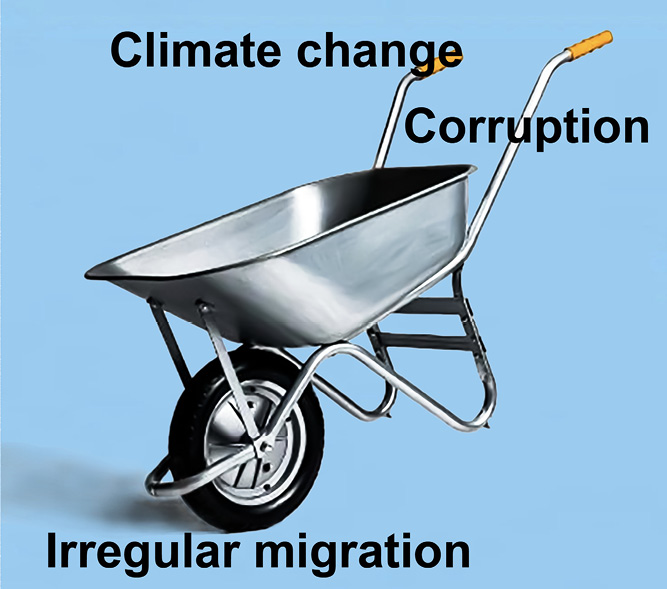
Building on Lee’s (1966) push–pull theory, this article advances the Wheelbarrow Motion Theory (WMT) to explain why irregular Global South-to-North migration accelerates under contemporary conditions. In push–pull theory, climatic stress and corruption are drivers, but they act in simultaneous or additive ways. On the other hand, WMT views them as joint propulsion systems that generate momentum. Climate change and corruption are like the two handles of a wheelbarrow: when both work together, displacement is swift and persistent; when any of these fail, mobility slows (Figure 2).
Figure 2: The Wheelbarrow Motion Theory
Source: created by author
The Wheelbarrow Motion Theory (WMT) provides a conceptual and metaphorical framework for analysing irregular South-to-North migration as a dynamic outcome of interacting structural forces in the twenty-first century. It conceptualises migration not as a linear response to isolated pressures but as a process driven by the synergistic interaction between climate stress and governance failure, with corruption emerging as a particularly influential manifestation of the latter. The theory responds directly to the limitations of traditional push–pull models, which, while useful for identifying migration incentives, treat drivers as additive and static (Lee, 1966). Such models struggle to explain contemporary climate-related displacement, where environmental pressures are mediated through political, institutional and governance contexts, risking environmental determinism by underplaying these interactions (Puma et al., 2022).
In the wheelbarrow metaphor, irregular migration is likened to the forward motion of a wheelbarrow moving over uneven terrain. This motion requires two handles to be actively pushed. The first handle represents climate stress, while the second represents governance failure, with corruption standing out as a dominant and forceful driver. Climate stress alone does not inevitably produce migration, nor does corruption in isolation. Significant and sustained migration flows emerge primarily when both handles are engaged simultaneously, reinforcing one another and generating momentum that exceeds the capacity of downstream controls.
The metaphor clarifies the components of this process while acknowledging its analytical boundaries. In the Wheelbarrow Motion Theory, sustained forward movement requires the concurrent operation of two forces. Much like a wheelbarrow that cannot be pushed with a single handle, persistent irregular migration is most likely to emerge when climate stress and governance failure act together. Either force on its own may produce pressure, immobility or short term displacement, but durable and large scale irregular migration tends to arise when environmental stress intersects with weak governing systems that are unable to protect livelihoods, manage risk or provide lawful mobility pathways.
Governance failure is treated here as a broad structural condition encompassing weak institutional design, poor policy coordination, limited administrative capacity, ineffective resource allocation and inadequate information systems. Within this wider condition, corruption is examined as a salient and empirically observable mechanism through which governance failure manifests, particularly in climate vulnerable contexts. Corruption undermines adaptation planning, diverts relief resources, distorts land and aid allocation and erodes trust in public institutions, thereby translating climate stress into migration pressure.
Within the metaphor, the bed or tray of the wheelbarrow represents Global South contexts where these pressures accumulate. The wheel represents migratory flux, including scale, speed and direction. Drawing on the aspirations–capabilities framework, affected populations retain agency through aspirations and capabilities shaped by resources, networks, and mobility infrastructure. Movement occurs as the wheelbarrow advances across institutional frictions at origin and destination.
WMT highlights three core dynamics. The first is synergy: a multiplicative interaction between climate stress and governance failure. Desertification, soil salinisation and sea-level rise, as well as droughts, floods and cyclones, all undermine livelihoods and adaptive ability (IPCC, 2022). Governance failure, particularly bribery, embezzlement, elite capture, nepotism and clientelism, diverts climate finance, weakens adaptation and reconstruction, distorts land and aid allocation, and undermines institutional trust (Olken and Pande, 2012; Transparency International, 2025). Higher perceived corruption is linked to increased emigration, especially among those with the financial and social resources to migrate (Poprawe, 2015; Arif, 2022).
The second dynamic is momentum. Once migration begins, it becomes path dependent. Migrant networks, remittances and smuggling economies reduce costs and risks for subsequent movers, sustaining and accelerating flows over time. The third dynamic is resistance. Border controls, visa regimes and securitisation policies introduce friction but rarely halt movement outright. Instead, they tend to reroute flows, increase risks and intensify irregularity without addressing underlying drivers (World Bank, 2023c). These dynamics are formalised through the migration momentum function:
M ≈ (C × G) / (A + R)
where M denotes migration momentum, C represents climate stress, G captures governance failure intensity, A reflects institutional and adaptive capacity, and R represents regulatory and border resistance. The multiplicative term (C × G) captures the core theoretical claim that climate stress and governance failure reinforce one another rather than acting independently. High climate exposure combined with weak governance produces disproportionately strong migration pressure relative to single-factor contexts. Conversely, stronger adaptive
capacity or effective regulation can dampen momentum, though rarely eliminate it entirely.
Within this formulation, adaptive capacity reflects the ability of institutions and communities to absorb shocks through effective governance, infrastructure, and social protection, while resistance captures policy-induced barriers along migration pathways. Importantly, momentum does not imply universal movement. Agency introduces selectivity, as only those with sufficient aspirations and capabilities are able to act on migration opportunities. WMT accommodates other migration drivers such as conflict, economic opportunity and family ties
but places the climate–governance nexus at the centre of analysis. Empirical patterns in regions such as the Horn of Africa and the Sahel, the Northern Triangle of Central America, and South Asia illustrate how recurrent climate shocks combined with governance weaknesses translate local crises into sustained irregular migration.
Push and pull factors shaping irregular migration
Climate stressors and mobility pressure
Over the past century, global climate patterns have shifted markedly, increasing the frequency and intensity of extreme events such as droughts, heat waves and hurricanes (Sherbinin, 2020). The Intergovernmental Panel on Climate Change predicts a 0.5°C global temperature rise between 2030 and 2052, affecting habitability and livelihoods. Such changes cause widespread social and economic upheaval because climate conditions underpin most economic activity (Shah, 2021). Climate change’s effects on agriculture, water and infrastructure in poor nations have drawn scholars, policymakers and advocacy groups’ attention to its role in migration (IOM, 2009; Sherbinin, 2020). Therefore, climate-related displacement is a current risk. Climate change was a major element in the 2016 Paris Agreement discussions and is closely linked to migration from sub-Saharan Africa to Europe and from Central America to the United States.
Historical evidence further confirms the link between climate variability and population movements. Climatic stress contributed to the decline of the Mayan Empire, influenced migration following the fall of the Western Roman Empire and facilitated the Mongolian westward expansion under wetter steppe conditions (Büntgen and Di Cosmo, 2016). More recent examples include the American Dust Bowl of the 1930s and the Sahelian droughts of the 1970s and 1980s, where declining land productivity undermined population support systems (Sherbinin, 2020). To explain these patterns, the IPCC has advanced a risk framework linking climate hazards to social vulnerability. Migration likelihood increases when hazards intensify and adaptive capacity remains limited, shaped by sociodemographic factors and access to resources (Sherbinin, 2020; Beyer et al., 2023).
Table 1. Types of Climate Events and Associated Migration Outcomes
|
Category |
Examples |
Nature of Change |
Likely Migration Outcome |
|---|---|---|---|
|
Fast-onset events |
Floods, storms, heat waves, rapid drought episodes |
Sudden and extreme climatic shocks |
Short-term displacement, with eventual return to origin areas; repeated shocks may trigger long-term movement |
|
Slow-onset events |
Gradual temperature rise, long-term rainfall variation, acidification, glacial retreat, soil salinisation, land and forest degradation, biodiversity loss, desertification |
Progressive and cumulative environmental deterioration |
Permanent migration or planned relocation as livelihoods and habitability decline |
Corruption and institutional breakdown
The UNDP recognises that climate change is a serious challenge to sustainable development, and that the most devastating results will be for poor people in poor countries in the global south. Consequently, the international community has pledged large amounts of money to mitigate the effects in developing countries. It is therefore critical that these funds are spent effectively and do not fall prey to corruption. Corruption is defined by UNDP (2008) as the misuse of entrusted power for private gain and manifests in multiple forms that shape governance outcomes and mobility decisions. These include bribery, embezzlement, fraud, extortion, nepotism, patronage, cronyism, clientelism, political corruption, grand corruption and state capture, all of which distort public decision-making and resource allocation (UNDP, 2010).
In climate-vulnerable contexts, corruption undermines climate finance by diverting funds from intended beneficiaries, weakening institutional capacity and eroding adaptation and mitigation efforts. These effects disproportionately burden vulnerable groups, including women and Indigenous communities, while sustained corruption erodes donor confidence and public trust, increasing migration pressures (Malaj and Firza, 2023). Corruption also directly facilitates irregular migration where legal pathways are limited, operating across origin, transit and destination stages through bribery, exploitation and gendered abuses such as sextortion (Poprawe, 2015; Merkle et al., 2020; Bernini et al., 2023; Baškot et al., 2025).
The combined effect of climate stress and corruption on irregular migrations
Climate change is simply one aspect in migration decisions, which are influenced by environmental, economic, social and political reasons (Sherbinin, 2020; Fontana, 2024). Alongside these pressures, corruption drives and facilitates migration across origin, transit and destination settings, affecting resources, institutions and mobility channels (Merkle et al., 2020). The push–pull paradigm can identify climate stress, corruption and relative stability as push and pull factors, but it cannot explain how these forces interact or why migration accelerates under specific conditions. The Wheelbarrow Motion Theory bridges this gap by viewing climatic stress and corruption as interconnected causes that drive migration. Corruption hinders adaption mechanisms, hurts relief and recovery efforts, and limits legal mobility as climate stress erodes livelihoods and increases risk. These forces exert pressure on the migration process, perpetuating irregular movement even with single-factor interventions.
When climatic stress and corruption limit legal options, irregular migration becomes sensible. Institutional, social and demographic factors influence route selection, with climate change and corruption as contributing factors (Baškot et al., 2025; Fontana, 2024). Corruption hinders access to adaptation programs, humanitarian aid, land rights and financial services, reducing the effectiveness of local coping strategies like income diversification or state support (Malaj and Firza, 2023; Maara and Maydom, 2024). Due to exorbitant expenses, tight visa regimes and limited employment quotas that many climate-affected populations cannot achieve, legal migration options remain mostly inaccessible (Malaj and Firza, 2023). Intermediaries use institutional weakness to raise prices and block formal routes. Thus, climate hardship and corruption drive irregular migration as the best alternative under constrained choice.
Critical analysis of irregular migration cases from the Global South
Horn of Africa
Across the Horn of Africa, including Somalia, Ethiopia, Kenya, Eritrea, South Sudan and Djibouti, irregular migration reflects a shared structural condition rather than isolated national crises. The region faces recurrent droughts, floods and ecosystem degradation alongside persistent governance failure, producing displacement that is increasingly durable and strategic rather than episodic
(UN OCHA, 2023; FAO, 2024). Within the Wheelbarrow Motion Theory, climate stress and corruption operate as reinforcing forces that jointly generate
migration momentum. Climate shocks erode livelihoods and household coping capacity, while corruption weakens adaptation systems, distorts relief delivery and undermines institutional trust, accelerating movement among those able
to migrate.
Somalia illustrates this connection. The greatest drought in forty years caused by five consecutive failed rainy seasons since 2020 left over 6.6 million people food insecure by late 2023 (FAO and WFP, 2023). Humanitarian aid corruption, including diversion and inflated beneficiary lists, exacerbated livelihood collapse and drove irregular migration to Yemen and the Gulf (Transparency International, 2022). Since 2019, droughts, floods and violence in Ethiopia have uprooted farming and pastoral populations. Corruption in emergency procurement and politicised aid allocation caused approximately 4.5 million IDPs, many of whom migrated to Sudan and Libya (World Bank, 2023b; UNHCR, 2024). In northern Kenya’s arid counties, protracted drought and county-level corruption hampered assistance delivery and resilience, pushing youngsters toward irregular pathways (Mwangi and Kramon, 2022; Maara and Maydom, 2024). Climate stress, elite capture and institutional disintegration cause large-scale displacement in Eritrea, Djibouti and Sudan (Böhmelt, 2025) African Development Bank (AfDB), 2022; UN OCHA, 2024). These cases show how the Wheelbarrow Motion Theory’s climate-governance nexus generates region-wide migration momentum that single-factor explanations cannot.
West and Central Africa (Sahel Region)
The Sahel, stretching across Mauritania, Mali, Burkina Faso, Niger, Chad, northern Nigeria and parts of Cameroon, represents one of the most structurally exposed zones to the combined pressures of climate stress and institutional fragility. Since 2020, persistent rainfall loss, rising temperatures, desertification and recurring droughts have increased food insecurity and harmed farming and pastoral livelihoods (FAO, 2023b; IPCC, 2022). Land degradation, dwindling water sites and fewer grazing lands have damaged agro-pastoral systems that traditionally absorbed climatic shocks through seasonal mobility. Climate-induced livelihood collapse is strongest in Niger, Mali and Burkina Faso (World Bank, 2023a). As households incorporate movement into risk diversification, crop failure, livestock death and soil infertility have upended rural production systems and survival methods. Due to corruption, arms trafficking and extremist groups are widespread, making conditions even worse for people affected by climate change (International Crisis Group, 2023; Transparency International, 2022). Furthermore, State officials and security commanders in countries like Burkina Faso and Mali have been accused of protection rackets, illicit mining taxation and humanitarian aid diversion (Idris et al, 2022).
The Sahel is a major feeder zone for irregular migration to Libya, Algeria, Tunisia and Europe. Climate stress drives rural people to transit hubs like Agadez, Gao and northern Chad, where migrants join trans-Saharan smuggling networks protected by corrupt officials (IOM, 2023a; UNODC, 2022a). Bribery allows people trafficking to coexist with formal security operations at borders. Due to drought-driven displacement and war, irregular movement becomes structural rather than episodic, with the Sahara becoming a sustained region of vulnerability characterised by extortion, forced labour and violent control by trafficking groups.
Latin America (Northern Triangle)
The Northern Triangle of Central America, comprising Guatemala, Honduras and El Salvador, is among the most climate-exposed and institutionally fragile migration producing regions globally. Intensifying climate extremes, including severe hurricanes, recurrent droughts linked to El Niño, deforestation and soil degradation, have weakened subsistence agriculture and rural livelihoods (IPCC, 2022; FAO, 2023a). Hurricanes Eta and Iota in 2020 displaced nearly seven million people and damaged key agricultural zones in Honduras and Guatemala (UN OCHA, 2021). By 2023, prolonged droughts in the Dry Corridor had driven crop failure and food insecurity, affecting almost nine million people (FAO and WFP, 2023). These pressures are compounded by corruption that undermines adaptation and recovery through distorted procurement, clientelist relief distribution and weak regulation of land and extractive projects (Transparency International, 2022; World Bank, 2022). Migration to the United States thus reflects environmental loss interacting with institutional failure rather than climate stress alone (IOM, 2023b; UNODC, 2022b).
South Asia
South Asia, especially Bangladesh and Pakistan, is one of the most populous and climate-exposed regions. Overlapping cyclones, monsoon flooding, river erosion, glacial melt, heat waves and saline intrusion impact agriculture, fisheries and urban livelihoods (IPCC, 2022; World Bank, 2023c). Recurrent cyclones and seasonal floods over the Ganges–Brahmaputra delta, rapid saline intrusion in coastal regions and riverbank erosion displace about 200,000 Bangladeshis yearly (IOM, 2022). Cyclone shelters and early warning systems have expanded; however, procurement fraud and low-quality work in land management, embankment construction and maintenance reduce their effectiveness (Transparency International Bangladesh, 2023). Displaced households move to Dhaka and Chittagong, where informal settlements are becoming staging locations for international labour migration.
Pakistan exhibits parallel dynamics driven by glacial lake outburst floods, monsoon variability and catastrophic river flooding. Over 30 million people were uprooted and nearly one third of agricultural output was destroyed in the 2022 floods (UN OCHA, 2022). Land administration, irrigation management and emergency procurement corruption hampered flood protection and relief delivery, while political elites stole rehabilitation funds (Asian Development Bank, 2026). Maladaptation and institutional failure turn transient displacement into persistent agrarian exodus. Migration brokers exploit this weakness by proposing debt-financed Gulf departure routes under coercive recruitment systems (IOM, 2023a), turning internal displacement into outward migration desires. Table 3 below synthesises evidence from the Horn of Africa, the Sahel, Latin America’s Northern Triangle and South Asia. It shows how similar mechanisms operate across diverse ecological and political contexts while producing region-specific migration outcomes.
Table 3. Climate Stress, Corruption Dynamics and Irregular Migration Across the Global South
|
Region |
Country / |
Dominant Climate Stressors |
Key Corruption and Governance Failures |
Resulting Migration Outcomes |
Key References |
|---|---|---|---|---|---|
|
Horn of Africa |
Somalia |
Consecutive failed rainy seasons, severe drought, collapse of pastoral systems, widespread food insecurity |
Diversion of humanitarian aid, inflated beneficiary lists, capture of relief by political and armed elites, chronic state fragility |
Mass internal displacement and high irregular migration toward Yemen and Gulf states |
FAO and WFP (2023); Transparency International (2022); UN (2023); IOM (2024a) |
|
Ethiopia |
Recurrent drought, flooding in lowlands, crop and livestock losses, climate stress intersecting with conflict |
Procurement fraud in emergency food supply, politicised aid targeting, weak resettlement accountability |
Over 4.5 million internally displaced; increased irregular routes via Sudan and Libya |
World Bank (2023b); Jenkins (2024); UNHCR (2024) |
|
|
Kenya (Northern Counties) |
Prolonged drought, livestock mortality, groundwater depletion, collapse of rain-fed agriculture |
Inflated water trucking contracts, ghost beneficiaries, politicisation of drought relief at county level |
Rising cross-border irregular migration toward Ethiopia, Sudan, and Libya |
Auditor General of Kenya (2023); Mwangi and Kramon (2022); IOM (2023a) |
|
|
Eritrea |
Long-term water stress, soil degradation, environmental exhaustion |
Highly rigid governance structures, absence of adaptive institutions |
Persistent outward irregular migration toward Sudan, Ethiopia, and Libya |
(Böhmelt, 2025) |
|
|
Djibouti |
Sea-level rise, saltwater intrusion, urban drought stress |
Elite capture of urban land, corruption in development contracts |
Irregular outward migration and transit movement toward Yemen and the Gulf |
AfDB (2022) |
|
|
Sudan |
Flooding, desertification, climate-induced land degradation, armed conflict |
Corruption in land administration, manipulation of humanitarian access, institutional collapse |
Over 8 million displaced; large-scale external migration toward Libya and Egypt |
UN OCHA (2024) |
|
|
Sahel (West & Central Africa) |
Niger |
Desertification, declining rainfall, heat extremes |
Border bribery, trafficking protection, aid diversion |
Major transit hub for Sahara routes toward Libya and Algeria |
FAO (2023a); IOM (2023a); Idris et al. (2022) |
|
Mali |
Recurrent drought, soil degradation |
Security sector corruption, illegal taxation by armed groups |
Internal displacement and trans-Saharan migration |
World Bank (2023c); UNDP (2023a) |
|
|
Burkina Faso |
Rainfall volatility, crop failure |
Collusion between militias and officials, diversion of relief aid |
Mass rural displacement and youth out-migration |
Transparency International (2022); International Crisis Group (2023) |
|
|
Chad |
Water scarcity, pastoral collapse |
Corruption in land administration and security forces |
Cross-border migration toward Libya and Sudan |
World Bank (2023c) |
|
|
Northern Nigeria |
Drought, land degradation, shrinking Lake Chad |
Insurgent financing networks, corrupt local governance |
Mixed climate-conflict displacement toward Niger and Libya |
IPCC (2022); UNODC (2022a) |
|
|
Latin America (Northern Triangle) |
Guatemala |
Dry Corridor droughts, hurricanes, floods, crop failure |
Land grabbing by extractive elites, corruption in reconstruction contracts |
Large-scale rural displacement and sustained migration toward the US |
FAO (2023b); World Bank (2022) |
|
Honduras |
Hurricanes Eta and Iota, river flooding, deforestation |
Inflated disaster contracts, clientelist relief allocation |
Persistent outward migration and post-disaster caravans |
UN OCHA (2021); Transparency International (2022) |
|
|
El Salvador |
Extended droughts, flash flooding, coastal erosion |
Politicisation of relief aid, weak municipal adaptation capacity |
Youth- and family-based irregular migration toward North America |
FAO & WFP (2023); IOM (2023a) |
|
|
South Asia |
Bangladesh |
Cyclones, river flooding, salinity intrusion, riverbank erosion |
Procurement fraud in embankments, corruption in land administration, politicised relief |
Large-scale internal displacement; rising debt-driven labour migration |
IOM (2022); Transparency International Bangladesh (2023) |
|
Pakistan |
Monsoon flooding, glacial melt, heat extremes |
Corruption in irrigation management, elite capture of reconstruction funds |
Protracted displacement and expansion of international labour migration |
UN OCHA (2022); Asian Development Bank (2026) |
Western policy responses
Existing approaches
Border controls have remained the dominant policy response to irregular migration. Over recent decades, the European Union, the United Kingdom and the United States have expanded enforcement through intelligence sharing, surveillance technologies, intensified patrols, biometric identification systems, e-borders and automated risk profiling, reflecting a broader shift toward securitised migration governance (Oelgemöller, 2017; van Liempt et al., 2023). In this securitised environment, deportation is a key response to irregular migration. Deportation involves apprehension, custody and repatriation, sometimes voluntary but sometimes forced, and a long procedure that often culminates in unsupported reintegration (Ambrosini and Minke, 2023). Evidence suggests that deportation seldom deters future migration and may encourage riskier mobility.
Destination nations increasingly use externalisation techniques beyond direct enforcement. Both bilateral and multilateral agreements aim to expand migration management beyond national borders by working with transit and origin nations. Joint patrols, foreign border force capacity-building, readmission agreements and migration management support are examples (Boas, 2021). The alleged root reasons of migration can be addressed through ‘upstream’ initiatives. The 2015 Valletta Action Plan and EU Emergency Trust Fund for Africa promoted stability, employment and governance reform in African partner states. These programmes have prioritised security, border control and migrant containment over long-term development, climate adaptation and anti-corruption reform, according to empirical evaluations (Boas, 2021).
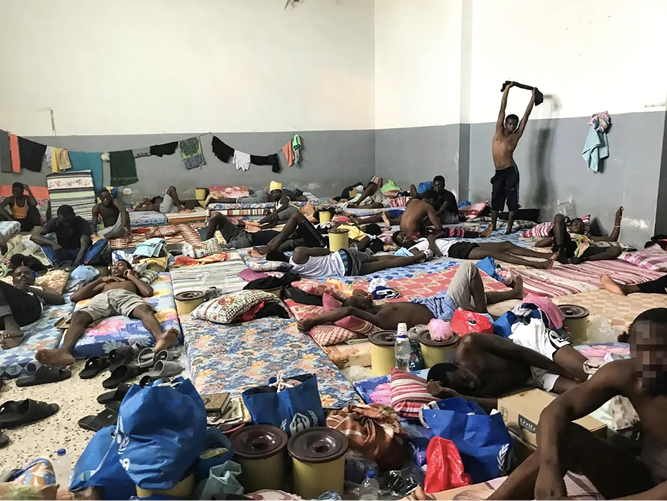
Humanitarian protection, limited legal migration and voluntary return and reintegration programmes are also used, but in small amounts. Current policy solutions are scattered and enforcement-heavy, failing to address the underlying link between climate stress and government failure that maintains irregular migration. Upstream measures also include agreements with third countries to block migration routes. The 2016 EU-Turkey deal and cooperation with Libya sharply reduced Mediterranean crossings. Yet these arrangements have been criticised as externalising migration control. Reports by Human Rights Watch (2019) documented severe abuses in Libyan detention centres, including overcrowding, poor sanitation, inadequate healthcare and systematic violence against migrants. Figure 3 shows the deteriorated conditions in the Libyian detention centres.
Figure 3. Detention conditions of migrants in Libya
Source: Human Rights Watch CC BY-NC-ND 4.0 (2019)
The European Union’s migration agreements with Libya have contributed to a reduction in Mediterranean crossings, often framed as a short-term political success. However, this outcome has come at significant long-term cost, including the entrenchment of violent actors, the weakening of state accountability and heightened risks to migrant safety (Abebe, 2019). Extensive evidence documents the widespread use of arbitrary detention, ill treatment and sexual violence against migrants held in Libyan facilities, particularly within detention centres linked to migration control arrangements (Ambrosini and Minke, 2023). Rather than directly attributing responsibility to specific donor funding streams, existing research highlights how externalisation strategies shift migration control to fragile contexts with limited oversight, thereby increasing the likelihood of systematic abuse. These dynamics underscore the humanitarian and governance risks associated with deterrence-based agreements that prioritise border containment over protection and institutional safeguards. The dominant theme emerging from these interventions is that they are centred on security and deterrence, with migration treated primarily as a border control problem rather than as a climate governance and institutional challenge. A summary of the current policies from the Global North is presented in Table 4.
Table 4. Major Western Policies Addressing Irregular Migration in Africa
|
Policy / Programme |
Primary Objective |
Core Instruments and Focus |
Critical Orientation |
|---|---|---|---|
|
European Neighbourhood Policy (Revised 2015) |
Strengthen cooperation between the EU and neighbouring African states |
Emphasis on policing, border security, counterterrorism, and migration control |
Migration framed mainly as a security issue, with limited attention to structural drivers such as livelihoods, governance, or climate stress (Abebe, 2019) |
|
Joint Valletta Action Plan (2015) |
Address irregular migration and forced displacement between Africa and Europe |
Root causes rhetoric combined with border control, return, readmission, and anti-smuggling measures |
Despite development language, implementation largely securitised and oriented toward EU stability concerns (Abebe, 2019) |
|
EU Emergency Trust Fund for Africa (EUTF) |
Promote stability and better migration management in Africa |
Border control, anti-smuggling operations, security sector support, limited development projects |
Security-heavy allocation diverts focus from long-term development and resilience, potentially reinforcing migration drivers (Boas, 2021) |
|
PARSEC Programme (Mali–Burkina Faso) |
Strengthen border security and surveillance |
Security equipment, border management capacity, policing |
Weak linkage to root causes of migration and instability; limited livelihood impact (Boas, 2021) |
|
GAR-SI (G5 Sahel) |
Combat terrorism and transnational organised crime |
Training mobile counterterrorism and border units |
Risk of increased corruption and coercion in peripheral regions, undermining civilian trust (Boas, 2021) |
|
G5 Sahel Framework |
Enhance regional security and development cooperation |
Joint military force, security coordination, limited development agenda |
EU support prioritises security over development, aligning more with European interests than local resilience (Boas, 2021) |
|
EUCAP Sahel Niger |
Strengthen Nigerien security forces and border control |
Training police and gendarmerie, border surveillance, migration control |
Reduces complex regional crises to narrow security logic, harming local economies (Boas, 2021) |
|
EUCAP Sahel Mali |
Support restoration of state authority and security sector reform |
Police, gendarmerie, counterterrorism, border control |
Focus on security over governance reform limits long-term stabilisation (Boas, 2021) |
|
EU Training Mission (EUTM) Mali |
Rebuild capacity of Malian Armed Forces |
Military training, technical support |
Limited monitoring and governance reform; failure to curb human rights abuses (Lebovich, 2018) |
|
EU and Member State Military Deployments |
Deter irregular migration and terrorism |
Direct troop deployments, joint exercises, security assistance |
Militarisation risks exacerbating conflict dynamics and undermining African demilitarisation goals (Abebe, 2019) |
|
Niger Law 036 (2015) |
Criminalise migrant smuggling |
Arrests, asset confiscation, enforcement in Agadez |
Enforcement harmed local economies, unevenly applied, and increased vulnerability without alternatives (Boas, 2021; Abebe, 2019) |
Pathways to regularisation
Most of the earlier mentioned responses to irregular migration (including deportation and detention) are based on a political framework in which migration is criminalised. An alternative to this approach is regularisation, in which the irregular migrants are given legal status. There are some examples of regularisation attempts in the recent past. The Biden Administration in the USA tried to regularise the undocumented immigrants in 2021, but the effort was largely not successful (Warren, 2021). The current US President, Donald Trump reversed the policy and commenced a nationwide crackdown on irregular migrants. In Italy, the government gave amnesty to some workers in essential sectors in 2022, to access basic services like healthcare services. In other countries, like France, Sweden and the Netherlands, regularisation is given on humanitarian grounds.
Structural limitations of Western policy responses to irregular migration
Despite increased recognition of climate-related mobility, dominant Western policy responses remain constrained by structural weaknesses that limit effectiveness.
A core problem is the continued separation of climate, migration, and governance policy domains. Climate finance mechanisms prioritise technical resilience while neglecting corruption risks and institutional capture that shape whether resources reach vulnerable populations, particularly in fragile states (UNDP, 2010; Fontana, 2024). Migration governance frameworks also ignore climate–corruption interactions, viewing mobility as a security issue addressed by deterrence, border externalisation and return agreements rather than a structural consequence of governance failure under environmental stress (Boas, 2021; Abebe, 2019). Lack of coordination between migration authorities, climate funding organisations and anti-corruption groups hampers prevention. Migration controls try to reduce vulnerabilities, but border enforcement spending outweighs livelihoods, land governance and disaster institutions (Boas, 2021; World Bank, 2023c).
Emerging good practice
Although still limited, several initiatives illustrate more integrated responses to climate, mobility, and governance challenges. One emerging practice is the
linking of climate resilience financing with governance safeguards. UNDP supported adaptation programmes in Bangladesh and the Sahel now incorporate corruption risk assessments, procurement transparency and community monitoring to reduce fund diversion (Transparency International Bangladesh, 2023). These measures show that resilience outcomes improve when institutional integrity is addressed. Regional frameworks also reflect progress. The IGAD Migration Policy Framework and the Kampala Ministerial Declaration recognise mobility as an adaptation strategy and promote coordination between migration, climate adaptation, and regional governance (IOM, 2023a). In addition, World Bank Climate and Development Reports integrate climate risk, displacement
and institutional capacity within unified diagnostics. Early warning and anticipatory action initiatives supported by FAO and WFP further demonstrate how forecast based financing can reduce asset loss and distress migration (FAO and
WFP, 2023).
Recommendations for Policy and Practice
I. Integrate climate fragility into migration governance frameworks: Migration policy in the Global North should explicitly recognise climate vulnerability as a structural driver of mobility. Empirical evidence shows that climate shocks interacting with weak institutions constrain lawful migration options and increase irregular movement (IPCC, 2022; Fontana, 2024).
II. Strengthen governance and anti-corruption safeguards in climate interventions: Effective climate adaptation requires institutional integrity. Corruption diverts climate money, slows catastrophe response, and increases displacement (UNDP, 2010; Malaj and Firza, 2023). To guarantee affected communities receive resources, procurement openness, land administration reform and independent oversight should be prioritised.
III. Prioritise investment in climate-resilient and diversified livelihoods: Evidence from agriculture, pastoral systems and renewable energy indicates that livelihood stability reduces migration pressure more effectively than securitised responses (FAO and WFP, 2023). Locally led adaptation practices offer more durable and context-appropriate outcomes.
IV. Improve multi-level and cross-regional coordination: Fragmentation between climate, migration and governance institutions undermines preventive capacity. Structured South–North dialogue, regional monitoring platforms and integrated early-warning mechanisms can enhance policy coherence and timely response (IOM, 2023b).
V. Expand lawful labour mobility pathways and strengthen labour regulation: Restrictive skill-based migration regimes and ineffective labour enforcement enhance irregular migration and exploitation (de Haas, 2021; Ambrosini and Minke, 2023). Expanding formal work paths and enforcing labour rules would minimise irregular flows and migrant vulnerability.
Conclusion
This paper has shown from evidence that irregular migration from the Global South to the Global North is a survival response to ecosystems that have been destabilised by the combined effects of governance failure and climatic stress. Corruption erodes institutional capacity, distorts relief and hinders adaptation, all of which combine to turn environmental pressure into structural displacement as climate change erodes livelihoods. According to the Wheelbarrow Motion Theory, corruption and climate stress serve as reinforcing factors that create continuous momentum that is beyond the reach of deterrence, explaining why migration continues despite tighter border controls. It is not enough to address each factor separately. When legal mobility options are restricted and adaptive systems fail, irregular migration becomes a reasonable response to limited options. Therefore, decarbonisation, governance reform, transparent climate funding and anticipatory adaptation in high-risk areas must all be integrated into upstream action for effective mitigation.
References
Abebe, T.T. 2019. Irregular Migration in the Mediterranean: Security Responses, Development Challenges and Human Rights Implications. Friedrich Ebert Stiftung. https://library.fes.de/pdf-files/iez/15223.pdf
Abel, G.J., M. Brottrager, J. Crespo Cuaresma and R. Muttarak. 2019. ‘Climate, conflict and forced migration’. Global Environmental Change 54 (54): 239–49. https://doi.org/10.1016/j.gloenvcha.2018.12.003
Adams, H. 2015. ‘Why populations persist: mobility, place attachment and climate change’. Population and Environment 37 (4): 429–48. https://doi.org/10.1007/s11111-015-0246-3
Adams, H. and S. Kay. 2019. ‘Migration as a human affair: Integrating individual stress thresholds into quantitative models of climate migration’. Environmental Science & Policy 93: 129–38. https://doi.org/10.1016/j.envsci.2018.10.015
African Development Bank. 2022. Djibouti Economic Uutlook 2022. https://www.afdb.org/en/countries-east-africa-djibouti/djibouti-economic-outlook
Almulhim, A.I., G.N. Alverio, A. Sharifi, R. Shaw … and I.R. Abubakar. 2024. ‘Climate-induced migration in the Global South: An in depth analysis’. NPJ Climate Action 3 (1). https://doi.org/10.1038/s44168-024-00133-1
Ambrosini, M. and M.H.J. Hajer. 2023. ‘Responses and solutions to irregular migration: Detention and deportation versus regularization’. IMISCOE Research Series 61–85. https://doi.org/10.1007/978-3-031-30838-3_4
Arif, I. 2022. ‘Educational attainment, corruption, and migration: An empirical analysis from a gravity model’. Economic Modelling 110: Article 105810.
https://doi.org/10.1016/j.econmod.2022.105802
Asian Development Bank. 2026. Climate Change and Disaster Risk Management. https://www.adb.org/what-we-do/topics/climate-change
Baškot, B., O. Erić, D. Tomaš and B. Ubiparipović. 2025. ‘Migration, corruption, and economic drivers: Institutional insights from the Balkan route’. World 6 (4): 147. https://doi.org/10.3390/world6040147
Batista, C., M. Knipper, A.C. Sedas, S.V. Farante … and M. Yglesias-González. 2024. ‘Climate change, migration, and health: perspectives from Latin America and the Caribbean’. The Lancet Regional Health – Americas 40: 100926.
https://doi.org/10.1016/j.lana.2024.100926
Bernini, A., L. Bossavie, D. Garrote-Sánchez and M. Makovec. 2023. ‘Corruption as a push and pull factor of migration flows: evidence from European countries’. Empirica. https://doi.org/10.1007/s10663-023-09600-0
Beyer, R.M., J. Schewe and G. Abel. 2023. ‘Modeling climate migration: dead ends and new avenues’. Frontiers in Climate 5: e1212649. https://doi.org/10.3389/fclim.2023.1212649
Boas, M. 2021. ‘EU migration management in the Sahel: unintended consequences on the ground in Niger?’ Third World Quarterly 42 (1): 52–67. https://doi.org/10.1080/01436597.2020.1784002
Böhmelt, T. 2025. ‘Coercive engineered migrations and environmental stress’. Journal of Peace Research. https://doi.org/10.1177/00223433251360202
Büntgen, U. and N. Di Cosmo. 2016. ‘Climatic and environmental aspects of the Mongol withdrawal from Hungary in 1242 CE’. Scientific Reports 6 (1). https://doi.org/10.1038/srep25606
Cottier, F. and I. Salehyan. 2021. ‘Climate variability and irregular migration to the European Union’. Global Environmental Change 69: 102275. https://doi.org/10.1016/j.gloenvcha.2021.102275
de Haas, H. 2021. ‘A theory of migration: The aspirations–capabilities framework’. Comparative Migration Studies 9: Article 8. https://doi.org/10.1186/s40878-020-00210-4
FAO and World Food Programme. 2023. Hunger Hot Spots: FAO–WFP Early Warnings on Acute Food Insecurity. https://www.wfp.org/publications/hunger-hotspots-fao-wfp-early-warnings-acute-food-insecurity
Faridi, R. 2018. Migration Theories: Lee’s Push Pull Theory. Rashid’s Blog: An Educational Portal, 5 April: https://rashidfaridi.com/2018/04/05/migration-theories-lees-push-pull-theory/
Fontana, I. 2024. ‘The great amplifier? Climate change, irregular migration, and the missing links in EU Responses’. Social Sciences 13 (8): 391. https://doi.org/10.3390/socsci13080391
Food and Agriculture Organization of the United Nations. 2023a. Hurricanes, Food Insecurity and Migration in Central America. https://www.fao.org/documents/card/en/c/cc4512en
Food and Agriculture Organization of the United Nations. 2023. The State of Food Security and Nutrition in the World 2023. Rome: FAO. https://openknowledge.fao.org/items/445c9d27-b396-4126-96c9-50b335364d01
Food and Agriculture Organization of the United Nations. 2024. Horn of Africa Drought Update 2024. https://www.fao.org/emergencies
Human Rights Watch. 2019. “No Escape from Hell”: EU Policies Contribute to Abuse of Migrants in Libya [Photograph]. https://www.hrw.org/report/2019/01/21/no-escape-hell/eu-policies-contribute-abuse-migrants-libya
Idris, I. 2022. Responses to Conflict, Irregular Migration, Human Trafficking and Illicit Flows along Transnational Pathways in West Africa. XCEPT Evidence Synthesis, GSDRC, University of Birmingham. https://gsdrc.org/publications/responses-to-conflict-irregular-migration-human-trafficking-and-illicit-flows-along-transnational-pathways-in-west-africa/
Intergovernmental Panel on Climate Change. 2022. AR6 Working Group II Contribution: Impacts, Adaptation and Vulnerability. https://www.ipcc.ch/report/ar6/wg2
International Crisis Group. 2023. The Sahel: Preventing Regional Spillover from Conflict and Corruption. https://www.crisisgroup.org
International Organization for Migration. 2009. Migration, Environment and Climate Change: Assessing the Evidence. https://publications.iom.int/system/files/pdf/migration_and_environment.pdf
International Organization for Migration. 2019. Enhancing Protection and Empowerment of Migrants and Communities Affected by Climate Change and Disasters in the Pacific region [Brochure]. https://environmentalmigration.iom.int/sites/g/files/tmzbdl1411/files/documents/PCCMHS-IOM-Programme-Brief.pdf
International Organization for Migration. 2022. Bangladesh and IOM Call for United and Urgent Action on Climate Migration. https://roasiapacific.iom.int/news/bangladesh-and-iom-call-united-and-urgent-action-climate-migration
International Organization for Migration. 2023a. Climate Change and Migration in Central America: Evidence and Policy Responses. Geneva: IOM.
International Organization for Migration. 2023b. Mixed Migration Trends in the Horn of Africa 2023. https://www.iom.int
International Organization for Migration. 2024a. Horn of Africa Migration Outlook 2024. https://www.iom.int
International Organization for Migration. 2024b. World Migration Report 2024, ed. by M. McAuliffe and L.A. Oucho. https://publications.iom.int/books/world-migration-report-2024
Jenkins, M. 2024. Corruption in Humanitarian Assistance in Conflict Settings
(U4 Helpdesk Answer 2024:26). U4 Anti-Corruption Resource Centre, Chr. Michelsen Institute. https://knowledgehub.transparencycdn.org/helpdesk/Corruption-in-humanitarian-assistance-in-conflict-settings_2024_Final.pdf
Lebovich, A. 2018. Halting Ambition: EU Migration and Security Policy in the Sahel. European Council on Foreign Relations. https://ecfr.eu/publication/halting_ambition_eu_migration_and_security_policy_in_the_sahel/
Lee, E.S. 1966. ‘A theory of migration’. Demography 3 (1): 47–57. https://doi.org/10.2307/2060063
Maara, J. and B. Maydom. 2024. ‘Do corruption experiences promote emigration? Observational and experimental evidence from Sub-Saharan Africa’. SSRN Electronic Journal. https://doi.org/10.2139/ssrn.4878290
Malaj, V. and N. Firza. 2023. ‘The impact of corruption on migration: Evidence from the Western Balkans’. Migration Letters 20 (8): 896–907. https://doi.org/10.59670/ml.v20i8.5627
Merkle, O., J. Reinold and M. Siegel. 2020. ‘Shaping the migration journey – the role of corruption and gender’. Data Archiving and Networked Services (DANS): 199–216. https://doi.org/10.4324/9780429288814-14
Mwangi, O. and E. Kramon. 2022. ‘Corruption, decentralization, and service delivery in Kenya’. African Affairs 121 (484): 394–417. https://doi.org/10.1093/afraf/adac010
Oelgemöller, C. 2017. The Evolution of Migration Management in the Global North. Routledge. https://doi.org/10.4324/9781315644547
Olken, B.A. and R. Pande. 2012. ‘Corruption in developing countries’.
Annual Review of Economics 4 (1): 479–509. https://doi.org/10.1146/annurev-economics-080511-110917
Poprawe, M. 2015. ‘On the relationship between corruption and migration: Empirical evidence from a gravity model of migration’. Public Choice 163 (3–4): 337–54. https://doi.org/10.1007/s11127-015-0255-x
Puma, M.J. et al. 2022. ‘Migration theory in climate mobility research’. Frontiers in Climate 4: Article 882343. https://doi.org/10.3389/fclim.2022.882343
Saraswati, Y., N. Nabila, S. Saefihim, R.I. Rahayu, A.Y. Siburian and A.A. Chusna. 2025. ‘Push-pull theory of migration impact on students decisions at East Java Province’. SHS Web of Conferences 212: 04025–04025. https://doi.org/10.1051/shsconf/202521204025
Schran, D. 2021. Corruption and Climate Vulnerability – a Devastating
Relationship, Transparency.org, 23 Feb. https://www.transparency.org/en/blog/corruption-and-climate-vulnerability-a-devastating-relationship
Shah, S. 2021. Climate Change Will Drive People Across Borders. Www.foreignaffairs.com, 1 Nov. https://www.foreignaffairs.com/articles/central-america-caribbean/2020-07-29/climate-change-will-drive-people-across-borders
Sherbinin, A. de. 2020. Climate Impacts as Drivers of Migration. Migrationpolicy.org, 20 Oct. https://www.migrationpolicy.org/article/climate-impacts-drivers-migration
Transparency International. 2022. Corruption Perceptions Index 2022.
https://www.transparency.org/en/cpi/2022
Transparency International. 2025. Corruption Perceptions Index 2022.
https://www.transparency.org/en/cpi/2024
UNHCR. (2024). Global trends: Forced Displacement in 2023. https://www.unhcr.org/globaltrends
United Nations Development Programme. 2008. Corruption and Development: Anti-Corruption Interventions for Poverty Reduction, Realization of the MDGs
and Promoting Sustainable Development (Primer on corruption and
development). UNDP.
United Nations Development Programme. 2023a. Sahel Human Development and Conflict Risk Report. https://www.undp.org
United Nations Development Programme. 2023b. Staying on Track: Tackling Corruption Risks in Climate Change. UNDP.
United Nations Office for the Coordination of Humanitarian Affairs. 2023. Horn of Africa Drought Situation Report. https://reliefweb.int
United Nations Office for the Coordination of Humanitarian Affairs. 2024. Sudan Humanitarian Needs Overview 2024. https://reliefweb.int
United Nations Office of the High Commissioner for Human Rights. 2025. How Rampant Corruption Unleashed a Human Rights Crisis in South Sudan. OHCHR.
United Nations Office on Drugs and Crime. 2022a. Global Report on Trafficking in Persons 2022. https://www.unodc.org
United Nations Office on Drugs and Crime. 2022. Transnational Organized
Crime in Central America and the Caribbean: A Threat Assessment.
https://www.unodc.org/toc/en/reports/TOCTACentralAmerica-Caribbean.html
United Nations. 2023. Report of the UN Monitoring Group on Somalia.
https://www.un.org/securitycouncil/sanctions/751
van Liempt, I., J. Schapendonk and A. Campos Delgado (eds). 2023. Research Handbook on Irregular Migration. Cheltenham: Edward Elgar Publishing.
https://doi.org/10.4337/9781800377509
Warren, R. 2021. ‘In 2019, the US undocumented population continued a decade-long decline and the foreign-born population neared zero growth’. Journal on Migration and Human Security 9 (1): 31–43. https://doi.org/10.1177/2331502421993746
World Bank. 2022. Bangladesh Country Climate and Development Report. Washington, DC: World Bank. https://openknowledge.worldbank.org/entities/publication/1d6b85c3-4959-5f93-af88-dda33f52ee37
World Bank. 2023a. Honduras Country Climate and Development Report. Washington, DC: World Bank. https://openknowledge.worldbank.org/entities/publication/cfe562d2-1a82-4e00-9b1f-d925c33668c6
World Bank. 2023b. Ethiopia Poverty and Climate Impact Assessment.
https://www.worldbank.org
World Bank. 2023c. World Development Report 2023: Migrants, Refugees, and Societies. https://www.worldbank.org/en/publication/wdr2023
Younis, N. 2022. Early Warning: How Iraq Can Adapt to Climate Change
[Policy brief]. European Council on Foreign Relations. https://ecfr.eu/
wp-content/uploads/2022/07/Early-warning-How-Iraq-can-adapt-to-climate-change_Younis.pdf