Peer Reviewed Article
A new definition of global overpopulation, explained and applied
Philip Cafaro1
1. Introduction
1.1. The bad environmental news and its fundamental cause
Recent years have brought a cascade of bad environmental news from around the world: melting glaciers and acidifying oceans; fires of unprecedented size and intensity; unusually numerous and severe tropical storms; record-breaking droughts; dying coral reefs and boreal forests; massive bird losses and insect die-offs; and much more. The news is grim and the trends suggest worse to come.
While the details and proximate causes vary, the underlying cause of all this bad news seems clear enough: an immense and rapidly growing human economy, serving the needs and wants of unprecedented numbers of people (Reid et al. 2005, Rees 2020). Humanity is generating so much atmospheric carbon because there are many more of us than there were one hundred years ago, we are much wealthier, and we have more powerful technologies at our disposal (IPCC 2022). We are displacing birds and insects, frogs and fish, big cats and rare salamanders, because we want their habitats for our own uses and because the dwindling habitats we do leave them are polluted, fragmented and otherwise degraded by our ever-growing economic activities (IPBES 2019).
As a ‘World scientists’ warning of a climate emergency’ put it, ‘profoundly troubling signs’ of ecological degradation include continued increases in human population and world gross domestic product (Ripple et al. 2020). ‘To secure a sustainable future’, advised the more than 11,000 scientists who signed the warning, ‘we must change how we live’, enacting ‘bold and drastic transformations regarding economic and population policies’. The warning emphasised the need to limit overall human economic activity, not just make it more efficient. In line with the obvious fact that more people generate more economic activity, it admonished that ‘the world population must be stabilized – and, ideally, gradually reduced – within a framework that ensures social integrity’.
The bad environmental news combined with the past hundred years’ population explosion – from two to more than eight billion human beings – support a prima facie argument for global overpopulation. Here is one plausible version.
1.2. A prima facie argument for global overpopulation
The evidence seems clear that eight billion people consuming and producing at current levels and with current technologies are not environmentally sustainable. Eight billion people, living as we are living, are destabilising Earth’s climate. Eight billion people, living as we are living, are heating and acidifying the oceans, filling them with plastic, rapidly destroying coral reefs, fishing out many marine fish stocks, and threatening the extinction of many ocean species (fish, birds, marine mammals). Eight billion people, living as we are living, are toxifying, simplifying and monopolising Earth’s varied landscapes.
According to Paul Ehrlich and John Holdren’s (1972) I = P × A × T formula, environmental impacts (I) are a function of a certain number of people (P) multiplied by their per capita wealth or affluence (A) multiplied by a factor (T) capturing the damage caused by the technologies used to meet their economic demands. When the value of any one of the factors on the right side of the equation increases, (I) goes up, and when they decrease, (I) goes down. This
holds for particular environmental impacts, such as carbon emissions (the Kaya identity used by atmospheric scientists to explain changes in CO2 emissions is a version of IPAT). It also holds for environmental impacts taken as a whole.
As population and wealth have gone up and human technologies have become more powerful, humanity’s overall environmental impacts have increased
(McNeill and Engelke 2014).
It appears that (I) needs to decrease substantially to avoid potential environmental catastrophe. However, there is no substantial constituency for reducing per capita wealth or consumption (A). In fact, the main goal of contemporary economic policies is to increase (A) as quickly as possible. Meanwhile, for two hundred and fifty years, technological innovations (T) have reliably increased overall energy and materials use and intensified human transformation and toxification of the biosphere. Given resistance or inability to reduce (A) or transform (T) in ways that significantly drive down per capita environmental impacts, we should judge whether we are overpopulated based on current per capita economic demands and their current impacts on the natural world. After all, human history suggests these are more likely to go up in the future than down. By these measures, humanity appears overpopulated.
It is tempting to define Earth’s human carrying capacity with reference to a suite of optimistic reforms to (A) or (especially) (T) which would allow global (P) to be higher (e.g. Ritchie 2024, Arrhenius et al. 2024). But we should resist going very far in this direction, for two reasons. First, it takes us away from current reality, where we have abundant evidence regarding what is or is not sustainable, and deeper into speculation, where we must guess. Second, such optimism assumes a willingness and ability to limit (A) or control (T) that humanity has never exhibited society-wide (Dilworth 2010). It is true that tackling (A) and (T) must be part of limiting (I) (Ganivet 2019). But for purposes of specifying a sustainable (P), until we see evidence of people radically scaling back their per capita demands on the natural world, sustainability advocates should not assume they will.
2. Doubts and reservations
2.1. Is successfully addressing population possible?
Critics sometimes respond that we cannot assume people will accept
smaller populations, any more than they will accept efforts to limit per capita affluence and consumption, or curb dangerous technologies. An early critic of this paper commented:
Giving up on the possibility of economic change is understandable, but what makes you think that there is any more support for widespread population shrinkage? Right now, there are significant movements afoot (many with religious roots, others more politically focused) to increase birthrates. I think that it is no more likely that a widespread global population decline movement will take hold than a widespread global economic or political revolution against consumption and destructive technologies.
It is true that there is considerable resistance to accepting smaller human numbers, particularly from business and political leaders committed to endless economic growth. But that does not mean that shrinking populations is not necessary. Reducing the numbers of producers and consumers could be the most important economic change needed to create sustainable economies (Daly and Farley 2010). It is certainly not the only important economic change needed, however, and population advocates do not typically argue that it is. Our guiding equation is I = P × A × T, not I = P (Bourban 2019). Moving any of these three factors in the right direction globally will be difficult, which is why we should work on all three as part of comprehensive efforts to limit overall economic activity and reduce humanity’s environmental impacts (Dietz and O’Neill 2013).
For contemporary societies, the evidence is actually much more hopeful regarding reining in (P) than (A) or (T). While almost every country in the world is more affluent than it was a hundred years ago and deploys destructive modern technologies to the extent it can afford them, almost all also have much lower fertility rates (Götmark and Andersson 2022). A majority of people today live in countries in which average fertility is below replacement rate (United Nations 2024). However they feel about population decline in the abstract, in practice most people choose small families when given the opportunity.
Furthermore, we already know how societies can reduce fertility justly and effectively: provide adults with modern contraception and educate them on the many personal and social benefits of small families (Hardee et al. 2013). We know that after a lag of a generation or two, lower-than-replacement fertility can translate into declining populations (Skirbekk 2022). We know all this because it has happened already in many countries around the world, from Greece and Italy to South Korea and Japan.
Reducing (P) is possible. Compared with reducing (A), it is popular. Compared with radically transforming (T), it is inexpensive. While limiting per capita environmental demands by addressing (A) and (T) must be part of efforts to create sustainable societies, reducing the number of capitas (addressing (P)) is in many ways the simplest and most straightforward component of sustainability efforts.
2.2. Is addressing population necessary?
What about the argument that the population problem is taking care of itself? Fertility is falling around the world. Globally the rate of population growth is slowing, from 2% annually in the 1960s to 1% more recently. Global population is on track to peak around 2080 and begin a slow decline, according to recent United Nations (2024) projections. It might even peak sooner and decline more rapidly, according to some demographers (Vollset et al. 2020). Still, complacency seems misguided, for three main reasons.
First, when assessed in absolute terms, the global population is still growing enormously. Half the rate of growth on a base population over twice as large means we are still adding seventy million people to the planet annually, about the same number as in the 1960s. It is the absolute size of human populations that determines environmental impacts. (P) in IPAT and the Kaya Identity stands for ‘total population’, not ‘rate of population growth’.
Second, projections of population stabilisation or decline are essentially educated guesses about the future. Populations might or might not stabilise, depending on the future choices of individuals and governments. Projections that predict a levelling off of human numbers assume greatly increased contraceptive use worldwide and the voluntary embracing of small-family norms in many poor, patriarchal societies (Turner and Götmark 2023). These outcomes might not happen. Making them happen will require substantial funding increases and greater commitments to national family planning efforts, from which some governments currently are retreating.
Third and most fundamentally, as Karin Kuhlemann (2018) points out, a stable population does not necessarily mean a sustainable population. The point is simple but routinely ignored. Environmentalists got used to talking about population growth as a problem sixty years ago, at the dawn of the modern environmental movement. It makes sense that we feel relief that the end of this growth may be in sight. But stabilising the global population at eight, ten, or twelve billion is almost surely much too high to be sustainable at current levels of affluence serviced by current technologies. This is the basic conclusion of the prima facie argument.
2.3. Lingering skepticism
Still, many committed environmentalists reject the prima facie argument. True, they say, eight billion people living the way we live now is unsustainable. But what if we lived differently? Then eight billion people, or perhaps more, could be sustainable. Besides, population growth has slowed or stopped in much of the world, while unsustainable environmental practices continue, particularly among the wealthy. We need to focus on reforming how we live (A or T), not on our numbers (P).
One alternative approach advocates simpler living (Mills 2003). It includes reducing unnecessary consumption (addressing A): flying less often, embracing vegetarianism, and so forth (Gambrel and Cafaro 2010, Wiedmann et al. 2020). Within the mainstream environmental movement, this approach often results in an ad hoc collection of suggested voluntary behavioural changes. But reducing per capita consumption forms part of more rigorous and comprehensive degrowth proposals as well, which contemplate radically reforming contemporary political economies to do away with the need for economic growth (Kallis 2019, Hickel 2020). This approach appeals to the left of the political spectrum; we can call it ‘ecosocialist’ in its more demanding forms, since proponents see a more equitable distribution of wealth and greater government control of the economy as essential to the degrowth project (Angus and Butler 2011, Vettese and Pendergrass 2022).
Calls to rein in personal consumption, limit inequality or end economic growth are anathema to the political right. A more palatable alternative for conservatives with environmental concerns is the ‘ecomodernist’ model favored by mainstream economists and the doyens of Silicon Valley and Wall Street (Asafu-Adjaye et al. 2015). Focused on addressing (T), this approach seeks to ‘decarbonise’ economies and more broadly to ‘decouple’ economic growth and rising consumption from increased resource and energy use and increased pollution (Rosling 2018). If the previous alternative would address climate change through exhortations to fly less often or stop consuming meat, with incentives or penalties if exhortation proves insufficient, the ecomodernist approach pins its climate hopes on alternative fuels, hyper-efficient farming and the like – and if these steps prove insufficient, solar radiation management or other forms of radical geoengineering. It asks us to double down on the modern project of increasing humanity’s knowledge, power and control of nature (Ritchie 2024).
Ecomodernists see themselves as optimists, showing humanity a path forward in which limiting our numbers, our consumption or our pursuit of wealth are unnecessary. Ecosocialists often doubt the sustainability or benefit of continued economic growth, but they join ecomodernists in support of deploying less harmful technologies and in decrying concerns about population. The problem is not too many people, they believe, but too many rich, selfish people (Khalfan et al. 2023). In contrast, population advocates see a need to limit both per capita impacts and the number of capitas, since increases in either one can negate decreases in the other (Lianos and Pseiridis 2016, Crist et al. 2022).2
Ecosocialists, ecomodernists and population advocates all agree: eight billion people consuming and producing at current per capita levels, with current technologies, are nowhere close to environmentally sustainable. But ecomodernists seek to tame the global economy without limiting its scale, while ecosocialists seek to limit its scale without limiting human numbers. Deploying the IPAT equation, we can say that they all agree that environmental impacts (I) must come down. But while ecomodernists look solely to (T) and managerial efficiencies to address environmental problems, ecosocialists typically look to (A) (at least among the wealthy) and (T), while population advocates believe we need to tackle all three factors simultaneously (Mitchell 2012, Bourban 2019).
In short, many environmentalists claim current environmental problems can be addressed successfully without reducing human numbers, while others disagree. Some deny the world is overpopulated, while others affirm that it is. We turn now to specifying a plausible framework for deciding who is correct.
3. A new definition of Overpopulation
3.1. Stipulated formal definition
Judgements regarding population matters necessarily involve both ethical principles and empirical claims (Cohen 1996, Coole 2018). A useful discussion of overpopulation must make both aspects explicit.
Harming our descendants by degrading essential ecosystem services appears to be an important and preventable evil in any defensible approach to ethics (Norton 1997, Rolston 2020). Philosophers employing a wide variety of ethical approaches have likewise argued that extinguishing numerous other species is an important and preventable evil (e.g. Francis 2015, Wienhues 2020, Nussbaum 2024). By stipulating the truth of these two ethical principles – it is wrong to seriously degrade future human generations’ necessary ecological support systems; it is wrong permanently to extinguish numerous other species – a working definition of overpopulation follows:
Human societies, or the world as a whole, are overpopulated when their populations are too large to preserve the ecosystem services necessary for future people’s wellbeing or to share the landscape fairly with other species.3
In my preferred eudaimonist ethical approach, I trace these principles to a common source, or grounding value: the flourishing of life is good. All life, human and nonhuman. Esse qua esse bonum est, wrote Saint Augustine: being as being is good. Vita qua vita bonum est, I say: life, simply as life, is good, in all its variety and abundance (Cafaro 2004, Cafaro 2022).4 Justice and sustainability, as justified fundamental political commitments, make compelling moral claims on us because they enable life’s flourishing (Nussbaum 2024). Overpopulation is bad and should be redressed because it undermines justice and sustainability, unnecessarily harming or destroying life, or threatening to do so (Crist et al. 2022). Of course, overpopulation must be addressed in ways that uphold the value of life and that treat living beings, human and nonhuman, respectfully (Crist 2019). But having thus defined overpopulation, there is a prima facie case for addressing it.
While my own preferred ethical framework is eudaimonism, there are compelling consequentialist, deontological, contractualist, religiously based, and other arguments explaining the wrongness of seriously degrading future generations’ ecological support systems and of extinguishing other species (e.g. Donaldson and Kymlicka 2011, Kortetmäki 2017, Wienhues 2020). The broad support for these two ethical principles should give this working definition of overpopulation wide plausibility. Over the past decade, several compelling deontological and consequentialist arguments that humanity is overpopulated have been published that rely on them (Rieder 2016, Hedberg 2020).
The scientifically verifiable aspects of overpopulation come into play in a number of ways (Attenborough 2011, Tucker 2019). They include which ecosystem services are necessary for societies to function well and whether they are being sustained (Steffen et al. 2015); whether and how other species are being displaced or extinguished (Ceballos et al. 2015); and whether current environmental impacts can be successfully reduced solely through behavioural restraint or technological improvements (Stephens et al. 2023). Such empirical questions run from the relatively straightforward and fully proven (yes, we are heating the Earth; yes, we are extinguishing species at many times the historical background rate) to the highly speculative and essentially unknowable (perhaps vertical farms, nuclear fusion and space colonies will make a population of 100 billion humans possible in a few thousand years; see Kurtzweil 2024). Scientific answers always come with error coefficients and some degree of uncertainty. Still, we must answer them as well as we can and use those answers to intelligently discuss what a sustainable population might be.
In service to this goal, let me stipulate a formalised definition of global overpopulation.5 The world is overpopulated if:
(1) people are degrading essential global ecosystem services in ways that could seriously harm current and future human generations; or
(2) people are displacing wild animals and plants so thoroughly that we threaten to cause a mass extinction event, permanently extinguishing a large percentage of Earth’s species; and
(3) (1) or (2) (or both) are being caused, in part, by an unprecedentedly large global human population; and
(4) avoiding (1) or (2) (or both) would become significantly more likely with a smaller global human population.
Formally this should be understood as: if [either (1) or (2)] and (3) and (4), then the world is overpopulated.
3.2. Clarifying the definition
A few points of clarification. First, I say the world is overpopulated ‘if’, not the world is overpopulated ‘if and only if’. There could be other good reasons to assert global overpopulation, such as the homogenisation and loss of human cultures. But the focus here is on ecological sustainability.
Second, criterion (2) is framed with sufficient generality to capture the moral intuitions of a wide range of those concerned about biodiversity loss and species extinction. That includes biocentric individualists (Palmer 2010), ecocentric holists (Rolston 1994) and perhaps even some formally anthropocentric environmentalists whose expansive view of human interests blurs the distinction between biodiversity’s intrinsic and instrumental values (e.g. Sarkar 2011).
Third, I state criteria (1) and (2) as a disjunction. Although there could be compelling scientific evidence for both (1) and (2), either by itself should be enough to ground a judgment that Earth is overpopulated. That is because they both involve gross injustice: of current people against future human generations in (1) and of humans against other species in (2). Including (1) and (2) as possible bases for a charge of overpopulation is meant to accommodate both anthropocentric and non-anthropocentric ethical views and the full range of environmental commitments.
Despite the plausibility of Bryan Norton’s (1997) ‘convergence hypothesis’, population matters are one area where the policy prescriptions of anthropocentrists and non-anthropocentrists might differ substantially.6 A robust sense that people owe other species a fair share of the landscape and the seas provides powerful additional reasons to rein in human numbers and probably supports a smaller optimal human population than one defined solely based on the well-being of people (Wilson 2016). Most discussions of planetary carrying capacity ignore other species (e.g. Greaves 2018, Rosling 2018). I disagree strongly with this view (Staples and Cafaro 2012, Cafaro 2015) and believe it is important to include the human population’s impact on other species in a definition of overpopulation. Nevertheless, anthropocentrists can have strong reasons to support smaller human populations. This formal definition of overpopulation allows for this possibility and for making explicit the degree of population policy convergence between anthropocentrists and non-anthropocentrists.
Fourth, criteria (1) and (2) incorporate a certain vagueness. How large a percentage of species must be extinguished before we call it a mass extinction event? How good and how significant must be the ‘good chance’ future human generations’ flourishing will be ‘significantly reduced’, before we affirm that our degradation of essential ecosystem services represents gross intergenerational injustice? I have set the bar high enough in criteria (1) and (2) so that if met, most readers (not just hardcore environmentalists) should agree they represent significant harms or injustices that should compel remedial action to reduce populations.
Fifth and crucially, criterion (4) asks readers to make a probabilistic judgment about political action in the real world, rather than demand certainty, or ask what might be possible in an ideal setting. In this it differs from recent work by ‘population axiologists’ attempting to specify an optimal global population (e.g. Broome 2012, Greaves 2019). Such attempts, engaging various complicated practical and theoretical issues, typically end in uncertainty and calls for ‘further study’ (e.g. Fleurbaey et al. 2019, Arrhenius et al. 2024). Whatever their value as intellectual exercises, such efforts provide no practical guidance regarding actual population policies. Population policy continues to get made with no discussion of its environmental consequences; as evidenced, for example, by recent public debates about boosting fertility rates in developed nations.
An alternative formulation for this last criterion could be: (4) avoiding severe ecological degradation or mass extinction (or both) is only possible with a smaller global human population. This approach is common, but it assumes without justification that we should first do everything else possible and only address our numbers if absolutely necessary. This stance automatically preferences technofixes, no matter how dangerous, and is not sufficiently precautionary (Dodson et al. 2020). Because the costs of failure are so steep, we need population policies that enhance the likelihood of our creating just and sustainable societies, not merely policies that are compatible with these goals in theory.
After all, we cannot definitively prove that successfully mitigating climate change or averting mass species extinction must involve smaller human numbers. Who knows what technological or social changes may happen? Proponents of hydroponics and ‘vertical farming’ push their preferred technofixes, in part, by promising to accommodate continued population growth while mitigating climate change and sparing biodiversity (Despommier 2010). It seems very likely these technologies and their associated productivity increases will instead be used as new agricultural technologies always have been: to support larger human populations, crowd out other species, externalise harms and increase agribusiness profits. But again, we do not have a crystal ball. What we do know is that in numerous places, recent population decreases have helped lower carbon emissions and open up new areas for ecological restoration, and that where populations are increasing, carbon emissions tend to go up and wildlife populations tend to go down (see sections 4.1 and 4.2).
We also know the environmental news is not good. Arguably, the imminent threat of ecological overshoot causing vast harms and grave injustices demands greater care, humility and precaution than modern societies have shown up until now in their environmental policies. Hence a probabilistic and reality-based criterion (4).
Having stipulated and clarified a formal definition of overpopulation, let us now attempt a more rigorous answer to the question: Is Earth currently overpopulated?
4. Applying the definition globally
4.1. Criteria met regarding harms to future people: Climate change
We will assume anthropogenic global climate change is real and that limiting it depends on human policy choices, not on waiting for natural changes to sunspot cycles, or earnest prayer. Our question is this: are criteria (1), (3) and (4) met regarding climate change and unacceptable harms to future generations, sustaining a charge of overpopulation? The answer appears to be yes.
According to the IPCC’s Sixth Assessment Report (2022), global climate change is already degrading essential ecosystem services around the globe, with worse to come at higher atmospheric carbon levels. One of the most worrisome threats is declining agricultural productivity; the IPCC, the UN’s Food and Agricultural Organization, and many independent scholars predict hundreds of millions of people will be at increased risk of hunger and starvation in coming decades from higher temperatures and reduced and more erratic precipitation (Hall et al. 2017). Additional threats include larger and more frequent fires, floods and tropical storms. At higher global temperatures, these problems threaten to synergise and create a ‘ghastly’ future for our descendants (Bradshaw et al. 2021). Unfortunately, criterion (1) is amply met respecting climate change.
What about criterion (3)? Is climate change a function of our large numbers? For decades, climate scientists have used the Kaya identity (a version of IPAT) to explain changes in global CO2 emissions: total CO2 Emissions = Population × GDP per capita × Energy used per unit of GDP × CO2 generated per unit of energy. Increase any of these factors and a proportional increase occurs in CO2 emissions (Kaya and Yokoburi 1997). According to the IPCC’s Fourth Assessment Report (2007): ‘GDP/per capita and population growth were the main drivers of the increase in global emissions during the last three decades of the 20th century … At the global scale, declining carbon and energy intensities have been unable to offset income effects and population growth and, consequently, carbon emissions have risen.’
The IPCC’s Fifth Assessment Report reiterated this message, asserting that ‘globally, economic and population growth continue to be the most important drivers of increases in CO2 emissions from fossil fuel combustion’ (IPCC 2014). ‘Without additional efforts to reduce greenhouse gas emissions beyond those in place today’, they wrote, ‘emissions growth is expected to persist driven by growth in global population and economic activities’ (IPCC 2014). These same themes are repeated in the IPCC’s most recent Sixth Assessment Report. It states: ‘Globally, GDP per capita and population growth remained the strongest drivers of CO2 emissions from fossil fuel combustion in the last decade. Trends since 1990 continued in the years 2010 to 2019’ (IPCC 2022). The Technical Summary for the Sixth Assessment Report notes that demographic and economic growth will likely continue driving emissions higher in the future.
So criterion (3) appears to be met: climate change is caused, in significant part, by humanity’s unprecedented numbers. Hence, avoiding catastrophic climate change seems more likely with smaller global populations (criterion 4). Fewer people mean fewer cars, planes and houses; less food and heating fuel needed, etc. All these decreases would help lower carbon emissions and all would be positively impacted by smaller human numbers, as numerous empirical analyses show (e.g. van Vuuren et al. 2018, Ripple et al. 2020). One influential study found that if the global population followed the United Nation’s low rather than its medium or ‘most likely’ growth path, this one change would provide 40 per cent of the emissions reductions needed to keep global warming under 2 degrees Celsius during this century (O’Neill et al. 2012).
The potential contributions of population reduction to climate change mitigation start small and increase over time, as smaller populations in one generation lead to smaller populations in the next, and the next, and the emissions reductions cumulate. This has led some to discount population measures, by arguing that ‘human population reduction is not a quick fix for environmental problems’ (Bradshaw and Brook 2014, Arrhenius et al. 2024). This is true, but neither is reducing average consumption levels, deploying new technologies, or anything else. There are no quick or easy solutions for global climate disruption. All potentially consequential efforts are expensive and demanding, generate opposition from powerful vested interests, and would take time to implement at scale. It seems strange to disparage particular climate policies as too slow or insufficient when the world’s governments aren’t considering faster or more effective ones, and when achieving sustainability is obviously an intergenerational task.
In sum: criteria (1), (3) and (4) of our overpopulation definition are clearly met regarding climate change. Because reducing human numbers would make averting catastrophic climate change significantly more achievable, we should reduce our numbers (Meijers 2016). Taking refuge in the bare possibility of averting climate catastrophe without addressing overpopulation is morally repugnant, given the danger to future human generations.
4.2. Criteria met regarding interspecies justice: Biodiversity loss
Are criteria (2), (3) and (4) met regarding biodiversity loss and the threat of mass extinction, independently sustaining a charge of overpopulation? Again the answer appears to be yes.
Consider first criterion (2). A scientific consensus exists that wild nature is rapidly dwindling, with wild vertebrate populations decreased by 69 per cent globally in just the last 50 years (World Wildlife Fund 2022). Rosenberg et al. (2019) report that approximately 2.9 billion fewer wild birds bred in North America in 2018 compared with 1970. Anthropogenic extinction levels are hundreds to thousands of times higher than historical background rates and rising (Pimm et al. 2014). The Secretariat of the United Nations Convention on Biological Diversity (2010) estimates that humanity could extinguish one out of every three species on Earth within the next one to two hundred years.
The United Nations has created a scientific panel modelled on the IPCC to summarise what is known about the causes, extent and possible solutions to biodiversity loss: the Intergovernmental Panel on Biodiversity and Ecosystem Services (IPBES). Its first comprehensive Global Assessment Report on Biodiversity and Ecosystem Services summarised human impacts on wild nature this way:
Humanity is a dominant global influence on life on earth, and has caused natural terrestrial, freshwater and marine ecosystems to decline. Global indicators of ecosystem extent and condition have shown a decrease by an average of 47 per cent of their estimated natural baselines, with many continuing to decline by at least 4 per cent per decade.
Human actions have already driven at least 680 vertebrate species to extinction since 1500 … The proportion of species currently threatened with extinction according to the IUCN’s Red List criteria averages around 25 per cent … More than 40 per cent of amphibian species, almost a third of reef-forming corals, sharks and shark relatives and over a third of marine mammals are currently threatened. (IPBES 2019: 24)
So criterion (2) clearly seems to be met. Conservation biologists debate whether a mass extinction, sometimes defined as the loss of 25 per cent or more of Earth’s species, has already begun. But few doubt that we threaten to cause one if we continue on our current path.
Turning to criterion (3), the general cause of global biodiversity loss is clear: other species are being displaced by a rapidly growing human economy, driven in part by growing human numbers (IPBES 2019, Diaz et al. 2019). We are replacing them with us, our economic support systems, our domestic animals and our trash (MacIver 2015). From 1970 through 2020, the same period wild vertebrate populations declined by 69 per cent, human numbers doubled, the size of the global economy quadrupled, and international trade increased tenfold (Ripple et al. 2020). The wildlife decline was caused by the human expansion (Marques et al. 2019, Cafaro et al. 2022). People took habitat and resources away from other species, because there were a lot more of us and because our economy became more successful at transforming wild nature into resources for human use and profit. As the IPBES (2019) notes: ‘Today, humans extract more from the Earth and produce more waste than ever before’.
The IPBES (2019) found that in recent decades habitat loss was the leading cause of terrestrial biodiversity loss, while overfishing was the most important cause of marine declines. Both were caused in part by our immense numbers. Growing human populations need to be fed, leading to the extensive conversion of forests, wetlands and other biodiverse ecosystems to agricultural uses (Crist et al. 2017). As the IPBES explains, with eight billion people, ‘over one third of the world’s land surface and nearly three-quarters of available freshwater resources are devoted to crop or livestock production’ (IPBES 2019: 28). Similarly, over the past century, immense tracts of natural habitat were lost to urban sprawl and infrastructure development to accommodate humanity’s burgeoning needs for housing, factories, commercial buildings, energy, transportation and recreation – all of which are driven higher by higher populations (Weber and Sciubba 2018).
In addition to habitat loss, habitat degradation is also linked to increased human numbers and higher population densities (Cafaro et al. 2023). For example, habitat fragmentation by human settlements and transportation corridors reduces the conservation value of natural areas. More people lead to more roadkill, invasive species, poaching, pollution and wildlife disturbance overall (Krishnadas et al. 2018). Agricultural intensification (e.g., increased pesticide and fertiliser use to feed burgeoning human numbers) has degraded wildlife habitat around the world (Crist et al. 2021). Climate change also degrades habitat and is expected to grow in importance as a cause of biodiversity loss in coming decades; we have already seen that population growth is an important driver of climate change. Yet another major driver of biodiversity loss is direct overexploitation of species – overhunting, overfishing, overharvesting – which again, are all ramped up by higher human populations (Ripple et al. 2015).
Reviewing the evidence, criterion (3) seems amply met: our unprecedented numbers are a major cause of global biodiversity loss. Moving to criterion (4), the question is not whether people might, theoretically, preserve Earth’s remaining biodiversity at something like our current global population. It is whether doing so becomes significantly more likely with a smaller one. Consider the evidence.
First, addressing this fundamental underlying cause of biodiversity loss seems relevant to reining in the many proximate causes identified by conservationists – especially since, unlike appeals to conscience or clever management schemes, fewer people would address not just one or two of these proximate drivers, but all of them. Fewer people reduces the pressure to convert wild habitats to (sterile) human uses, decreases hunting and fishing pressures, decreases carbon emissions and thus slows climate change, reduces the trade and travel that spread invasive species, and reduces air, water and soil pollution. The one key change of fewer people ameliorates all these major drivers of biodiversity loss.
Second, there is solid empirical evidence that when human numbers decrease, wild nature often rebounds (Pereira and Navarro 2015). One sees this phenomenon particularly clearly in Europe, densely populated but also the first continent to end humanity’s modern population explosion. Europe’s overall population has stabilised in recent years and its rural population has declined by 20 per cent since 1960, contributing to extensive abandonment of less productive farmland. These trends have been very valuable for wildlife, particularly large herbivores and carnivores, which have naturally recolonised many former agricultural areas (Chapron et al. 2014). Ecological restoration helps accelerate and lock in these benefits. Similar examples can be found throughout the world in places where human numbers have decreased (Overpopulation Project 2020).
Third, biological theory also suggests that avoiding a mass extinction depends on significantly reducing the global human population. Conservation biologists calculate that setting half the globe’s terrestrial and aquatic habitats off limits to intensive human economic uses could preserve 85 to 90 per cent of the world’s species long-term; a higher percentage could be protected through extra efforts to safeguard particularly rich ecosystems (Wilson 2016, Dinerstein et al. 2017). But setting aside this much wildlife habitat becomes much more feasible with smaller human populations (Crist et al. 2021). There is a necessary trade-off between the extent of habitat and resources allocated to people and the amount available to the rest of life. Currently, at more than eight billion people, human use is vastly prioritised over biodiversity protection (IPBES 2019).
In sum, criteria (2), (3) and (4) appear to be met for biodiversity loss, justifying an interspecies justice argument for human overpopulation that complements the previous finding of overpopulation based on intergenerational human justice. This argument should still convince those who prefer to speak of the ‘moral considerability’ or ‘intrinsic value’ of other species rather than ‘interspecies justice’ (Sandler 2012, Rolston 2020). Because reducing human numbers would make averting a mass extinction significantly more likely, we should reduce
our numbers.
4.3. Criteria met generally: Ecological overshoot of planetary boundaries
Of course, many people do not take other species’ moral considerability seriously. But even those who can contemplate mass extinction with equanimity still must consider the harms to humans caused by overpopulation (see section 4.1). Humanity appears to be in planetary ecological overshoot: taking more resources and discharging more pollutants than Earth’s ecosystems can safely handle (Rees 2020, Rees 2023). We typically discuss this using the shorthand term ‘climate change’, but we actually face a plethora of environmental problems with the potential to seriously harm large numbers of people.
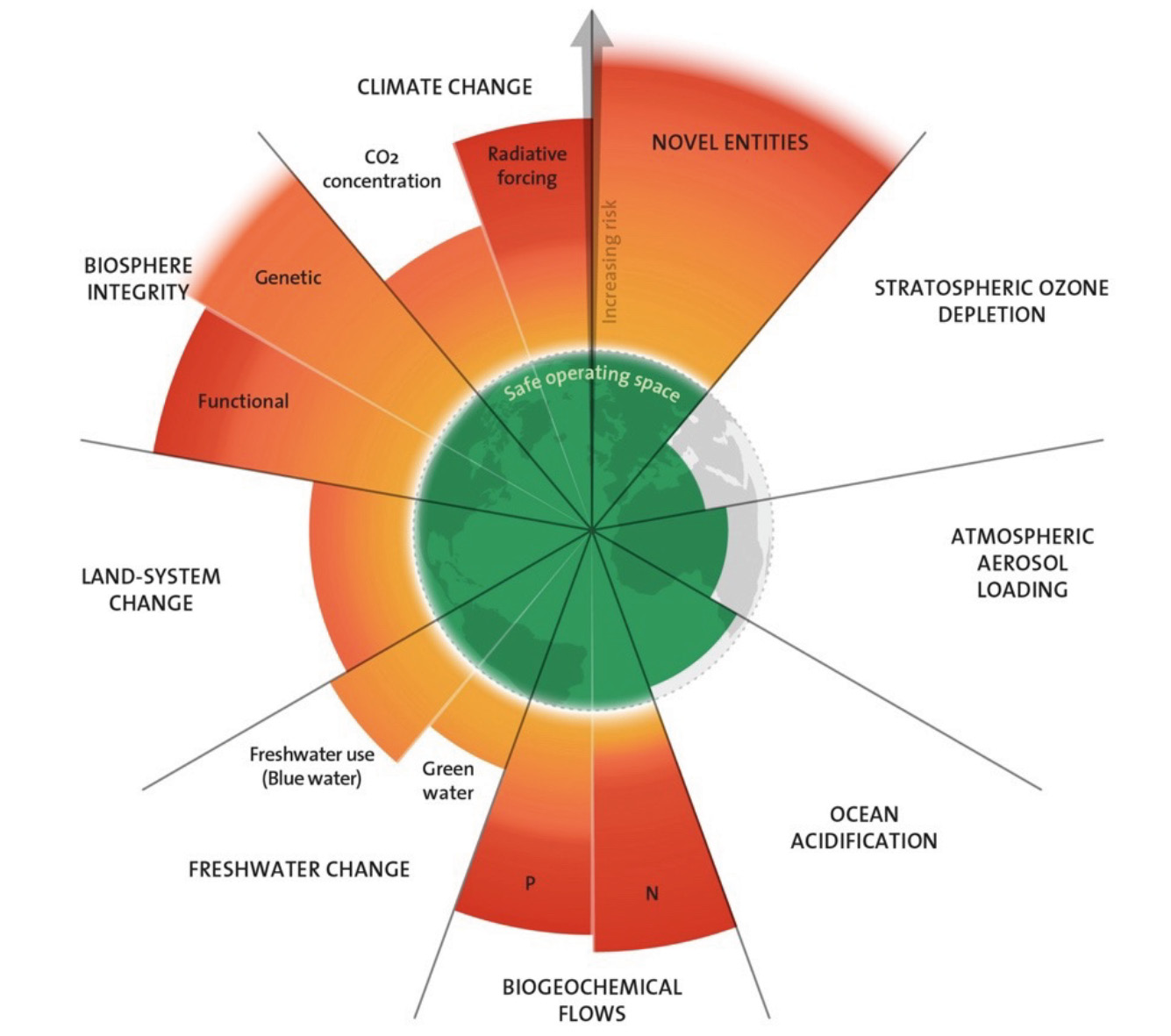
The planetary boundaries (PB) approach quantifies these challenges at the global level, with climate change and biodiversity loss only two of nine boundaries that help spell out a ‘safe operating space’ for humanity’s use of the biosphere (Steffen et al. 2015, Steffen et al. 2018). Additional boundaries include ocean acidification, freshwater withdrawals and pollution, stratospheric ozone depletion, creation and proliferation of artificial entities, phosphorus and nitrogen pollution, land system change, and atmospheric aerosol loading (Richardson et al. 2023). In each case, the developers of the PB approach specify levels of use or degrees of change that can be sustained indefinitely without directly harming large numbers of people or deranging ecological systems in ways which might harm them indirectly. Beyond these levels of use or change the potential exists for catastrophic harms – and the further beyond them we venture, the more likely such harms become (from orange to red in Figure 1 below).
A recent assessment found that humanity has entered the danger zone for six of the nine PBs and that in only one sector are we moving away from danger by decreasing our impacts (ozone depletion) (Richardson et al. 2023). In each of these six cases, excessive human environmental impacts are directly tied to unprecedented human numbers (Reid et al. 2005, Higgs 2017, Rees 2023).
Figure 1. Current status of indicators for nine planetary boundaries for safe human use of the biosphere, showing six of the nine boundaries transgressed (entering the orange and red zone)
Source: Azote for Stockholm Resilience Centre, based on analysis in Richardson et al. 2023.
CC BY-NC-ND 3.0
Figure 1 is warning that humanity is deep into ecological overshoot, exposing current and future generations to grave environmental dangers. The ecologically predictable world in which humankind created our complex civilizations, the Holocene epoch from approximately 12,000 BCE to the present, is over (McNeill and Engelke 2014). What replaces it remains to be seen. We are causing myriad changes, but we are not in control of them. While societies have created massive artificial infrastructures to support their current populations, these complex structures still depend on natural ecosystem services that can no longer be taken for granted. In general, then, criteria (1), (3) and (4) of our stipulated overpopulation definition are met. Even from a purely anthropocentric ethical perspective, in which all that really matters is human wellbeing, the world appears to be overpopulated.
5. An ethical response
5.1. Precaution versus wishful thinking
There is no lack of schemes in the scientific and policy literatures for solving global environmental problems without addressing overpopulation. Because discussing population has fallen out of fashion, such proposals do not have to mention it; they can simply take enormous future numbers as given (Coole 2018, Götmark et al. 2021). One recent study, for example, is titled ‘Feeding ten billion people is possible within four terrestrial planetary boundaries’ (Gerten et al. 2020). As it turns out, all we need to do is completely reinvent global agriculture. According to the study, agriculture as currently practiced could only provide a sufficient, balanced diet for 3.4 billion people – less than half humanity’s existing numbers – without trashing the planet. But if we expand irrigation while managing it more carefully, shift croplands from more to less biodiverse regions (moving tens of millions of farmers in the process), tighten up supply chains to drastically cut food waste, increase fertiliser use here while decreasing it there, eat less meat and more beans – if we do all these things and a lot more, everywhere, we could actually feed 10.2 billion people while ratcheting back pollution and biodiversity loss and still remaining within safe boundaries for use of the biosphere. In theory. A recent report from the EAT – Lancet Commission on Healthy, Sustainable, and Just Food Systems makes similar recommendations and exhibits similar complacency regarding human numbers (Rockström et al. 2025).
Perhaps all these reforms are possible, even at the enormous scales envisioned; perhaps they are all worthwhile. But it seems mistaken implicitly to define Earth’s human carrying capacity on such a speculative basis. There is no more essential human resource than sufficient food, while no ongoing human activity is doing more to displace other species and exceed planetary boundaries than agriculture (Crist et al. 2017). It seems grossly imprudent to menace humanity with the Scylla of mass starvation and the Charybdis of ecological collapse unless we achieve heroic changes across the entirety of global agriculture, particularly when good options exist to reduce agricultural demand by limiting population growth, widening the strait of eco-safety that all parties agree we need to pass through.
After forty years of half-hearted efforts to mitigate climate change, it should be clear neither rational self-interest nor altruistic concern for future generations are necessarily sufficient to motivate action to protect the global commons – especially when powerful, entrenched financial interests are at stake (Gilens and Page 2014). Even if robust action to deal with tough environmental challenges is forthcoming, unexpected technological or political difficulties could derail good faith efforts, or deliver results short of expectations. Our efforts could generate unexpected negative consequences and need to be discontinued. We should not assume numerous complicated efficiency improvements, deployed on an immense scale, will only deliver increased efficiency. If nations were as serious as they should be about ensuring sufficient food for future citizens, they would not rely exclusively on techno-managerial fixes, but hedge their bets by also pursuing population reduction.
But let’s imagine things turn out as well as possible within the agricultural sector, specifically. For the sake of argument, let us stipulate we can feed ten or even twenty billion people, indefinitely, without trespassing directly on any of the nine planetary boundaries in feeding them. Won’t increased human numbers scale up the many other demands we make on the world – with all that implies regarding potential planetary boundary breaking? Demands for housing, clothing and transportation; demands for materials, energy and space. Feeding more people means ... more people. As we have seen, more people scale up our demands on the natural world.
Here other experts rush to reassure us that in every case, managerial and technological improvements can meet the challenges of larger and more demanding numbers of people (Rockström and Klum, 2015). A recent book, Hannah Ritchie’s Not the End of the World: How We Can Be the First Generation to Build a Sustainable Planet (2024), collects such guarantees across a wide spectrum of environmental challenges, assuring readers that smaller populations or curbing economic growth are not necessary. But at some point, the authors of such defences are no longer making rational judgements about whether particular policies are likely to achieve particular goals. Instead, they are declaring their fundamental ideological allegiance to laissez-faire capitalism and complete human domination of the natural world (Asafu-Adjaye et al. 2015). Proposals to geoengineer Earth’s atmosphere or oceans to allow continued economic and demographic growth reveal similar ideological commitments (Stephens et al. 2023).
5.2. Realism versus ideology
It was to rescue the question of Earth’s human carrying capacity from such ideologically driven special pleading that I proposed the ethically and empirically grounded definition of overpopulation in section 3. So let’s take a step back, into the real world of clever but fallible human beings as we actually know them. By Gerten and colleagues’ calculations, agriculture as currently practiced could only provide a sufficient diet for less than half the existing human population without degrading the global environment. Actually existing agriculture for eight billion people has played an important role in pushing past four planetary boundaries: biospheric integrity, land-system change, climate change and over-nitrification of Earth’s waters (Crist et al. 2017, Gerten et al. 2020). All this strongly suggests humanity is overpopulated.
Recent estimates of a sustainable global population tend to run between two and four billion people, depending on a variety of factors, most importantly how opulently people want to live (Dasgupta 2019, Tucker 2019, Tamburino and Bravo 2021). The higher the average levels of wealth and consumption, the lower the sustainable human population. For example, Theodore Lianos and Anastasia Pseiridis (2016) calculate that the world could safely accommodate 3.1 billion people living on an average annual income of $9,000, an amount they deem sufficient to sustain a materially satisfactory life, while remaining within the ecological constraints assumed by the Living Planet Index. At higher income levels, according to these authors, the maximum sustainable population decreases proportionally.
Other researchers come up with higher or lower numbers for a sustainable global population (e.g. Arrhenius et al. 2024). The key point is that it is imprudent to place too much weight on any one of them. Instead, we should define a sustainable human population based on how people are living now and how that is actually impacting the global environment. Based on these realities, humanity appears to be significantly overpopulated today and should pursue population reduction going forward.
Elsewhere I detail policy proposals to accomplish population reduction gradually and fairly (Cafaro 2021, Cafaro 2026). Here I will merely suggest that in an overpopulated world, couples should voluntarily restrict themselves to one or two children – or remain childless if that is their preference, without guilt or reprobation (Bajaj et al. 2024) – while governments should enact policies to enable and encourage such small families.
Above all, national governments should guarantee their citizens universal, affordable access to family planning services, including modern contraception. Such policies are a winner all around: enhancing individual freedom and women’s rights, decreasing poverty, and reducing human numbers (Hardee et al. 2013, Brown and Hardee 2024). They have proven successful in reducing fertility and slowing population growth in many parts of the world (O’Sullivan 2020). Which specific population policies nations choose will legitimately differ, given the demographic, economic and social differences between them (Hedberg 2020). All policies should be made through informed, democratic decision-making (Conly 2016) and should respect human rights (Hickey et al. 2016). But their explicit goal should be fewer people – because today there are too many of us.
6. Conclusion
The approach to defining overpopulation laid out in this essay is cautious and reality-based for a reason. The reason is that life is good. We owe it to our children and grandchildren to pass on the means to enjoy it: a healthy, flourishing biosphere. Overpopulation threatens massive suffering for billions of people and extinction for millions of species. These facts justify humane efforts to reduce human numbers, as a matter of justice between current and future generations, and between people and other species. Addressing population is only part of creating just and sustainable societies, but it is a necessary part. While taking up population matters can be contentious and challenging, continuing to ignore them will likely prove much worse.
References
Angus, I., and S. Butler. 2011. Too Many People? Population, Immigration, and the Environmental Crisis. Chicago: Haymarket Books.
Arrhenius, G., et al. 2024. Sustainable Population in the Time of Climate Change. Stockholm: Institute for Futures Studies.
Asafu-Adjaye, J., et al. 2015. An Ecomodernist Manifesto. Berkeley:
Breakthrough Institute.
Attenborough, D. 2011. ‘Impact of population growth on the planet’. Lecture
to the Royal Society for the Encouragement of Arts, Manufactures and
Commerce, London.
Bajaj, N., et al. 2024. ‘Confronting the United Nations’ pro-growth agenda: A call to reverse ecological overshoot’. The Journal of Population and Sustainability 8 (2): 15–44. https://doi.org/10.3197/JPS.63799977346495
Benatar, D. 2008. Better Never to Have Been: The Harm of Coming into Existence. New York: Oxford University Press.
Bourban, M. 2019. ‘Croissance démographique et changement climatique: Repenser nos politiques dans le cadre des limites planétaires’. La Pensée Écologique 1 (3): 19–37. https://doi.org/10.3917/lpe.003.0019
Bradshaw, C., and B. Brook. 2014. ‘Human population reduction is not a quick fix for environmental problems’. Proceedings of the National Academy of Sciences 111 (46): 16610–16615. https://doi.org/10.1073/pnas.1410465111
Bradshaw, C., et al. 2021. ‘Underestimating the challenges of avoiding a ghastly future’. Frontiers in Conservation Science 1: 615419. https://doi.org/10.3389/fcosc.2020.615419
Broome, J. 2012. Climate Matters. New York: Norton.
Brown, W., and K. Hardee. 2024. ‘Can the International Conference on Population and Development Programme of Action and Cairo Consensus normalize the discourse on population?’ Global Health: Science and Practice 12: e2400121. https://doi.org/10.9745/GHSP-D-24-00121
Cafaro, P. 2004. Thoreau’s Living Ethics: Walden and the Pursuit of Virtue. Athens: University of Georgia Press. https://doi.org/10.1353/book11532
Cafaro, P. 2015. ‘Three ways to think about the sixth mass extinction’. Biological Conservation 192: 387–393. https://doi.org/10.1016/j.biocon.2015.10.017
Cafaro, P. 2021. ‘Just population policies for an overpopulated world’. Ecological Citizen 5 (1): 55–64.
Cafaro, P. 2022. ‘Reducing human numbers and the size of our economies is necessary to avoid a mass extinction and share Earth justly with other species’. Philosophia 50: 2263–2282. https://doi.org/10.1007/s11406-022-00497-w
Cafaro, P. 2026 (forthcoming). ‘Too many people: Applying IPAT in an overpopulated world’. In T. Ruuska and T. Nyfors (eds), Sufficiency: From Growth and Overshoot to Enoughness, pp. 173–205. Leiden: Brill.
Cafaro, P., and J. O’Sullivan. 2019. ‘How should ecological citizens think about immigration?’ Ecological Citizen 3: 85–92.
Cafaro, P., et al. 2022. ‘Overpopulation is a major cause of biodiversity loss and smaller human populations are necessary to preserve what is left’. Biological Conservation 272: 109646. https://doi.org/10.1016/j.biocon.2022.109646
Cafaro, P., et al. 2023. ‘Population effects on biodiversity and climate change: Evidence from recent scientific literature, 2010–2022’. Indian Journal of Population and Development 3: 149–206.
Ceballos, C., et al. 2015. ‘Accelerated modern human-induced species losses: Entering the sixth mass extinction’. Science Advances 1: e1400253. https://doi.org/10.1126/sciadv.1400253
Chapron, G., et al. 2014. ‘Recovery of large carnivores in Europe’s modern human-dominated landscapes’. Science 346: 1517–1519.
Cioran, E.M. 2013. The Trouble with Being Born. New York: Arcade Publishers.
Cohen, J., 1996. How Many People Can the Earth Support? New York:
WW Norton.
Conly, S. 2016. One Child: Do We have a Right to More? New York: Oxford University Press. https://doi.org/10.1093/acprof:oso/9780190203436.001.0001
Coole, D. 2018. Should We Control World Population? Cambridge: Polity Press.
Crist, E. 2019. Abundant Earth: Toward an Ecological Civilization. Chicago: University of Chicago Press. https://doi.org/10.7208/chicago/9780226596945.001.0001
Crist, E., et al. 2017. ‘The interaction of human population, food production,
and biodiversity protection’. Science 356: 260–264. https://doi.org/10.1126/science.aal2011
Crist, E., et al. 2021. ‘Protecting half the planet and transforming human systems are complementary goals’. Frontiers of Conservation Science 2: 761292.
https://doi.org/10.3389/fcosc.2021.761292
Crist, E., et al. 2022. ‘Scientists’ warning on population’. Science of the Total Environment 845: 157166. https://doi.org/10.1016/j.scitotenv.2022.157166
Daly, H., and J. Farley. 2010. Ecological Economics: Principles and Applications. Second edition. Washington, DC: Island Press.
Dasgupta, P. 2019. Time and the Generations: Population Ethics for a Diminishing Planet. New York: Columbia University Press. https://doi.org/10.7312/dasg16012
Despommier, D. 2010. The Vertical Farm: Feeding the World in the 21st Century. New York: Thomas Dunne.
Diaz, S., et al. 2019. ‘Pervasive human-driven decline of life on earth points to the need for transformative change’. Science 366: 1327.
Dietz, R., and D. O’Neill. 2013. Enough Is Enough: Building a Sustainable Economy in a World of Finite Resources. Oakland, CA: Berrett-Koehler Publishers.
Dilworth, C. 2010. Too Smart for Our Own Good: The Ecological Predicament of Mankind. Cambridge: Cambridge University Press. https://doi.org/10.1017/CBO9780511840357
Dinerstein, E., et al. 2017. ‘An ecoregion-based approach to protecting half the terrestrial realm’. Bioscience 67: 534–545. https://doi.org/10.1093/biosci/bix014
Dodson, J., et al. 2020. ‘Population growth and climate change: Addressing the overlooked threat multiplier’. Science of the Total Environment 748: 141346. https://doi.org/10.1016/j.scitotenv.2020.141346
Donaldson, S., and W. Kymlicka. 2011. Zoopolis: A Political Theory of Animal Rights. New York: Oxford University Press.
Ehrlich, P., and J. Holdren. 1972. ‘Critique’. Bulletin of the Atomic Scientists 28 (5): 16–27. https://doi.org/10.1080/00963402.1972.11457930
Fleurbaey, M., et al. 2019. ‘The social cost of carbon: Valuing inequality, risk, and population for climate policy’. The Monist 102: 84–109. https://doi.org/10.1093/monist/ony023
Francis. 2015. ‘Encyclical Letter Laudato Si’ of the Holy Father Francis: On Care for Our Common Home’. 24 May. The Vatican.
Gambrel, J., and P. Cafaro. 2010. ‘The virtue of simplicity’. Journal of Agricultural and Environmental Ethics 23 (1–2): 85–108. https://doi.org/10.1007/s10806-009-9187-0
Ganivet, E. 2019. ‘Growth in human population and consumption both need to be addressed to reach an ecologically sustainable future’. Environment, Development and Sustainability 22: 4979–4998. https://doi.org/10.1007/s10668-019-00446-w
Gerten, D., et al. 2020. ‘Feeding 10 billion people is possible within four terrestrial planetary boundaries’. Nature Sustainability 3: 200–208. https://doi.org/10.1038/s41893-019-0465-1
Gilens, M., and B. Page. 2014. ‘Testing theories of American politics: Elites, interest groups, and average citizens’. Perspectives on Politics 12 (3): 564–581. https://doi.org/10.1017/S1537592714001595
Götmark, F., and M. Andersson. 2022. ‘Achieving sustainable population: Fertility decline in many developing countries follows modern contraception, not economic growth’. Sustainable Development 31 (3): 1606–1617. https://doi.org/10.1002/sd.2470
Götmark, F., et al. 2021. ‘Discussing population concepts: Overpopulation is a necessary word and an inconvenient truth’. Indian Journal of Population and Development 1 (1): 51–60.
Greaves, H. 2018. ‘Optimal population size’. In G. Arrhenius, K. Bykvist and
T. Campbell (eds), Oxford Handbook of Population Ethics. Oxford: Oxford University Press.
Greaves, H. 2019. ‘Climate change and optimum population’. The Monist 102 (1): 42–65. https://doi.org/10.1093/monist/ony021
Hall, C., et al. 2017. ‘The impact of population growth and climate change on food security in Africa: Looking ahead to 2050’. International Journal of Agricultural Sustainability 15 (2): 124–135. https://doi.org/10.1080/14735903.2017.1293929
Hardee, K., et al. 2013. Voluntary Family Planning Programs That Respect,
Protect, and Fulfill Human Rights: A Conceptual Framework. Washington, DC: Futures Group.
Hedberg, H. 2020. The Environmental Impact of Overpopulation:
The Ethics of Procreation. Abingdon-on-Thames, UK: Routledge.
https://doi.org/10.4324/9781351037020
Hickel, J. 2020. Less is More: How Degrowth Will Save the World. London:
William Heinemann.
Hickey, C., et al. 2016. ‘Population engineering and the fight against climate change’. Social Theory and Practice 42 (4): 845–870. https://doi.org/10.5840/soctheorpract201642430
Higgs, K. 2017. ‘Limits to growth: Human economy and planetary boundaries’. Journal of Population and Sustainability 2 (1): 15–36. https://doi.org/10.3197/jps.2017.2.1.15
Intergovernmental Panel on Biodiversity and Ecosystem Services (IPBES). 2019. Summary for Policymakers: Global Assessment Report on Biodiversity and Ecosystem Services. IPBES Secretariat.
Intergovernmental Panel on Climate Change (IPCC). 2007. Climate Change 2007: Mitigation. Contribution of Working Group III to the Fourth Assessment, Technical Summary. IPCC Secretariat.
Intergovernmental Panel on Climate Change (IPCC). 2014. Summary for Policymakers. Climate Change 2014: Mitigation of Climate Change. Contribution of Working Group III to the Fifth Assessment Report. IPCC Secretariat.
https://doi.org/10.1017/CBO9781107415416
Intergovernmental Panel on Climate Change (IPCC). 2022. Climate Change 2022: Mitigation of Climate Change. Contribution of Working Group III to the Sixth Assessment Report. IPCC Secretariat. https://doi.org/10.1017/9781009157926
Kallis, G. 2019. Limits: Why Malthus Was Wrong and Why Environmentalists Should Care. Redwood City, CA: Stanford University Press. https://doi.org/10.1515/9781503611566
Kaya, Y., and K. Yokoburi. 1997. Environment, Energy, and Economy: Strategies for Sustainability. Tokyo: United Nations University Press.
Khalfan, A., et al. ٢٠٢٣. Climate Equality: A Planet for the 99%. Oxford: Oxfam International. https://doi.org/10.21201/2023.000001
Kharas, H. 2017. ‘The unprecedented expansion of the global middle class:
An update’. Working Paper 100. Brookings Global Economy and Development.
Kortetmäki, T. 2017. Justice in and to Nature: An Application of the Broad Framework of Environmental and Ecological Justice. Jyväskylä Studies in Education, Psychology and Social Research 587. Jyväskylä: University of Jyväskylä.
Krishnadas, M., et al. 2018. ‘Parks protect forest cover in a tropical biodiversity hotspot, but high human population densities can limit success’. Biological Conservation 223: 147–155. https://doi.org/10.1016/j.biocon.2018.04.034
Kuhlemann, K. 2018. ‘“Any size population will do?” The fallacy of aiming for stabilization of human numbers’. The Ecological Citizen 1: 181–189.
Kurtzweil, R. 2024. The Singularity Is Nearer: When We Merge with AI. New York: Viking Press.
Lianos, T., and A. Pseiridis. 2016. ‘Sustainable welfare and optimum population size’. Environmental Development and Sustainability 18 (6): 1679–1699. https://doi.org/10.1007/s10668-015-9711-5
MacIver, C. 2015. ‘Procreation as appropriation’. In S. Hannan, S. Brennan and R. Vernon (eds), Permissible Progeny? The Morality of Procreation and Parenting, pp. 107–129. Oxford: Oxford University Press. https://doi.org/10.1093/acprof:oso/9780199378111.003.0005
Marques, A., et al. 2019. ‘Increasing impacts of land use on biodiversity and carbon sequestration driven by population and economic growth’. Nature: Ecology & Evolution 3: 628–637. https://doi.org/10.1038/s41559-019-0824-3
McNeill, J., and P. Engelke. 2014. The Great Acceleration: An Environmental History of the Anthropocene Since 1945. Cambridge, MA: Harvard University Press. https://doi.org/10.4159/9780674970731
Meijers, T. 2016. ‘Climate change and the right to one child’. In G. Bos and
M. Düwell (eds), Human Rights and Sustainability, pp. 181–194. Abingdon-on-Thames, UK: Routledge. https://doi.org/10.4324/9781315665320-14
Mills, S. 2003. Epicurean Simplicity. Washington, DC: Island Press.
Mitchell, R.B. 2012. ‘Technology is not enough: Climate change, population, affluence, and consumption’. The Journal of Environment & Development 21 (1): 24–27. https://doi.org/10.1177/1070496511435670
Norton, B. 1997. ‘Convergence and contextualism’. Environmental Ethics 19 (1): 87–100. https://doi.org/10.5840/enviroethics199719141
Nussbaum, M. 2024. Justice for Animals: Our Collective Responsibility. New York: Simon & Schuster.
O’Neill, B.C., et al. 2012. ‘Demographic change and carbon dioxide emissions’. The Lancet 380 (9837): 157–164. https://doi.org/10.1016/S0140-6736(12)60958-1
O’Sullivan, J.N. 2020. ‘The social and environmental influences of population growth rate and demographic pressure deserve greater attention in ecological economics’. Ecological Economics 172: 106648. https://doi.org/10.1016/j.ecolecon.2020.106648
Overpopulation Project. 2020. ‘Rewilding success stories’. Online at https://overpopulation-project.com/rewilding-success-stories/ (accessed 4 December
4 2025).
Palmer, C. 2010. Animal Ethics in Context. New York: Columbia University Press.
Pereira, H., and L. Navarro (eds). 2015. Rewilding European Landscapes. Cham: Springer International. https://doi.org/10.1007/978-3-319-12039-3
Pimm, S., et al. 2014. ‘The biodiversity of species and their rates of extinction, distribution, and protection’. Science 344 (no. 6187) (art. 1246752): 1–10.
https://doi.org/10.1126/science.1246752
Rees, W. 2020. ‘Ecological economics for humanity’s plague phase’. Ecological Economics 169: 106519. https://doi.org/10.1016/j.ecolecon.2019.106519
Rees, W. 2023. ‘The human eco-predicament: Overshoot and the population conundrum’. Vienna Yearbook of Population Research 21: 21–39. https://doi.org/10.1553/p-eznb-ekgc
Reid, W.V., et al. 2005. The Millennium Ecosystem Assessment: Ecosystems and Human Well-being. Washington, DC: Island Press.
Richardson, K., et al. 2023. ‘Earth beyond six of nine planetary boundaries’. Science Advances 9: eadh2458. https://doi.org/10.1126/sciadv.adh2458
Rieder, T. 2016. Toward a Small Family Ethic: How Overpopulation and Climate Change Are Affecting the Morality of Procreation. New York: Springer.
Ripple, W., et al. 2015. ‘Collapse of the world’s largest herbivores’. Science Advances 1: e1400103. https://doi.org/10.1126/sciadv.1400103
Ripple, W.J., et al. 2020. ‘World scientists’ warning of a climate emergency’. BioScience 70 (1): 8–12. https://doi.org/10.1093/biosci/biz152
Ritchie, H. 2024. Not the End of the World: How We Can Be the First Generation to Build a Sustainable Planet. New York: Little, Brown, Spark.
Rockström, J., and M. Klum. 2015. Big World, Small Planet: Abundance within Planetary Boundaries. New Haven: Yale University Press.
Rockström, J., et al. 2025. ‘The EAT–Lancet Commission on healthy, sustainable, and just food systems’. The Lancet 406 (10512): 1625–1700. https://doi.org/10.1016/S0140-6736(25)01201-2
Rolston III, H. 1994. Conserving Natural Value. New York: Columbia
University Press.
Rolston III, H. 2020. A New Environmental Ethics. London: Routledge. https://doi.org/10.4324/9781003036746
Rosenberg, K., et al. 2019. ‘Decline of the North American avifauna’. Science 366 (6461): 120–124. https://doi.org/10.1126/science.aaw1313
Rosling, H. 2018. Factfulness: Ten Reasons We’re Wrong About the World – and Why Things Are Better Than You Think. New York: Flatiron.
Sandler, R. 2012. The Ethics of Species: An Introduction. New York: Cambridge University Press. https://doi.org/10.1017/CBO9781139151221
Sarkar, S. 2011. Environmental Philosophy: From Theory to Practice. Malden, MA: Wiley-Blackwell.
Secretariat of the Convention on Biological Diversity. 2010. Global Biodiversity Outlook 3. Montreal: Secretariat of the Convention on Biological Diversity.
Skirbekk, V. 2022. Decline and Prosper! Changing Global Birth Rates and
the Advantages of Fewer Children. London: Palgrave-Macmillan. https://doi.org/10.1007/978-3-030-91611-4
Staples, W., and P. Cafaro. 2012. ‘For a species right to exist’. In P. Cafaro and E. Crist (eds), Life on the Brink: Environmentalists Confront Overpopulation,
pp. 283–300. Athens, GA: University of Georgia Press.
Steffen, W., et al. 2015. ‘Planetary Boundaries: Guiding Human Development on a Changing Planet’. Science 347: 1259855. https://doi.org/10.1126/science.1259855
Steffen, W. et al. 2018. ‘Trajectories of the Earth System in the Anthropocene’. Proceedings of the National Academy of Sciences 115 (6223): 8252–8259.
https://doi.org/10.1073/pnas.1810141115
Stephens, J., et al. 2023. ‘The dangers of mainstreaming solar geoengineering: A critique of the National Academies report’. Environmental Politics 32 (1): 157–166. https://doi.org/10.1080/09644016.2021.1989214
Tamburino, L., and G. Bravo. 2021. ‘Reconciling a positive ecological balance with human development: a quantitative assessment’. Ecological Indicators 129: 107973. https://doi.org/10.1016/j.ecolind.2021.107973
Tamburino, L., et al. 2023. ‘An analysis of three decades of increasing carbon emissions: The weight of the P factor’. Sustainability 15 (4): 3245. https://doi.org/10.3390/su15043245
Tamburino, L., et al. 2025. ‘Carbon Inequality: Resolving Contradictory Results from Two Different Approaches’. Qeios (pre-print). https://doi.org/10.32388/CNVHVF
Tucker, C. 2019. A Planet of 3 Billion. Atlas Observatory Press.
Turner, N., and F. Götmark. 2023. ‘Human fertility and religions in sub-Saharan Africa: A comprehensive review of publications and data, 2010–2020’. African Journal of Reproductive Health 27 (1): 119–172.
United Nations. 2024. World Population Prospects 2024. Population Division, Department of Economic and Social Affairs, New York.
van Vuuren, D., et al. 2018. ‘Alternative pathways to the 1.5 C target reduce the need for negative emission technologies’. Nature Climate Change 8: 391–397. https://doi.org/10.1038/s41558-018-0119-8
Vettese, T., and D. Pendergrass. 2022. Half-Earth Socialism. London: Verso.
Vollset, S., et al. 2020. ‘Fertility, mortality, migration, and population scenarios for 195 countries and territories from 2017 to 2100: A forecasting analysis for the Global Burden of Disease Study’. The Lancet 396 (10258): 1285–1306. https://doi.org/10.1016/S0140-6736(20)30677-2
Weber, H., and J. Sciubba. 2018. ‘The effect of population growth on the environment: Evidence from European regions’. European Journal of Population 35: 379–402. https://doi.org/10.1007/s10680-018-9486-0
Wiedmann, T., et al. 2020. ‘Scientists’ warning on affluence’. Nature Communications 11: 3107. https://doi.org/10.1038/s41467-020-16941-y
Wienhues, A. 2020. Ecological Justice and the Extinction Crisis: Giving Living Beings Their Due. Bristol: Bristol University Press. https://doi.org/10.1332/policypress/9781529208511.001.0001
Wilson, E.O. 2016. Half Earth: Our Planet’s Fight for Life. New York: Norton.
World Wildlife Fund. 2022. Living Planet Report 2022 – Building a Nature-Positive Society. Gland, Switzerland.
1 Colorado State University. Email: Philip.Cafaro@ColoState.EDU
2 In fact, this is what has happened in recent decades with carbon emissions. Many wealthy nations have decreased per capita carbon emissions through efficiency improvements and technology switching, holding their total emissions steady or even decreasing them (Tamburino et al. 2023). Meanwhile, growth of a several billion-strong ‘global consuming class’ in developing countries has greatly increased these nations’ per capita and total emissions, leading to increased global emissions overall (Kharas 2017, Tamburino et al. 2025).
3 What might constitute fairly sharing the landscape with other species is a big question that I cannot do justice to here; good starts to answering it have been made by Rolston (1994) and Wienhues (2020). Given the current scale of human destruction of other forms of life, only a very minimal conception of interspecies fairness seems required to justify the argument presented here.
4 That life is good is a basic presupposition of most approaches to ethics. For eloquent arguments that life is not in fact good, see David Benatar (2008) and E.M. Cioran (2013).
5 Overpopulation can occur at all scales, however, from the local to the global, and population matters deserve our attention at all of them. Sustainability advocates should be particularly concerned with overpopulation at the national level, given that most population policy is made at this level (Cafaro and O’Sullivan 2019).
6 The convergence hypothesis posits that if one considers the full range of human interests and values, this should lead to the same practical environmental policies advocated by those who find direct intrinsic value in the non-human world.