Shruthi Kumar
The Role of Palm-Leaf Manuscripts in the Preservation of Traditional Siddha Medicine in Tamil Nadu, South India
PLANT PERSPECTIVES 3/2 - 2026: 389–393
doi: 10.3197/whppp.63876246815936
Open Access CC BY 4.0 © The Author
 Palm leaves have been vital in preserving and legitimising indigenous knowledge of science and medicine in India. Siddha medicine, one of the earliest traditional medical systems in the world, is often perceived as illegitimate or pseudoscientific (Weiss 2009: 39). For much of its history, knowledge of Siddha medicine was passed down orally, making it difficult to establish its legitimacy through documentary evidence. Siddha medicine was marginalised within India, overshadowed by colonial preferences for Ayurveda and Sanskrit texts (Kanagarathinam 2018). Palm-leaf manuscripts, however, provided one of the few sources of written evidence for Siddha medicine, enabling it to challenge such perceptions, root itself in the classical Tamil script and establish itself as a ‘real’ science both within India and globally. The medical wisdom contained in these palm-leaf manuscripts certainly substantiates the science of Siddha, along with the chemical processes of preserving the palm leaves themselves. Originating in Tamil Nadu, South India, Siddha medicine has evolved from its origins in alchemy, philosophy and religion to modern biomedical research in the use of poly-herbal medical compounds to treat disease and maintain health. While palm leaves can be a material witness in biochemically tracing the origins of Siddha medicine, the true dates are difficult to ascertain accurately but are estimated to date back to 2500 bce (Pandey et al. 2013). Palm leaves enabled the earliest written documentation of Siddha medicine and therefore its survival to the present day. This meditation discusses how palm leaves preserved and historically sustained the knowledge economy of Siddha medicine in India.
The original palm-leaf manuscripts of Siddha medicine written by the very first Siddhars no longer exist. However, before the original palm-leaf deteriorated, the chosen disciples of the ancient Siddhars recorded and copied the information from the original manuscript to a new palm-leaf. Old and decaying manuscripts were then composted by being burnt in ghee or thrown into the river. As the oldest medium of written communication in Southern India, the palm leaf required methods of preparation and preservation that were, in and of themselves, scientific processes. The chemical process of preservation of the palm leaves allows the organic material to sustain a lifespan of about 300 years, preserving the Indigenous knowledge of medicine for generations. The palm-leaf manuscripts we have today are the result of umpteen iterations of the transcription and preservation process.
In South India, recordkeepers wrote on palm leaves (from mainly Borassus flabellifer and Corypha umbraculifera varieties, commonly known as palmyra and talipot, respectively) because they were durable, cheap and readily available (Kumar et al. 2009). The preparation and preservation processes of palm leaves vary slightly across geographies within India. In Kerala (Tamil Nadu’s sister state), palm leaves must be in a semi-mature condition when extracted. The leaves are then dehydrated and dried in the sun before being stripped into leaflets. The leaves are pressed with sesame oil, boiled with rice or turmeric juice, and re-oiled. This process removes acidic impurities in the leaves, making them more fire-resistant and waterproof. The palm leaves are boiled in a copper vessel where copper ions penetrate the leaflets increasing durability (Padmakumar et al. 2003). In some cases/regions, the recordkeepers protect leaves against insects and fungi by fumigating them with thymol vapours or submerging them in lime. Carbon black mixed with oil helps preserve the imprints of the ink. The application of sesame, camphor or lemongrass oil helps the leaves maintain the proper balance between flexibility and brittleness over time. Altogether, these preparation and preservation processes extend the lifespan of the palm-leaf manuscript to about 300–350 years, with some surviving up to 600 years (Ibid).
While palm-leaf manuscripts were a historically critical vehicle for the preservation of Siddha medicine, their modern survival is tenuous. Six hundred years is not forever. Especially in South India’s tropical and political climate, the palm-leaf manuscripts remain vulnerable to decay. Neglect by the National Government of India, for instance, has led to these manuscripts being undervalued and discarded rather than cherished and preserved (Kanagarathinam and Lourdusamy 2023). Siddha medicine’s vast literature, primarily in palm-leaf form, risks being lost forever, as only Classical Tamil scholars or Siddha doctors can translate and digitise the leaves. Family collections of these manuscripts are scattered across Tamil Nadu, often forsaken and deemed useless. Preserving these manuscripts is urgent. They hold significant historical and scientific value. The existence of palm-leaf manuscripts and the skill required to create them challenges colonial perceptions of Siddha medicine as unscientific, repositioning its knowledge as a truly scientific medical system both within India and in the global economy.
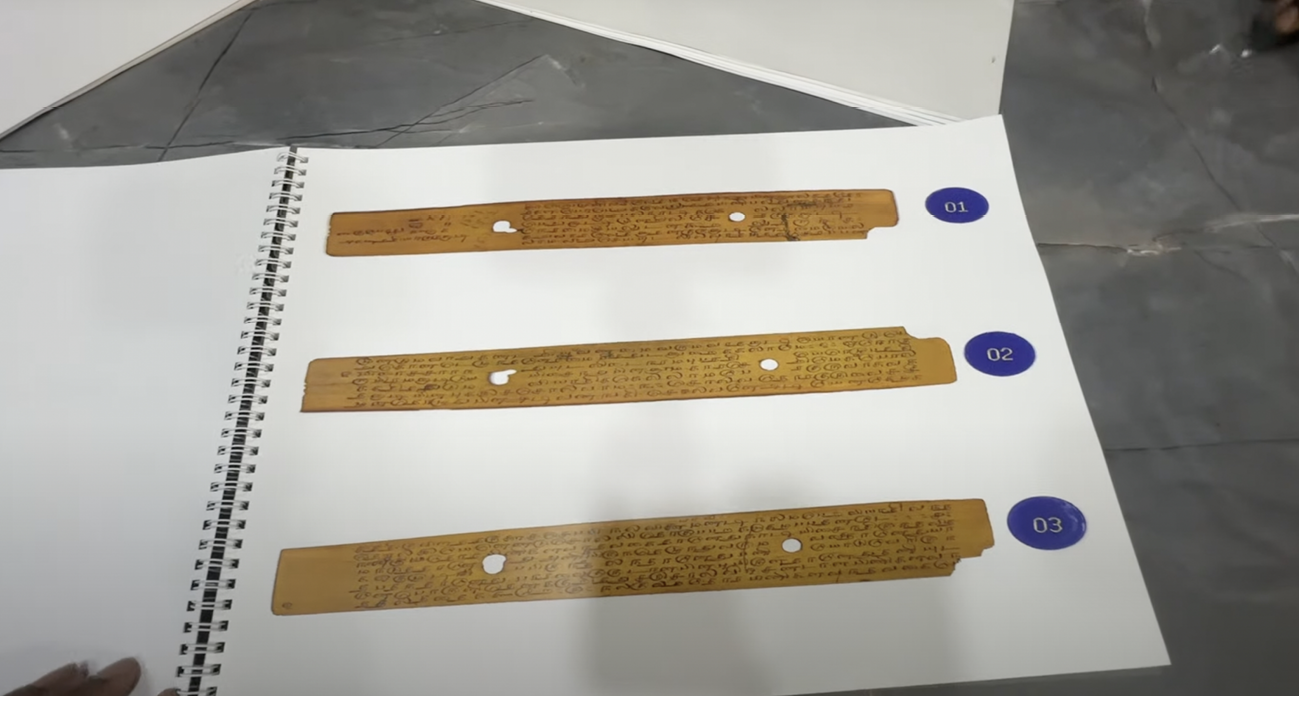
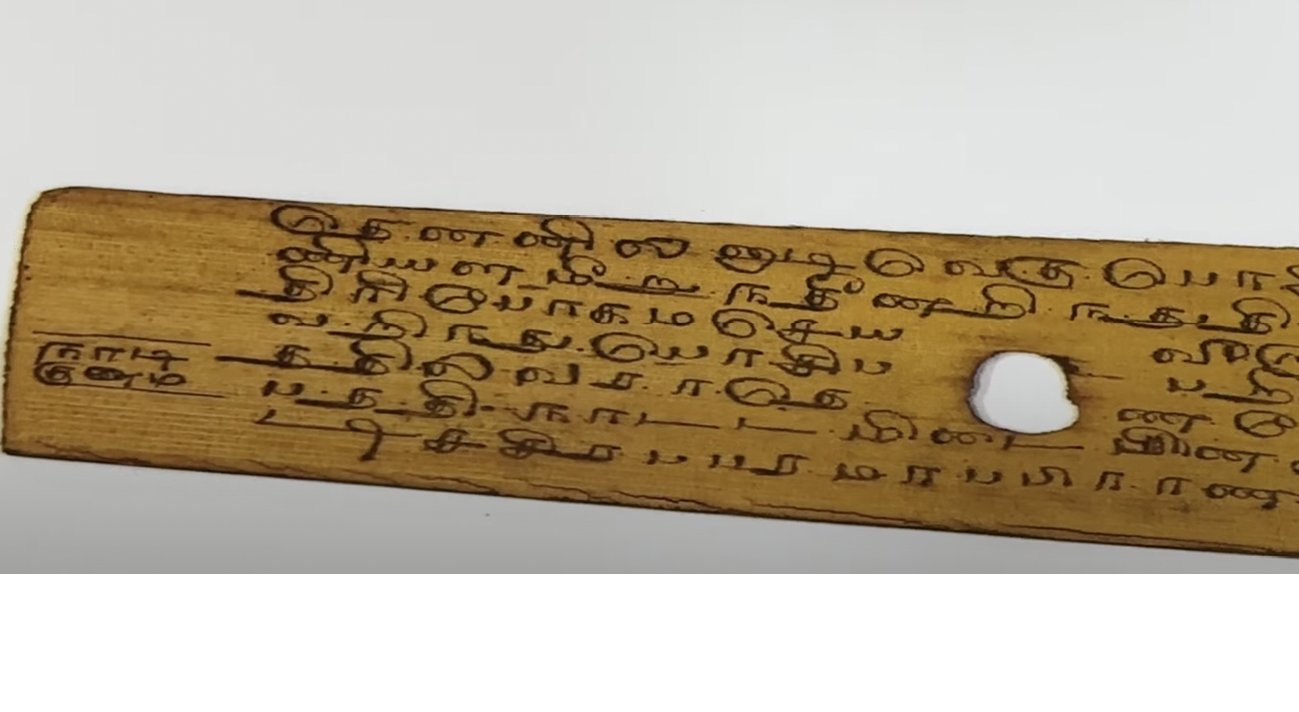
Figure 1.
Photos taken by Shruthi Kumar, 10 January 2024, at the Central Institute of Classical Tamil (CICT) in Chennai, India, showcasing CICT’s preservation efforts with respect to Siddha palm-leaf manuscripts.
Kanagarathinam, D.V. 2018. ‘Revitalisation of Ayurveda: Institutionalisation and standardisation of medicine in colonial South India’. Journal of Indian History and Culture 24: 241–67.
Kanagarathinam, D.V. and J.B. Lourdusamy. 2023. ‘Rise of Siddha medicine: causes and constructions in the Madras Presidency (1920–1930s)’. Medical History 67 (1): 42–56.
https://doi.org/10.1017/mdh.2023.10
Kumar, D.U., G. Sreekumar and U.A. Athvankar. 2009. ‘Traditional writing system in southern India—palm leaf manuscripts’. Design Thoughts 7: 2–7.
Padmakumar, P.K., V.B. Sreekumar, V.V. Rangan and C. Renuka. 2003. ‘Palm leaves as writing material: History and method of processing in Kerala’. PALMS-LAWRENCE 47:125–29.
Pandey, M.M., S. Rastogi and A.K.S. Rawat. 2013. ‘Indian traditional ayurvedic system of medicine and nutritional supplementation’. Evidence‐Based Complementary and Alternative Medicine 2013 (1): 376327.
Weiss, R.S. 2009. Recipes for Immortality: Healing, Religion, and Community in South India. Oxford University Press.
Shruthi Kumar is a researcher and writer whose work explores the history, transmission and contemporary relevance of traditional medical knowledge systems, particularly Siddha medicine in South India. She graduated from Harvard University in 2024 with a degree in History of Science and Economics and a secondary field in Human Evolutionary Biology. Her senior thesis, ‘Ancient Cures to Modern Diseases: The Birth of Siddha Medicine and Its Use in the COVID-19 Pandemic’, was presented at the 2024 Richard Macksey National Undergraduate Humanities Research Conference, the Harvard Scholarship & Social Justice Undergraduate Research Conference, and the Mellon Mays Northeast Regional Conference.
Email: shruthikumar200@gmail.com