Gbenga Adesina and Case Watkins
Transatlantic Ecologies of the African Oil Palm: Photo-Poetic Explorations of the Intimacies of Diaspora
PLANT PERSPECTIVES 3/2 - 2026: 238–265
doi: 10.3197/whppp.63876246815929
Open Access CC BY 4.0 © The AuthorS
This collaborative, experimental essay considers, feels and relates stories that emerge from the transatlantic diaspora of the African oil palm (Elaeis guineensis Jacq). Grounded in photographs from Bahia, Brazil, a poet and a geographer respond to the images and to each other with theoretical narratives and poetic meditations. Exchanging in these various modes, we explore a range of intimate ecologies, landscapes and foodways forged by coalitions of palms and people in diaspora.
Photography, poetry, political ecology, palm oil, landscapes, Costa do Dendê, Bahia, Atlantic world, African diaspora, Afro-Brazil
Danço a magia, canto a Bahia
Prosada e versada no dendê, no dendê
Bahia
África do lado de cá
Reza, alegria, rito, harmonia
I dance the magic, I sing Bahia
Composed and versed in dendê, in dendê
Bahia
Africa, on this side
Prayer, joy, ritual, harmony
– Mateus Aleluia, ‘Bahia bate o tambor,’ Track 3 on Fogueira Doce (Três Selos, 2017, LP). Our translation.
Is there any plant more infamous than the African oil palm (Elaeis guineensis Jacq.)? As the twenty-first century’s most produced, traded and derided edible oil, palm oil has become a poster child of globalised capitalist extraction run amok. Grown mostly in plantation monocultures blazed into rainforest biomes in Southeast Asia (and elsewhere in the tropical Global South), the African oil palm has earned a nasty reputation as a land grabbing, greenhouse gas emitting, biodiversity eroding nightmare (Robins 2021). Still, none of this is the fault of the palm itself – an exceptionally prolific, versatile and beneficial plant with rich socioecological histories resonating through West and Central Africa and into diaspora (Watkins 2021). In this experimental essay, we reflect on those lesser-explored diasporic histories and the intimate ecologies they have entwined.
Over at least the past 5,000 years, the African oil palm has collaborated with human partners to create and sustain communities, cultures and cosmologies in West and Central Africa. Yoruba communities, as just one example, revere the oil palm as the ‘tree of life’ whose oil represents the nourishing ‘blood of the Earth,’ essential in the preparation of many ritual and mundane foods (Ojo 1967: 53; Ológundúdú 2008: 39). When the transatlantic slave trade began kidnapping and trafficking millions of African souls to the Americas, the African oil palm made the journey along with them. Together with a rich variety of African plants, seeds, animals and foods, the palm and its oils became early travellers on the brutal transatlantic circuit of African bodies and other goods.1 Thus the African diaspora is, and has always been, more-than-human – an immense diffusion of people, plants, knowledge, power and resistance that has reshaped the demographics, politics, cultures and ecologies of the Americas and beyond.
Diaspora holds an abundance of meanings. For people and other beings separated from their homelands, diaspora can evoke distance, uprootedness and loss. Yet, at the same time, diaspora carries with it new opportunities for connection, for community and for place-making (Williams et al. 2025, Henson 2024: 1–26). Separated from more familiar contexts and webs of relation, diaspora integrates its agents – whether people, plants or other beings – into new social-ecological relations. It is this reshuffling of relation and potential that captivates this essay. Just as diaspora severs some bonds, it creates potentials for new ones. Coming into relation with new places thus creates new collaborations, new ecologies, new intimacies.
In this photo-poetic exploration, a poet and essayist from Lagos, Nigeria, and a gringo geographer working in Brazil consider, feel and relate stories that emerge from the transatlantic diaspora of the African oil palm. Grounded in photographs of diasporic ecologies from Bahia, Brazil, we respond to the images and each other with theory, poetry and lyrical prose. Experimenting in these various modes, we explore a range of intimate transatlantic ecologies, landscapes and foodways forged by palms and people in diaspora. We connect cultural-environmental geographies of the African oil palm with under-appreciated theories and theorists in and of Brazil and elsewhere in the Global South to highlight the generative tensions underlying diaspora and more-than-human relationality. The resulting visual, narrative-theoretical and poetic reflections offer a coalescent yet ephemeral treatment of the ever-shifting intimacies of palms, landscapes, ecologies and foodways in Bahia, the African diaspora and their Atlantic worlds. We stress that the thoughts we string together here are experimental rather than conclusive. We offer them as an invitation to imagine with us.
A note on methods
Case Watkins shot these photographs as a part of ongoing ethnographic fieldwork in Bahia, Brazil, beginning in 2008. All the knowledge and images represented here were derived from ethnographic practices centring informed consent, community autonomy and ethical commitments to walking with our collaborators (Sundberg 2014, Watkins 2021). Gbenga Adesina selected these seven images from a much larger array. Without discussing the photos and before any captions or narratives were written, the two authors individually prepared drafts in response to the images – the former based in poetry and lyrical prose and the latter based in narrative and theoretical exploration. Drafts were exchanged, discussed and then revised in response to each other’s treatments and ideas. Revised drafts were then collated and edited for clarity.
THE AFRICAN (DIASPORIC) OIL PALM
The dispersal of the African oil palm has always been socioecological. Initially a pioneer species limited to the interstices of West African ecotones, the palm followed humans as they opened rainforest canopies with cycles of swidden-fallow mosaics, eventually forming dense groves across much of West and Central Africa.2 In exchange for nurture and protection, the palm provided its human collaborators with nourishing oils, intoxicating wines, and a host of domestic uses. This interactive web of relation contributed to the development of Western African societies from the southern fringes of the Sahel across the Niger Delta and deep within the rainforests of the Congo Basin. Neither palm nor people wielded these influences individually. Instead, we find agency and change in their intimate social-ecological relations.
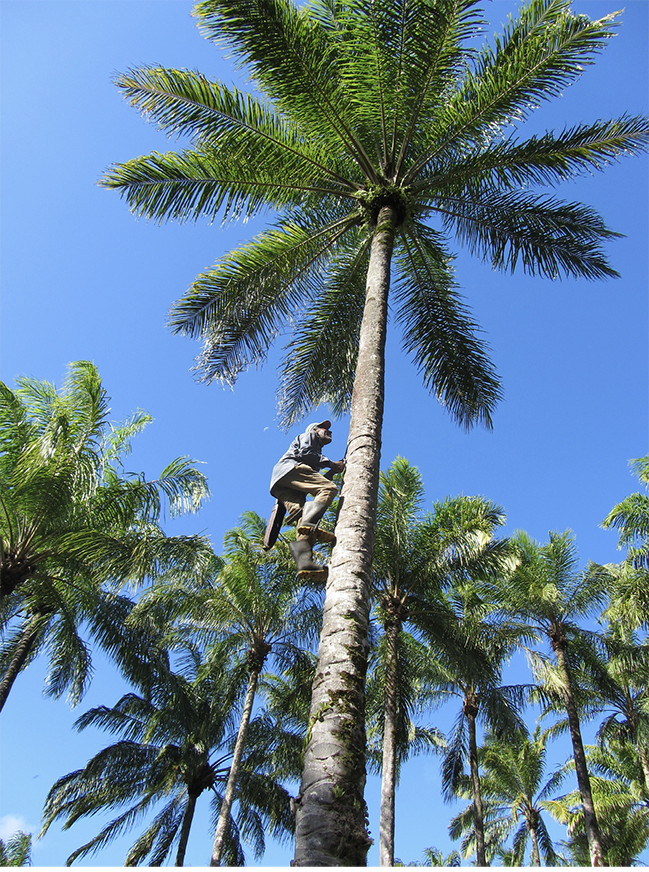
Figure 1.
An elderly Afro-Brazilian man climbs a dendezeiro to harvest its fruit on the rural outskirts of Cairu, seat of the Tinharé archipelago, on Bahia’s Dendê Coast (2012).
All photos: Case Watkins.
In Yoruba cosmology, heaven is a tree. A vertical paradise or a dream of paradise striated by gravity. You access it not by sudden rapture but through climbing.
The climber inches forward, listening to his body, listening to the body of the tree which is the body of the earth. Climbing is an act of listening. The tree has to allow itself to be climbed. The tree has to be climbed with a rope made from the tree itself. The climbing rope is a duality woven from coarseness and tenderness. One part of the rope is strung together from a trellis of woven cane. The other part is cut from the bark of an oil palm frond. The coarseness and tenderness are in perpetual flux and listening. The rope which is made from the tree twists around the body of the tree and the body of the climber who is made of earth. He’s the king of an elusive gravity. In Yoruba cosmology, kings don’t die. They ascend to the roof. They climb to the crown of leaves at the dome of the vertical heaven where the ancestors live and form a cloud. Or they become the fruits at the crown of the trees. Seeds represent the unborn which become trees. Trees and leaves represent the living which produce fruits. Fruits are the ancestors. Death is ripeness.
Across the Atlantic, the land that would become (the Brazilian state of) Bahia had been home to various indigenous communities for at least ten millennia prior to the accidental arrival of Portuguese sailors in the year 1500 (Cabral and Bustamante 2016). In the decades that followed, Bahia became a central nexus in the colonisation of the Americas and the transatlantic slave trade – two interdependent crimes against humanity with immense influence in the making and maintenance of the modern world. Indigenous communities persevere in Bahia, despite centuries of attempted genocide and other atrocities, while people of African descent now comprise more than eighty per cent of the state’s populace. As elsewhere in the (post)colonial world, ‘home’ is a deceivingly simple designation enveloped in tortuously complex histories and geographies.3
Since the early twentieth century, scholars and officials have placed Bahia at the heart of Afro-Brazilian life and culture (for example Ickes and Reiter 2018). But how did this happen? The factors and processes of social-ecological change are numerous and complex, but one that commands our attention here is the intimacy of people and plants in diaspora. Since the earliest days of colonisation, people and plants of African descent have collaborated to create landscapes, communities and cultures in Bahia and throughout Brazil. Geographer Robert Voeks has detailed an astonishing array of African plants growing in Brazilian soil, many of which serve vital roles in Afro-Brazilian religions and cosmologies (Voeks 1997). One of these, the African oil palm, has firmly naturalised in coastal Bahia, flourishing across forests, pastures, yards, highway medians, ditches, farms and fields from the urban capital to rural agrarian communities to the swampy edges of mangrove ecosystems.
Arriving in Brazil no later than the early seventeenth century, the palm and its nutrient-rich oils remain fundamental in Bahia’s distinctive Afro-Brazilian landscapes, foodways and religions. Bahians refer to their locally sourced palm oil as azeite de dendê, an Atlantic portmanteau of the Arabo-Iberian term for olive oil (azeite) and a Kimbundu Bantu word for palm oil (ndende). Following Portuguese convention, the palm that so graciously furnishes this oil became the dendezeiro. When Brazilians describe something – anything – as ‘in’ or ‘of dendê’, they mark it indelibly as both African and Bahian. For centuries, dense and productive groves of emergent dendezeiros have dominated landscapes and cultures in the coastal plains and tablelands running south of Bahia’s capital, Salvador.4 In the late twentieth century, officials in the state’s Secretariat of Culture and Tourism officially named that region the Dendê Coast (Costa do Dendê) in a public nod to the dendezeiro and the cultures it nourishes.5
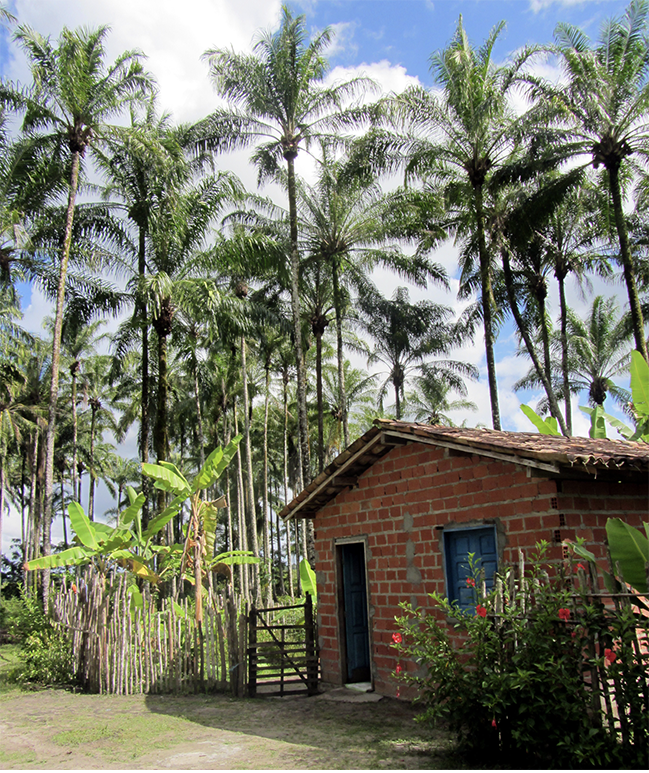
Figure 2.
An emergent grove of dendezeiros, elsewhere known as African oil palms, towers above a family home and its dooryard gardens in the terraqueous municipality of Igrapiuna on Bahia’s Dendê Coast (2012).
I’m thinking of a Yoruba proverb, Aye loja orun nile which in this context I’ll translate as ‘The world is a market place, home is heaven.’ If the modernity of the world was invented with the notion of you and your children as commodities, home or heaven for you then might be the opposite of the auction block. A place where you exist outside the brutal logic of barter or extraction. The marketplace is contagious with dangerous noise and music of entrapment which unsettles your spirit. But home is rest, a nest for you, bird of passage and multiple flights, a nest for you among the trees.
Despite the brutalities of colonialism and transatlantic enslavement, Afrodescendants have formed vibrant communities in Bahia’s Atlantic coastal regions since their arrival five centuries ago. Many of these communities – known in Brazil as quilombos, or comunidades quilombolas – were founded by self-liberated, formerly enslaved people and have long harboured humans, plants and cultural practices of African descent (Carney and Rosomoff 2009, Gomes 2015, Bledsoe 2017).6 The homescape depicted in Figure 2 displays a range of quilombola ethics and practices. Assembled from local kiln-dried terracotta bricks and shingles, and surrounded by recently harvested dendezeiros, diversified agroecological gardens and joyful hibiscus flowers, this home is neither ‘natural’ nor ‘artificial’. Rather, it results from ancestral strategies of abundance, what the late great quilombola farmer, poet, scholar and activist Antonio ‘Nego’ Bispo dos Santos called biointeração (biointeraction). Placed in contradistinction to the ‘developmentalist perspective’ pushed in colonial thinking, biointeraction is an onto-epistemological vision and way of life that works in circular, non-linear patterns to bridge Earth’s constituents, among them people, plants, water and soil (dos Santos 2015, esp. ch. 3). ‘To discuss ecology without mentioning architecture’, Nego Bispo warns us, ‘is an illusion’ (dos Santos 2023: 65).
Biointeraction thus offers us a path otherwise than the colonial logics of extraction. While colonial-Western thinking frames the world through arbitrary binaries such as ‘natural’ and ‘man-made,’ biointeraction sees and works toward an integrated Earth where humans participate in socioecological synergies. And even as these and other quilombola philosophies root and flourish in Brazilian soil, they emerge from the swirling currents and offshore shoals of the Atlantic World where indigenous and diasporic wisdoms meet and commingle (King 2019).
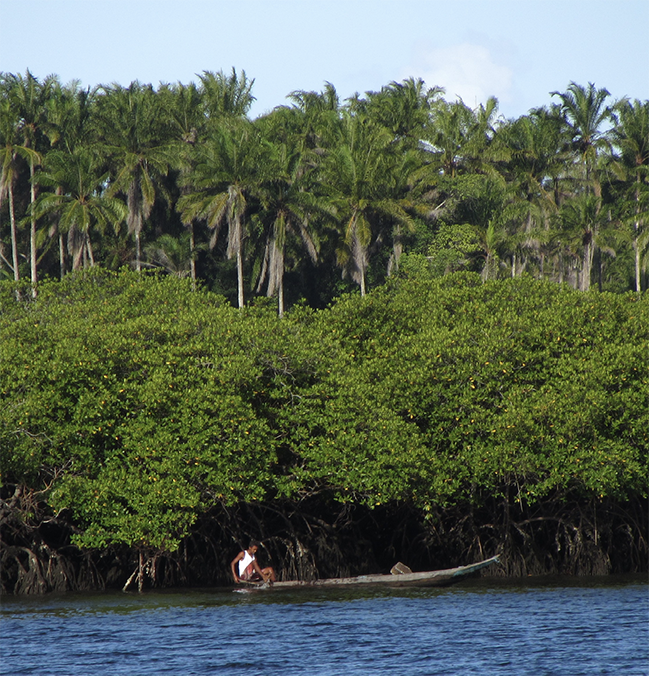
Figure 3.
A boater gathers shellfish amidst the mangroves, overlooked by an emergent grove of dendezeiros in the estuary of the Rio Igrapiuna on Bahia’s Dendê Coast (2012).
I know this place. I was there 400 years ago. On a nearby shore, I saw white ships arriving, I trembled and ran. The names of the ships were whispers I had heard in a strange dream of ships arriving. I hid with my father and mother in the nooks of the mangroves. We muffled the cries of the children and prayed the raiders would not find us.
*
I know this place. I was there yesterday in my dream. I’m there even now. Look. The roots of the mangroves are tangled like ancestry and memory. They lean and bow toward each other like elders in a mutual ecological obeisance. They extend upward in a canopy like a harmony of hands, then above them, the gazelle neck of the palm trees which contain the spirit of my grandfather sway with a wicked grace.
*
Mangroves, like jazz, grow into two directions at once.
*
A boy in a white cotton singlet. He’s lean and graceful
like an eel. He was born for the precise symmetry of the river.
He sits on the precipice of a boat. History is a boat. One leg extends toward the river and the other extends toward the past. I know this landscape from my past and I know it from my future.
*
The river that ends here begins in a desert. An ocean waits at the mouth of the estuary to swallow us.
*
I dreamt and I saw islands and archipelagos migrating. In the dream of ecologies, my body was a door of passage and a bridge. Between the old world and new world, I was a map of fragments. Between the seasons measured not by calendars, but by palm trees appearing and disappearing, I was a door of manifold returns. The Atlantic was a silver coin and my blood was on both sides. I was haunted and made sacred by my fragmentation.
I slept in the old world and woke up in the new world with a gasp: I can’t breathe. These deltas, a memory. The landscape is a mirror.
*
In the dream of ecologies, my body is a dream of passage and a bridge. Between the old world and new world, I’m a map of fragments. Between the seasons measured not by calendars, but by palm trees appearing and disappearing in a dream of migrating islands and archipelagos, I’m a door of manifold returns. The Atlantic is a silver coin and my blood is on both sides.
I’m haunted and made sacred by my fragmentation. There are days I sleep in the old world and wake up in the new world with a gasp: I can’t breathe. These deltas, a memory. The landscape is a mirror.
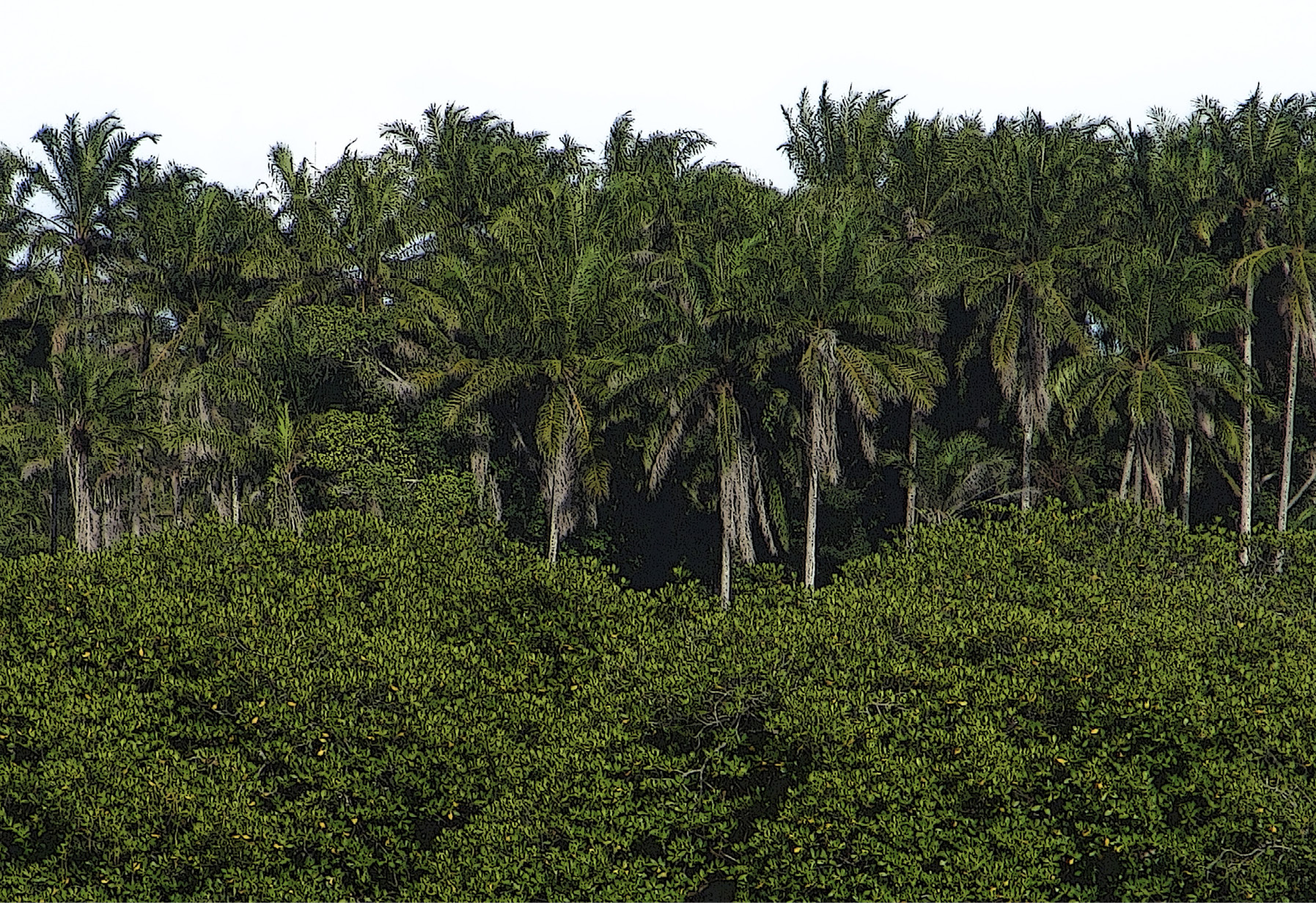
Bahia’s Dendê Coast connects South America to the Atlantic Ocean. But where does one end and the other begin? Here groves of dendezeiros give way to muddy mangroves before falling into a tangled network of brackish estuaries and saltwater inlets. This watery landscape is striking in its similarity to those of the Niger Delta, and elsewhere in West and Central Africa, where humans have managed and benefited from the dense groves of oil palms that line the upland fringes of intertidal mangroves. On both sides of the South Atlantic, these liminal spaces fluctuate between land and water, never fully conceding to either category in that false dichotomy.
Thinking with this fluidity, geographers Haripriya Rangan and Judith Carney have highlighted such ‘aquaterras’ and their outsized roles in shaping coastal livelihoods, particularly in the global Tropics (Rangan and Carney 2025). Instead of ‘marginal’ territories desperately in need of (Western) development, they find realms of socioecological abundance and potential where generations of communities have thrived through innovative strategies of adaptation. Sloping gently from tableland forest to aquaterra, the Dendê Coast marks the dissolution of South America into the Atlantic—the colossal, unforgiving body that connects Bahia with the African continent.
Here the rhythmic lapping of tidewater recalls the poetic imagery of Ôrí, a 1989 film by Raquel Gerber documenting the ferocious and innovative scholar-activism of the radical Black Brazilian polyhistor Beatriz Nascimento. For Nascimento, the African diaspora and its constituents emerge from a condition of transatlanticidade (transatlanticity) – at once a continuum, a map and a collective embodiment (Gerber with Nascimento 1989). Her contemplation of the metaphysics and materialities of aquatic space is stunning in its congruence with Nego Bispo’s concept of confluência (confluence), as well as the lively theorization of the river shared by Indigenous leader and philosopher Ailton Krenak (dos Santos 2015: 89–103; Krenak 2024). Empowered by these allied yet distinct visions we might behold the Atlantic shores of the Dendê Coast as a fluid manifestation of the cultural, political and ecological intimacies of the African diaspora.
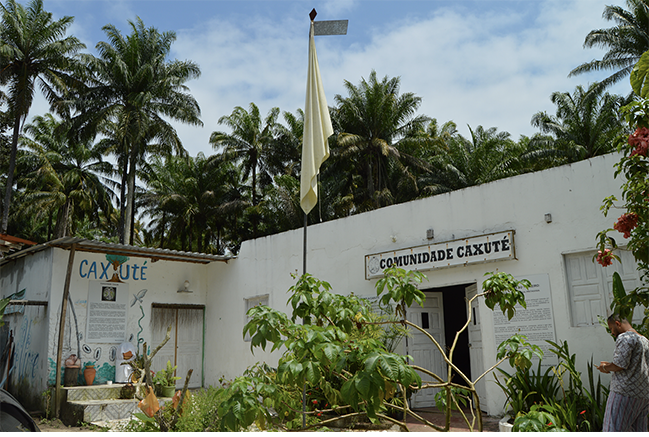
Many Afro-Brazilian communities and their knowledge systems contribute to a global mobilisation toward decoloniality – a collective dismantling of the stubbornly entrenched structures of social, cultural, political and ecological power imposed through colonialism (Mignolo and Escobar 2009, Kimmerer 2013, dos Santos 2015, Penniman 2018: ch. 3, Daigle and Ramirez 2019: 78–84, Krenak 2024). Quilombo communities on the Dendê Coast such as Graciosa and Lamego have joined this effort, inspiring collective action and a range of political-economic-ecological struggles toward just futures. The Comunidade Terreiro Caxuté, an Afro-Brazilian religious and educational community, draws on ancestral wisdom, pedagogy, and ecological ethics to care for its people and places. Founded in 1994 by Maria Balbina dos Santos, a sacerdotisa (priestess) of the Afro-Brazilian religion Candomblé known throughout the region as Mam’etu Kafurengá, or simply Mãe Bárbara, the community serves an astonishing variety of social-ecological functions. Among these, the compound operates as an extended family home, house of worship (terreiro), cultural-environmental museum, agroecological extension office, primary school, community library and food bank ‘born and raised among the dendezeiros’ (Luangomina 2019: 36). Based in Afro-Brazilian traditions they describe as Bantu-Indigenous, its members apply ancestral methods and ethics to build and maintain community. These efforts are part of their approach to ‘terreiro pedagogy,’ the community’s guiding philosophy, which emphasises a ‘process of teaching-learning’ based in hybridity, multiplicity and circulation over the colonised binaries of teacher-student, nature-society and work-life (dos Santos 2019: 51–54). They use azeite de dendê in the preparation of sacred and routine foods; they use its fruit and kernels in divinations and other rituals; and from the fronds they make mariô to adorn the entrances of their ceremonial spaces. Their holistic approach to dendê – at once sacred, cultural, economic, and environmental – descends from diasporic ancestral traditions to propose futures of abundance based in socioecological wellbeing and care.
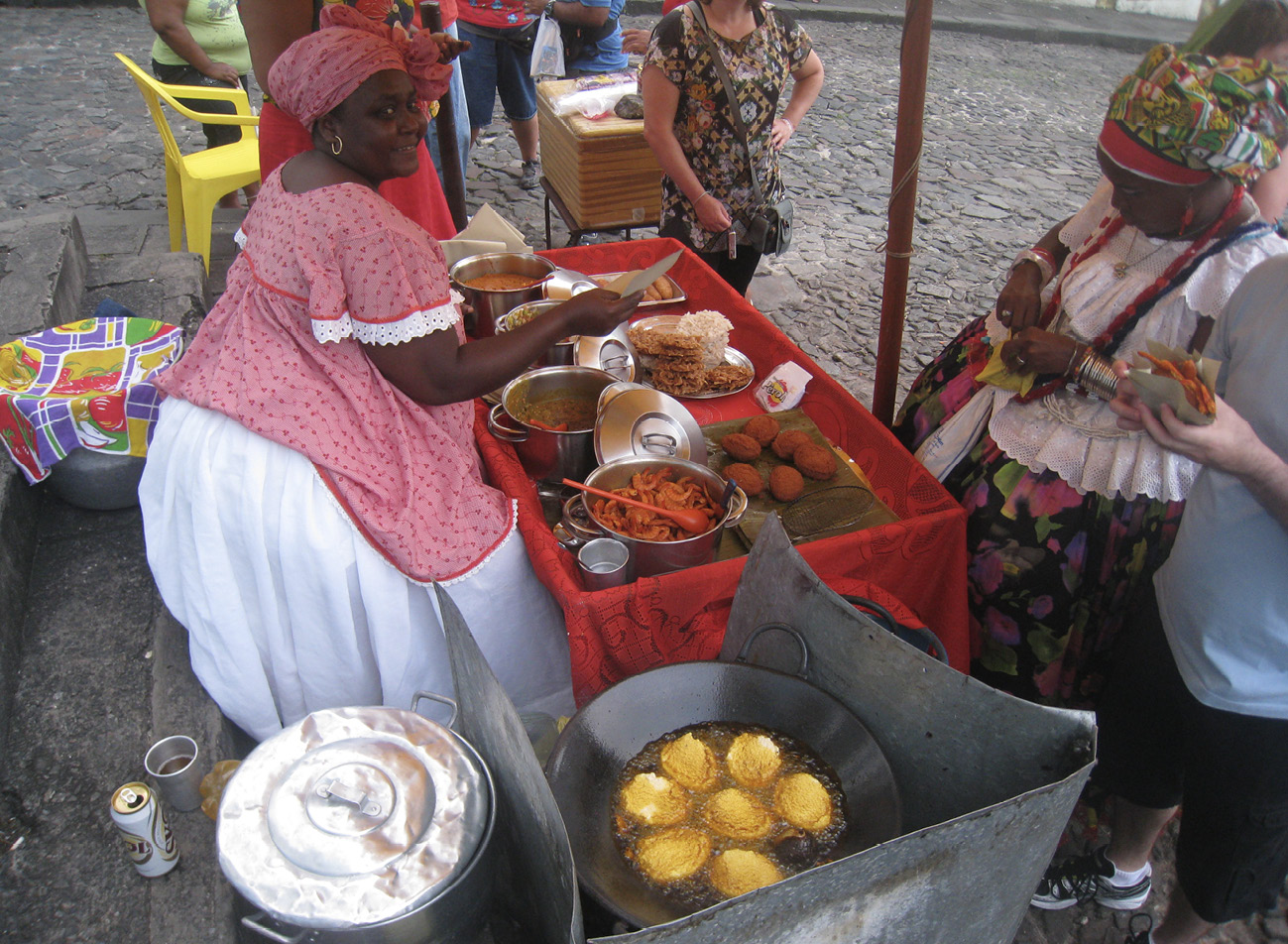
Figure 5.
A Baiana de acarajé deep-fries her signature dish in locally sourced azeite de dendê (2008).
According to my people, the Yorubas, there are two kinds of death. Good death and bad death. Bad death has the insignia of famine, of a thing cut off too early. But good death is a rite of maturation and passage. You pass from among us to the realm of ancestors to watch over us. We rejoice and eat Akara at the funeral to mark the transition. We beseech the god of the portals.
But Akara is about life. It’s not the dead who eats it, it’s the living. We eat it at the bazaar and market stalls, at the street corners and the street vendors. It’s food in motion, food on the run. It’s food that crosses doors, crosses borders and oceans.
Akara is the food of the living. Wherever there is
Akara there is aliveness. It’s food made sacred by the people’s communal hunger. It’s the food of the cycle of life and death. It’s almost like colour of earth, the colour of flesh. The oil is the blood. Take this, eat and remember.
Bahia’s most prominent purveyors of azeite de dendê and its ancestral foodways have to be the ubiquitous Baianas de acarajé. Scattered through the state, country and beyond, these mostly Black women vendors stand at the forefront of Afro-Brazilian foodways and religious cultures. Their eponymous dish, acarajé, is a diasporic bean cake fritter descended from the Yoruba delicacy àkàrà. Baianas fashion their savoury pastries from hand-milled black-eyed peas, deep-fry them in locally-produced azeite de dendê, and finally slather them with okra – ingredients all native to West Africa. Finishing with dried shrimp and a fiery pepper sauce, they love to warn the gringos, ‘Cuidado, viu?! É picante. [Careful, you hear?! It’s spicy.]’
Baianas have much to teach us about the interrelations of gender, culture, politics, religion, labour and food. In her fieldwork with Baianas and their labour union in Salvador, Vanessa Castañeda shows how Baianas masterfully navigate fraught social mores to wield considerable social, economic, and cultural power (Castañeda 2021). Drawing on centuries of tradition, as well as their own interpretations of Black Feminism, Baianas have mobilised diasporic foodways and cultural ingenuity to provide for themselves and their families, perpetuate Afro-Brazilian religious beliefs and practices (especially related to Candomblé) and spread joy. Despite the profound structural inequities persisting from colonial past to neoliberal present, Baianas command important roles in local economies and the cultural politics of ‘historical patrimony’ by seizing official recognition of their traditions from state and federal authorities.7 Innovating foodways with deep diasporic roots, Baianas and their acarajé continue to (re)connect people with ancestral plants, practices and landscapes.
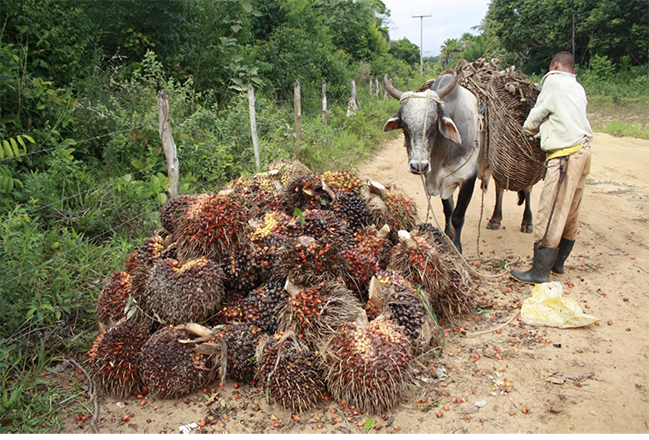
Figure 6.
A young wage worker unloads freshly harvested dendê fruit from an elderly ox (2012). The fruit awaits transport to nearby processors who will transform its flesh into azeite for sale in regional markets.
Think of the fruit, ecstatic flesh. Think of the seed of the fruit, ecstatic destiny. Wind is the messenger of their propagations. A seed splinters in the soil, breaks loose from its burial shroud and resurrects. What resurrects begins to grow downward and upward like a vertical river. It gathers the energy of the earth to itself. The roots dig down toward the bones of ancestors. The shoot rises like prayers. It grows honouring the sun and the moon with the dance of its slender stems. Guided by its inner head, its essence and a secret map of the future all being carried inside them, the seed does not stop until it has become a fruit. Like a boy, there is a story inside it. Every seed is a destiny.
Thanks to the prominence of dendê oil in Bahian and Afro-Brazilian foodways and religious cultures, most people recognise that substance only in its final processed state: azeite. Less well known are its precursors of seeds, soil, trees, fruits, expertise and effort. To become palm fruit and finally palm oil, dendê must pass through various stages of production, harvest and processing – all dependent on specialised knowledge and physical labour. Without knowledgeable people willing to work, there can be no dendê for regional foodways and religious expressions. This fact is unfortunately becoming more apparent in Bahia, as a collapse in local labour markets is coinciding with the chaos of climate change and centuries of misguided development policies to precipitate a crisis in local dendê production (Watkins 2025).
Faced with this crisis, public and private elites have regrettably doubled down on their support for one-size-fits-all approaches to agrarian development. Instead of recognising the devastation caused by centuries of top-down, colonial-corporate development schemes, authorities continue to push inaccurate and unconscionable narratives that more and more plantation monocultures could ameliorate the crisis. These efforts come as merely the most recent onslaught in centuries of colonial-cum-capitalist agro-industrial development rhetoric and policies. What if the authorities instead recognised and supported local workers and their communities, ancestral landscapes of dendezeiros and the wisdom they together embody? (Watkins 2025). What if they heeded the calls of social(-ecological) movements active in the region, such as Teia dos Povos, who organise and advocate for food sovereignty and agroecological systems such as Bahia’s ancestral dendê landscapes? (Ferreira and Felício 2021)
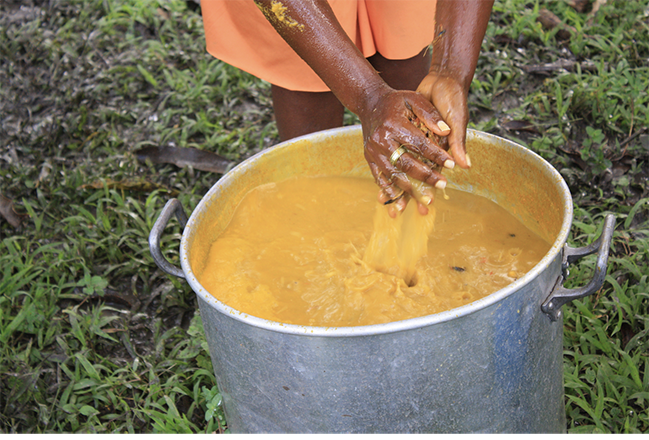
Figure 7.
A quilombola woman ‘washes’ oil from fresh dendê fruit to derive azeite in the quilombo community of Kaonge, located in the Iguape district of Bahia’s Recôncavo across the Bay of All Saints from Salvador (2012).
Think then of these hands, the hands of my mother. There is a covenant between the seeds and the hands. The hands know through an intimate memory the tenderness of the seeds, the fruits and the oil. The hands know – through a knowledge older than the hands – of the covenant of hands and the seeds, the covenant between the fruits of the seeds and the oil of the fruit. These baptismal hands. The hands submerge in the river of oil. The hands dip, glide, glaze over the seeds, fruits, and oil. The oil blesses the hands. The hands bless the oil. The hands do not bruise or hurt the fruits. The hands talk to the seeds. The hands dance with the fruits until there is a harmony, the harmony of ancestors or lovers. The harmony of a covenant.
‘The heart of the proposal’ offered by Teia dos Povos ‘is in the idea that agroecology is feminine and feminist’ (Ferreira and Felício 2021: 124). Affirming this revelation, the agroecology of dendê in Bahia remains a diasporic, hereditary and gendered practice that connects contemporary communities with ancestors on either side of the Atlantic. While harvesting fruit has long been a duty mostly for men and boys, the manual labour of processing oil from fruit is typically conducted by women and girls (Lody 1992: 33). Here the hands that ‘wash’ the azeite from the fruit perpetuate ancestral practice, at once mundane and sacred, Bahian and African – transatlantic, yet quotidian.
This sacred practice continues in communities throughout coastal Bahia, including Kaonge, Dendê, Engenho da Ponte and the other quilombos of the Iguape peninsula. Writing from and with those communities, quilombola scholar, advocate and poet Rosane Viana Jovelino frames these activities within a ‘solidarity economy’ based on the agroecological cultivation of dendê, polycultural gardens of manioc and other native plants, beekeeping, fishing and shellfish gathering, handicrafts and community-based tourism – all sustained through inclusive democratic systems which balance and rotate leadership among genders and age groups (Jovelino 2018). These and thousands of other quilombo communities deserve not only inalienable rights to their lands and livelihoods, but indeed our sincere recognition as exemplars of inclusive democracy, socioeconomic solidarity and viable ecologies.
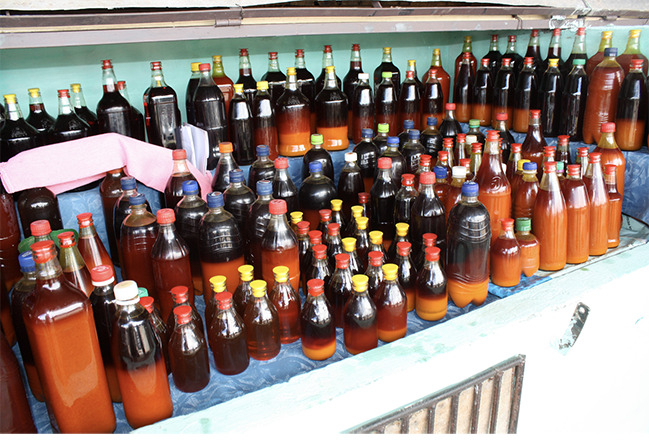
Figure 8.
Bottles of artisanal azeite de dendê, qualified as azeite de pilão (meaning processed via ancient transatlantic methods using mortars and pestles), sit for sale in an open street market in Valença, the largest city and de facto urban capital of Bahia’s Dendê Coast (2009).
Cargo on these shores once meant palm oil, kernel seeds, ivory, cotton, dyewood, pepper and humans.
*
The flow of palm oil is the flow of the beautiful divine. The blood
of a fruit that is bruised and in its bruising blesses the earth. Where there is no flow of oil,
there will be no remission of sin. Where there is no remission of sin, there will be sacrifice. Palm oil is the spirit of sacrifice. Palm oil is prayer and propitiation for mercy. The antidote to evil.
*
Cargo on these shores once meant palm oil, kernel seeds, ivory, cotton, dyewood, pepper, and humans.
*
The ships that once carried humans shackled with bruised wrists that dripped blood onto the wooden floors of the ship later carried palm oil that dripped onto the wooden floors of the bruised ship on the same spots the blood had been. In the memory of a disintegrated wood in the afterlife of trees somewhere, a wood remembers the oil of the Africans and the blood of the Africans on the same spot of wood. The oil made sacred by the blood. The blood made sacred by the oil. How could you have stolen a people’s prayer and called it cargo? Or how could you steal a people’s prayer and call it cargo?
Azeite de dendê is a plural and protean essence of Afro-Brazilian cultures and cosmologies. For Candomblé initiate and multi-modal Bahian artist Ayrson Heráclito, dendê represents a fundamental material element of the Black Atlantic, its ‘blood, semen, and saliva’ (Heráclito 2022) His oeuvre of an ‘afro-diasporic cultural body’ thus harmonises with Beatriz Nascimento’s concept of transatlanticity, both referencing space as simultaneously geographical and corporeal (Burocco 2024). For her part, Nascimento credits azeite de dendê as one of four elements of the ‘red blood of the vegetable kingdom’ that contains and carries axé – the vital force of existence. ‘That which is structure, from which all departs or returns. The home of all Knowledge’ (Nascimento 2023: 316–17, her emphasis).
In his ethnography of the dendezeiro, Brazilian anthropologist Raul Lody details the relations of dendê within Afro-Brazilian foodways and religious practices. Even as dendê retains its essential dynamism and plurality as an expansile symbol and substance, its most profound meanings and functions within Afro-Brazilian cosmologies associate it with the Orixá Exú, a West African-Bahian trickster deity also known as Legba or Nzila, the ‘principal agent of dendê’ and the very ‘owner of the dendezeiros’ (Lody 1992: 12, 10).8 Adherents of Candomblé typically open their ceremonies with a padê, a ritual offering that includes a serving of farofa de dendê (manioc flour toasted in palm oil), to placate the irascible Exú and bring together people, ancestors and deities. Evidencing the fluidity and reciprocity that often guides Western African and Afro-Brazilian thinking, ‘Exú becomes dendê, just as dendê becomes Exú, without this limiting … dendê exclusively to Exú.’ Dendê, Lody goes on, can therefore be seen broadly as ‘African blood’ and, quite specifically, as the ‘orange sperm’ of Exú— ‘the most dendê of all’ (Lody 1992: 79, 81–92, 9, 10, 12).
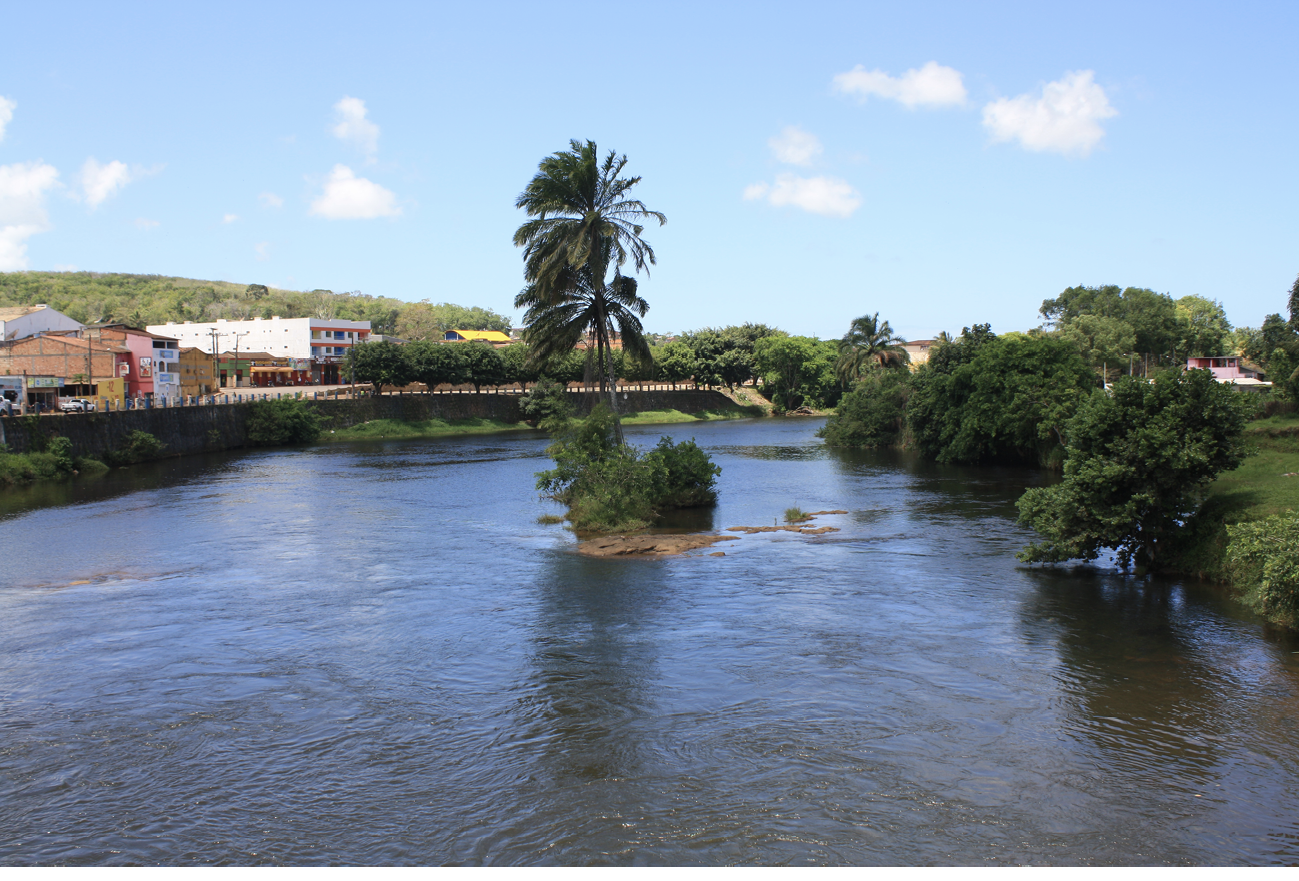
Figure 9.
A pair of dendezeiros emerge from a tiny fluvial island in the middle of the Rio Una as it flows through the village of the same name in Southern Bahia, roughly 150 kilometres south of the region officially dubbed the Dendê Coast (2012).
It was said the Africans on those ships dreamt the mangrove trees with their thick, tangled legs, rose up to their full height like furious giants and followed the ships. The native river followed them too. The mangroves with their tangled legs like ancestry and the native rivers howled and trailed the ships. Then they furiously sped past the ships and by an ancient map inside them – since trees and rivers are older than humans – arrived at the New World before the ships. When the Africans arrived their mangroves and rivers were waiting for them.
Or sometimes the river was a seed in the landscape of a dream and then it began to grow branches like spirits.
From a tiny foothold in an aquatic expanse, life on earth emerges. River, soil and tree converge to nurture an intimate transatlantic existence. Only together, in coalition, could they create and sustain this particular home. And while the tiny island harboured a seed, that seed went on to form roots which now anchor the island, protecting it from encroachments and erosions, and aggregating, when flows allow, yet more earth. For Indigenous philosopher and organizer Ailton Krenak, the river is alive; a sacred provider of life; an ancestor; a teacher. Sharing his people’s ancestral wisdom, Krenak explains how rivers speak with their own language. They regenerate from the traumas of human violence. They learn, they change course and they converge to find an ocean. And still, they are us. ‘The rock and the water are so wonderfully entangled with us that we can say “we-river, we-mountains, we-earth” … We allow ourselves to be water and feel this incredible power that it has to take different paths’ (Krenak 2024: 1–14, quote p. 3).
Krenak also admires and engages Nego Bispo’s complementary concept of confluências. Thinking with Bispo, Krenak describes confluences as political-ecological devices formed of both convergences and divergences, transfigurations that ‘evoke the context of diverse worlds that can affect each other’ (2024: 21–23). Rather than accepting everything into its main channel, the river converges with some (life-giving) ideas and activities, and diverges from others. Bahia’s ancestral palm oil landscapes, for instance, converge with manioc and other beings and techniques indigenous to South America, just as they diverge from the necrocapitalist politics and ecologies of monoculture. Confluências thus provide methods for coalescing and building strength through onto-epistemological diversities. ‘The river’, Nego Bispo teaches,
does not stop being a river because it converges with another river; on the contrary, it becomes itself and other rivers, it becomes stronger. When we enter into confluence, we do not stop being us, we become us and other people – we render. Confluence is a force that yields, that increases, that expands (dos Santos 2023: 4–5).9
This river, this theoretical-material space of watery, more-than-human simultaneity, must eventually fall into its estuary. The Rio Una, as all rivers in eastern South America, finds its final confluence at the shores of the Atlantic. In this way, we find the immortal inspirations of Krenak, Bispo and Nascimento – three brave and brilliant Brazilian theorists – converging to form an intimate transatlantic coalition. Blessed and empowered with their gifts, it is left to us to carry forward the promise of this confluence, to imagine, create and sustain new worlds.
Bledsoe, A. 2017. ‘Marronage as a past and present geography in the Americas’. Southeastern Geographer 57 (1): 30–50.
Burocco, L. 2024. ‘Ayrson Heráclito’. World African Artists United - Editorials, 18 March, https://waau-art.com/2024/03/18/ayrson-heraclito/
Cabral, D. and A. Bustamante (eds). 2016. Metamorfoses Florestais: Culturas, Ecologias e as Transformações Históricas da Mata Atlântica Brasileira. Curitiba: Editora Prismas.
Capone, S. 2010. Searching for Africa in Brazil: Power and Tradition in Candomblé. Durham, NC: Duke University Press.
Carney, J.A. and R.N. Rosomoff. In the Shadow of Slavery: Africa’s Botanical Legacy in the Atlantic World. Berkeley: University of California Press.
Castañeda, V. 2021. Political and Traditional: The Baianas de Acarajé of Salvador, Brazil. Ph.D. New Orleans, Louisiana, Tulane University.
Daigle, M. and M.M. Ramírez. 2019. ‘Decolonial geographies’. In Keywords in Radical Geography: Antipode at 50. Hoboken: Wiley.
Fairhead, J. and M. Leach. 1996. Misreading the African Landscape: Society and Ecology in a Forest-Savanna Mosaic. Cambridge: Cambridge University Press.
Ferreira, J. and E. Felício. 2021. Por Terra e Território: Caminhos da Revolução dos Povos no Brasil. Arataca, Brazil: Teia dos Povos.
Gerber, R. with M.B. Nascimento. 1989. Ôrí. Angra Filmes; Fundação do Cinema Brasileiro.
Gomes, F.d.S. 2015. Mocambos e quilombos: Uma história do campesinato negro no Brasil. São Paulo: Claro Enigma.
Henson, B. 2024. Emergent Quilombos: Black Life and Hip-Hop in Brazil. Austin: University of Texas Press.
Heráclito, A. 2022. ‘Obras: Dendê’, https://ayrsonheraclito.com
Ickes, S. and B. Reiter (eds). 2018. The Making of Brazil’s Black Mecca: Bahia Reconsidered. East Lansing: Michigan State University Press.
Jovelino, R.V. 2018. ‘Development as a democratic practice: The case of the quilombola communities in the Iguape Basin and Valley – Bahia’. Sur 15 (28): 181–92.
Kimmerer, R.W. 2013. Braiding Sweetgrass: Indigenous Wisdom, Scientific Knowledge and the Teachings of Plants. Minneapolis: Milkweed Editions.
King, T.L. 2019. The Black Shoals: Offshore Formations of Black and Native Studies. Durham, NC: Duke University Press.
Krenak, A. 2024. Ancestral Future. Cambridge; Hoboken: John Wiley & Sons.
Lody, R. 1992. Tem Dendê, Tem Axé: Etnografia do Dendezeiro. Rio de Janeiro: Pallas.
Luangomina, H.d.S.B.T. 2019. ‘Candomblé Bantu-Indígena da Bahia: Organização sociorreligiosa e relação global da Comunidade Caxuté na Costa do Dendê’. MS Thesis in Social Sciences, Cachoeira, Bahia, Universidade Federal do Recôncavo da Bahia, https://www.ufrb.edu.br/.
Mignolo W.D. and A. Escobar (eds). 2009. Globalization and the Decolonial Option. London; New York: Routledge.
Miki, Y. 2018. Frontiers of Citizenship: A Black and Indigenous History of Postcolonial Brazil. Cambridge: Cambridge University Press.
Nascimento, M.B. 2023. The Dialectic is in the Sea: The Black Radical Thought of Beatriz Nascimento, ed. C.A. Smith, B.N.F. Gomes and A. Davies. Princeton: Princeton University Press.
Ojo, G.J.A. 1967. Yoruba Culture: A Geographical Analysis. Ife; London: University of Ife; University of London Press.
Ológundúdú, D. 2008. The Cradle of Yoruba Culture. New York: Center for Spoken Words.
Penniman, L. 2018. Farming While Black: Soul Fire Farm’s Practical Guide to Liberation on the Land. White River Junction, VT: Chelsea Green Publishing.
Rangan, H. and J. Carney. 2025. ‘Towards a buoyant political ecology: Rethinking marginalization for coastal climate change adaptation in the tropics’. Journal of Political Ecology 32 (1), https://doi.org/10.2458/jpe.5860
Robins, J.E. 2021. Oil Palm: A Global History. Chapel Hill: University of North Carolina Press.
dos Santos, A.B. 2015. Colonização, Quilombos: Modos e significações. Brasília: Instituto Nacional de Ciência e Tecnologia.
dos Santos, A.B. 2023. A Terra dá, a Terra Quer. São Paulo: Ubu.
dos Santos, M.B. 2019. Pedagogia do Terreiro: Experiências da Primeira Escola de Religião e Cultura de Matriz Africana do Baixo Sul da Bahia. Simões Filho, Bahia: Kalango.
Secretaria da Cultura e Turismo da Bahia. 2001. Roteiros Ecoturísticos da Bahia: Costa do Dendê. Salvador: Secretaria da Cultura e Turismo.
Sundberg, J. 2014. ‘Decolonizing posthumanist geographies’. Cultural Geographies 21 (1) (2014): 33–47.
Voeks, R.A. 1997. Sacred Leaves of Candomblé. Austin: University of Texas Press.
Watkins, C. 2021. Palm Oil Diaspora: Afro-Brazilian Landscapes and Economies on Bahia’s Dendê Coast. Cambridge: Cambridge University Press.
Watkins, C. 2025. ‘Changing climates, same old stories: Recognizing and intersecting the futurities of Bahia’s ancestral (agro)forests’. In A.A. Moulton and D.M. Harris (eds), Political Ecologies of Futurity: Storytelling Plantation Afterlives, Climate Erasures, and Socioecological Justice. London: Bloomsbury Academic. pp. 157–74.
Williams, T. and others. 2025. ‘Black livingness and insurgent ecological politics: Thinking across Black geographies / Atlantics / ecologies’. Dialogues in Human Geography, https://doi.org/10.1177/20438206251364964
Gbenga Adesina, Nigerian poet and essayist, is the inaugural Mellon Foundation Postdoctoral Fellow in Global Black and Diasporic Poetry at the Furious Flower Poetry Center, James Madison University. His work has been translated into six languages and counting, including Italian, French, Spanish and Slovenian. His recent poetry book, Death Does not End at the Sea, won the 2025 Anisfield-Wolf Book Award for Poetry and was longlisted for the 2025 National Book Award.
Email: adesinge@jmu.edu
https://orcid.org/0009-0002-8695-9644
Case Watkins is a cultural and environmental geographer and Associate Professor of Justice Studies at James Madison University. He studies the interactions of cultures, politics and environments; how they shape landscapes and societies, and what they can teach us about social and environmental justice. Blending ethnography, archival research and geospatial analyses, his recent book Palm Oil Diaspora reconstructs the environmental histories and political ecologies of palm oil landscapes, cultures and economies in Brazil and across the Atlantic World to reveal a complex African diaspora of people, plants and knowledge. The work was recognised with the Roberto Reis Book Award and received an Honorable Mention for the Meridian Book Award.
Email: watki2ac@jmu.edu
https://orcid.org/0000-0001-8319-6392
1 On the African diaspora of plants, animals and foodways, see Carney and Rosomoff (2009).
2 On the socioecological benefits of ‘swidden-fallow’ or ‘shifting’ cultivation in West Africa, see Fairhead and Leach (1996).
3 See the 2022 Brazilian Population Census at https://www.ibge.gov.br (accessed 10 June. 2024). On the entanglements of Black and Indigenous histories in Bahia, see Miki (2018).
4 Here and throughout, we use the term ‘emergent’ to deliberately reference the ‘emergent properties’ produced by complex systems, in this case the unplanted distribution and reproduction of African oil palms within biodiverse groves and (agro)forests spread across coastal Bahia. See Watkins (2021: 49–55).
5 Secretaria da Cultura e Turismo da Bahia (2001). It is important to note here that the official labeling was always about boosting tourism rather than supporting local communities or acknowledging the extraordinary African diasporic feats and legacies embedded in the region’s cultures and landscapes.
6 The Brazilian Constitution of 1988 codified public support for quilombos, and as of this writing, the federal government has recognised 3,752 quilombo communities across the country. See Fundação Cultural Palmares at https://www.gov.br/palmares/
7 Castañeda (2021) details the fraught cultural-political processes that led to the official recognition of the Baianas de acarajé by IPHAN, Brazil’s National Historic and Artistic Heritage Institute.
8 The three major families or ‘nations’ of Afro-Brazilian Candomblé revere pantheons of similar but distinct deities. In the Yoruba-based pantheon of Orixás revered in Candomblé Nagô-Ketu, Exú is the name of the deity referred to here; in the Fon-based traditions of Candomblé Jeje, he is also known as the Vodun Legba or Leba; and in the Bantu-based traditions of Candomblé Bantu (or sometimes Angola), he is known as the Inkice Nzila. See Capone 2010: 269.
9 In the original Portuguese, dos Santos uses the verb ‘render’, which can mean ‘to yield’ and ‘to generate’ in the sense of (agricultural) production. All emphasis ours.